
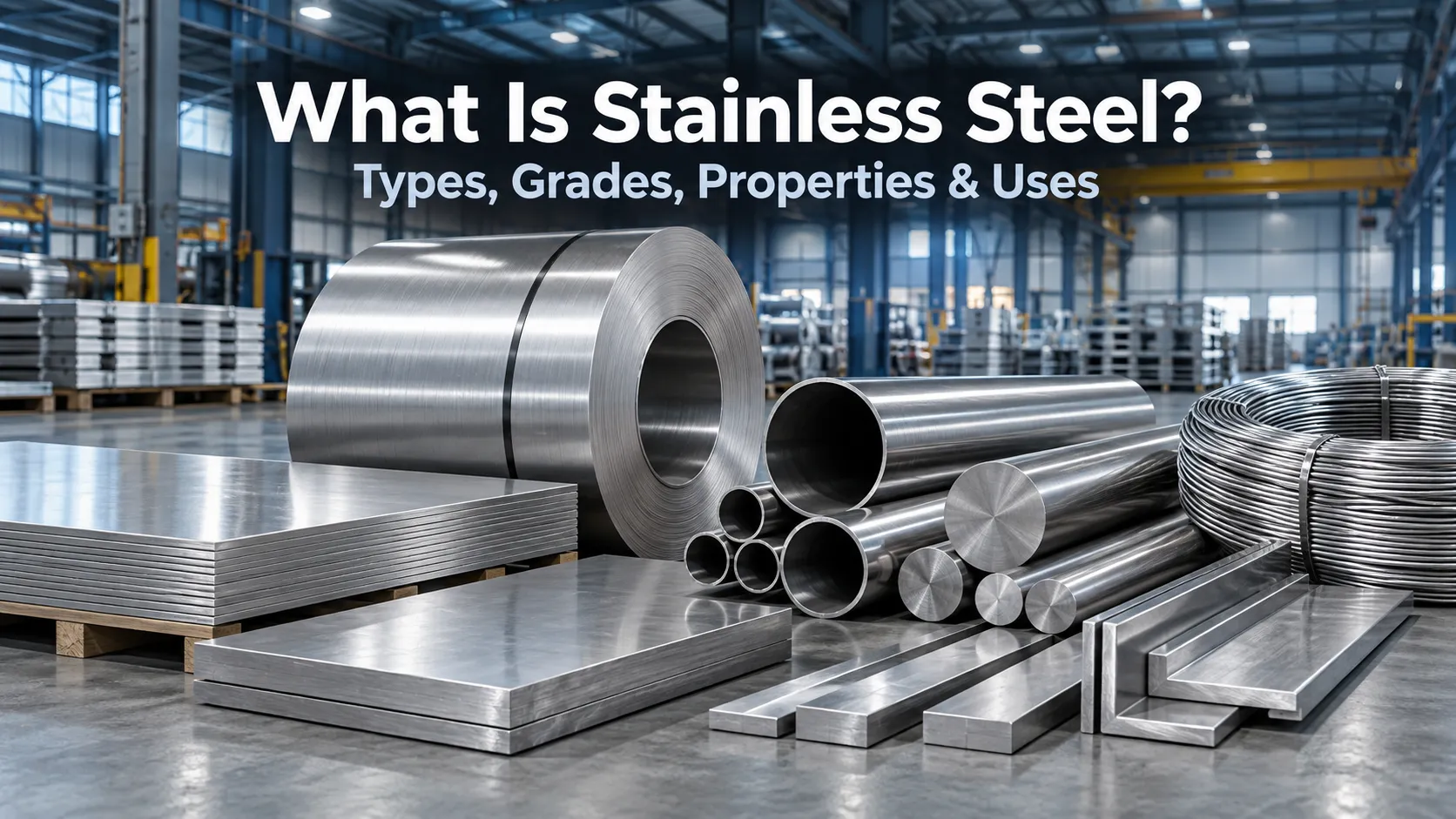
Stainless steel is not a single material or a single grade. It is a large family of iron-based alloys developed to provide corrosion resistance, mechanical strength, durability, cleanability and long service life.
The feature that fundamentally distinguishes stainless steel from ordinary carbon steel is chromium。
Stainless steels contain at least approximately 10.5%鉻. When chromium in the alloy is exposed to oxygen, it forms an extremely thin chromium-rich oxide layer on the surface. This invisible passive film helps protect the underlying metal from corrosion.
That simple principle explains why stainless steel can remain corrosion resistant without relying on paint, galvanizing or another external coating.
But it does not mean that every stainless steel performs the same way.
A 430 stainless steel appliance panel, a 304 food-processing tank, a 316L chemical pipe, a 2205 duplex pressure vessel and a 2507 super duplex offshore component are all stainless steels, yet they can have very different:
- Chemical compositions
- Microstructures
- 耐腐蝕性
- 機械強度
- Magnetic properties
- 可焊性
- 形成性
- Temperature capability
- 成本
- Suitable service environments
For engineers, fabricators and international buyers, the real question is therefore not simply:
Should I use stainless steel?
A better set of questions is:
- Which stainless steel family should I use?
- Which grade is appropriate?
- Will the material be exposed to chlorides or chemicals?
- Is welding required?
- What strength is needed?
- Will the material operate at high or low temperature?
- Which surface finish is required?
- Do I need sheet, plate, coil, pipe, tube, bar or another form?
- Which ASTM, EN, JIS, GB or other standard applies?
This guide explains stainless steel from both an engineering and purchasing perspective and provides a practical starting point for selecting the correct material.
What Is Stainless Steel?
Stainless steel is an iron-based alloy containing enough chromium to develop a protective passive surface layer that significantly improves corrosion resistance。
Iron is still the primary constituent in most stainless steels. The difference is that chromium and other alloying elements are deliberately added to modify the way the metal reacts with its environment.
Chromium is essential.
Other elements may include:
- 鎳
- 鉬
- 碳
- 錳
- 氮
- 矽
- 鈦
- Niobium
- 銅
By adjusting these elements and controlling the material’s microstructure, steelmakers can produce hundreds of stainless steel grades for different operating conditions.
This is why the term 不銹鋼 should be understood as a material family rather than one fixed composition.
Why Is Stainless Steel Resistant to Corrosion?
The corrosion resistance of stainless steel comes primarily from its passive layer。
Chromium Forms a Passive Film
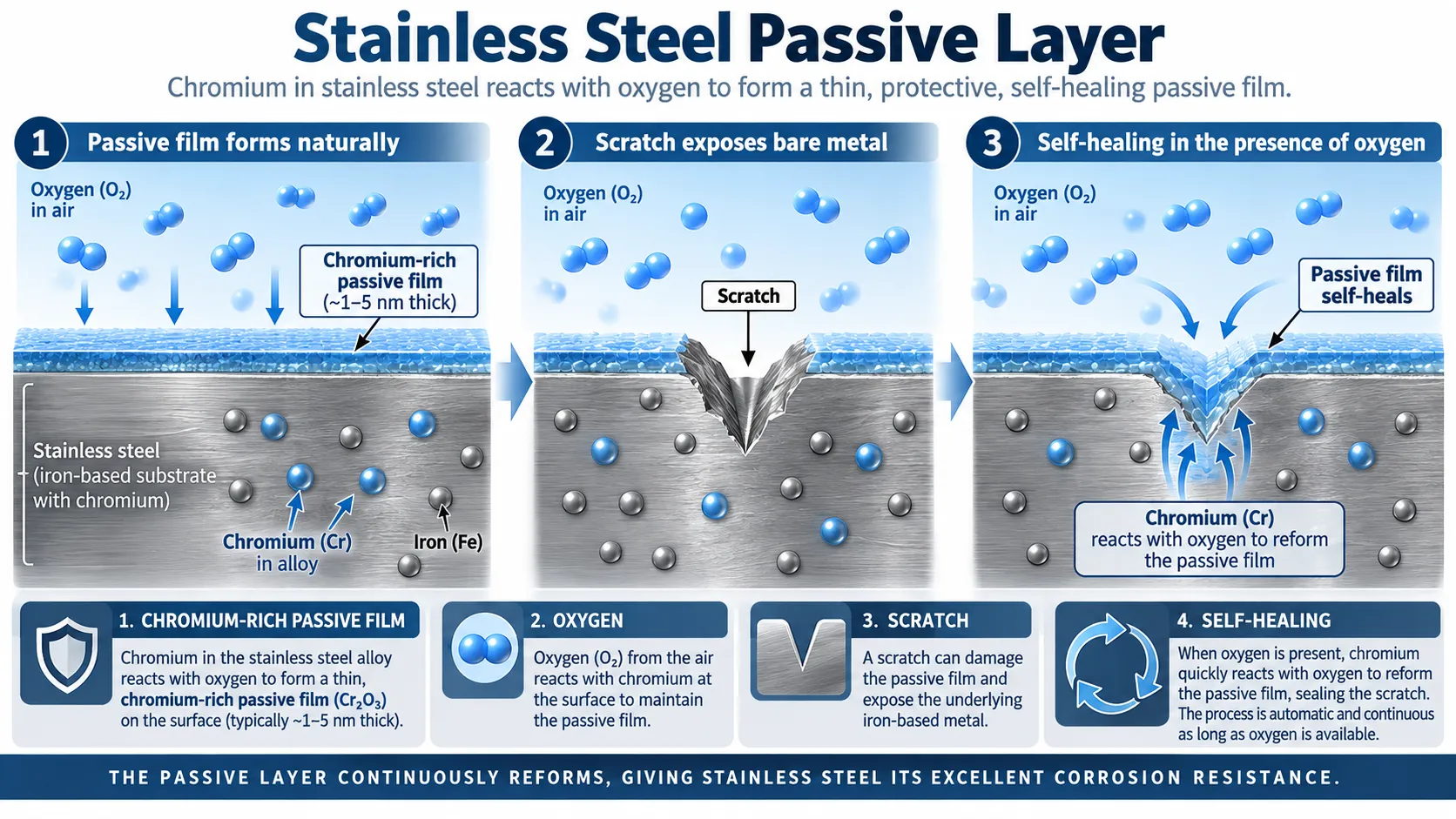
When chromium-containing stainless steel is exposed to oxygen, chromium near the surface reacts with oxygen and forms an extremely thin chromium-rich oxide film.
This passive film is:
- Very thin
- Strongly adherent
- Continuous
- Relatively stable
- Invisible to the naked eye
- Capable of reforming under suitable conditions
Unlike ordinary iron oxide, which can form loose and flaky rust, the passive layer adheres closely to the stainless steel surface and helps separate the underlying metal from the surrounding environment.
The Passive Layer Can Self-Heal
One of the most important characteristics of stainless steel is its ability to re-passivate。
Imagine that a stainless steel surface is lightly scratched.
The scratch may temporarily expose fresh metal. However, if sufficient oxygen is available, chromium at the newly exposed surface reacts with oxygen again and rebuilds the passive film.
This is why stainless steel corrosion resistance does not depend on keeping an external paint layer completely intact.
The protection originates from the alloy itself.
Why Doesn’t Ordinary Carbon Steel Do This?
Carbon steel contains iron but normally does not contain enough chromium to create the same stable passive film.
When carbon steel is exposed to water and oxygen, iron oxides can form.
These corrosion products do not usually provide the same continuous, self-repairing protection as the chromium-rich passive film of stainless steel.
This is one of the fundamental differences between stainless steel and ordinary carbon steel.
Can Stainless Steel Rust?
是的。
The word stainless does not mean corrosion-proof。
Stainless steel can corrode when:
- The selected grade is not suitable for the environment
- Chloride concentration is too high
- Salt deposits remain on the surface
- Crevices trap stagnant solution
- Aggressive chemicals attack the passive film
- Surface contamination introduces iron particles
- Welding is poorly controlled
- Post-weld cleaning is inadequate
- Temperature exceeds the grade’s suitable range
- The design creates unfavorable corrosion conditions
Different forms of stainless steel corrosion include:
- General corrosion
- 點腐蝕
- 縫隙腐蝕
- Galvanic corrosion
- Intergranular corrosion
- 應力腐蝕破裂
- High-temperature oxidation
Pitting and crevice corrosion are especially important in chloride-containing environments.
For example, 304 stainless steel can perform very well in many general environments but may not be the correct choice for continuous exposure to saltwater.
This is why grade selection matters。
Is Stainless Steel a Coating?
不。
Stainless steel is not ordinary steel with a stainless coating applied on top.
Chromium and the other alloying elements are present throughout the metal.
That is very different from:
- Painted carbon steel
- Powder-coated steel
- Galvanized steel
- Metal-plated steel
A simplified comparison is shown below.
| 特徵 | 不銹鋼 | Coated Carbon Steel |
|---|---|---|
| Corrosion protection | Alloy-generated passive film | Applied surface coating |
| Chromium throughout material | 是的 | Usually no |
| Protection after minor scratch | Passive film may reform | Base steel may become exposed |
| 維護 | Generally low with correct grade | Coating may require repair |
| Surface appearance | Natural metallic finish | Depends on coating |
| Initial cost | 通常較高 | Often lower |
| 生命週期成本 | Can be attractive in corrosive service | Depends heavily on coating life |
| 典型用途 | Food, chemical, architectural, marine, industrial | Construction, machinery, structures |
This does not mean stainless steel is always better than coated carbon steel.
正確的材料取決於:
- 環境
- Required service life
- Maintenance strategy
- Structural requirements
- 製造
- 外貌
- Total lifecycle cost
What Is Stainless Steel Made Of?
The exact composition depends on the grade.
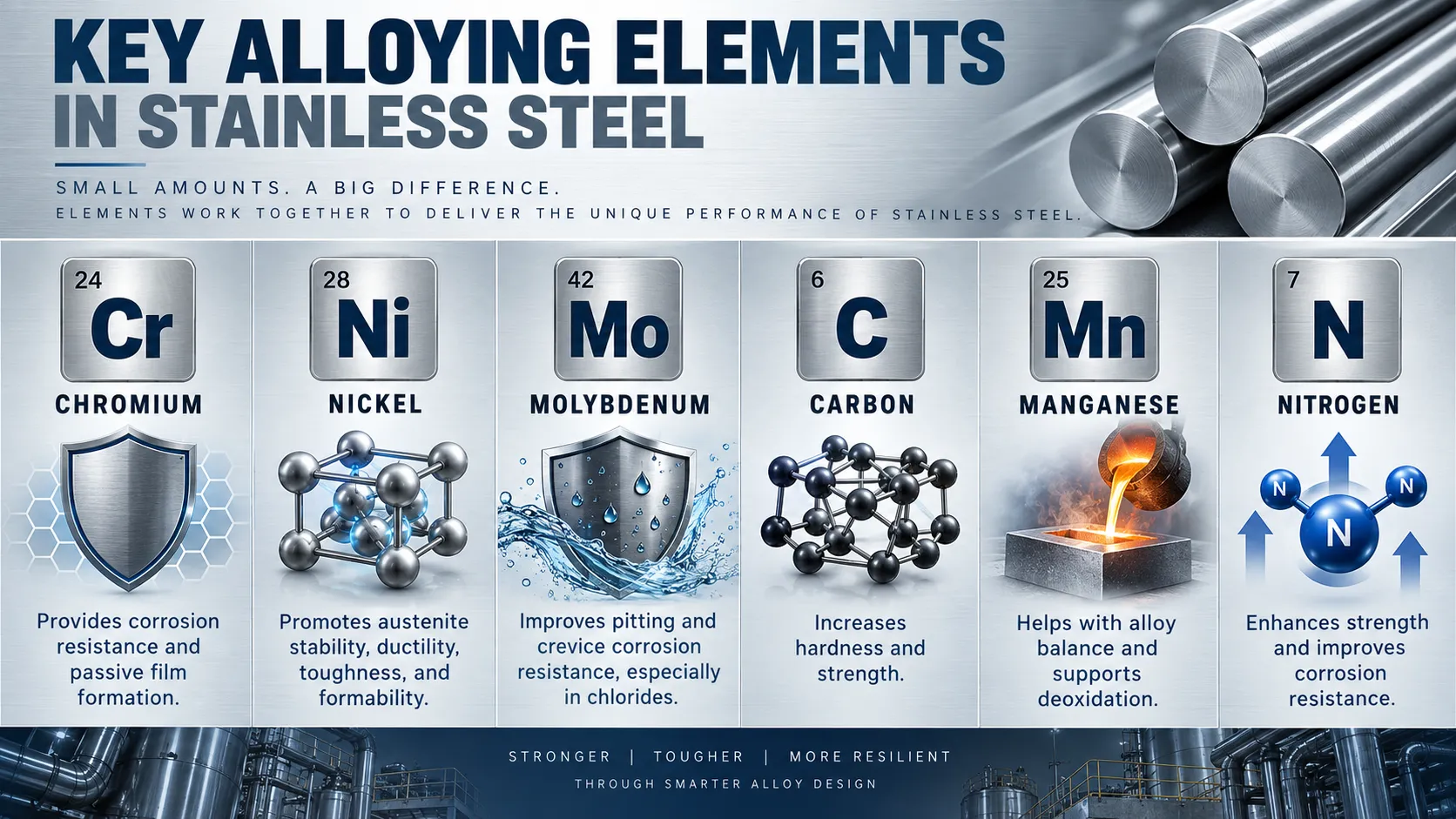
Several alloying elements are especially important.
Chromium — Cr
Chromium is the defining element of stainless steel.
Its most important role is helping form the chromium-rich passive film responsible for corrosion resistance.
Higher chromium levels can also contribute to:
- 抗氧化性
- 高溫性能
- Stability of certain stainless steel microstructures
However, chromium content alone does not determine the complete corrosion behavior.
Nickel, molybdenum, nitrogen and other elements also matter.
Nickel — Ni
Nickel is particularly important in many austenitic stainless steels.
It helps stabilize the austenitic structure and contributes to:
- 延性
- 韌性
- 形成性
- 可焊性
- 低溫韌性
304 is one of the best-known chromium-nickel stainless steels.
You can learn more in our detailed 304 Stainless Steel guide。
Molybdenum — Mo
Molybdenum is an important addition in grades such as 316 and many duplex stainless steels.
Its main practical advantage is improved resistance to localized corrosion, particularly:
- 點蝕
- 縫隙腐蝕
This becomes particularly important in environments containing chlorides.
The presence of molybdenum is one of the major reasons 316 is generally more resistant to chloride attack than 304.
For a detailed comparison, see 304 與 316 不鏽鋼。
Carbon — C
Carbon influences strength, hardness and heat-treatment behavior.
Martensitic stainless steels use carbon to achieve higher hardness after heat treatment.
In austenitic stainless steels, excessive carbon can create concerns during certain welding and high-temperature exposure conditions.
This is why low-carbon grades such as:
- 304L
- 316L
are widely used for welded fabrication.
Manganese — Mn
Manganese contributes to alloy balance and steelmaking.
In some stainless steel compositions it can also help stabilize austenite.
200-series stainless steels such as 201 typically use increased manganese together with lower nickel compared with conventional 300-series austenitic grades.
Nitrogen — N
Nitrogen can significantly improve strength and can also contribute to resistance against localized corrosion.
It is particularly important in many duplex and super duplex stainless steels.
Other Alloying Elements
Depending on the grade, stainless steel may also contain:
鈦
Used in stabilized grades such as 321.
Niobium
Used in stabilized alloys and precipitation-hardening systems.
銅
May be added for specific corrosion or forming characteristics.
硫
May be deliberately increased in certain free-machining grades.
The combination of these alloying elements helps explain why stainless steel grades can behave so differently even when they look almost identical.
The Five Main Types of Stainless Steel
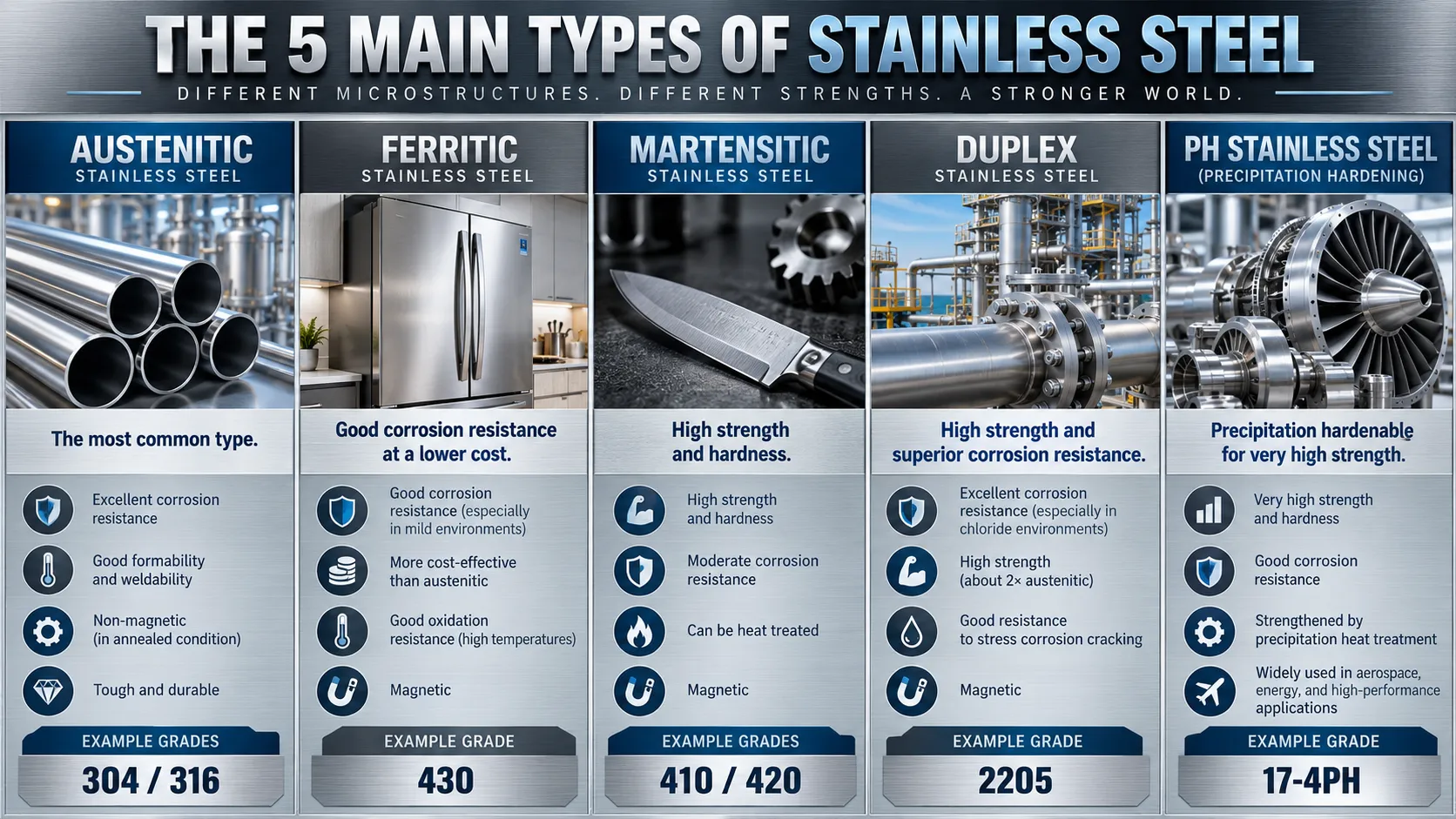
Stainless steels are commonly classified according to their metallurgical microstructure.
The five major families are:
- 奧氏體
- 鐵素體
- 馬氏體
- 雙工
- 沉澱硬化
1. Austenitic Stainless Steel
Austenitic stainless steel is the most widely recognized stainless steel family.
Common grades include:
- 201
- 301
- 304
- 304L
- 316
- 316L
- 321
- 347
Austenitic grades are widely used because they provide a useful combination of:
- 耐腐蝕性
- 延性
- 形成性
- 韌性
- 可焊性
- Surface quality
Common applications include:
- 食品加工設備
- 坦克
- 廚房設備
- 化工設備
- Pharmaceutical systems
- Architectural cladding
- 熱交換器
- Automotive components
- Pipe and tube systems
Annealed austenitic stainless steels such as 304 and 316 are normally non-magnetic or only weakly magnetic.
Cold working can cause some austenitic grades to develop measurable magnetic response.
2. Ferritic Stainless Steel
Ferritic stainless steels are chromium-containing stainless steels with a ferritic microstructure.
Common grades include:
- 409
- 430
- 439
- 441
- 446
They are normally magnetic.
Ferritic grades generally contain little or no deliberately added nickel compared with conventional 300-series stainless steels.
This can make them an economical choice where their corrosion and mechanical performance are sufficient.
Typical characteristics include:
- 磁性行為
- Useful corrosion resistance
- Good oxidation resistance in selected grades
- Good formability in many sheet applications
- Competitive material cost
典型應用包括:
- 電器
- 廚房設備
- 裝飾板
- 汽車排氣系統
- Interior architectural components
- Heat-resistant components
430 is one of the most familiar ferritic grades.
If you are comparing 430 with 304 for sheet applications, see our guide to 304 與 430 不鏽鋼板。
3. Martensitic Stainless Steel
Martensitic stainless steels are used where mechanical strength, hardness and wear resistance are important.
Common grades include:
- 410
- 420
- 431
- 440a
- 440B
- 440c
They are generally magnetic and can be hardened through heat treatment.
典型應用包括:
- Knives
- Cutlery
- 軸
- 閥門零件
- 幫浦組件
- 渦輪機零件
- 手術器械
- 緊固件
- 耐磨件
Compared with 304 or 316, many martensitic grades provide higher hardness but lower corrosion resistance.
Material selection is therefore a balance between:
hardness + strength + wear resistance + corrosion environment
rather than corrosion resistance alone.
4. Duplex Stainless Steel
Duplex stainless steel contains both:
- Austenitic structure
- Ferritic structure
The two-phase microstructure gives duplex grades a useful combination of strength and corrosion resistance.
Common grades include:
- Lean duplex grades
- 2205
- 2507超級雙工
Typical advantages include:
- Higher yield strength than conventional annealed austenitic grades
- Good resistance to chloride-related corrosion
- Good resistance to stress corrosion cracking in suitable environments
- Useful weldability when correct procedures are followed
- 磁性行為
2205 is widely used in:
- 化學加工
- 石油和天然氣
- 紙漿和紙張
- 水處理
- 承壓設備
- 離岸設備
- 海水淡化
- 工藝管道
5. Precipitation-Hardening Stainless Steel
Precipitation-hardening stainless steels, often called PH stainless steels, can achieve very high mechanical strength through controlled heat treatment.
One of the best-known grades is:
17-4ph
Typical advantages include:
- Very high strength
- Good hardness
- Useful corrosion resistance
- Dimensional stability
- Heat-treatment-controlled properties
典型應用包括:
- 航天
- 幫浦組件
- 軸
- 閥門
- 緊固件
- High-strength mechanical components
- Precision equipment
Stainless Steel Family Comparison
| 不銹鋼系列 | 普通成績 | Typical Magnetic Behavior | 耐腐蝕性 | 力量 | 形成性 | 典型的應用 |
|---|---|---|---|---|---|---|
| 奧氏體 | 201, 304, 316, 321 | Usually low in annealed condition | Good to excellent | 中度至高 | 出色的 | Food, chemical, architectural, tanks |
| 鐵素體 | 409, 430, 441 | 磁的 | 中度到良好 | 緩和 | 好的 | Appliances, exhaust, decoration |
| 馬氏體 | 410, 420, 440C | 磁的 | 緩和 | High after heat treatment | 降低 | Blades, shafts, valves, wear parts |
| 雙工 | 2205,2507 | 磁的 | Very good to excellent | 高的 | 緩和 | Offshore, chemical, process equipment |
| PH | 17-4PH, 15-5PH | Usually magnetic | 好的 | 很高 | Grade dependent | Aerospace, valves, shafts |
Common Stainless Steel Grades
The stainless steel family contains many grades, but a relatively small group accounts for a large proportion of global industrial purchasing.
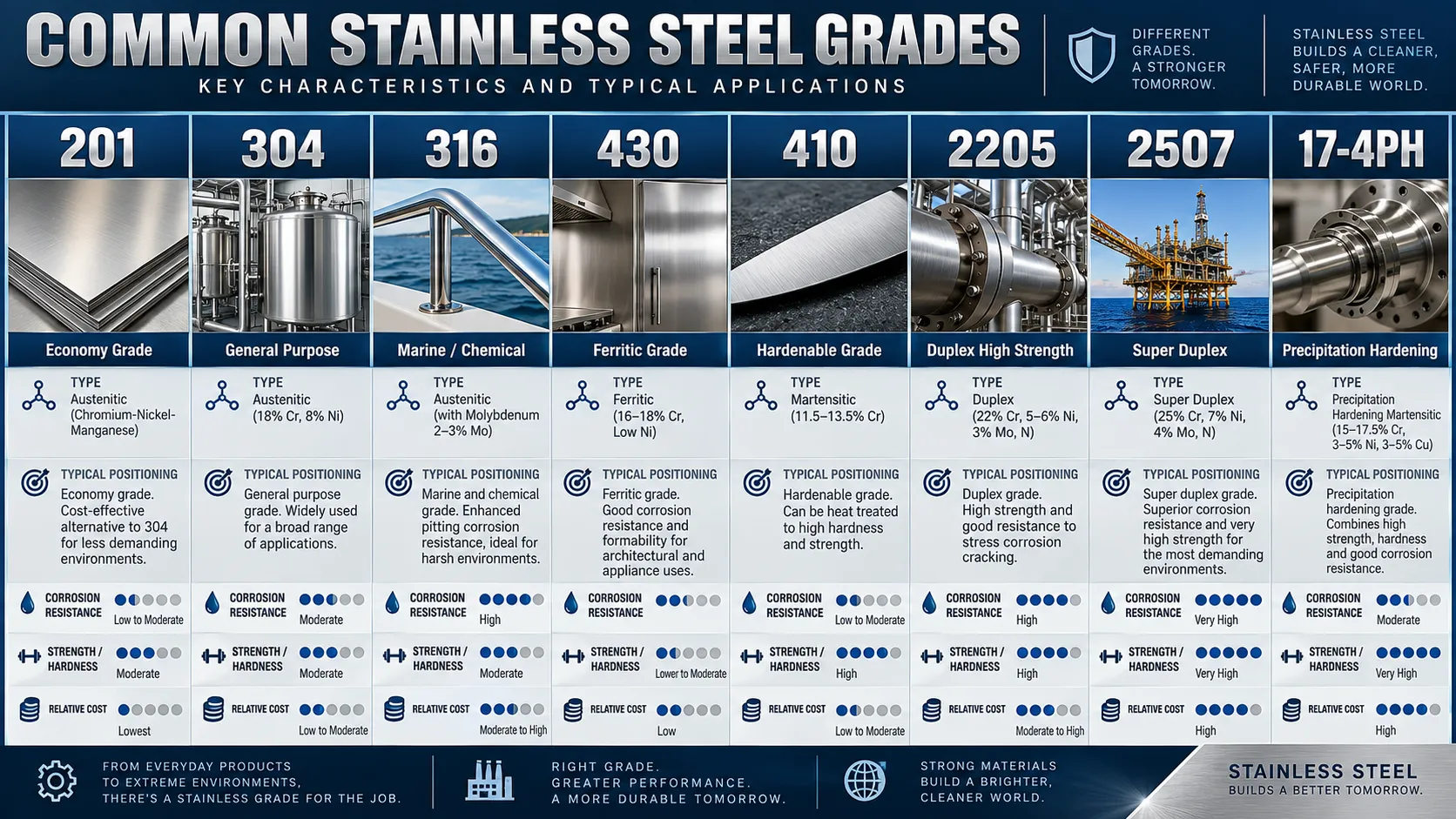
201不銹鋼
201 is an austenitic stainless steel that typically uses higher manganese and lower nickel content than conventional 304.
It is commonly considered for cost-sensitive applications where extremely high corrosion resistance is not required.
Typical uses include:
- Indoor decorative products
- 家具
- 欄桿
- 廚房用具
- Architectural trim
- General fabricated products
It should not automatically be treated as a direct replacement for 304 in aggressive environments.
304 and 304L Stainless Steel
304 is one of the most widely used stainless steel grades.
It offers a strong combination of:
- 耐一般腐蝕
- 形成性
- 可焊性
- 可用性
- 表面光潔度選項
- Cost efficiency
典型應用包括:
- 食品設備
- 坦克
- 廚房
- Architectural products
- General industrial fabrication
- 管道和管材
- Sheet and coil products
304L is the lower-carbon version and is widely used in welded structures.
316 and 316L Stainless Steel
316 contains molybdenum, which improves resistance to localized corrosion compared with 304 in many chloride-containing environments.
典型應用包括:
- 化工設備
- Pharmaceutical systems
- Coastal structures
- 食品加工設備
- 熱交換器
- 工藝管道
- Marine-related equipment
316L provides lower carbon content and is widely specified in welded fabrication.
321不銹鋼
321 is a titanium-stabilized austenitic stainless steel.
It is commonly considered for elevated-temperature applications and components where stabilization is important.
Typical uses include:
- 熱交換器
- 排氣系統
- High-temperature piping
- Aerospace components
- Thermal equipment
430不銹鋼
430 is a widely used ferritic stainless steel.
這是:
- 磁的
- Relatively economical
- Suitable for many mild environments
- Common in sheet applications
典型應用包括:
- 電器
- 廚房設備
- 裝飾條
- Interior architecture
- Household products
410不鏽鋼
410 is a martensitic stainless steel.
It can be heat treated to achieve higher hardness and strength.
典型應用包括:
- 閥門
- 軸
- 緊固件
- Pump parts
- 渦輪機零件
- 機械部件
420 Stainless Steel
420 provides greater hardening potential than many general-purpose stainless grades.
Typical uses include:
- Knives
- Blades
- 手術工具
- Wear-resistant components
- Precision mechanical parts
2205雙鏈不銹鋼
2205 is one of the most widely used duplex stainless steels.
It combines:
- 高強度
- Good chloride resistance
- Useful weldability
- Good resistance to stress corrosion cracking in suitable conditions
典型應用包括:
- 化學加工
- 石油和天然氣
- 承壓設備
- Offshore structures
- 管道
- Water-treatment systems
2507超級雙工不銹鋼
2507 is a super duplex stainless steel designed for particularly demanding environments.
It provides:
- Very high strength
- High chromium, molybdenum and nitrogen alloying
- Strong resistance to localized corrosion
- Suitability for severe chloride service
典型應用包括:
- 海上系統
- 海水設備
- 淡化植物
- 化學加工
- Aggressive process piping
17-4PH Stainless Steel
17-4PH is a precipitation-hardening stainless steel used when high mechanical strength is a primary requirement.
典型應用包括:
- Aerospace components
- 軸
- 泵浦
- 閥門
- 緊固件
- 精密零件
Quick Stainless Steel Grade Comparison
| 年級 | Family | Main Characteristic | 典型用途 |
|---|---|---|---|
| 201 | 奧氏體 | Economical Cr-Ni-Mn grade | Interior decoration, furniture |
| 304 / 304L | 奧氏體 | General-purpose corrosion resistance | Food, construction, tanks |
| 316 / 316L | 奧氏體 | Improved chloride resistance | Chemical, coastal, pharmaceutical |
| 321 | 奧氏體 | Stabilized for elevated temperature | Exhausts, heat equipment |
| 430 | 鐵素體 | Magnetic and economical | Appliances, decorative panels |
| 410 | 馬氏體 | Heat treatable | Shafts, valves, mechanical parts |
| 420 | 馬氏體 | Higher hardness | Blades, instruments |
| 2205 | 雙工 | High strength + corrosion resistance | 化學、海上、壓力系統 |
| 2507 | Super Duplex | Severe corrosion environments | Seawater, desalination, offshore |
| 17-4ph | PH | Very high strength | Aerospace, shafts, valves |
304 與 316 不鏽鋼
304 and 316 are frequently compared because both are widely used austenitic stainless steels.
The most important compositional difference is the addition of molybdenum in 316.
| 財產 | 304 | 316 |
|---|---|---|
| Family | 奧氏體 | 奧氏體 |
| 主要合金系 | Cr-nie | Cr-in-i |
| 耐一般腐蝕 | 非常好 | 非常好 |
| 耐氯化物點蝕性 | 降低 | 更高 |
| 形成性 | 出色的 | 出色的 |
| 可焊性 | 出色的 | 出色的 |
| 相對材料成本 | 降低 | 更高 |
| Common applications | 通用 | Chemical, coastal, chloride-containing environments |
When Is 304 a Good Choice?
304 is commonly selected for:
- Indoor applications
- General outdoor environments
- 食品設備
- 廚房
- 坦克
- 建築學
- 一般製造
- Freshwater systems
When Should 316 Be Considered?
316 or 316L may be more appropriate where the equipment encounters:
- 氯化物
- 鹽霧
- 沿海環境
- Certain chemical solutions
- Aggressive cleaning agents
- 醫藥加工
- More demanding process conditions
However, 316 should not automatically be assumed to be suitable for every seawater application.
Continuous seawater exposure, elevated temperature, crevices and severe chloride concentrations may require:
- 2205雙工
- 2507超級雙工
- Another higher-alloy stainless steel
Read our dedicated 304 vs 316 Stainless Steel comparison for a more detailed analysis.
Stainless Steel vs Carbon Steel
Stainless steel and carbon steel are both iron-based materials, but they are optimized for different priorities.
| 財產 | 不銹鋼 | 碳鋼 |
|---|---|---|
| 耐腐蝕性 | High when correctly selected | Generally lower without coating |
| 鉻含量 | Significant | Usually low |
| 表面保護 | Passive film | Often paint, galvanizing or coating |
| 初始材料成本 | 通常較高 | Usually lower |
| 維護 | Often lower in corrosive service | Depends on coating system |
| 力量 | 廣泛的範圍 | 廣泛的範圍 |
| Surface appearance | Natural metallic finish | Often coated or painted |
| 典型應用 | Food, chemical, architectural, hygienic, marine | Structures, machinery, construction |
Carbon steel remains an excellent engineering material.
If corrosion resistance is not a major concern, carbon steel may provide a more economical solution.
Stainless steel becomes especially valuable when a project requires:
- 耐腐蝕性
- 衛生
- 可清潔性
- Attractive metallic appearance
- 維護低
- Long service life
Key Properties of Stainless Steel
耐腐蝕性
Corrosion resistance is the defining characteristic of stainless steel.
However, resistance varies significantly between grades.
A 430 ferritic stainless steel used in an indoor appliance does not provide the same corrosion resistance as 316L, 2205 or 2507.
Material selection must always match the actual environment.
力量
There is no single “strength of stainless steel.”
Strength depends on:
- 年級
- 微觀結構
- 熱處理
- 冷加工
- 產品形態
- 厚度
- 適用標準
Duplex and precipitation-hardening stainless steels can provide significantly higher strength than conventional annealed 300-series stainless steels.
Ductility and Formability
Austenitic stainless steels are especially valued for formability.
304 can be:
- Bent
- Rolled
- 蓋章
- Deep drawn
- Press formed
This makes it particularly useful for sheet-metal fabrication.
可焊性
304, 304L, 316 and 316L are widely welded using established industrial welding processes.
Low-carbon variants such as 304L and 316L are commonly used where welding is important.
Duplex and martensitic stainless steels can also be welded, but they may require more carefully controlled procedures.
耐熱性
Selected stainless steels can provide useful performance at elevated temperatures.
High-temperature material selection should consider:
- 氧化
- 蠕動
- 熱膨脹
- Thermal fatigue
- 冶金穩定性
- Mechanical strength at temperature
A stainless steel that works well at room temperature may not necessarily be suitable for continuous high-temperature operation.
Low-Temperature Performance
Many austenitic stainless steels retain useful toughness at low temperatures.
This is one reason austenitic stainless steels are used in certain cryogenic systems.
Hygiene and Cleanability
Stainless steel is widely used in:
- 食品加工
- Beverage production
- Dairy equipment
- 製藥設備
- Medical environments
Smooth stainless surfaces can be cleaned effectively and do not require a paint coating for corrosion protection.
外貌
Stainless steel can be produced in many surface conditions ranging from industrial mill finishes to highly polished decorative surfaces.
This allows stainless steel to serve both:
- Engineering purposes
- Architectural purposes
回收
Stainless steel is recyclable and has established global scrap value.
Its long service life can also help reduce replacement frequency in suitable applications.
Is Stainless Steel Magnetic?
The answer depends on the stainless steel family.
| Family | Typical Magnetic Behavior |
|---|---|
| 奧氏體 | Usually non-magnetic or weakly magnetic when annealed |
| 鐵素體 | 磁的 |
| 馬氏體 | 磁的 |
| 雙工 | 磁的 |
| PH Stainless | Many common grades are magnetic |
A common myth is:
If a magnet sticks to the material, it is not stainless steel.
This is incorrect.
Grades such as:
- 430
- 410
- 420
- 2205
are genuine stainless steels and are magnetic.
Even 304 can develop some magnetic response after significant cold working.
A magnet should therefore 不是 be used as the sole method for identifying a stainless steel grade.
Common Stainless Steel Product Forms
Stainless steel grade is only one part of a purchase specification.
Buyers must also define the required product form.
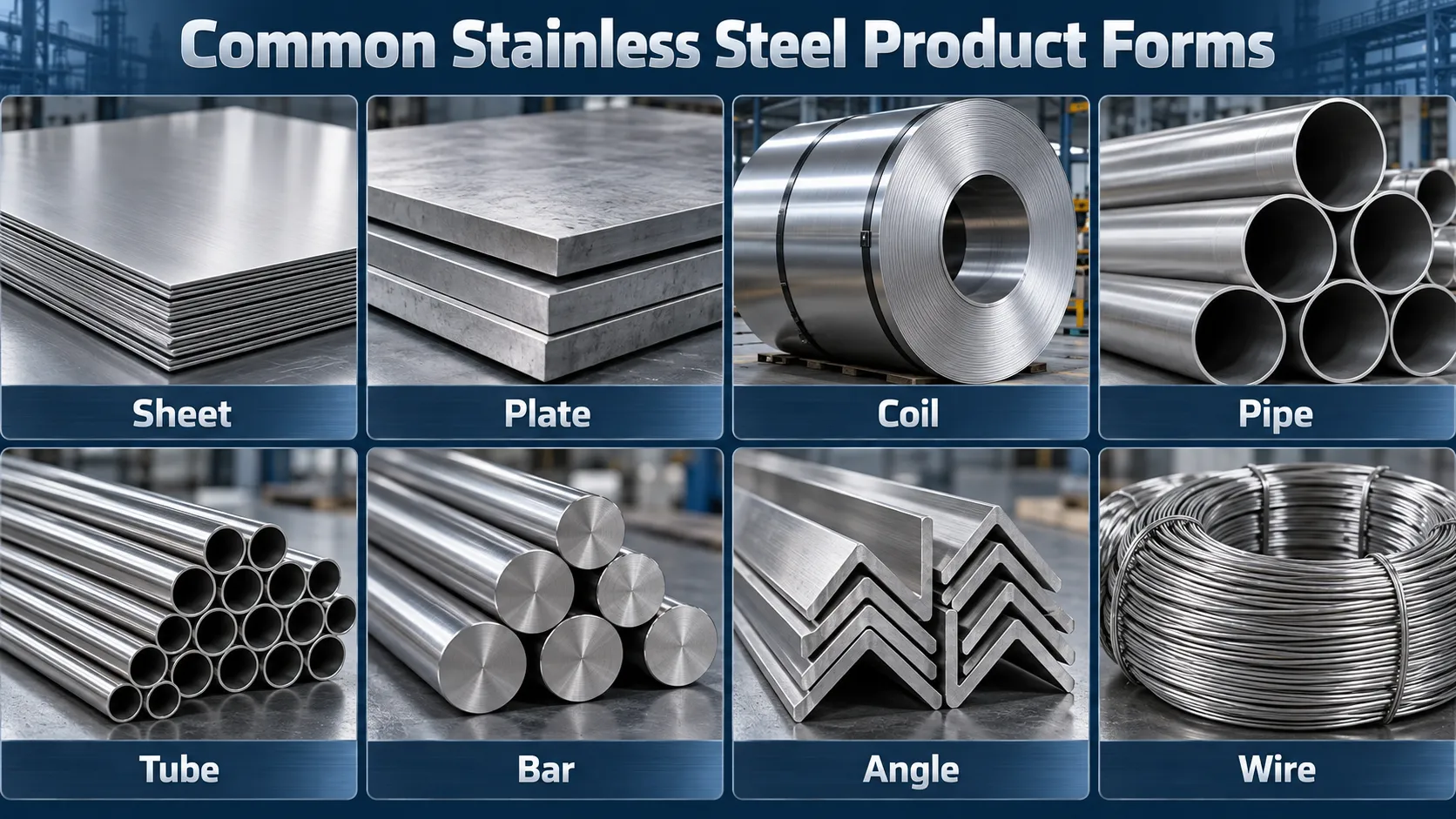
At Gengfei Steel, our 不銹鋼產品系列 covers multiple flat and long-product forms for industrial manufacturing and project applications.
不銹鋼板
不銹鋼板 is commonly used for:
- 食品設備
- 櫥櫃
- 坦克
- Enclosures
- 建築面板
- 廚房設備
- Machine covers
- Decorative fabrication
Important purchasing parameters include:
- 年級
- 厚度
- 寬度
- 長度
- 表面飾面
- 寬容
- Protective film
- 邊緣條件
不銹鋼板
Plate is typically associated with thicker flat stainless products used in heavier fabrication.
典型應用包括:
- 壓力容器
- 工業罐
- 結構成分
- 化工設備
- 離岸設備
- Heavy machinery
The exact dividing line between sheet and plate depends on the relevant standard and commercial convention.
不銹鋼卷材
不銹鋼線圈 is suitable for continuous manufacturing and further processing.
Typical downstream operations include:
- 分切
- 定長切割
- 滾壓成型
- 沖壓
- Tube manufacturing
- Appliance production
- Automotive component production
Coil purchasing normally requires careful definition of:
- 年級
- 厚度
- 寬度
- 線圈ID
- 捲材重量
- 表面
- 邊緣
- 寬容
不銹鋼條
Stainless steel strip is narrower flat material often used for high-volume manufacturing and precision components.
應用包括:
- 彈簧
- Clamps
- 電子產品
- 汽車零件
- Seals
- Precision stamping
Thickness tolerance, edge condition and temper can be particularly important.
不銹鋼管
Stainless steel pipe is widely used for fluid transportation and process systems.
Pipe is often specified according to:
- 名義管尺寸
- 日程
- 外徑
- 壁厚
- Applicable pipe standard
應用包括:
- Chemical systems
- 水處理
- 食品加工
- 工藝管道
- 石油和天然氣
- Energy equipment
Stainless Steel Tube
Tube is often specified by outside diameter and wall thickness.
It is widely used in:
- 熱交換器
- 儀器儀表
- 衛浴設備
- 汽車系統
- Mechanical structures
- Precision assemblies
Pipe and tube may appear similar, but their dimensional conventions and standards can be very different.
我們的 304 Stainless Steel Tubing guide explains the subject in more detail.
不銹鋼棒材
不銹鋼棒材 is available in forms including:
- 圓鋼
- 扁鋼
- Square bar
- Hex bar
應用包括:
- 機加工組件
- 軸
- 緊固件
- 泵浦
- 閥門
- 結構成分
- Mechanical equipment
不銹鋼角鋼
Stainless steel angle is used in:
- Frames
- 支持
- Equipment structures
- 建築學
- Food machinery
- Chemical installations
- Corrosion-resistant structural assemblies
不銹鋼線
Stainless steel wire is available for applications including:
- 彈簧
- Mesh
- 緊固件
- Cable
- Filtration
- Industrial weaving
- 焊接
- 精密零件
Stainless Steel Surface Finishes
Surface finish can affect:
- 外貌
- 可清潔性
- 反射率
- 製造
- 腐蝕行為
- Customer acceptance
Common stainless steel finishes include:
| 結束 | Typical Appearance | 典型的應用 |
|---|---|---|
| 1號 | Rougher matte hot-rolled surface | Industrial plate |
| QR 圖 | Dull cold-rolled surface | Industrial processing |
| 2b | Smooth matte / slightly reflective | 一般板材製造 |
| BA | 明亮退火 | Appliances, decoration |
| 第4號 | Brushed / satin | Kitchens, architecture |
| 髮際線 | Linear decorative finish | Elevators, wall panels |
| 鏡面/8K | Highly reflective | Premium decorative applications |
Finish terminology can vary between:
- Mills
- Regions
- 標準
- Customers
For decorative projects, simply stating “brushed” or “mirror” may not be sufficient.
A purchase specification may also need to define:
- 表面粗糙度
- Grinding direction
- Polishing quality
- Protective film
- Visual acceptance criteria
How Is Stainless Steel Made?
Stainless steel manufacturing varies by mill and product type, but the overall production route typically contains several stages.
1. Raw Material Preparation
The production charge may contain:
- Stainless steel scrap
- Iron-bearing materials
- Ferrochromium
- 鎳
- 鉬
- Other alloy additions
Precise raw-material selection depends on the final grade.
2. Melting
Raw materials are melted to create the basic alloy.
3. Refining
The molten steel is refined to control:
- 碳
- 鉻
- 鎳
- 鉬
- 氮
- 雜質
- Final chemistry
Small chemistry differences can determine whether the final alloy qualifies as 304, 316, 2205 or another grade.
4. Casting
The refined stainless steel is cast into intermediate forms such as:
- Slabs
- Billets
- Blooms
The form depends on the downstream product.
5. Hot Rolling
Cast material is reheated and hot rolled into:
- 盤子
- Hot rolled coil
- 酒吧
- Other intermediate products
6. Annealing
Heat treatment helps establish the required microstructure and properties.
7. Pickling and Descaling
Hot processing creates surface oxides.
Pickling and related processes remove scale and restore a clean stainless steel surface.
8. Cold Rolling
Cold rolling may be used when buyers require:
- Thinner gauge
- Better dimensional control
- 改善表面光潔度
- More precise tolerances
9. Finishing
Depending on the product, additional processing can include:
- 分切
- 切割
- Leveling
- 磨削
- 拋光
- Drawing
- Peeling
- 加工
- Tube forming
10. Inspection
Inspection can involve:
- 化學成分
- 機械性能
- 方面
- 表面狀況
- 平坦
- 直線度
- Nondestructive testing
- Product-specific tests
The required inspection scope depends on the standard and purchase order.
Where Is Stainless Steel Used?
Stainless steel is used across many industries because different grades can be selected for different combinations of corrosion resistance, strength and fabrication requirements.
食品和飲料
Commonly considered grades include:
- 304
- 304L
- 316
- 316L
應用包括:
- 坦克
- Brewing equipment
- Dairy systems
- 食品加工機械
- 廚房設備
- Conveyors
- 管道
化學處理
Depending on the chemical environment, materials may include:
- 316L
- 2205
- 2507
- Higher-alloy stainless steels
應用包括:
- Reactors
- 儲罐
- 熱交換器
- 工藝管道
- Scrubbers
- 壓力容器
Grade selection should always consider:
- 化學
- 專注
- 溫度
- 壓力
- 流動條件
海洋和近海
Marine environments require special attention because chlorides can promote pitting and crevice corrosion.
Potential grades include:
- 316L
- 2205
- 2507
應用包括:
- 離岸設備
- Coastal infrastructure
- 海水淡化
- 管道
- 緊固件
- 海洋硬件
There is no single stainless steel that is automatically suitable for every marine environment.
建築和建築
Stainless steel is widely used for:
- 外牆
- 扶手
- 屋頂
- 電梯面板
- 裝飾條
- 結構成分
- Public-space installations
Surface appearance and long-term staining resistance can be as important as mechanical strength.
汽車和運輸
應用包括:
- 排氣系統
- Trim
- 管子
- 隔熱罩
- Structural parts
- Fuel-system components
Ferritic and austenitic grades are both widely used.
Pharmaceutical and Medical Equipment
Stainless steels are used for:
- 製藥罐
- Process systems
- Laboratory equipment
- Medical equipment
- 潔淨室組件
316L is particularly common in many high-hygiene systems, although the exact material specification depends on the process.
Energy
Stainless steels are used across:
- Power generation
- 石油和天然氣
- 熱交換器
- 製程設備
- Renewable energy
- Nuclear-related systems
These applications may involve combinations of:
- 壓力
- 溫度
- 腐蝕
- 疲勞
- Mechanical loads
How to Choose the Right Stainless Steel Grade
Choosing stainless steel should be an engineering decision rather than simply selecting the most famous grade.

A practical selection process can begin with six questions.
Step 1: What Is the Environment?
First determine where the material will actually operate.
範例包括:
- Indoor dry environment
- General outdoor exposure
- Urban atmosphere
- Coastal environment
- Marine environment
- Chemical plant
- Food-processing environment
- High-humidity environment
- 持續沉浸
This immediately helps narrow the suitable grade range.
例如:
Indoor decorative application
201 or 430 may be worth evaluating.
General industrial equipment
304 may be sufficient.
Coastal or chloride-containing environment
316L may be more appropriate.
嚴重氯化物服務
Duplex or super duplex may need to be considered.
Step 2: What Type of Corrosion Is Expected?
Do not evaluate corrosion resistance only as “good” or “bad.”
Ask which corrosion mechanism is relevant.
Possible mechanisms include:
- General corrosion
- 點蝕
- 縫隙腐蝕
- 應力腐蝕破裂
- Intergranular corrosion
- Galvanic corrosion
For chloride exposure, pitting and crevice corrosion deserve particular attention.
This is where alloying additions such as:
- 鉬
- 氮
- Higher chromium
become especially important.
Step 3: How Much Strength Is Required?
If normal mechanical strength and excellent formability are sufficient, an austenitic grade such as 304 may be appropriate.
If the project requires significantly higher yield strength, duplex stainless steel may offer advantages.
For hardness and wear resistance, consider martensitic stainless steel.
For very high strength, precipitation-hardening stainless steel may be appropriate.
The material should therefore be selected according to actual mechanical requirements rather than simply corrosion resistance.
Step 4: What Temperature Will the Material Experience?
Consider both:
- Normal operating temperature
- Maximum upset temperature
High temperature can affect:
- 力量
- 氧化
- Scaling
- 蠕動
- 冶金穩定性
Low temperature may require good toughness.
Certain austenitic grades are particularly useful for low-temperature applications.
Specialized heat-resistant stainless steels should be evaluated for sustained elevated-temperature service.
Step 5: Will the Material Be Welded?
Welding can influence:
- 微觀結構
- 腐蝕行為
- Distortion
- Residual stress
- 機械性能
For common welded fabrication:
- 304L
- 316L
are frequently selected.
Duplex stainless steel can also be welded successfully, but heat input, filler metal and phase balance must be controlled.
Martensitic stainless steels may require:
- Preheating
- Controlled cooling
- Post-weld heat treatment
depending on grade and component requirements.
Step 6: Choose the Grade
Only after understanding the previous conditions should the grade be finalized.
A simplified starting guide is:
| 要求 | Grades Commonly Evaluated |
|---|---|
| Low-cost indoor decorative use | 201, 430 |
| General-purpose stainless fabrication | 304 / 304L |
| Greater chloride resistance | 316 / 316L |
| Elevated-temperature stabilized applications | 321 |
| Higher hardness / wear | 410,420 |
| High strength + chloride resistance | 2205 |
| 嚴重氯化物服務 | 2507 |
| Very high-strength precision parts | 17-4ph |
This is a screening guide, not a substitute for final engineering evaluation.
How to Specify Stainless Steel When Requesting a Quote
A good stainless steel enquiry should contain more than the grade.
例如:
ASTM A240 316L stainless steel sheet, 2.0 mm × 1500 mm × 3000 mm, 2B finish, 20 metric tons.
This is much more useful than:
Need stainless steel sheet.
When requesting a quotation, try to provide:
1. 等級
範例:
- 201
- 304
- 304L
- 316L
- 430
- 2205
- 2507
2. Standard
範例:
- ASTM
- ASME
- 在
- 他
- GB
3.產品形態
範例:
- 床單
- 盤子
- 線圈
- 條
- 管道
- 管子
- 圓鋼
- Angle
- Wire
4. 尺寸
Depending on product:
- 厚度
- 寬度
- 長度
- 外徑
- 壁厚
- 直徑
5. Quantity
狀態:
- 件
- Tons
- 捲材重量
- Required annual quantity
where applicable.
6. Surface Finish
範例:
- 1號
- 2b
- BA
- 第4號
- 髮際線
- 鏡子
7. Processing Requirements
範例:
- 分切
- 定長切割
- 雷射切割
- 拋光
- 磨削
- 倒角
- Custom dimensions
8. Inspection Requirements
If required, specify:
- 工廠測試證書
- 化學分析
- 機械測試
- 無損檢測
- 第三方檢驗
9. Destination
For international trade, provide:
- 國家
- 港口
- 交貨條款
This helps suppliers quote freight and packaging correctly.
Stainless Steel Standards and Grade Designations
International stainless steel buyers frequently encounter several designation systems for similar materials.
Common systems include:
- AISI / Type
- ASTM
- 我們
- 在
- 他
- GB
- KS
Some familiar examples are:
| Common Grade | 我們 | 在 | 他 |
|---|---|---|---|
| 304 | S30400 | 1.4301 | SUS304 |
| 304L | S30403 | 1.4307 / related designation | SUS304L |
| 316 | S31600 | 1.4401 | SUS316 |
| 316L | S31603 | 1.4404 | SUS316L |
| 430 | S43000 | 1.4016 | SUS430 |
| 2205 | S32205 / related duplex designation | 1.4462 | Specification dependent |
| 2507 | S32750 | 1.4410 | Specification dependent |
International cross-reference tables are useful, but similar designations should not automatically be assumed to be perfectly interchangeable。
Before purchasing, verify:
- 化學成分
- 機械要求
- 熱處理
- 產品標準
- 方面
- 測試要求
You can also use our 不銹鋼等級交叉引用表 as a starting reference.
Advantages of Stainless Steel
優異的耐腐蝕性
With correct grade selection, stainless steel can provide long service life without paint or another protective coating.
Wide Range of Grades
The stainless steel family covers applications from decorative panels to severe chemical and offshore equipment.
Good Fabricability
Many grades can be:
- 焊接
- Bent
- 形成
- Rolled
- 機械加工
- 拋光
迷人的外觀
Stainless steel can provide both engineering performance and architectural appearance.
衛生表面
Smooth stainless steel surfaces are suitable for many food, beverage and pharmaceutical environments.
長期使用壽命
Correctly specified stainless steel can reduce replacement and maintenance requirements.
回收
Stainless steel can be recycled and reused through established metal recycling systems.
Limitations of Stainless Steel
Stainless steel is not the correct answer for every project.
更高的初始成本
Stainless steel normally costs more than ordinary carbon steel.
Wrong Grade Selection Can Still Cause Corrosion
Using 304 in a severe chloride environment simply because it is “stainless” can lead to premature corrosion.
工作硬化
Many austenitic stainless steels work harden during machining and cold forming.
Specialized Fabrication May Be Required
Duplex, martensitic and precipitation-hardening grades may require more carefully controlled:
- 焊接
- 加工
- 熱處理
Surface Contamination Can Cause Problems
Carbon-steel grinding particles and tooling contamination can create rust staining on stainless surfaces.
Proper workshop segregation and cleaning are important where surface quality matters.
Frequently Asked Questions About Stainless Steel
What is stainless steel?
Stainless steel is an iron-based alloy containing sufficient chromium, generally at least around 10.5%, to form a thin chromium-rich passive film that provides significantly improved corrosion resistance.
Why doesn’t stainless steel rust easily?
Chromium reacts with oxygen to create a protective passive film on the surface. This film reduces interaction between the underlying metal and the environment.
Can stainless steel rust?
Yes. Stainless steel is corrosion resistant rather than completely corrosion-proof. Chlorides, chemicals, crevices, contamination, temperature and incorrect grade selection can cause corrosion.
Is stainless steel a coating?
No. Stainless steel is an alloy. Chromium and other alloying elements are contained throughout the metal.
What are the five types of stainless steel?
The five main stainless steel families are:
- 奧氏體
- 鐵素體
- 馬氏體
- 雙工
- 沉澱硬化
What is the most common stainless steel?
304 is one of the most widely used stainless steel grades because it combines good corrosion resistance, formability, weldability, availability and cost.
What is the difference between 304 and 316?
316 contains molybdenum, which generally gives it better resistance to localized corrosion in chloride-containing environments than 304.
304 is usually more economical.
Is 316 always better than 304?
不。
316 offers additional corrosion resistance, but if the environment does not require that extra performance, 304 can be the more economical choice.
What does the L mean in 304L and 316L?
這 L indicates a lower-carbon version.
304L and 316L are widely used in welded applications where reduced carbon helps minimize sensitization-related concerns.
Is stainless steel magnetic?
Some stainless steels are magnetic.
Ferritic, martensitic and duplex stainless steels are normally magnetic.
Annealed austenitic grades such as 304 and 316 are normally non-magnetic or weakly magnetic, although cold working can increase magnetic response.
Is 430 real stainless steel?
是的。
430 is a ferritic stainless steel commonly used for appliances, decorative applications and other mild environments.
It is magnetic.
What is duplex stainless steel?
Duplex stainless steel contains both austenitic and ferritic phases.
Grades such as 2205 offer higher strength than conventional austenitic stainless steel together with useful resistance to chloride-related corrosion.
What is super duplex stainless steel?
Super duplex stainless steel is a highly alloyed duplex material designed for more demanding environments.
2507 is one of the best-known super duplex grades.
What is food-grade stainless steel?
“Food grade” is not one universal stainless steel grade.
304 and 316 are widely used in food-processing equipment, but suitability depends on:
- 食品化學
- 清潔劑
- 溫度
- Regulatory requirements
- Equipment design
What stainless steel is used in marine environments?
316L is widely used in coastal and marine-related applications, but severe or continuous seawater exposure may require higher-alloy materials such as duplex or super duplex stainless steel.
Can stainless steel be welded?
是的。
Many stainless steels are routinely welded.
304L and 316L are especially common for welded fabrication.
Specialized grades may require controlled welding procedures.
Is stainless steel stronger than carbon steel?
沒有普遍的答案。
Both material families contain many grades.
Some duplex and precipitation-hardening stainless steels provide very high strength, while other stainless grades prioritize formability or corrosion resistance.
Always compare actual specified mechanical properties.
What is the difference between stainless steel sheet and plate?
Both are flat stainless steel products.
Plate is generally associated with thicker material and heavier fabrication, but the exact distinction depends on the applicable product specification and industry convention.
What is the difference between stainless steel pipe and tube?
Pipe is commonly specified by nominal pipe size and schedule.
Tube is more commonly specified by actual outside diameter and wall thickness.
The applicable manufacturing and dimensional standards can also differ.
Gengfei Steel Stainless Steel Supply
Gengfei Steel supplies stainless steel materials for industrial manufacturing, fabrication and international project requirements.
我們的 不銹鋼產品系列 包括:
- 不銹鋼板
- 不銹鋼板
- 不銹鋼線圈
- 不銹鋼條
- 不銹鋼管
- 不銹鋼管
- Stainless steel round bar
- Stainless steel flat bar
- 不銹鋼角鋼
- Stainless steel wire
Commonly supplied grades include:
- 201
- 304
- 304L
- 316
- 316L
- 321
- 410
- 420
- 430
- 2205
- 2507
- 17-4ph
Depending on the product, we can support requirements involving:
- Custom dimensions
- 分切
- 定長切割
- 表面處理
- Export packaging
- 材質認證
- International standards
For an efficient quotation, provide the grade, standard, product form, dimensions, quantity, surface finish, destination and any special inspection requirements.
最後的想法
Stainless steel is much more than a shiny, rust-resistant metal.
It is a broad family of engineering alloys whose performance is controlled by:
chemistry + microstructure + processing + environment + fabrication + product specification
Chromium gives stainless steel its fundamental passive behavior, while elements such as nickel, molybdenum and nitrogen allow specific grades to provide different combinations of:
- 耐腐蝕性
- 力量
- 形成性
- 可焊性
- Temperature resistance
For general-purpose fabrication, 304 remains one of the most important choices.
Where chloride resistance becomes more important, 316 or 316L may provide an advantage.
Where high strength and more demanding corrosion resistance are both required, duplex grades such as 2205 may be appropriate.
For severe chloride environments, super duplex grades such as 2507 can be considered.
For hardness and wear, martensitic grades such as 410 and 420 offer a different performance profile.
The correct selection process is therefore not:
Which stainless steel is best?
Instead, it should be:
Which stainless steel grade best matches this environment, mechanical requirement, fabrication process and total lifecycle cost?
Answering that question is the foundation of reliable stainless steel specification and purchasing.
