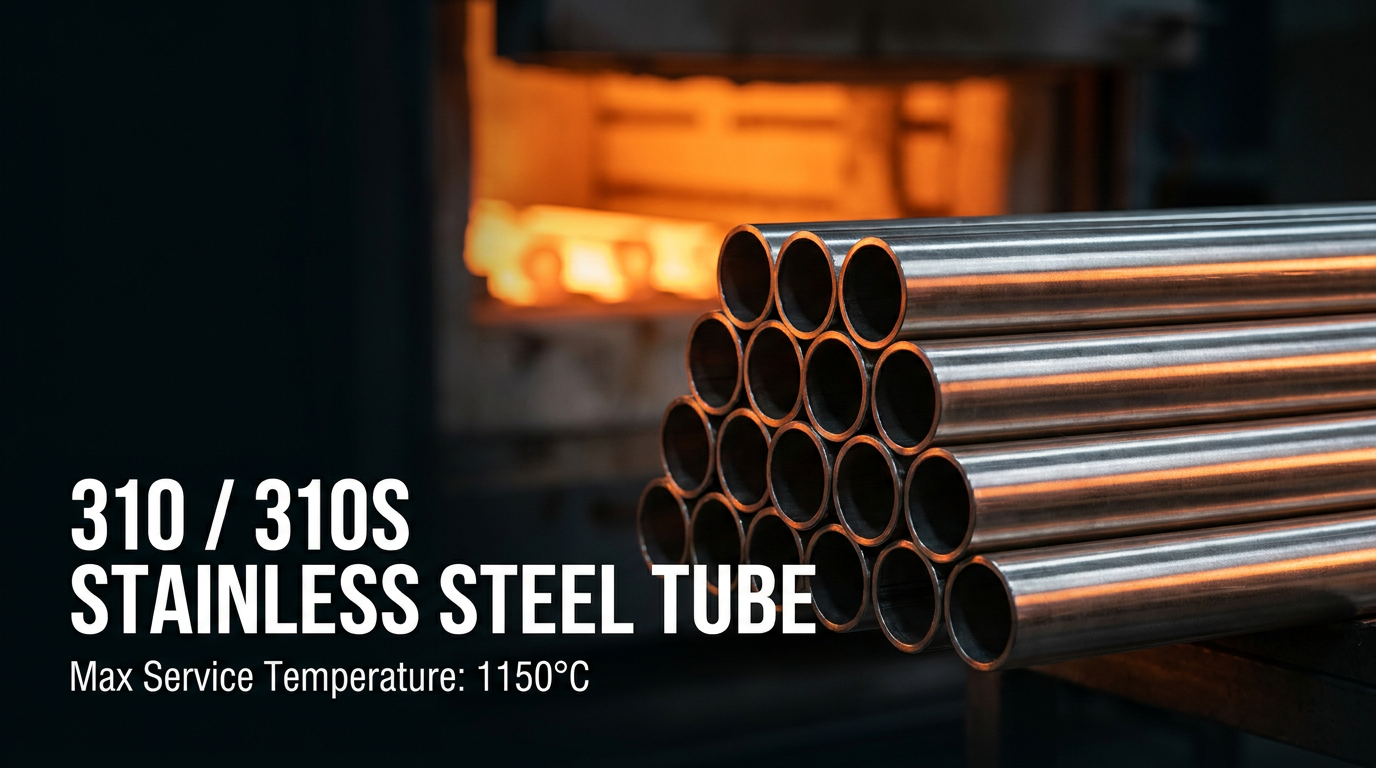
Introduction: The Ultimate High-Temperature Tubing Solution
In modern heavy industries—particularly power generation, thermal processing, and chemical refining—piping systems are routinely subjected to extreme thermal loads and corrosive atmospheres. For these demanding environments, standard austenitic grades like 304 or 316 are structurally and metallurgically insufficient. The 310 stainless steel tube represents the ultimate solution, engineered specifically to maintain structural integrity and resist severe oxidation at elevated temperatures.
Characterized by its exceptionally high chromium and nickel content, Grade 310 (and its low-carbon variant, 310S) is a premium heat-resistant austenitic stainless steel. Under continuous service, it exhibits outstanding resistance to scaling and thermal fatigue at temperatures up to 1150°C (2102∘F2102∘F).
At GF Steel, we manufacture and globally distribute seamless and welded 310/310S stainless steel tubes conforming to rigorous international standards (ASTM, EN, JIS). This technical guide provides a detailed overview of Grade 310 metallurgy, mechanical characteristics, high-temperature performance, and industrial application sectors.
Chemical Composition: The Power of Chromium and Nickel
The exceptional high-temperature stability of the 310 stainless steel tube is a direct result of its highly alloyed chemical formulation.
Chromium (24.0% – 26.0%): Promotes the formation of a dense, adherent, and self-healing chromium oxide passive layer that isolates the base metal from high-temperature oxygen, sulfur, and carbon-bearing gases.
Nickel (19.0% – 22.0%): Stabilizes the austenitic grain structure, maintaining high ductility, toughness, and creep strength at temperatures where ferritic steels become brittle or lose structural strength.
Table 1: Chemical Composition Limits (% by Weight) for 310 and 310S Stainless Steel (per ASTM A312 / ASTM A213)
310S has lower carbon to minimize carbide precipitation during welding
Manganese (Mn)
≤ 2.00
≤ 2.00
Deoxidizer, increases hardenability
Silicon (Si)
≤ 1.50
≤ 1.50
Enhances oxidation resistance
Phosphorus (P)
≤ 0.045
≤ 0.045
Impurity limit
Sulfur (S)
≤ 0.030
≤ 0.030
Impurity limit
Iron (Fe)
Remainder
Remainder
Base metal
Engineering Note: Grade 310S is highly recommended for applications involving cyclic heating and cooling, or where extensive welding is required. The lower carbon content (≤0.08%≤0.08%) dramatically reduces the risk of chromium carbide precipitation at grain boundaries, preventing intergranular corrosion.
Mechanical and Physical Performance Specifications
Despite being optimized for elevated thermal zones, 310 stainless steel retains robust mechanical properties at ambient room temperatures.
Key Performance Advantages under Extreme Environments
4.1 Superior Oxidation Resistance
In continuous air service, 310 stainless steel tubes successfully resist scaling at temperatures up to 1150°C, provided reducing sulfur gases are not present. In intermittent thermal service, the tube can withstand up to 1040°C (1904∘F1904∘F) before significant scaling occurs, owing to the high adhesion of its oxide film.
4.2 Outstanding Creep Strength
“Creep” refers to the slow, progressive deformation of a material under constant stress at elevated temperatures. Thanks to its balanced nickel-chromium matrix, 310/310S provides substantial creep-rupture strength, allowing it to withstand high internal pressures in boilers and superheaters without structural collapsing.
4.3 Resistance to Hot Corrosion (Carburization and Sulfidation)
The high alloy content of 310 stainless steel provides excellent resistance to carburizing (carbon absorption) and moderate sulfidation in oxidizing atmospheres. It outperforms lower-alloyed grades like 304 or 316 in moderately carburizing environments found in petrochemical cracking units.
Petrochemical & Chemical Refining: Catalyst support grids, thermal cracking tubes, heat exchangers, fluid catalytic cracking (FCC) systems, and steam boilers.
Power Generation: Coal gasifier components, superheater tubes, reheater tubes, pulverizers, and sootblower piping.
Environmental & Waste Management: Waste incinerator liners, rotary kilns, and exhaust gas purification systems.
Mineral Processing: Cement kiln components, ore roasting furnaces, and calcination systems.
Manufacturing Specifications & Quality Assurance
To ensure absolute safety and reliability in critical industrial operations, GF Steel supplies 310/310S tubes in compliance with the following international standards:
ASTM A312 / ASME SA312: Standard Specification for Seamless, Welded, and Heavily Cold Worked Austenitic Stainless Steel Pipes.
ASTM A213 / ASME SA213: Standard Specification for Seamless Ferritic and Austenitic Alloy-Steel Boiler, Superheater, and Heat-Exchanger Tubes.
EN 10216-5: European Standard for Seamless Stainless Steel Tubes for Pressure Purposes.
JIS G3459: Japanese Industrial Standard for Stainless Steel Pipes.
Our advanced quality control measures include 100% Hydrostatic Testing, Positive Material Identification (PMI), Ultrasonic Testing (UT), Eddy Current Inspection, and microscopic grain boundary evaluations to eliminate any risk of micro-cracks or intergranular vulnerabilities.
Contact GF Steel: Your Global Industrial Supply Partner
As a leading global supplier of high-performance metal alloys, GF Steel combines massive stock inventories with precision custom manufacturing. Contact our engineering and sales department today to request Mill Test Certificates (MTCs), technical spec sheets, or custom price quotations.