
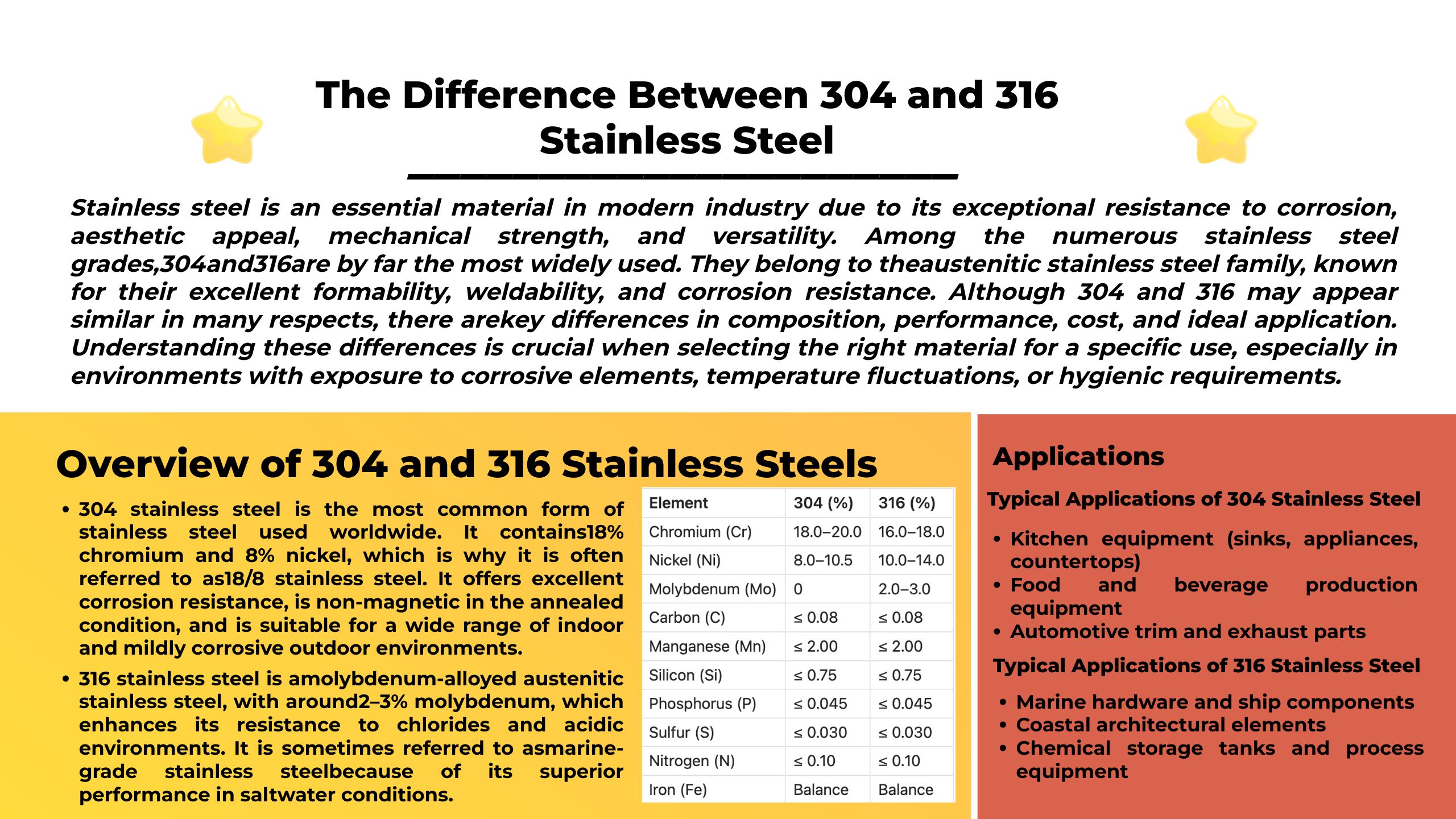
Stainless steel is an essential material in modern industry due to its exceptional resistance to corrosion, aesthetic appeal, mechanical strength, and versatility. Among the numerous stainless steel grades, 304 and 316 are by far the most widely used. They belong to the austenitic stainless steel family, known for their excellent formability, weldability, and corrosion resistance.
Although 304 and 316 may appear similar in many respects, there are key differences in composition, performance, cost, and ideal application. Understanding these differences is crucial when selecting the right material for a specific use, especially in environments with exposure to corrosive elements, temperature fluctuations, or hygienic requirements.
This article provides a detailed comparison between 304 and 316 stainless steels, examining their chemical compositions, mechanical and physical properties, corrosion resistance, fabrication characteristics, cost differences, applications, and more.
1. Overview of 304 and 316 Stainless Steels
What is 304 Stainless Steel?
304 stainless steel is the most common form of stainless steel used worldwide. It contains 18% chromium and 8% nickel, which is why it is often referred to as 18/8 stainless steel. It offers excellent corrosion resistance, is non-magnetic in the annealed condition, and is suitable for a wide range of indoor and mildly corrosive outdoor environments.
UNS designation: S30400
EN/DIN designation: 1.4301
304 Stainless Steel: Everything You Need to Know About
What is 316 Stainless Steel?
316 stainless steel is a molybdenum-alloyed austenitic stainless steel, with around 2–3% molybdenum, which enhances its resistance to chlorides and acidic environments. It is sometimes referred to as marine-grade stainless steel because of its superior performance in saltwater conditions.
UNS designation: S31600
EN/DIN designation: 1.4401
Understanding 316 Stainless Steel: Properties, Applications, and Advantages
2. Chemical Composition
The key difference between 304 and 316 stainless steel lies in their molybdenum content, which significantly affects corrosion resistance and chemical durability.| Element | 304 (%) | 316 (%) |
|---|---|---|
| Chromium (Cr) | 18.0–20.0 | 16.0–18.0 |
| Nickel (Ni) | 8.0–10.5 | 10.0–14.0 |
| Molybdenum (Mo) | 0 | 2.0–3.0 |
| Carbon (C) | ≤ 0.08 | ≤ 0.08 |
| Manganese (Mn) | ≤ 2.00 | ≤ 2.00 |
| Silicon (Si) | ≤ 0.75 | ≤ 0.75 |
| Phosphorus (P) | ≤ 0.045 | ≤ 0.045 |
| Sulfur (S) | ≤ 0.030 | ≤ 0.030 |
| Nitrogen (N) | ≤ 0.10 | ≤ 0.10 |
| Iron (Fe) | Balance | Balance |
3. Mechanical Properties
Both 304 and 316 stainless steels share similar mechanical characteristics, but 316 is slightly stronger and more resilient in elevated temperature and corrosive settings.| Property | 304 Stainless Steel | 316 Stainless Steel |
|---|---|---|
| Density (g/cm³) | 8.00 | 8.00 |
| Tensile Strength (MPa) | 515–750 | 515–750 |
| Yield Strength (0.2% offset, MPa) | ≥ 205 | ≥ 205 |
| Elongation (% in 50 mm) | ≥ 40 | ≥ 40 |
| Hardness (Brinell) | ≤ 201 | ≤ 217 |
| Modulus of Elasticity (GPa) | 193 | 193 |
4. Corrosion Resistance
304 Stainless Steel: General Use
304 stainless steel has excellent corrosion resistance under mildly acidic and atmospheric conditions. It performs well in fresh water, indoor applications, and non-chloride industrial settings.
However, in the presence of chloride ions (like saltwater or de-icing salts), 304 is susceptible to pitting and crevice corrosion. This makes it less suitable for harsh marine or chemical environments.
316 Stainless Steel: Harsh Environments
The molybdenum in 316 stainless steel significantly enhances its corrosion resistance. It resists:
- Pitting corrosion in chloride environments
- Crevice corrosion
- Sulfuric, hydrochloric, acetic, formic, and tartaric acids
Therefore, 316 is preferred for coastal, marine, chemical processing, and high-moisture environments, where 304 would eventually corrode.
5. Applications
Typical Applications of 304 Stainless Steel
- Kitchen equipment (sinks, appliances, countertops)
- Food and beverage production equipment
- Automotive trim and exhaust parts
- Architectural paneling
- Domestic water piping and tubing
- Brewing and dairy industry components
Typical Applications of 316 Stainless Steel
- Marine hardware and ship components
- Coastal architectural elements
- Chemical storage tanks and process equipment
- Oil and gas pipelines
- Pharmaceutical and medical devices
- Water treatment and desalination systems
If salt, chemical exposure, or sterilization is required, 316 is the go-to option.
6. Fabrication and Workability
Both 304 and 316 are easy to fabricate using standard machining and forming techniques. However, due to 316’s higher molybdenum content, it:
- Work-hardens slightly faster
- Requires sharper tools and slower machining speeds
- Is more resistant to galling (adhesive wear)
Welding is straightforward for both, but 316L is often preferred for welded structures to prevent intergranular corrosion due to its lower carbon content.
7. Cost Comparison
One of the most noticeable differences between 304 and 316 is price. Due to the addition of molybdenum and higher nickel content, 316 stainless steel is typically 20–30% more expensive than 304.| Material | Approx. Relative Cost |
|---|---|
| 304 Stainless Steel | Baseline |
| 316 Stainless Steel | 20–30% higher |
8. Variants: 304L vs 316L
The “L” in 304L and 316L stands for “low carbon” (less than 0.03%).
304L
- Better weldability than standard 304
- Lower risk of carbide precipitation
- Suitable for heavy-gauge components
316L
- Preferred for welded chemical processing equipment
- Lower susceptibility to intergranular corrosion
- Better for biomedical implants and marine welds
9. Magnetic Properties
Both 304 and 316 are non-magnetic in the annealed condition. However, cold working (like rolling, forming, or machining) can induce magnetism in both alloys. 316 is generally less magnetic than 304 when cold worked.
10. Appearance and Finishes
Both grades offer similar aesthetic finishes:
- Brushed (No. 4)
- Mirror polished (No. 8)
- Matte or satin
However, due to its higher corrosion resistance, 316 maintains its finish longer in harsh environments.
11. Summary Comparison Table
| Property/Feature | 304 Stainless Steel | 316 Stainless Steel |
|---|---|---|
| Composition | Cr: 18–20%, Ni: 8–10.5% | Cr: 16–18%, Ni: 10–14%, Mo: 2–3% |
| Corrosion Resistance | Good | Excellent (esp. in salt/chloride) |
| Strength | High | Slightly higher |
| Temperature Tolerance | High | Excellent |
| Magnetic Response | Non-magnetic (annealed) | Non-magnetic (annealed) |
| Cost | Lower | Higher |
| Best Use Case | Indoor, food-safe, general use | Marine, chemical, medical use |
| Weldability | Very good | Very good (better with 316L) |
| Durability | High | Very high |
12. Choosing Between 304 and 316
Ask the following questions:- Will the component be exposed to chlorides, saltwater, or harsh chemicals?
- If yes → Choose 316
- Is cost a limiting factor for non-aggressive environments?
- If yes → Choose 304
- Is welding involved?
- Prefer low-carbon variants: 304L or 316L
- Is long-term appearance important (e.g., architecture)?
- 316 resists staining and corrosion better



Conclusion
Both 304 and 316 stainless steels are exceptional materials offering durability, corrosion resistance, and ease of fabrication. While they look and behave similarly under many conditions, the difference lies in the presence of molybdenum in 316, which significantly elevates its corrosion resistance and durability in aggressive environments.
Choosing the right grade depends on the application, environment, and budget. When in doubt, selecting 316 provides an extra margin of safety and performance—especially in marine, chemical, or medical environments.
Understanding these differences ensures optimal material performance, cost-efficiency, and long-term reliability.
Gengfei Provides High Quality 304 and 316 Stainless Steel
Please let us know your procurement requirements, and we will quickly tailor the most competitive quotation for you.
- [email protected]
- +86 19139863252
- Jenny-GFSteel

