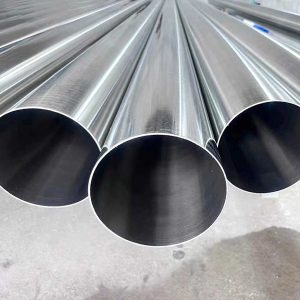
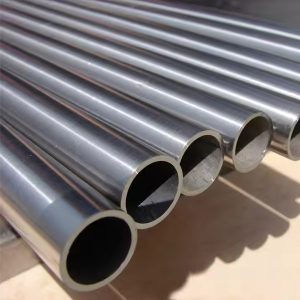
304 stainless steel tubing is the most widely used austenitic stainless tube for general corrosion resistance, good formability, and reliable weldability. In global trade you’ll also see it as:
AISI 304 / UNS S30400
EN 1.4301 / X5CrNi18-10
It’s often called “18/8” because its nominal chemistry is around 18% chromium and 8% nickel, which helps form a stable, corrosion-resistant passive film and an austenitic structure with excellent forming behavior.
1) 304 Tubing vs 304 Pipe (Why the Standard Matters)
In practice:
Tubing is commonly ordered by OD × wall thickness (or sometimes ID × wall), with tighter dimensional focus for heat exchangers, instrumentation, sanitary lines, and mechanical/structural tube.
Pipe is usually ordered by NPS (Nominal Pipe Size) + Schedule, and follows pipe standards (often different from tubing standards).
For buyers, the fastest way to avoid mix-ups is to specify the correct ASTM/EN standard for the end use (general service vs boiler/heat exchanger vs sanitary vs ornamental/structural).
2) Common Standards for 304 Stainless Steel Tubing
Here are the standards most frequently used when someone requests “304 stainless steel tubing”:
ASTM A269 – General Service Tubing (Seamless or Welded) Used for general corrosion-resisting service and low/high temperature service. Typical supplied sizes are ≥ 1/4 in ID and ≥ 0.020 in wall, and the standard includes a clear ordering checklist (grade, OD & wall, length, optional tests, test reports).
ASTM A213 – Boiler / Superheater / Heat Exchanger Tubes (Seamless) For high-temperature/pressure service (heat exchangers, boilers). Covers grades including TP304, and lists typical ranges such as 1/8 in ID to 5 in OD with 0.015–0.500 in wall (unless otherwise ordered).
ASTM A270 – Sanitary Tubing (Seamless, Welded, or Heavily Cold-Worked) Designed for dairy/food service with special surface finish requirements; covers sizes up to 12 in OD and allows specific finishes such as mechanical polishes (No. 80/120/180/240), electropolish, and maximum roughness requirements when ordered.
ASTM A554 – Welded Mechanical Tubing (Ornamental / Structural / Exhaust) For applications where appearance or mechanical performance is needed; covers welded tubing up to 16 in OD and ≥ 0.020 in wall.
EN standard (common in EU / pressure piping projects)
BS EN 10217-7 – Welded Stainless Tubes for Pressure Purposes A recognized pressure-tube route in Europe; the standard has been updated over time (2005 → 2014 → 2021).
3) Typical Chemical Composition (304)
Across widely used references for 304 / 1.4301, typical composition targets are roughly:
Cr ~ 17.5–19.5%
Ni ~ 8.0–10.5%
C ≤ ~0.07% (304)
With controlled Mn/Si/P/S limits depending on the governing spec
Note: exact composition limits and product analysis tolerances depend on the product standard (tubing vs plate vs pipe) and the edition specified.
4) Mechanical & Physical Properties
For annealed 304, common minimum/typical reference values include:
Important buying note: some datasheets clearly state that properties shown for flat rolled products (like ASTM A240) are similar but not necessarily identical to those required for other product forms such as pipe/tube—so always rely on the tube standard + MTR for acceptance.
5) Corrosion Resistance: Where 304 Works (and Where It Doesn’t)
304 has excellent corrosion resistance in many environments, but buyers should watch for chlorides:
Pitting/crevice corrosion can occur in chloride-containing environments, and stress corrosion cracking risk increases at elevated temperatures (e.g., above ~60°C).
For mild chloride exposure, worldstainless notes 1.4301 (304) can suit mild environments (example guidance mentions < 200 ppm chloride for certain mild conditions), while 1.4401 (316) is preferred where chloride is present in the atmosphere.
Practical selection rule
Indoor / mild outdoor / non-salt environments → 304 tubing is usually cost-effective.
304 has good oxidation resistance and is commonly used up to around 870°C in many oxidation-focused applications (application dependent).
304L (low carbon) is often selected when you want improved resistance to sensitization in welding and heavy gauge fabrication.
304H (higher carbon) is used where higher elevated-temperature strength is desired (pressure-containing/high-temperature service), but temperature range and corrosion considerations must be evaluated.
Dual certification warning: It’s common for stock to be “dual certified” 304/304L, but some references caution this may be unacceptable for certain high-temperature applications.
7) Seamless vs Welded 304 Tubing
Seamless 304 tubing
Best when you need:
high pressure capability in many designs
demanding heat exchanger/boiler service (often specified by standard, e.g., A213 is seamless)
Welded 304 tubing
Best when you need:
cost efficiency in larger diameters
sanitary/mechanical tube with controlled weld quality and specified finishes (e.g., A270, A554)
8) Surface Finishes (Especially Important for Sanitary Tubing)
If you’re buying food/dairy/pharma tubing, finish is often as important as chemistry:
ASTM A270 allows specifying finishes such as mill finish, mechanically polished finishes (No. 80/120/180/240), electropolished, and also allows ordering by maximum roughness average requirements
Tip: Always state whether you need ID polish, OD polish, or both, and whether the finish must be measured and reported.
Manufacturing route: Seamless or Welded (and if sanitary: heavily cold-worked welded?)
Size: OD × wall (and tolerance requirement)
Length: random / fixed / cut-to-length
Heat treatment condition (annealed / solution treated per standard)
Test requirements: hydrostatic or NDT electric test, flattening/flaring, etc. (as applicable)
Surface finish (mill/pickled/BA/polished; for A270 specify Ra/finish type)
Documentation: MTR + any third-party inspection needs
Packing: end caps, protective wrap, export seaworthy packaging
FAQ: 304 Stainless Steel Tubing
Is 304 stainless tubing magnetic?
304 is generally considered non-magnetic in typical austenitic condition (though magnetism can vary with processing).
Can 304 be hardened by heat treatment?
304 cannot be hardened by heat treatment; it’s typically solution treated/annealed and rapidly cooled to restore corrosion resistance and ductility.
Which is better for welding: 304 or 304L?
304L is commonly chosen for heavy gauge welding to reduce sensitization risk; 304 has excellent weldability too, and filler selection (e.g., 308/308L family) is common depending on procedure.
When should I choose 316 instead of 304?
When chlorides/salt exposure matters (coastal atmosphere, brines, chlorinated systems), 316 is typically preferred for better chloride resistance.
Buy 304 Stainless Steel Tubing
For projects sourcing 304 stainless tubing internationally, the biggest success factor is aligning standard + finish + test documentation with your end use. If you share your target application (sanitary line, heat exchanger, structural/ornamental tube, instrumentation), GengFei Steel can help match the right standard (A269/A213/A270/A554/EN routes), manufacturing method, and documentation package.
If you want, tell me your application + OD/wall + standard, and I’ll draft a ready-to-send RFQ template and a “what to check on the MTR” checklist specific to that tubing standard.