
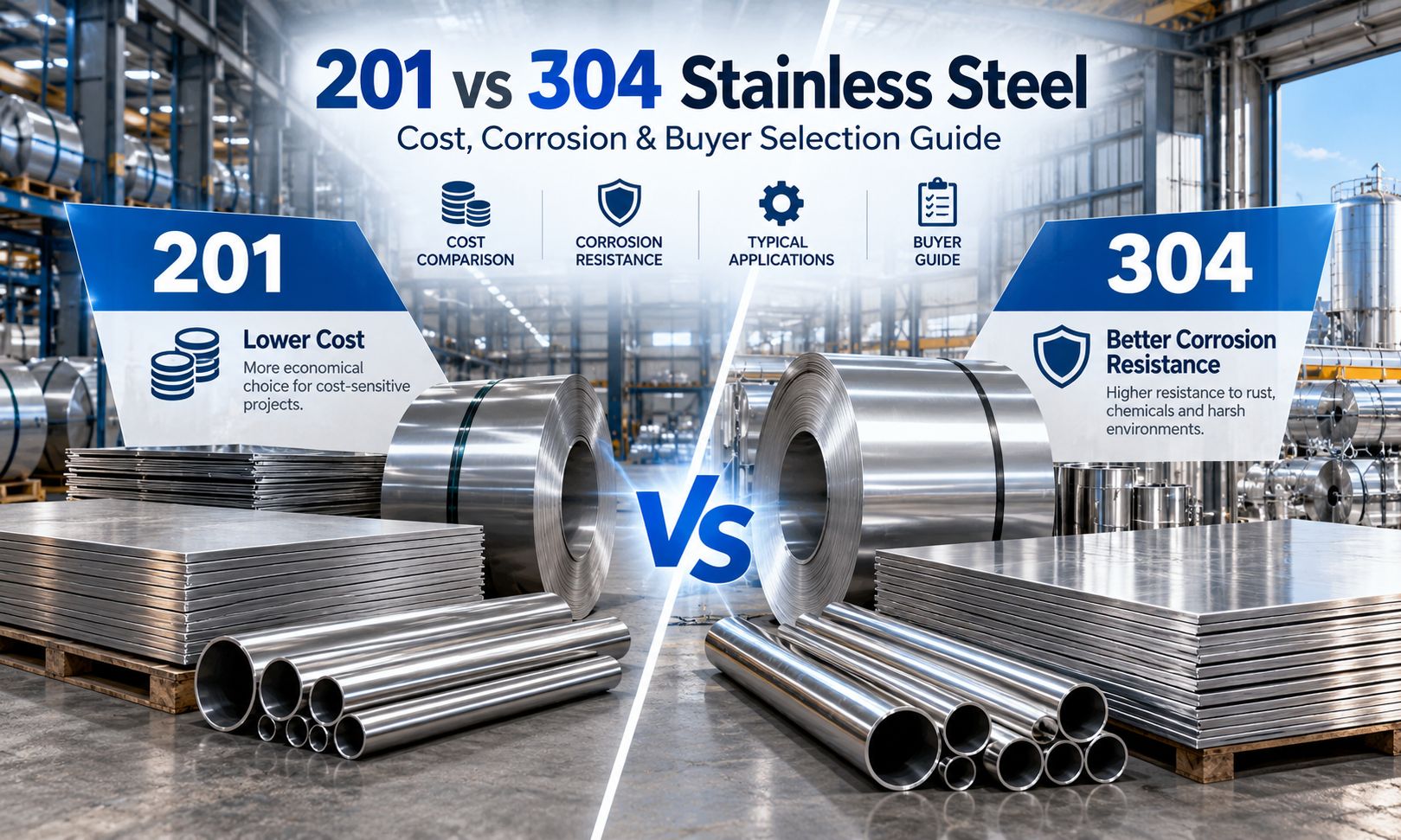
The main difference between 201 and 304 stainless steel is their alloy composition. Grade 201 uses more manganese and less nickel, making it an economical austenitic stainless steel, while 304 contains more chromium and nickel and is widely selected for its corrosion resistance, fabrication performance, and broader range of applications.
For many stainless steel buyers, the decision comes down to one question:
Is the lower initial cost of 201 worth the potential differences in corrosion performance, forming behavior, and long-term service life?
The answer depends on the material specification, operating environment, fabrication process, and expected service life.
Standard 201 stainless steel is not an inferior imitation of 304. It is an established stainless steel grade with useful corrosion resistance, relatively high strength, and a strong work-hardening response.
However, 201 and 304 should not be treated as automatically interchangeable.
For applications involving outdoor exposure, chloride-containing environments, frequent cleaning, complex forming, or strict customer specifications, the additional performance margin and established acceptance of 304 may justify its higher purchase cost.
This guide compares the two grades from an engineering and international purchasing perspective, including how to verify the material before shipment.
201 vs 304 Stainless Steel: Quick Comparison
| Tài sản | Thép không gỉ 201 | Thép không gỉ 304 |
|---|---|---|
| Gia đình thép không gỉ | Austenitic | Austenitic |
| Chỉ định Hoa Kỳ | S20100 | S30400 |
| Common EN reference | 1.4372 | 1.4301 |
| Crom | 16–18% | 18–20% |
| Niken | 3.5–5.5% | 8–10,5% |
| Mangan | 5.5–7.5% | Maximum 2.0% |
| Nitơ | Maximum 0.25% | Maximum 0.10% |
| Carbon | Maximum 0.15% | Maximum 0.08% |
| Relative material cost | Nói chung là thấp hơn | Generally higher |
| Chống ăn mòn chung | Good in suitable environments | Good across a broader range of environments |
| Khả năng chống rỗ | Can approach 304 in certain conditions | Generally offers more corrosion margin |
| Sức mạnh | Often higher in comparable annealed conditions | Lower yield strength in many comparable annealed specifications |
| Work hardening | Mạnh | Moderate to strong |
| Tính định dạng | Good, with processing considerations | Xuất sắc |
| Khả năng hàn | Weldable with appropriate procedures | Xuất sắc |
| Magnetic behavior | Generally low in annealed condition | Generally low in annealed condition |
| Typical applications | Interior decoration, furniture, utensils, selected formed parts | Food equipment, tanks, general fabrication, architecture, piping |
| Main buying advantage | Alloy cost efficiency | Versatility and wider application acceptance |
Chemical values represent commonly specified UNS grades in flat-product comparisons. Exact requirements depend on the governing product standard.
Quick selection: Consider 201 for cost-sensitive products in controlled, mildly corrosive environments when its chemistry and forming behavior meet the specification. Choose 304 when greater corrosion margin, wider fabrication acceptance, or general-purpose versatility is required.
What Is the Difference Between 201 and 304 Stainless Steel?
Both 201 and 304 are members of the austenitic stainless steel family.
Austenitic stainless steels generally provide a useful combination of corrosion resistance, toughness, and cold-forming capability.
The difference is how the austenitic structure is achieved through alloying.
Thép không gỉ 201
Grade 201 belongs to the 200 series of stainless steels.
Its alloy design uses higher manganese and nitrogen to replace part of the nickel traditionally used in chromium-nickel austenitic stainless steels.
This approach can reduce alloy cost while maintaining an austenitic microstructure.
Standard 201 is commonly used for:
- Stainless steel coil and strip
- Interior decorative sheet
- Dụng cụ nhà bếp
- Furniture components
- Automotive trim
- Thiết bị gia dụng
- Selected manufactured components
The combination of manganese and nitrogen also contributes to its relatively high strength and work-hardening behavior.
Thép không gỉ 304
Grade 304 is one of the most widely used austenitic stainless steels.
It has a conventional chromium-nickel alloy composition, commonly described as 18/8 stainless steel.
Its advantages include:
- Broad general corrosion resistance
- Khả năng định hình tuyệt vời
- Good toughness
- Khả năng hàn tuyệt vời
- Wide product availability
- Established international specifications
304 is widely used in food processing, industrial equipment, tanks, architecture, and general manufacturing.
For more background, read our 304 Stainless Steel Properties and Applications Guide.
201 vs 304 Chemical Composition
The chemical composition is the foundation of the differences between these two grades.
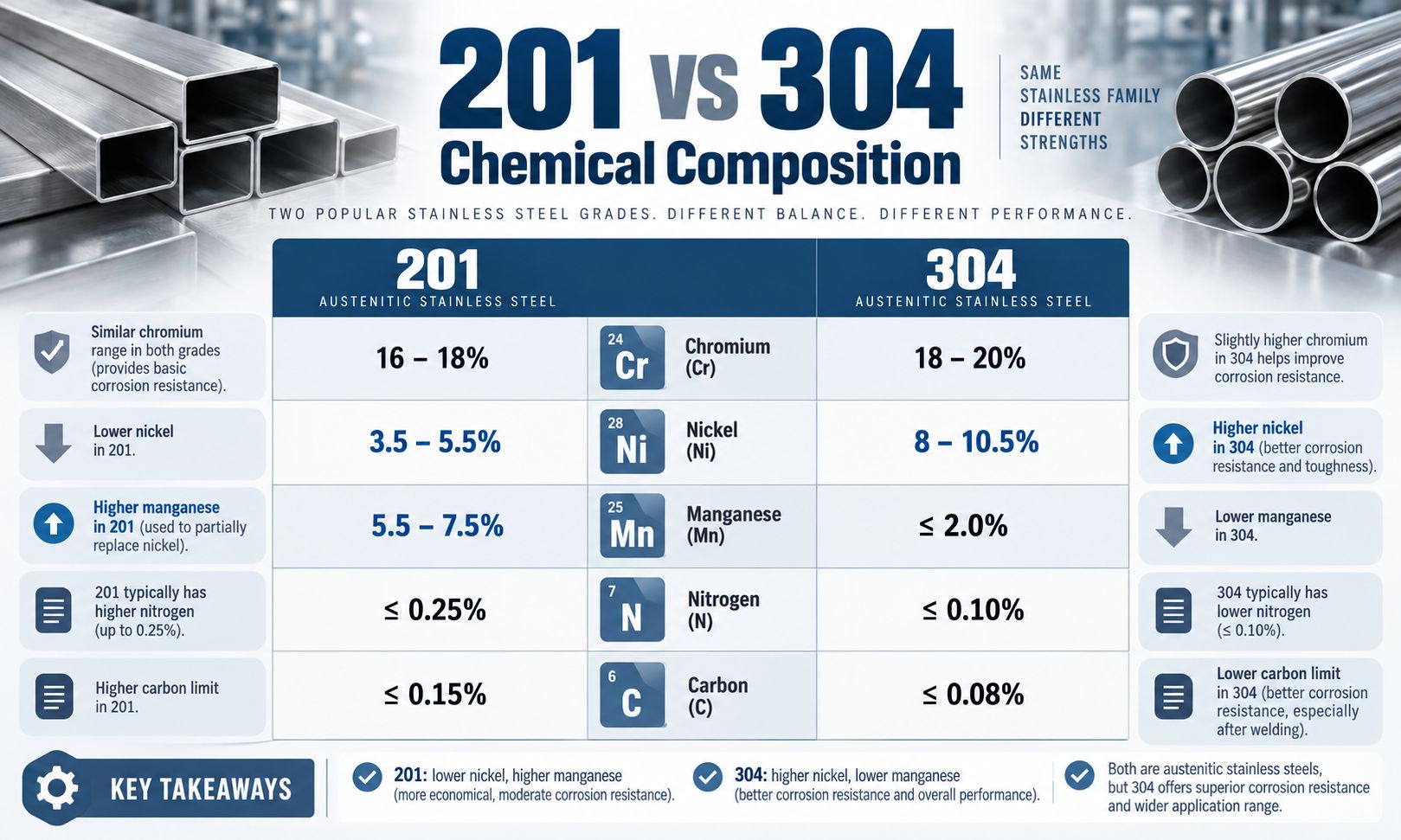
So sánh thành phần hóa học
| Yếu tố | 201 / UNS S20100 | 304 / UNS S30400 | Main Significance |
|---|---|---|---|
| Crom (CR) | 16.0 –18.0% | 18.0 …20.0% | Màng thụ động và khả năng chống ăn mòn |
| Niken (NI) | 3.5–5.5% | 8.0–10,5% | Austenite stability and toughness |
| Mangan (MN) | 5.5–7.5% | ≤2.0% | Austenite stabilization and alloy balance |
| Nitơ (N) | ≤0.25% | ≤0.10% | Strength and microstructure |
| Carbon (c) | ≤0.15% | ≤0,08% | Strength, carbide precipitation |
| Silicon (SI) | ≤0.75% | ≤0.75% | Hành vi luyện thép và oxy hóa |
| Phốt pho (P) | ≤0.060% | ≤0.045% | Controlled residual element |
| Lưu huỳnh | .030,030% | .030,030% | Controlled residual element |
| Sắt (Fe) | Sự cân bằng | Sự cân bằng | Kim loại cơ bản |
Composition basis: commonly specified ASTM-type 201 and 304 stainless steels. Check the applicable edition of the actual material standard for contractual limits.
Chromium: Why Does 304 Generally Offer More Corrosion Margin?
Chromium forms the thin passive film that protects stainless steel from corrosion.
304 generally contains more chromium than standard 201.
This contributes to its broader corrosion resistance, although actual performance also depends on nitrogen, nickel, other alloying elements, surface condition, and the surrounding environment.
It would be incorrect to say that standard 201 has no meaningful corrosion resistance. Properly specified 201 can perform well in many suitable environments.
Nickel: The Main Cost Driver
Nickel is an important element in austenitic stainless steel.
Because nickel is an expensive alloying material, reducing nickel content can provide a significant cost advantage.
Standard 201 typically contains 3.5–5.5% nickel, compared with approximately 8.0–10.5% in 304.
However, nickel content alone does not define corrosion performance. It also contributes to the stability of the austenitic structure and influences material behavior.
Manganese: How 201 Reduces Nickel Dependence
201 uses considerably more manganese than 304.
Manganese helps stabilize the austenitic structure in combination with nitrogen and the remaining nickel.
This makes 201 an economical alternative for appropriately selected applications.
However, higher manganese content changes the metallurgy and processing behavior. It does not mean that 201 is simply a cheaper version of 304 with identical properties.
Nitrogen: Strength and Work Hardening
Nitrogen is particularly important in 201 stainless steel.
It helps stabilize austenite and contributes to higher strength.
Together with the alloy’s microstructure, nitrogen helps explain why 201 can have higher yield strength and a stronger work-hardening response than 304.
These differences can be beneficial in some components but may require adjustments in forming operations.
201 vs 304 Corrosion Resistance: Does 201 Rust Faster?
This is one of the most important questions for stainless steel buyers.
304 generally offers a broader corrosion-resistance margin, but it is not accurate to claim that every standard 201 product will rust quickly or that 304 can never rust.
Actual performance depends on the selected alloy, environment, surface finish, fabrication, and maintenance.
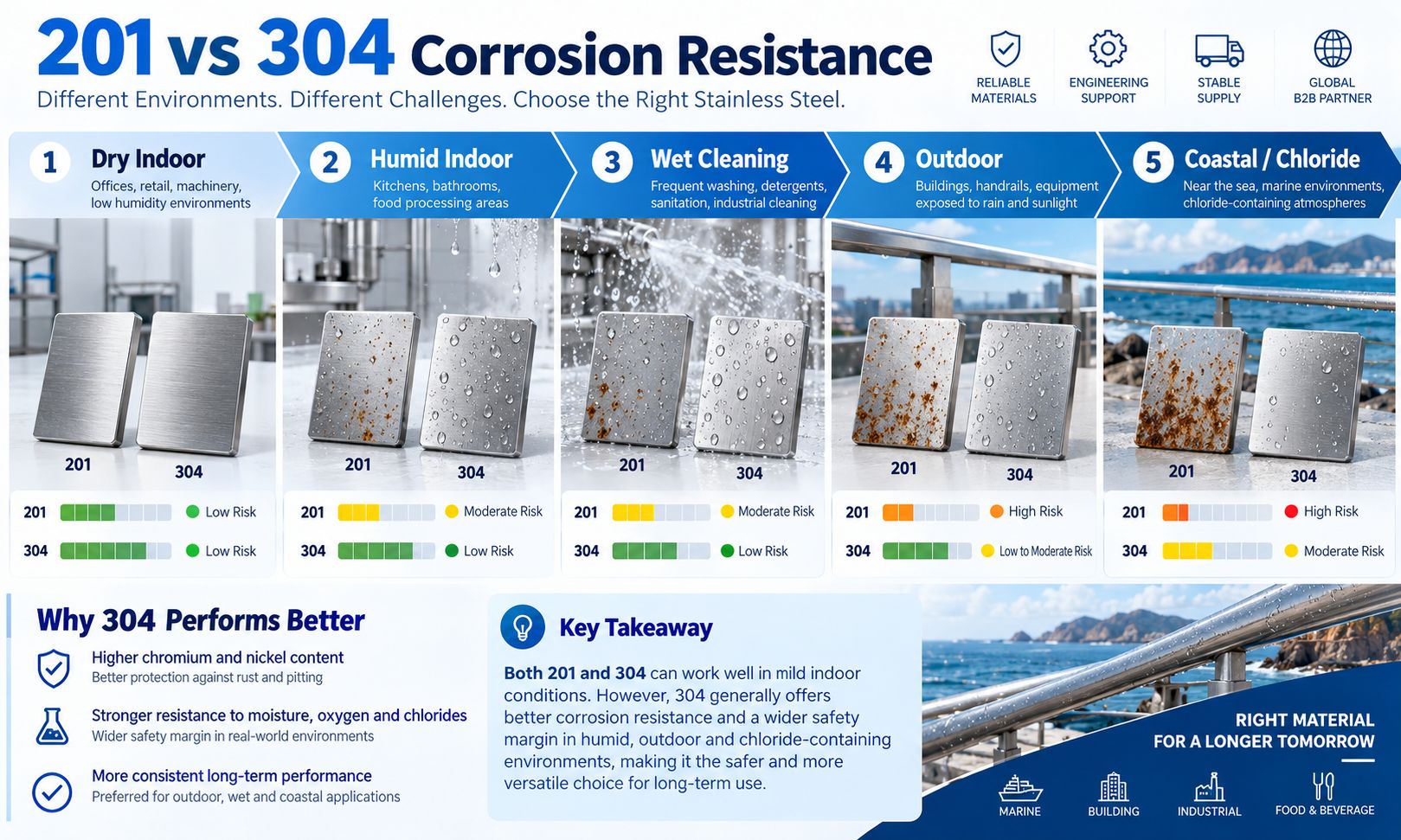
Illustrative comparison of potential corrosion exposure. The surfaces and risk indicators are not results from a standardized salt-spray or immersion test.
Dry Indoor Environments
Examples include:
- Furniture frames
- Tấm trang trí nội thất
- Office equipment
- Retail fixtures
- Kệ
- Indoor trim
These environments generally have relatively low corrosion demands.
201 can be a suitable and economical material when its properties satisfy the project specification.
304 also performs well but may add cost without providing a necessary benefit.
Humid Indoor Environments
Examples include:
- Bathrooms
- Kitchens
- Laundry areas
- Humid workshops
- Indoor facilities with condensation
Moisture and condensation make corrosion conditions more demanding.
201 may remain suitable in some applications, but the frequency and duration of moisture exposure should be considered.
304 is often a more conservative choice when long service life and consistent appearance matter.
Frequent Wet Cleaning
Applications subjected to repeated washing or cleaning deserve special attention.
Factors include:
- Water chemistry
- Cleaning agents
- nồng độ clorua
- Cleaning temperature
- Thời gian làm ướt
- Bề mặt hoàn thiện
- Drainage
The term frequent cleaning does not automatically require 304, but it increases the importance of confirming the grade’s chemical compatibility.
For hygienic industrial equipment, 304 is widely specified because of its established fabrication and corrosion performance.
Outdoor Environments
Outdoor stainless steel may be exposed to:
- Rainwater
- Condensation
- Atmospheric pollutants
- Surface deposits
- Temperature variation
- Cleaning chemicals
304 is commonly preferred for general outdoor applications where greater corrosion margin is required.
However, local conditions still matter.
An outdoor installation in a clean, low-chloride environment is very different from one beside a coastal highway or industrial chemical plant.
Coastal and Chloride-Containing Environments
Chloride exposure can increase the risk of localized corrosion.
Important factors include:
- Salt deposition
- nồng độ clorua
- Nhiệt độ
- Tình trạng bề mặt
- Hình học kẽ hở
- BẢO TRÌ
- Time of wetness
For demanding coastal applications, neither 201 nor 304 should be specified solely because the material is described as stainless steel.
A more highly alloyed stainless steel such as 316 or 316L may be needed.
For continuous seawater immersion or severe chloride service, even 316L may require further evaluation against duplex or higher-alloy alternatives.
Xem của chúng tôi 304 vs 316 Stainless Steel Comparison for more information.
Practical Corrosion Environment Matrix
| Môi trường | 201 | 304 | Buying Consideration |
|---|---|---|---|
| Dry indoor decoration | Often suitable | Thích hợp | 201 may reduce cost |
| Indoor furniture | Often suitable | Thích hợp | Consider forming and appearance |
| Mild indoor humidity | Đánh giá | Common choice | Check moisture exposure |
| Frequent wet cleaning | Evaluate carefully | Thường được ưu tiên | Review cleaning chemistry |
| General outdoor atmosphere | Application dependent | Commonly preferred | Consider deposits and maintenance |
| Coastal salt deposits | Requires careful validation | Also requires evaluation | 316-family upgrade may be necessary |
| Ngâm nước biển liên tục | Not a default choice | Not a default choice | Evaluate higher-alloy materials |
| Aggressive chemical service | Requires compatibility assessment | Requires compatibility assessment | Select by actual chemistry |
This table provides initial guidance rather than a guaranteed prediction of corrosion performance.
Is 201 Stainless Steel Lower Quality Than 304?
Không nhất thiết.
This is a common misunderstanding.
Standard 201 stainless steel is a recognized alloy, not a counterfeit material.
It has its own chemical composition, mechanical characteristics, and appropriate applications.
In some nonaggressive environments, properly specified 201 can offer corrosion resistance approaching 304.
It can also provide higher yield strength and a stronger work-hardening response.
The real problem occurs when a material is supplied under an inaccurate or incomplete designation.
Examples include:
- An unspecified low-nickel material sold simply as “201”
- Material that does not meet the requested grade specification
- 201 supplied when the customer ordered 304
- Incorrect or mismatched MTC documentation
- Commercial grade variants treated as standard 201 without verification
The engineering question is therefore not whether 201 is “real stainless steel.”
It is whether the material complies with the correct standard and meets the project’s performance requirements.
201 vs 304 Mechanical Properties
The mechanical properties of stainless steel depend on:
- Chemical composition
- Tiêu chuẩn sản phẩm
- Xử lý nhiệt
- Gia công nguội
- Độ dày
- Tính khí
- Lộ trình sản xuất
In comparable annealed conditions, 201 generally has higher yield strength than 304.
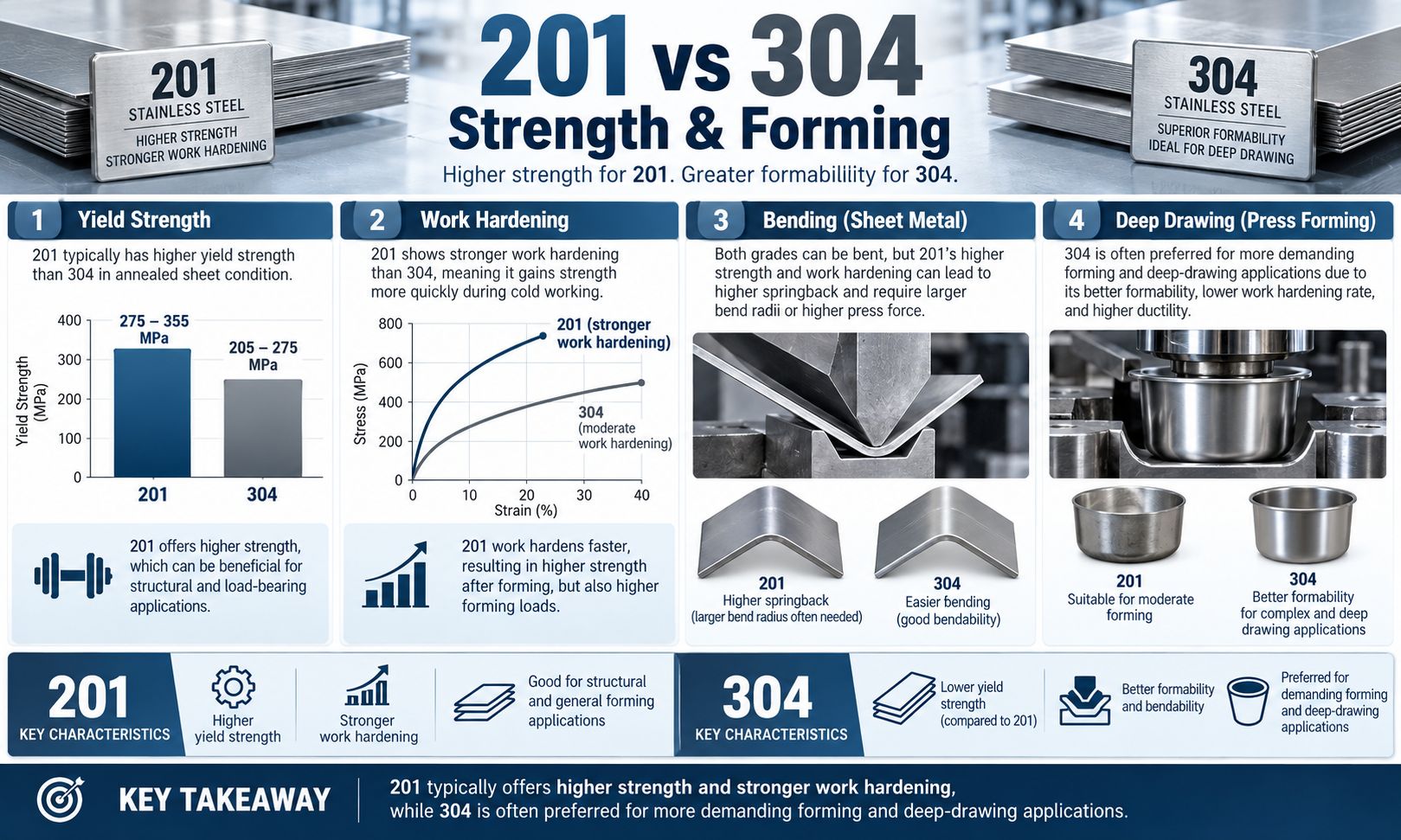
The graph and forming illustrations show general trends, not certified material properties or measured stress-strain curves.
Mechanical Property Comparison
| Tài sản | 201 | 304 |
|---|---|---|
| Yield strength in comparable annealed conditions | Generally higher | Nói chung là thấp hơn |
| Độ bền kéo | Cao | Cao |
| độ dẻo | Tốt | Xuất sắc |
| Work-hardening response | Mạnh | Moderate to strong |
| Cold-forming behavior | Good, but process-sensitive | Widely established |
| Vẽ sâu | Possible with appropriate process design | Widely used |
| Hardening by heat treatment | Not normally used | Not normally used |
| Strength increase by cold working | Đúng | Đúng |
As an example of the effect of grade specifications, BSSA reports minimum 0.2% proof strengths of approximately 350 MPa for 201 and 230 MPa for 304 in its comparative material reference.
These are standard-dependent values, not universal measured strengths of every product.
For purchasing, compare the mechanical-property requirements in the same product standard and delivery condition.
Why Can 201 Be Stronger Than 304?
The higher nitrogen content and alloy design of 201 can increase strength.
This may provide advantages when:
- Material strength is important
- Component thickness is being optimized
- Cold working is part of manufacturing
- Structural performance must be balanced against material cost
However, greater strength can also require higher forming loads.
Does Higher Strength Mean Better Material?
KHÔNG.
Higher yield strength is not automatically better for every component.
For example, a material that requires more force to bend or exhibits greater springback may increase manufacturing difficulty.
A lower-strength material with favorable ductility can be more economical for complex forming.
The best choice depends on the actual product design.
201 vs 304 Work Hardening
Both 201 and 304 are austenitic stainless steels that can strengthen during cold working.
201 generally has a stronger work-hardening response.
This means that as it is plastically deformed, its resistance to further deformation can increase rapidly.
Advantages of Strong Work Hardening
Potential benefits include:
- Increased strength after forming
- High final component strength
- Useful performance in selected cold-worked products
Manufacturing Challenges
Potential challenges include:
- Higher press forces
- More springback
- Increased tooling loads
- Different forming limits
- Greater difficulty maintaining tight dimensions
This is why material substitution should be reviewed with the manufacturing team rather than decided purely on material price.
201 vs 304 Formability, Bending and Deep Drawing
Sheet Metal Bending
Both grades can be bent.
However, 201 may require different process settings because of its higher strength and work-hardening characteristics.
Important parameters include:
- Bend radius
- Sheet thickness
- Grain direction
- Tooling
- Press capacity
- Springback allowance
Dập
201 and 304 are both used in stamped components.
For high-volume production, differences in forming force, tooling wear, springback, and scrap rate can affect the total production cost.
Vẽ sâu
304 is widely used for demanding drawing operations.
Examples include:
- Deep kitchen sinks
- Container
- Food-processing components
- Complex housings
201 can also be used for drawing, but its stronger work-hardening behavior can require different tooling, lubrication, forming stages, or material condition.
For a difficult drawing application, actual forming trials are more reliable than assuming that either grade will behave identically.
201 vs 304 Welding
Both 201 and 304 can be welded using suitable stainless steel welding processes.
These may include:
- GTAW / TIG
- GMAW / MIG
- SMAW
- Resistance welding
- Other qualified methods
However, the exact welding procedure should depend on the material composition and application.
Welding 201 Stainless Steel
When welding 201, important considerations include:
- Exact alloy chemistry
- Filler-metal compatibility
- Đầu vào nhiệt
- Joint design
- Rủi ro nhạy cảm
- Weld-zone corrosion
- Required mechanical properties
Because 201 has a different Cr-Ni-Mn-N chemistry from 304, welding procedures should not be transferred without evaluation.
Welding 304 Stainless Steel
304 has a long-established welding history and is widely used in industrial fabrication.
Where extensive welding and post-weld corrosion resistance are important, lower-carbon 304L may be selected.
For more information, see 304 vs 304L Stainless Steel: Differences, Welding & When to Use Each.
Can 201 and 304 Be Welded Together?
Potentially, yes.
However, dissimilar-grade welding should be evaluated according to:
- Base-metal compositions
- Kim loại phụ
- Joint design
- Yêu cầu cơ khí
- Môi trường ăn mòn
- Qualified welding procedure
The materials should not be treated as automatically interchangeable in a code-controlled welded assembly.
201 vs 304 Stainless Steel Cost
For many buyers, cost is the reason they first compare these grades.
201 generally has a lower initial alloy cost because its composition reduces reliance on nickel.
However, material purchase price is only one part of the total cost of a stainless steel component.
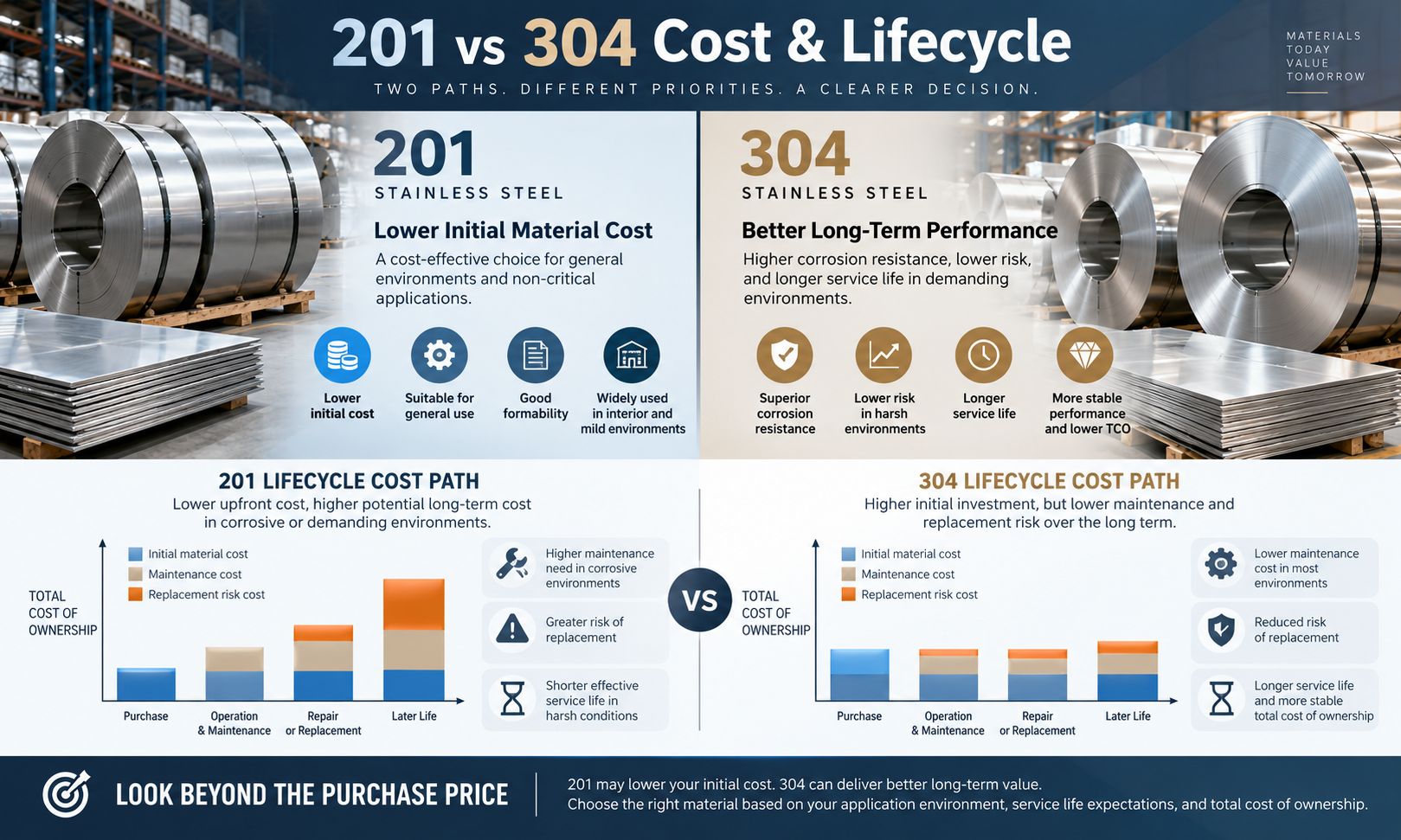
Conceptual cost comparison only. It does not represent actual market prices or a guaranteed service-life advantage.
Why Is 201 Generally Cheaper?
The main explanation is its lower nickel content.
Stainless steel pricing is influenced by:
- Nickel market price
- Chromium and other alloy costs
- Nhà máy thép
- Production volume
- Product dimensions
- Bề mặt hoàn thiện
- Lộ trình sản xuất
- sẵn có
- Số lượng đặt hàng
- Freight and logistics
Because these variables change, there is no reliable universal percentage by which 201 is always cheaper than 304.
For example, prices for decorative strip, wide coil, welded tube, and polished sheet may differ significantly even when the grades are the same.
Initial Price vs Total Cost of Ownership
An international buyer should consider:
Total Cost of Ownership = Purchase Cost + Fabrication Cost + Maintenance Cost + Expected Repair or Replacement Cost
The important question is whether the material savings are large enough to justify any difference in processing cost or service risk.
Illustrative Cost Comparison
The following table is a hypothetical calculation using arbitrary cost units, not a market quotation, forecast, or expected failure rate.
| Cost Component | 201: Mild Indoor Use | 304: Mild Indoor Use | 201: Demanding Exposure | 304: Demanding Exposure |
|---|---|---|---|---|
| Material purchase | 100 | 125 | 100 | 125 |
| Sự chế tạo | 20 | 20 | 20 | 20 |
| BẢO TRÌ | 5 | 5 | 25 | 8 |
| Repair/replacement allowance | 0 | 0 | 45 | 0 |
| Illustrative total | 125 | 150 | 190 | 153 |
The example demonstrates two possible outcomes.
In a mild environment, 201 may remain the economical choice if both grades meet the service requirements.
In a more demanding environment, higher maintenance or replacement costs could eliminate the initial saving.
The values are not intended to predict actual corrosion failures. A real lifecycle comparison requires project-specific service data.
When Does 201 Offer Better Value?
201 can be economically attractive when:
- The environment is mild
- The specified design life is achievable
- The application is not corrosion critical
- Its forming behavior is acceptable
- Maintenance requirements are low
- The customer permits the grade
- Material traceability is available
Ví dụ có thể bao gồm:
- Indoor furniture
- Decorative trim
- Kệ
- Certain appliance components
- Selected kitchen utensils
- Interior architectural products
In these conditions, paying extra for 304 may not always produce enough additional value to justify the cost.
When Is 304 Worth the Higher Price?
304 may justify its additional material cost when:
- The environment is more demanding
- Corrosion resistance is important
- Long-term appearance matters
- Frequent wet cleaning is expected
- Complex forming is required
- The project specifies 304
- Replacement is costly
- Warranty and customer acceptance are important
Các ứng dụng điển hình bao gồm:
- Food-processing machinery
- Industrial tanks
- General process equipment
- Architectural components
- Welded assemblies
- Equipment requiring established stainless material specifications
Can 201 Replace 304 Stainless Steel?
Sometimes, but 201 should never be substituted for 304 without confirming the applicable design, performance, and purchasing requirements.
A material substitution should be evaluated through several questions.
1. Does the Customer Specification Permit Substitution?
If a drawing or purchase order explicitly specifies 304, the supplier should not substitute 201 without approval.
Lower purchase cost does not override the specified grade.
2. Is Corrosion Resistance Adequate?
Review:
- Độ ẩm
- Nhiệt độ
- clorua
- Hóa chất
- Cleaning agents
- Environmental exposure
- Expected service life
3. Are Mechanical Properties Acceptable?
Higher strength is not always an advantage.
Forming forces, springback, dimensional accuracy, and fatigue requirements may also matter.
4. Is the Product Heavily Formed?
For complex forming, a change in work-hardening response can affect:
- Tooling
- Production settings
- Rejection rates
- Finished dimensions
5. Is Welding Required?
Review filler metal, welding procedure, sensitization risk, and final corrosion requirements.
6. Are There Regulatory or Industry Requirements?
Food contact, sanitary equipment, pressure systems, and other regulated applications may have specific requirements.
The final choice must satisfy those requirements rather than rely on a generic statement that both materials are stainless steel.
Is All 201 Stainless Steel the Same?
KHÔNG.
This is particularly important for buyers sourcing stainless steel from international suppliers.
Standard 201 / UNS S20100 is a defined stainless steel grade.
However, some markets also use commercial names such as:
- 201 J1
- 201 J2
- 201 J3
- 201 J4
- Other low-nickel 200-series trade designations
These designations may refer to different commercial compositions or processing characteristics.
They should not automatically be assumed to meet standard UNS S20100 chemistry.
Standard Grade vs Commercial Designation
| Nhân tố | Standard 201 / UNS S20100 | Commercial 201-Type Material |
|---|---|---|
| Chemical composition | Defined by applicable specification | Must be confirmed from actual specification |
| Grade identification | Recognized standard designation | May use mill or market terminology |
| Chromium content | Defined range | Can vary |
| Nickel content | Defined range | Can vary |
| Yêu cầu cơ khí | Follow governing standard | Require documented values |
| Material substitution | Engineering approval may still be needed | Additional verification often necessary |
| Recommended verification | MTC + traceability + testing as required | Full chemistry and specification verification |
The existence of a commercial designation does not automatically mean the material is unsuitable.
It means the buyer should not infer a standardized chemical composition from the trade name alone.
Why Does This Matter?
Two products may both be marketed under a familiar commercial stainless steel name but have different:
- Chromium content
- Nickel content
- Manganese content
- Nitrogen content
- Corrosion behavior
- Tính chất cơ học
The buyer needs to identify the actual material—not rely solely on a sales description.
How to Identify 201 vs 304 Stainless Steel
201 and 304 can look almost identical.
A bright finish, brushed surface, or mirror polish is not proof of grade.
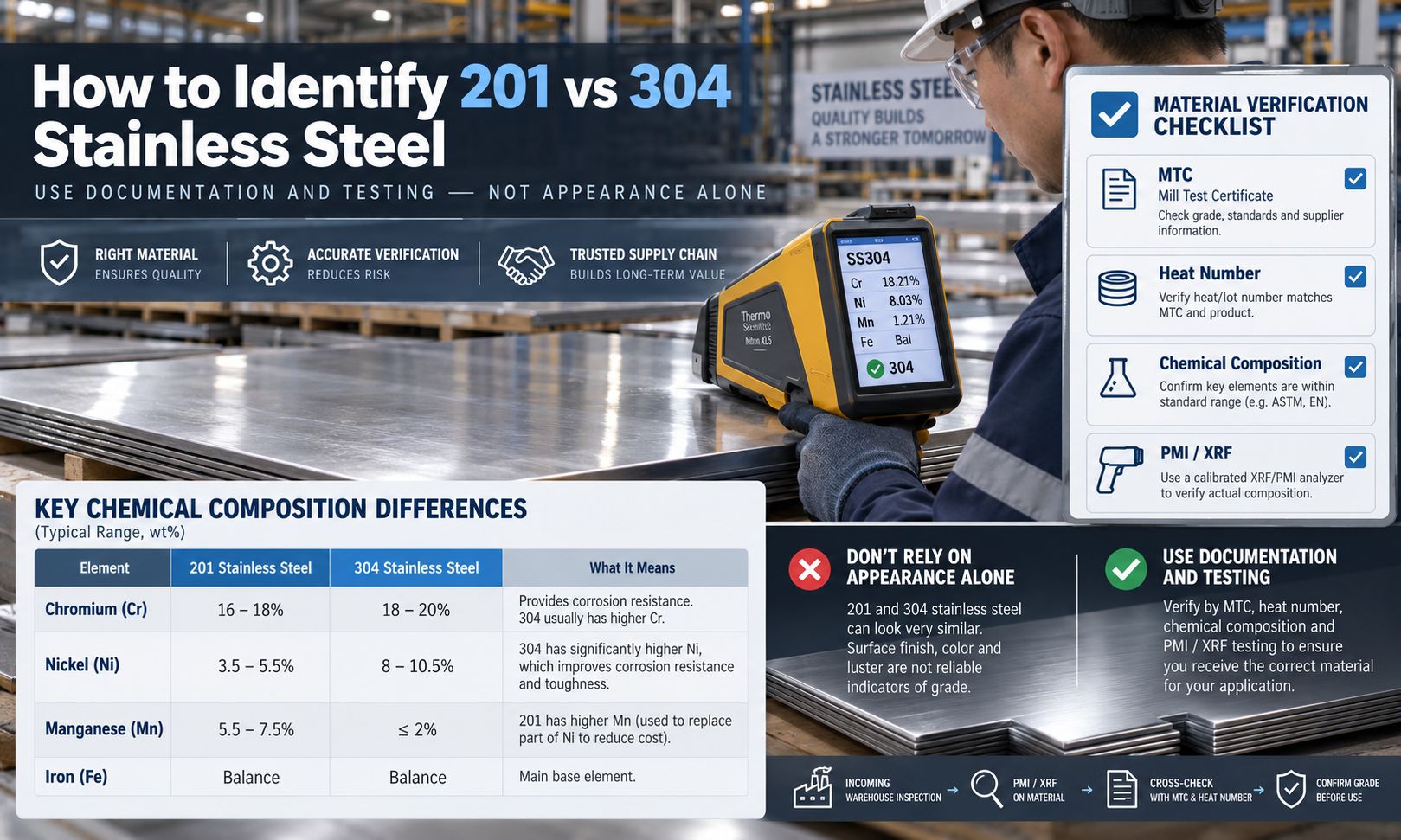
The analyzer display and composition values in the illustration are examples, not actual Gengfei inspection results or certification.
Method 1: Check the Mill Test Certificate
The MTC should identify the material and provide traceable test information.
Important fields include:
- Cấp
- Chỉ định Hoa Kỳ
- Applicable product standard
- Heat number
- Chemical composition
- Tính chất cơ học
- Tình trạng vật chất
- Product dimensions
Check that the chemical composition actually meets the specified grade limits.
Method 2: Verify the Heat Number
The heat number connects a product to a steelmaking heat.
For traceable industrial supply, the heat number should be consistent across applicable:
- Đánh dấu vật liệu
- MTC
- Packing or inspection documentation
- Test records
A certificate that cannot be reliably linked to the delivered material provides weaker verification.
Method 3: Use PMI / XRF Testing
Positive Material Identification (PMI) can help verify alloy composition.
Handheld XRF instruments are commonly used to identify major alloying elements such as:
- Crom
- Niken
- Mangan
Because 201 and 304 have significantly different nickel and manganese ranges, XRF can be useful for differentiating them.
However, successful verification depends on the analyzer’s calibration, test conditions, surface preparation, and the chemistry being measured.
Method 4: Laboratory Chemical Analysis
For more demanding or disputed cases, laboratory testing can provide a more comprehensive analysis.
Depending on the requirement, methods may include:
- Quang phổ phát xạ quang học (OES)
- Other appropriate chemical-analysis methods
- Independent laboratory inspection
The chosen method should be suitable for the elements and accuracy required.
Can a Magnet Distinguish 201 from 304?
KHÔNG.
Both grades are austenitic stainless steels.
Their magnetic behavior can vary with:
- Gia công nguội
- Tình trạng vật chất
- Deformation
- Cấu trúc vi mô
A magnet cannot reliably establish whether a product is 201 or 304.
Can Appearance or Color Identify the Grade?
KHÔNG.
Both grades can be supplied with finishes such as:
- 2b
- BA
- Số 4
- Đường chân tóc
- Gương
The appearance depends heavily on the surface finish and processing.
Visual inspection is useful for checking surface defects, but not for certifying the alloy grade.
What About Stainless Steel Identification Liquids?
Some commercially available chemical identification solutions are marketed for distinguishing common stainless grades.
They may provide preliminary screening, but results depend on reagent chemistry, use conditions, and interpretation.
They should not replace appropriate testing and material documentation when grade verification is contractually important.
Material Verification Checklist for International Buyers
| Verification Item | What to Check | Why It Matters |
|---|---|---|
| Cấp | 201 / S20100 or 304 / S30400 | Identifies intended alloy |
| Tiêu chuẩn | ASTM / EN / JIS / GB specification | Establishes required properties |
| Heat number | Matches delivered material | Truy xuất nguồn gốc |
| Crom | Meets grade requirement | Corrosion-related alloy content |
| Niken | Correct range | Differentiates 201 and 304 |
| Mangan | Correct range | Differentiates 201 and 304 |
| Nitơ | Meets specification | Mechanical and metallurgical compliance |
| Mechanical results | Yield, tensile, elongation | Structural/fabrication requirements |
| Bề mặt hoàn thiện | Matches purchase order | Appearance and processing |
| Kích thước | Thickness, width, length, diameter | Product conformity |
| PMI | Used where required | Independent alloy verification |
| Kiểm tra của bên thứ ba | If specified | Additional purchasing assurance |
For critical projects, specify the inspection and acceptance requirements before production or shipment.
201 vs 304 by Product Form
Material selection should also consider the product being purchased.
For example, a stainless steel decorative coil and a welded industrial tank have different manufacturing and service requirements.
201 vs 304 Stainless Steel Sheet
Both grades are used in sheet products.
201 sheet may be selected for:
- Indoor decorative panels
- Nội thất
- Appliance components
- Tấm tường
- Noncritical fabricated products
304 sheet is widely used for:
- Thiết bị thực phẩm
- Industrial enclosures
- Xe tăng
- General architectural fabrication
- More demanding wet-service components
The decision should consider the environment, surface finish, mechanical properties, and forming requirements.
Explore our Stainless Steel Sheet Product Range.
201 vs 304 Stainless Steel Coil
Coil is one of the most commercially important forms for both grades.
201 coil is commonly evaluated where customers need economical material for:
- tạo hình cuộn
- Dập
- Decorative production
- Furniture manufacturing
- Appliance components
304 coil is widely used in:
- Thiết bị thực phẩm
- Industrial manufacturing
- Tubing production
- More demanding fabricated components
Coil purchasing requirements commonly include:
- Cấp
- Độ dày
- Chiều rộng
- Coil inside diameter
- Trọng lượng cuộn
- Bề mặt hoàn thiện
- Edge condition
- Dung sai độ dày
Xem của chúng tôi Cuộn dây thép không gỉ 201 product page.
201 vs 304 Stainless Steel Strip
Precision strip applications require additional attention to:
- Tính khí
- Dung sai độ dày
- Edge condition
- Độ phẳng
- Forming behavior
- Springback
201 may provide useful strength and cost advantages in selected applications.
304 is widely used when broader corrosion compatibility and established forming performance are priorities.
For more information, see our Dải thép không gỉ products.
201 vs 304 Stainless Steel Pipe and Tube
201 tube is commonly associated with decorative and general structural applications.
Examples include:
- Furniture frames
- Indoor handrails
- Ống trang trí
- Fixtures
- Selected noncritical structures
304 pipe and tube are widely used in applications where broader corrosion resistance is important.
Examples include:
- General process piping
- Thiết bị chế biến thực phẩm
- Xe tăng
- Industrial systems
- Ống cơ khí
For fluid service, purchasers must additionally consider the relevant pressure rating, pipe or tube standard, joining method, and corrosion requirements.
Relevant products include 201 ống thép không gỉ Và Ống thép không gỉ 304.
201 vs 304 Stainless Steel Bar
Bar products are used in machined and fabricated components.
For bar selection, compare:
- Diameter tolerance
- Tình trạng vật chất
- Yield and tensile strength
- Khả năng gia công
- Tình trạng bề mặt
- Corrosion requirements
- Final component use
Different grades and tempers can require different machining settings.
Xem của chúng tôi Stainless Steel Bar Range.
201 vs 304 Stainless Steel Applications
The following table provides a practical first-stage selection guide.
| Ứng dụng | Grade Commonly Considered | Main Selection Factor |
|---|---|---|
| Indoor decorative sheet | 201 / 304 | Budget, finish, specified chemistry |
| Furniture frames | 201 / 304 | Cost, strength, fabrication |
| Indoor railings | 201 / 304 | Humidity, cleaning, appearance |
| Elevator decorative panels | 201 / 304 | Environment, surface finish, maintenance |
| Dụng cụ nhà bếp | 201 / 304 | Product design, food-contact requirements |
| Bồn rửa nhà bếp | 201 / 304 | Formability, corrosion and cleaning chemistry |
| Thiết bị chế biến thực phẩm | 304 commonly selected | Corrosion, hygiene, fabrication requirements |
| General industrial tanks | 304 / 304L | Environment and welding |
| Outdoor architecture | 304 commonly considered | Exposure and maintenance |
| Coastal installations | Higher-alloy evaluation may be needed | Chlorides, deposits, temperature |
| Thiết bị hóa chất | Application-specific | Chemical compatibility |
| Thiết bị nước biển | Higher-alloy engineering selection | Localized corrosion risk |
These are general selection directions, not universal grade approvals.
201 vs 304 for Kitchen Equipment
Both grades can be used in certain kitchen-related products, but the requirements differ substantially between applications.
Ví dụ:
A decorative kitchen panel may prioritize appearance, cost, and ease of cleaning.
A commercial food-processing tank may require stricter corrosion resistance, fabrication controls, weld quality, and material documentation.
A kitchen sink may require excellent deep-drawing behavior, resistance to water and cleaning chemicals, and a durable surface finish.
304 is a common choice for many demanding kitchen and food-equipment applications.
However, standard 201 is also used in utensils and selected catering products.
Material suitability should be evaluated against the specific product and applicable food-contact requirements rather than assuming either grade automatically qualifies for every application.
Is 201 Stainless Steel Food Grade?
The phrase food grade stainless steel is not one universal metallurgical grade designation.
A food-contact material must satisfy the applicable regulatory and technical requirements for its intended use.
These may concern:
- Material composition
- Kháng ăn mòn
- Bề mặt hoàn thiện
- Cleanability
- Chemical migration
- Nhiệt độ
- Food chemistry
- Regulatory compliance
304 is widely used in food-processing equipment.
Standard 201 may be suitable for certain food-contact products when the applicable requirements are met.
The final material should be evaluated against actual service conditions and relevant food-contact regulations.
Is 201 Stainless Steel Safe for Outdoor Use?
201 may be suitable for selected outdoor applications in mild environments, but it should not be specified automatically for all outdoor service.
Important questions include:
- Is the installation near the sea?
- Will salt or road de-icing chemicals accumulate?
- Is the component frequently wet?
- Can it be cleaned regularly?
- Are there inaccessible crevices?
- Is appearance critical?
- What is the expected service life?
For environments with significant corrosion exposure, 304 or a higher-alloy stainless steel may be preferable.
How to Choose 201 vs 304 Stainless Steel
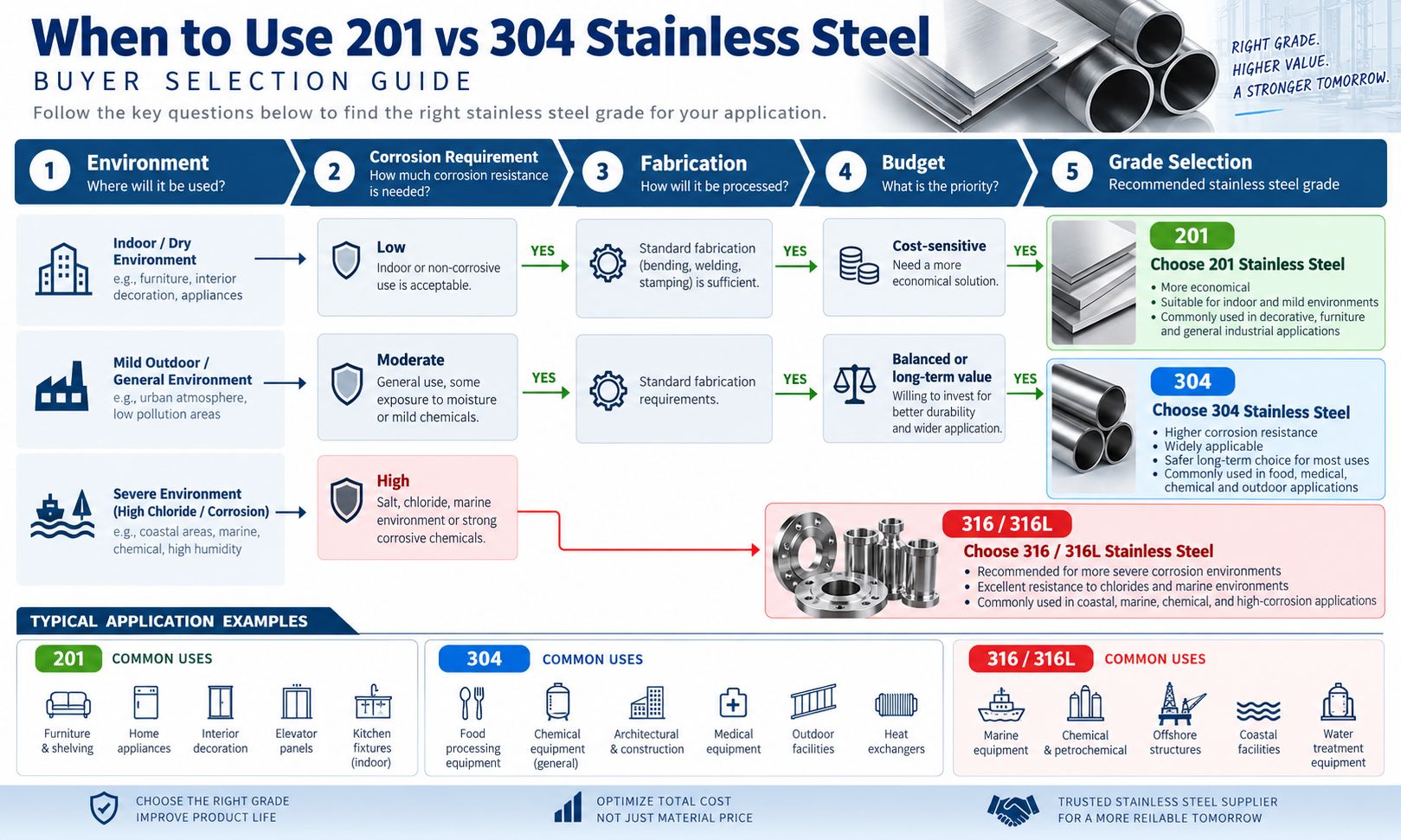
The selection diagram is a simplified guide. Actual grade acceptance depends on the project specification, fabrication requirements, and service environment.
A reliable buying decision should follow five steps.
Step 1: Define the Environment
Identify the actual service conditions:
- Dry indoor
- Humid indoor
- General outdoor
- Coastal
- Phơi nhiễm hóa học
- Frequent cleaning
- Continuous immersion
This is the first filter for corrosion suitability.
Step 2: Define Corrosion Requirements
Determine whether the product needs:
- Basic atmospheric corrosion resistance
- Resistance to moisture and cleaning agents
- Resistance to chlorides
- Long-term appearance retention
- Resistance to specific chemicals
Do not choose by grade name alone.
Step 3: Evaluate Fabrication
How will the product be made?
- uốn
- Vẽ sâu
- Dập
- Hàn
- Gia công
- tạo hình cuộn
- Đánh bóng
201 and 304 can respond differently to these processes.
Step 4: Compare Total Cost
Compare not only the material quotation but also:
- Processing cost
- Scrap rate
- Tooling requirements
- BẢO TRÌ
- Expected service life
- Replacement risk
- Yêu cầu kiểm tra
Step 5: Confirm the Grade
Only after the first four steps should the purchase specification be finalized.
When Should You Choose 201?
Consider standard 201 when:
- The environment is mild
- Corrosion requirements are satisfied
- The customer permits 201
- Lower alloy cost is important
- The component design can accommodate its strength and forming response
- A defined standard and certified material are available
Các ứng dụng điển hình bao gồm:
- Indoor furniture
- Tấm trang trí
- Interior trim
- Selected appliance parts
- Cost-sensitive fabricated products
When Should You Choose 304?
Consider 304 when:
- A broader corrosion margin is needed
- The project explicitly specifies 304
- More demanding wet exposure is expected
- Established forming and welding performance is important
- Long-term appearance is a priority
- Material replacement would be costly
- Customer or industry acceptance favors 304
Các ứng dụng điển hình bao gồm:
- Thiết bị chế biến thực phẩm
- Industrial tanks
- General machinery
- Pipe and tube
- Architectural components
- Commercial equipment
When Neither 201 nor 304 Is the Best Choice
Sometimes the correct purchasing decision is to consider another grade.
Thép không gỉ 430
430 is a ferritic stainless steel.
It may be an economical option for selected appliance, decorative, and indoor applications.
However, it has different magnetic, forming, welding, and corrosion characteristics.
For details, read 304 vs 430 Stainless Steel Sheets.
Thép không gỉ 304L
304L is the lower-carbon version of 304.
It is commonly considered where extensive welding and sensitization-related corrosion are concerns.
See Thép không gỉ 304 so với 304L.
Thép không gỉ 316 / 316L
316-family stainless steels contain molybdenum, which improves resistance to localized corrosion in many chloride-containing environments.
These grades may be more appropriate where the environment requires greater corrosion resistance than 304.
However, severe seawater and hot chloride applications may still require higher-alloy engineering solutions.
How to Specify 201 or 304 in a Purchase Order
An incomplete stainless steel purchase specification can lead to material disputes, delays, or incorrect substitutions.
For example, the following enquiry is incomplete:
Need 201 stainless steel coil. Please quote.
Một cuộc điều tra mạnh mẽ hơn sẽ là:
ASTM A240 Type 201 (UNS S20100) stainless steel coil, 0.80 mm × 1219 mm, 2B finish, 20 MT, slit edge, MTC required, FOB Shanghai. No substitution without written approval.
This specifies the intended material much more clearly.
Stainless Steel RFQ Checklist
| Mục | Information to Provide |
|---|---|
| Material grade | 201 / UNS S20100 or 304 / UNS S30400 |
| Governing standard | Exact applicable product standard and edition |
| Hình thức sản phẩm | Sheet, plate, coil, strip, pipe, tube, bar |
| Độ dày | mm or inch |
| Chiều rộng | mm or inch |
| Chiều dài | Standard or cut-to-size |
| Bề mặt hoàn thiện | 2B, BA, No.4, HL, Mirror, etc. |
| Bờ rìa | Mill edge, slit edge, deburred |
| Sức chịu đựng | According to applicable standard |
| Mechanical condition | Annealed or specified temper |
| Số lượng | Pieces, coils or metric tons |
| Material certificate | MTC, EN 10204 3.1 if required |
| PMI/testing | If required |
| Xử lý | Slitting, cutting, polishing, forming |
| Ứng dụng | Actual intended use |
| Điểm đến | Country and port |
| Delivery terms | EXW, FOB, CIF or other agreed terms |
Should Buyers Request PMI Before Shipment?
PMI can be valuable where:
- Incorrect-grade substitution is a material risk
- Large quantities are involved
- The project has strict traceability requirements
- Material verification is required by contract
- A commercial grade designation is ambiguous
The purchase order should define whether testing is required on every item or on a specified sampling basis.
Buying 201 or 304 Stainless Steel from China
When sourcing internationally, buyers should focus on specification clarity rather than treating all materials with the same commercial label as equivalent.
A practical sourcing process is:
- Confirm the intended standard and grade.
- Define the product form and dimensions.
- Confirm the service environment and fabrication requirements.
- Request the proposed material specification and available certification.
- Establish approval rules for material substitution.
- Agree on required inspections.
- Verify material traceability before shipment.
- Review the final shipping and quality documentation.
This helps reduce misunderstandings between:
- Buyer
- Nhà cung cấp
- Nhà máy thép
- Fabricator
- Inspection provider
- End customer
Why Purchase Order Clarity Matters
A quotation for:
Tấm thép không gỉ 201
may not provide enough information to confirm compliance with a project requiring:
UNS S20100 to a specified ASTM product standard.
Likewise, a quotation for:
304 decorative stainless steel sheet
must still address thickness, tolerance, surface finish, and processing requirements.
For purchasing purposes, the full specification is more important than the short commercial product name.
Gengfei Steel 201 and 304 Stainless Steel Supply
At Gengfei Steel, we supply stainless steel materials for manufacturing, fabrication, and international project requirements.
Our stainless steel product range includes:
- Stainless steel sheet and plate
- Cuộn thép không gỉ
- Dải thép không gỉ
- Stainless steel pipe and tube
- Thanh thép không gỉ
- Stainless steel angles and other profiles
Buyers can explore the following product categories:
Cuộn dây thép không gỉ 201
304 Stainless Steel Sheet
View 304 Stainless Steel Sheet
201 ống thép không gỉ
Dải thép không gỉ
Complete Stainless Steel Product Range
Explore Gengfei Stainless Steel Products
Depending on the product and order requirements, Gengfei can support selection and quotation for appropriate grades, dimensions, surface finishes, cutting, slitting, and export supply.
For efficient quotation, provide:
Grade + Standard + Product Form + Dimensions + Finish + Quantity + Certification + Processing + Application + Destination
When the final grade has not been confirmed, sharing the actual environment and manufacturing process can help narrow the material options.
Frequently Asked Questions About 201 vs 304 Stainless Steel
1. What is the biggest difference between 201 and 304 stainless steel?
The biggest difference is their alloy composition.
201 contains less nickel and more manganese than 304. This can reduce alloy cost and increase strength and work-hardening response.
304 contains more chromium and nickel and is widely selected for its corrosion resistance and general-purpose fabrication performance.
2. Is 201 stainless steel cheaper than 304?
Generally, yes.
201 contains less nickel, which can reduce alloy cost.
However, actual pricing depends on raw-material markets, mill, product form, size, finish, and order quantity.
3. Does 201 stainless steel rust easily?
Standard 201 is corrosion-resistant stainless steel.
It can perform well in suitable environments, but corrosion remains possible, especially under unfavorable moisture, chloride, contamination, or chemical conditions.
Actual performance depends on grade chemistry and exposure.
4. Is 304 stainless steel rust-proof?
KHÔNG.
304 is corrosion resistant, not completely rust-proof.
Chlorides, crevices, aggressive chemicals, contamination, and improper fabrication can cause corrosion.
5. Is 201 stainless steel stronger than 304?
In comparable annealed conditions, 201 often has higher yield strength and a stronger work-hardening response.
The exact difference depends on the applicable product standard and material condition.
6. Is 304 always better than 201?
KHÔNG.
304 provides broader general-purpose applicability, but 201 can be a suitable and more economical choice for certain applications.
The best grade depends on corrosion requirements, strength, processing, cost, and project specifications.
7. Can 201 replace 304 stainless steel?
Only when the substitution is technically acceptable and permitted by the customer or governing specification.
201 should not be supplied as a replacement for specified 304 without approval.
8. Is 201 stainless steel suitable for kitchen utensils?
Standard 201 is used in certain kitchen utensils and catering products.
However, suitability depends on the product design, food-contact requirements, cleaning conditions, and applicable regulations.
9. Is 201 stainless steel food grade?
There is no universal rule that the designation 201 alone guarantees food-contact suitability.
The finished product must satisfy the applicable food-contact and service requirements.
10. Can 201 and 304 stainless steel be welded?
Yes, both can be welded.
However, their different compositions and fabrication characteristics mean that welding procedures and filler-metal selection should be evaluated for the actual application.
11. Is 201 stainless steel magnetic?
201 is an austenitic stainless steel and is generally non-magnetic or weakly magnetic in the annealed condition.
Cold working can change its magnetic response.
Magnetic behavior should not be used as a reliable grade-identification method.
12. Can a magnet distinguish 201 from 304?
KHÔNG.
Both are austenitic stainless steels, and either can develop magnetic response after cold working.
Use material documentation and suitable chemical-analysis methods for grade verification.
13. Can handheld XRF identify 201 and 304?
Yes, properly performed handheld XRF testing can often help distinguish the grades by measuring key alloying elements such as chromium, nickel, and manganese.
However, the method and instrument must be suitable for the required analysis.
14. Are 201 J1, J2, J3 and J4 the same as standard 201?
Not automatically.
These may be commercial designations used for different low-nickel stainless steel compositions.
Buyers should request the actual chemistry, governing standard, and material documentation.
15. Which is better for outdoor railings: 201 or 304?
304 is commonly preferred when greater corrosion resistance and appearance retention are required.
However, the appropriate grade depends on local atmospheric conditions, salt exposure, maintenance, and project specifications.
Severe coastal environments may require a higher-alloy stainless steel.
16. Which is better for stainless steel furniture?
For indoor furniture in mild conditions, 201 can be an economical option.
304 may be selected where higher corrosion resistance, wet exposure, or customer specifications justify it.
17. Which is easier to form: 201 or 304?
Both grades are formable, but 304 is widely used in demanding forming applications.
201 often has a stronger work-hardening response and may require different tooling and forming parameters.
18. Is 201 stainless steel suitable for seawater?
201 should not be treated as a default choice for continuous seawater service.
Such environments require careful corrosion engineering, and higher-alloy materials may be necessary.
19. How can I avoid receiving 201 when I ordered 304?
Specify the exact grade and product standard, require traceable MTC documentation, verify heat numbers, and arrange appropriate PMI or laboratory inspection where needed.
20. Should I buy 201 or 304 stainless steel sheet?
Choose based on the environment, fabrication method, customer specification, service life, and total cost.
201 may offer cost savings in suitable mild environments.
304 is widely selected when corrosion margin, fabrication versatility, and long-term performance are greater priorities.
Final Verdict: Should You Choose 201 or 304 Stainless Steel?
There is no universal winner between 201 and 304 stainless steel.
Choose 201 when:
- The application environment is sufficiently mild
- The project permits the grade
- Cost efficiency is important
- Its mechanical and forming behavior is suitable
- The specified corrosion performance can be achieved
- The supplied material is properly identified and verified
Choose 304 when:
- Broader corrosion resistance is required
- The material will be used in more demanding wet environments
- Established forming or welding performance is important
- The project specifies 304
- Long-term appearance and maintenance are important
- Customer acceptance and material traceability require the 304 grade
For severe chloride exposure, chemical processing, or seawater service, neither 201 nor 304 should be selected without further evaluation.
The most reliable approach is:
Environment → Corrosion Requirements → Mechanical Properties → Fabrication → Lifecycle Cost → Material Verification → Purchase Specification
For international buyers, the most important lesson is that the lowest initial stainless steel price is not always the lowest total project cost.
The correct grade is the material that meets the technical specification, performs reliably throughout its intended service life, and provides the best overall value for the application.
