

How to Choose Aluminum Checker Plate for Truck, Trailer and Marine Decking: Alloy, Thickness, Patterns and Buying Guide
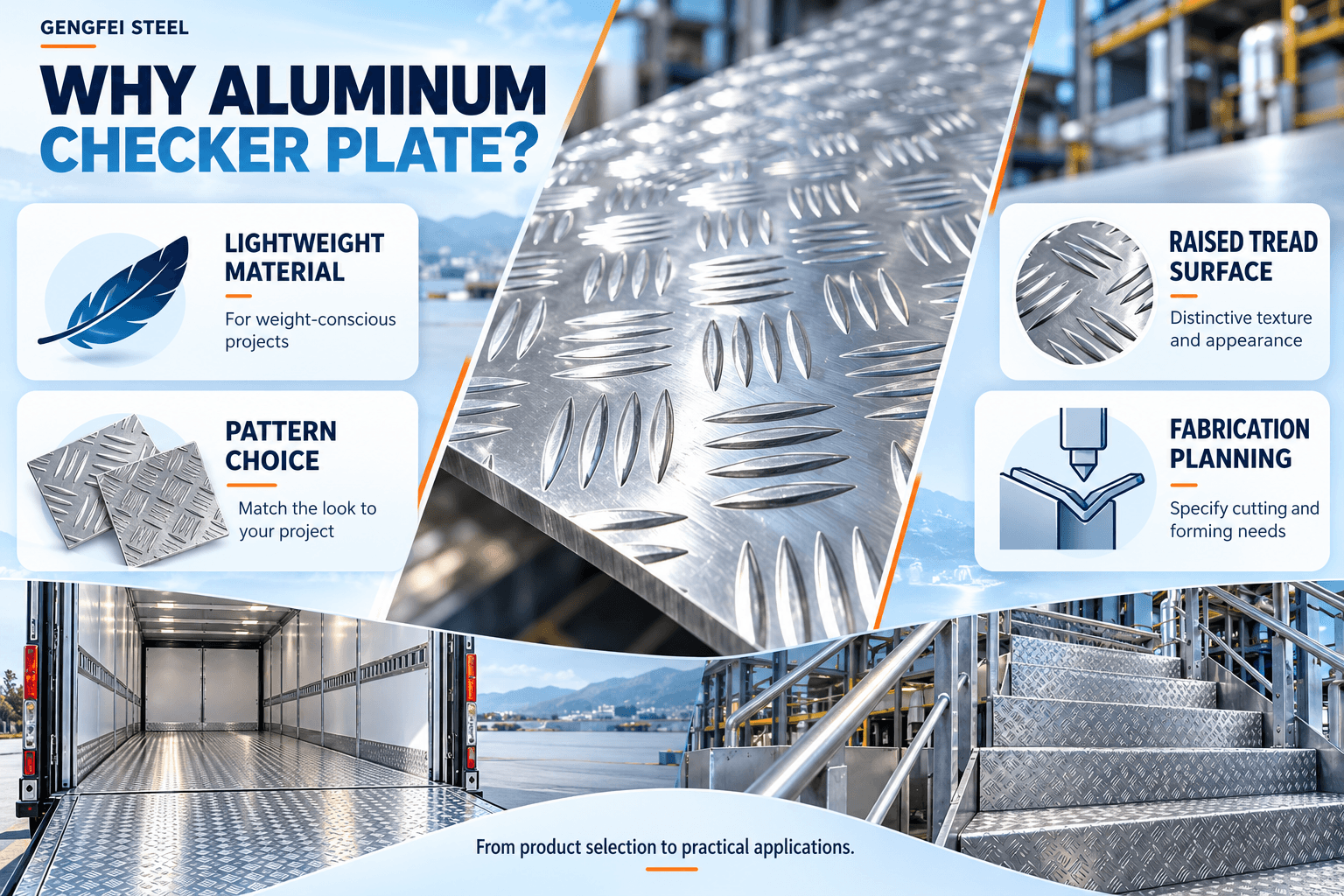
Aluminum checker plate is widely used in transportation, marine engineering, industrial flooring, and construction. Its combination of lightweight properties, corrosion resistance, and raised surface patterns makes it a practical material for applications where surface traction, durability, and reduced structural weight are important.
From truck floors and heavy-duty trailer decks to ship walkways and industrial access platforms, aluminum checker plate provides a versatile alternative to conventional steel flooring materials.
However, choosing the right aluminum checker plate involves more than selecting a pattern or thickness. Different aluminum alloys, tempers, base metal thicknesses, and surface designs offer different mechanical and fabrication characteristics. The correct specification also depends on load conditions, supporting structures, operating environments, and installation methods.
For truck manufacturers, trailer builders, shipyards, equipment manufacturers, and aluminum distributors, selecting an unsuitable specification can result in unnecessary material costs, fabrication difficulties, or insufficient structural performance.
This comprehensive guide explains how to select aluminum checker plate for truck flooring, trailer decks, marine applications, and industrial platforms. It covers alloy selection, thickness measurement, pattern types, load considerations, corrosion resistance, quality inspection, and purchasing specifications.
1. What Is Aluminum Checker Plate?
Aluminum checker plate, also known as aluminum tread plate, aluminum diamond plate, or aluminum chequer plate, is a flat-rolled aluminum product with raised patterns on one surface.
These patterns are formed during the rolling process and provide additional surface texture compared with conventional smooth aluminum sheets.
Depending on the manufacturing process, aluminum checker plate is available in different raised patterns, including one-bar, two-bar, three-bar, five-bar, and diamond designs.
The raised surface can improve traction under suitable operating conditions while providing a distinctive industrial appearance.
Main Characteristics of Aluminum Checker Plate
- Lightweight Construction: Aluminum has a density of approximately 2.7 g/cm³, significantly lower than conventional carbon steel. This makes it useful for transportation projects where reducing vehicle weight is important.
- Corrosion Resistance: Aluminum naturally forms a protective oxide layer. Certain aluminum-magnesium alloys, including 5052 and 5754, are commonly considered for outdoor and marine-related applications.
- Textured Surface: Raised patterns provide additional surface texture compared with smooth aluminum sheets.
- Fabrication Flexibility: Depending on alloy and temper, checker plate can be cut, bent, drilled, welded, and processed into customized components.
- Attractive Appearance: Its raised pattern provides a functional and decorative surface for industrial flooring, vehicle interiors, equipment covers, and architectural applications.
2. Main Applications of Aluminum Checker Plate
Aluminum checker plate is used in several industries because it combines low material weight, useful corrosion resistance, and a textured surface. The correct specification depends on the intended application and actual operating conditions.
2.1 Truck Flooring
Truck manufacturers and vehicle body builders frequently use aluminum checker plate for:
- Truck cargo floors
- Truck body flooring
- Loading platforms
- Vehicle access steps
- Wheel arch covers
- Toolboxes
- Protective floor panels
A lightweight floor material can contribute to reducing the vehicle’s unladen weight. This may help operators optimize payload capacity, subject to applicable vehicle regulations and structural design requirements.
The raised pattern also provides additional surface texture for workers handling cargo during loading and unloading.
2.2 Trailer Decking
Aluminum checker plate is widely used in trailer manufacturing, particularly for applications where weight reduction and practical flooring performance are important.
Common applications include:
- Flatbed trailers
- Utility trailers
- Equipment transport trailers
- Enclosed trailers
- Commercial vehicle platforms
- Loading ramps
- Special-purpose transportation trailers
For trailer manufacturers, reducing unladen weight can improve transportation efficiency. Aluminum checker plate provides a textured floor surface while generally weighing less than a comparable steel plate.
However, trailer flooring is a structural application. Its load-bearing performance depends on the plate thickness, alloy, temper, support spacing, reinforcement design, and loading conditions.
2.3 Marine Decking and Boat Flooring
Marine environments create additional challenges for metal materials. Ships and boats may be exposed to saltwater, high humidity, changing temperatures, and frequent washing.
Aluminum checker plate can be used in suitable marine applications such as:
- Boat walkways
- Engine room access platforms
- Gangways
- Maintenance platforms
- Vessel access areas
- Marine stairs
- Protective deck surfaces
For marine projects, buyers should carefully evaluate alloy selection, corrosion exposure, fabrication methods, and compatibility with other metals.
2.4 Industrial Flooring and Construction
Industrial checker plate is also used for factory walkways, workshop platforms, warehouse ramps, loading docks, stair treads, equipment access platforms, and protective wall panels.
In these applications, the correct thickness, support structure, surface condition, and installation method are important for long-term performance.

3. Which Aluminum Alloy Is Best for Checker Plate?
Alloy selection is one of the most important factors affecting aluminum checker plate performance. Different aluminum alloys offer different combinations of strength, corrosion resistance, formability, and weldability.
3.1 1060 and 1100 Aluminum Checker Plate
1060 and 1100 belong to the commercially pure aluminum series. They offer good general corrosion resistance, thermal and electrical conductivity, and formability.
Typical applications include:
- Decorative panels
- General-purpose protective covers
- Light-duty applications
- Architectural components
- Applications requiring good formability
These alloys are generally considered for applications where high structural strength is not the primary requirement.
3.2 3003 Aluminum Checker Plate
3003 belongs to the aluminum-manganese alloy series. It is widely used for general-purpose aluminum products because of its good corrosion resistance and formability.
Main characteristics include:
- Good general corrosion resistance
- Good workability
- Good formability
- Suitable for various fabrication operations
- Economical for many commercial applications
Typical applications include general industrial flooring, decorative panels, equipment covers, light-duty platforms, and vehicle interior components.
3.3 5052 Aluminum Checker Plate
5052 belongs to the aluminum-magnesium alloy series. It is widely recognized for its corrosion resistance, useful mechanical properties, and fabrication characteristics.
Main characteristics include:
- Good corrosion resistance
- Good resistance to marine atmospheres
- Good formability
- Good weldability with suitable procedures
- Useful strength for many transportation applications
Typical applications include truck flooring, trailer decks, vehicle components, marine access platforms, industrial walkways, and outdoor equipment.
5052 is an important option for buyers who require a balance of corrosion resistance, strength, and fabrication performance.
3.4 5754 Aluminum Checker Plate
5754 is another aluminum-magnesium alloy widely used in transportation and marine-related industries.
Its characteristics include:
- Good corrosion resistance
- Good weldability
- Good formability in appropriate tempers
- Suitable mechanical properties
- Good performance in various outdoor environments
Typical applications include trailer flooring, commercial vehicle components, marine walkways, industrial platforms, and transportation equipment.
3.5 5083 and 5086 Aluminum for Marine Projects
5083 and 5086 are high-magnesium aluminum alloys commonly used in demanding marine and structural applications.
They offer useful combinations of strength, corrosion resistance, and weldability for appropriately specified marine structures.
Typical applications include shipbuilding, marine hull structures, offshore equipment, and specialized marine components.
For demanding marine projects, buyers should confirm the required product form, alloy, temper, material certification, and applicable marine standards. These alloys should not automatically be assumed to be available in every checker plate pattern or specification.
Aluminum Checker Plate Alloy Comparison
| Alloy | Main Characteristics | Typical Applications |
|---|---|---|
| 1060 / 1100 | Good formability and general corrosion resistance | Decorative and light-duty applications |
| 3003 | Good formability and general corrosion resistance | General flooring and protective panels |
| 5052 | Good corrosion resistance and fabrication performance | Truck floors, trailers and marine-related applications |
| 5754 | Good corrosion resistance and weldability | Transportation and marine fabrication |
| 5083 / 5086 | Marine structural properties and weldability | Specified marine structural applications |
There is no single aluminum alloy that is best for every checker plate application. The correct choice depends on the intended use, loading conditions, corrosion exposure, forming requirements, welding procedures, and applicable standards.
4. Understanding Aluminum Checker Plate Temper Designations
Besides alloy selection, buyers should also confirm the temper designation. The temper describes the processing condition of the aluminum and has an important influence on its mechanical properties.
Common Aluminum Temper Designations
- O Temper: Annealed condition, generally offering good formability.
- H12: Strain-hardened condition with a specified degree of hardening.
- H14: Strain-hardened condition, commonly used where a balance between strength and formability is required.
- H22 / H24: Strain-hardened and partially annealed conditions with different mechanical property levels.
- H32: Strain-hardened and stabilized condition, commonly encountered in 5xxx series alloys.
- H114: A temper designation encountered in certain aluminum tread plate products. Confirm its applicability against the product standard.
- T6: Solution heat-treated and artificially aged condition, commonly associated with heat-treatable alloys such as 6061.
The same aluminum alloy can have different mechanical properties in different tempers. For example, 5052-O and 5052-H32 are not identical in strength and forming behavior.
A complete purchase specification should therefore include both the alloy and temper.
5. Aluminum Checker Plate Patterns: Which Design Should You Choose?
Aluminum checker plate is available in several raised pattern designs. The most common options include one-bar, two-bar, three-bar, five-bar, and diamond patterns.
5.1 One-Bar Pattern
One-bar or propeller-style checker plate features elongated raised elements. It is used in industrial flooring, transportation components, and decorative applications.
5.2 Two-Bar Pattern
Two-bar checker plate features two raised bars arranged in a repeating pattern. It is commonly used in industrial and commercial flooring products.
5.3 Three-Bar Pattern
Three-bar checker plate features three raised elements in a repeating arrangement. It is used for flooring, protective panels, and industrial applications.
5.4 Five-Bar Pattern
Five-bar aluminum checker plate features five raised bars arranged in a repeating pattern.
It is widely used for truck floors, trailer decks, industrial walkways, access platforms, loading areas, and vehicle steps.
5.5 Diamond Pattern
Diamond plate features raised diamond-shaped patterns. It is commonly used for truck beds, toolboxes, loading ramps, industrial platforms, decorative panels, and equipment covers.
How Should Buyers Choose a Pattern?
Pattern selection should consider:
- Intended application
- Required surface traction
- Direction of pedestrian or vehicle movement
- Drainage and cleaning conditions
- Appearance requirements
- Fabrication and installation methods
- Pattern availability from the supplier
A more prominent pattern does not automatically guarantee a safer floor. Actual slip resistance should be evaluated according to the operating environment and relevant safety requirements.

6. Aluminum Checker Plate Thickness: Base Thickness vs. Overall Thickness
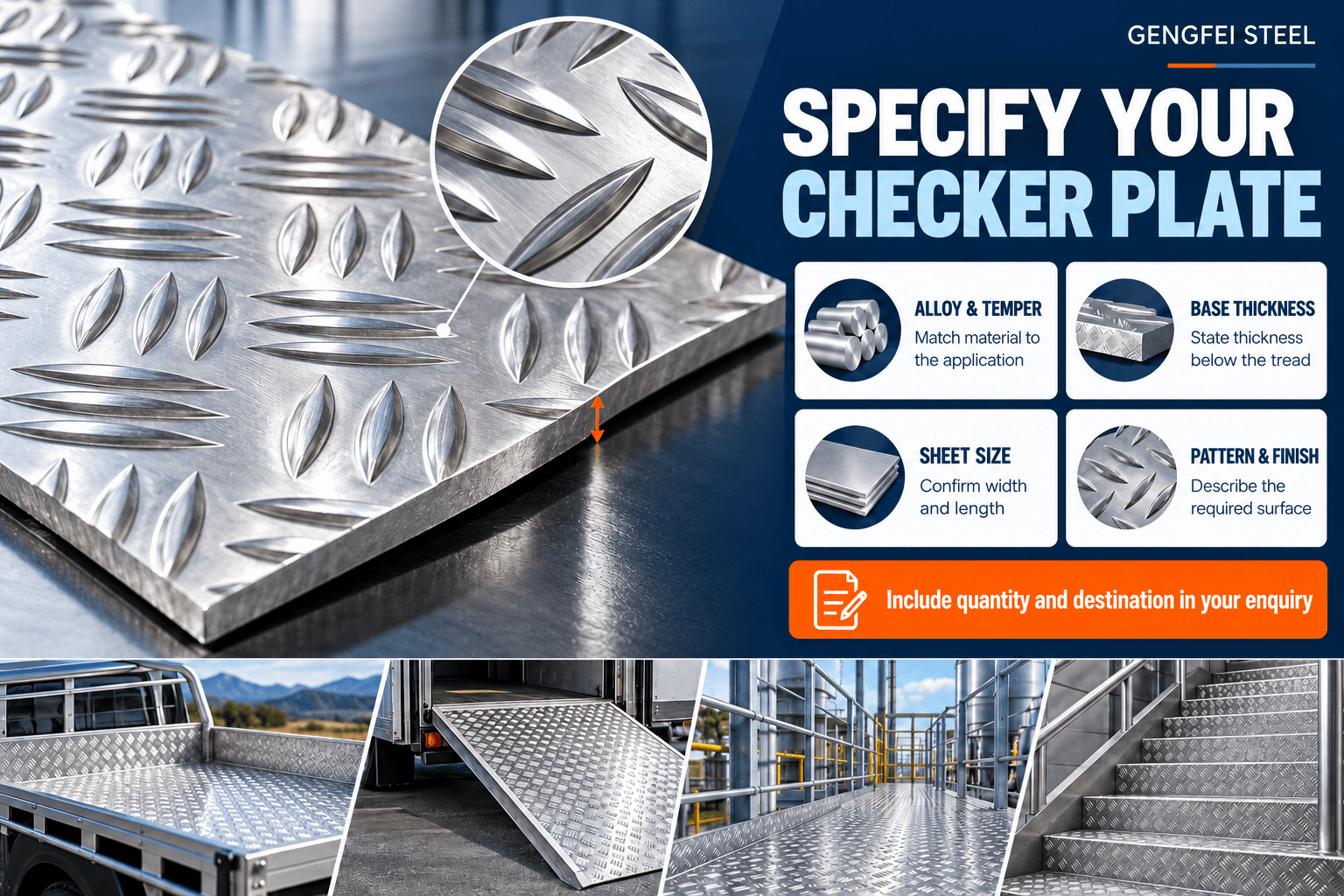
Thickness is one of the most important specifications when purchasing aluminum checker plate. However, checker plate has a raised pattern on one surface, so buyers must understand the difference between base thickness and overall thickness.
What Is Base Thickness?
Base thickness refers to the thickness of the flat aluminum substrate measured in the area between the raised patterns. It does not include the height of the raised pattern.
What Is Overall Thickness?
Overall thickness refers to the total dimension measured from the bottom surface of the plate to the top of the raised pattern.
As a simplified dimensional relationship:
Overall Thickness = Base Thickness + Pattern Height
Actual measurements should follow the applicable product standard and agreed inspection method.
Why Does This Difference Matter?
Imagine two suppliers offering aluminum checker plate.
- Supplier A quotes 3.0 mm base thickness.
- Supplier B quotes 3.0 mm overall thickness.
These two products may have different actual aluminum substrate thicknesses.
If the buyer compares the quotations without checking the measurement method, the materials may not be equivalent. This can affect actual material weight, structural performance, fabrication requirements, and total purchasing cost.
Purchasing recommendation: Always specify whether the required thickness refers to the base metal or the overall dimension including the raised pattern.
7. How to Choose the Correct Thickness for Truck and Trailer Flooring
There is no universal aluminum checker plate thickness suitable for every truck or trailer. The required thickness depends on structural design and actual loading conditions.
A light utility trailer and a heavy machinery transport trailer may have completely different flooring requirements.
Important Factors Affecting Thickness Selection
1. Vehicle Type
Different vehicles have different structural configurations and loading requirements. A commercial delivery vehicle, flatbed trailer, and heavy equipment trailer should not automatically use the same flooring specification.
2. Support Spacing
The distance between crossmembers or supporting beams affects plate deflection. A plate installed over closely spaced supports may perform differently from the same plate installed over a wider unsupported span.
3. Load Distribution
A uniformly distributed load is different from a concentrated load. Forklift wheels, machinery feet, and vehicle tires may create concentrated loading conditions.
4. Plate Alloy and Temper
Different alloys and tempers have different yield strengths, tensile strengths, and elongation characteristics. The material must be evaluated using its actual certified properties.
5. Fabrication Method
Welding, bending, fastening, and cutting may affect the finished structure. Welded aluminum structures require consideration of the properties in the heat-affected zone.
6. Service Conditions
Repeated loading, vibration, impact, abrasion, and environmental exposure can influence long-term flooring performance.
Preliminary Application Guide
| Application | Main Selection Considerations |
|---|---|
| Light utility trailer | Vehicle design, support spacing and expected load |
| Commercial truck floor | Cargo weight, crossmember spacing and wheel loading |
| Heavy equipment trailer | Concentrated loads, dynamic effects and reinforcement |
| Loading ramp | Wheel loads, ramp angle and supporting structure |
| Marine walkway | Pedestrian loads, corrosion exposure and drainage |
| Industrial platform | Equipment loads, deflection limits and support spacing |
These are selection guidelines rather than engineering thickness ratings. For structural applications, the final thickness should be calculated or verified by a qualified engineer.
8. How to Select Aluminum Checker Plate for Marine Decking
Marine environments require additional attention because aluminum components may experience continuous exposure to moisture, salt, and dissimilar metals.
8.1 Select the Correct Aluminum Alloy
For general marine fabrication, 5052 and 5754 are commonly considered because of their corrosion resistance and fabrication properties.
For more demanding marine structural applications, 5083 and 5086 are frequently specified in appropriate marine tempers. The final selection should follow the vessel design and relevant material standards.
8.2 Consider Seawater Exposure
Different parts of a vessel may experience different exposure conditions, including interior equipment platforms, covered engine room floors, exterior walkways, exposed deck areas, and structures with frequent seawater contact.
The corrosion protection requirements may differ significantly. Buyers should communicate the actual operating environment rather than simply describing the product as marine grade.
8.3 Prevent Galvanic Corrosion
Galvanic corrosion can occur when aluminum is electrically connected to certain dissimilar metals in the presence of an electrolyte.
Installation should consider compatible fasteners, electrical isolation, protective washers, suitable sealants, drainage arrangements, and contact with other metals.
8.4 Prevent Water Trapping
Marine flooring should be designed to avoid unnecessary water accumulation. Poor drainage can increase corrosion risks, especially in joints, crevices, and enclosed areas.
Regular cleaning and inspection also help maintain the performance of aluminum components.
8.5 Confirm Marine Material Documentation
For demanding marine projects, buyers may need a Material Test Certificate, chemical composition report, mechanical property test results, alloy and temper identification, applicable standard documentation, and third-party inspection documents where required.
A general commercial checker plate should not be presented as marine-certified material unless the relevant certification and documentation are actually available.
9. Aluminum Checker Plate Weight Calculation
Weight is an important purchasing consideration, especially for truck manufacturers, trailer builders, and large industrial projects.
The theoretical weight of a flat aluminum sheet can be estimated using the following formula:
Weight (kg) = Length (m) × Width (m) × Base Thickness (mm) × 2.70
This simplified formula uses an approximate aluminum density of 2,700 kg/m³.
Example: 3 mm Aluminum Plate
Suppose a flat aluminum sheet has the following dimensions:
- Length: 2.4 m
- Width: 1.2 m
- Base thickness: 3 mm
- Assumed density: 2,700 kg/m³
Calculation:
2.4 × 1.2 × 3 × 2.70 = 23.33 kg
The estimated flat-sheet weight is approximately 23.33 kg.
However, aluminum checker plate has additional material in its raised pattern. Therefore, the actual checker plate weight will generally be higher than the theoretical weight of the corresponding flat sheet.
For accurate purchasing and freight calculations, request the supplier’s confirmed unit weight or actual weighing information.
10. Surface Finish and Processing Options
Aluminum checker plate can be supplied with different surface finishes depending on the application.
Mill Finish
Mill finish is a standard surface condition suitable for many industrial, transportation, and general-purpose applications.
Bright Finish
Bright checker plate provides a more reflective and decorative appearance. It is commonly selected for toolboxes, vehicle interiors, and architectural applications.
Anodized Finish
Anodizing creates a controlled oxide layer on the aluminum surface. It can improve surface durability and appearance, depending on the alloy, process, and application.
Protective Film
Protective film can be applied to reduce the risk of surface scratches during processing, handling, and transportation.
Common Processing Services
- Cutting to size
- Shearing
- Laser cutting
- Waterjet cutting
- Bending
- Drilling
- Edge deburring
- Protective film application
- Customized packaging
Buyers should confirm whether the selected alloy, temper, thickness, and pattern are compatible with the required processing method.
11. International Standards for Aluminum Checker Plate
International standards help define product requirements, material properties, dimensions, and inspection procedures.
ASTM B632/B632M
ASTM B632/B632M is a specific standard for aluminum-alloy rolled tread plate. It covers rolled flat tread plate with a raised pattern on one side and defines relevant alloy, temper, and thickness requirements.
For buyers purchasing rolled aluminum tread plate under an ASTM specification, this is an important standard to discuss with the supplier.
View ASTM B632/B632M-24 at ASTM International.
ASTM B209/B209M
ASTM B209/B209M covers aluminum and aluminum-alloy sheet and plate. It is a relevant general material specification, but it should not automatically replace a specific tread plate standard when the purchase concerns rolled checker plate.
EN 485
The EN 485 series addresses aluminum and aluminum-alloy sheet, strip, and plate, including technical conditions of inspection and delivery, mechanical properties, and dimensional tolerances, depending on the applicable part.
GB/T 3880
GB/T 3880 is a Chinese standard series covering aluminum and aluminum-alloy plates, sheets, and strips for general industrial applications.
ASTM B928/B928M
ASTM B928/B928M covers specified high-magnesium aluminum-alloy sheet and plate products intended for marine service and similar environments.
Buyers must confirm the product form and applicable requirements for the actual checker plate being purchased.
Important purchasing advice: Do not specify only ASTM or EN without identifying the required product standard. A complete purchase specification should include the applicable standard, alloy, temper, base thickness, pattern, dimensions, mechanical property requirements, and inspection documentation.
12. Quality Inspection: What Should Buyers Check Before Shipment?
Quality inspection helps ensure that delivered aluminum checker plate matches the agreed purchasing specification.
12.1 Alloy Verification
Confirm that the supplied material matches the specified alloy. Chemical composition can be verified using appropriate laboratory testing methods.
12.2 Temper Verification
Check that the material temper matches the purchase order. The alloy and temper together determine the applicable mechanical property requirements.
12.3 Thickness Inspection
Measure the base thickness according to the agreed standard and inspection method. Do not measure only the top of the raised pattern when verifying base metal thickness.
12.4 Pattern Inspection
Check pattern consistency, raised pattern height, pattern definition, surface uniformity, and visible rolling defects.
12.5 Dimensional Inspection
Verify length, width, thickness, flatness, squareness, and dimensional tolerances.
12.6 Surface Quality Inspection
Inspect the material for scratches, dents, surface contamination, oil stains, corrosion marks, uneven pattern appearance, and handling damage.
12.7 Mechanical Property Testing
Where required by the contract or applicable standard, verify tensile strength, yield strength, elongation, and other specified mechanical properties.
12.8 Documentation
Depending on order requirements, buyers may request:
- Mill Test Certificate
- Chemical composition report
- Mechanical property test report
- Dimensional inspection report
- Third-party inspection certificate, if required
- Packing list
- Commercial invoice
13. Packaging and Shipping of Aluminum Checker Plate
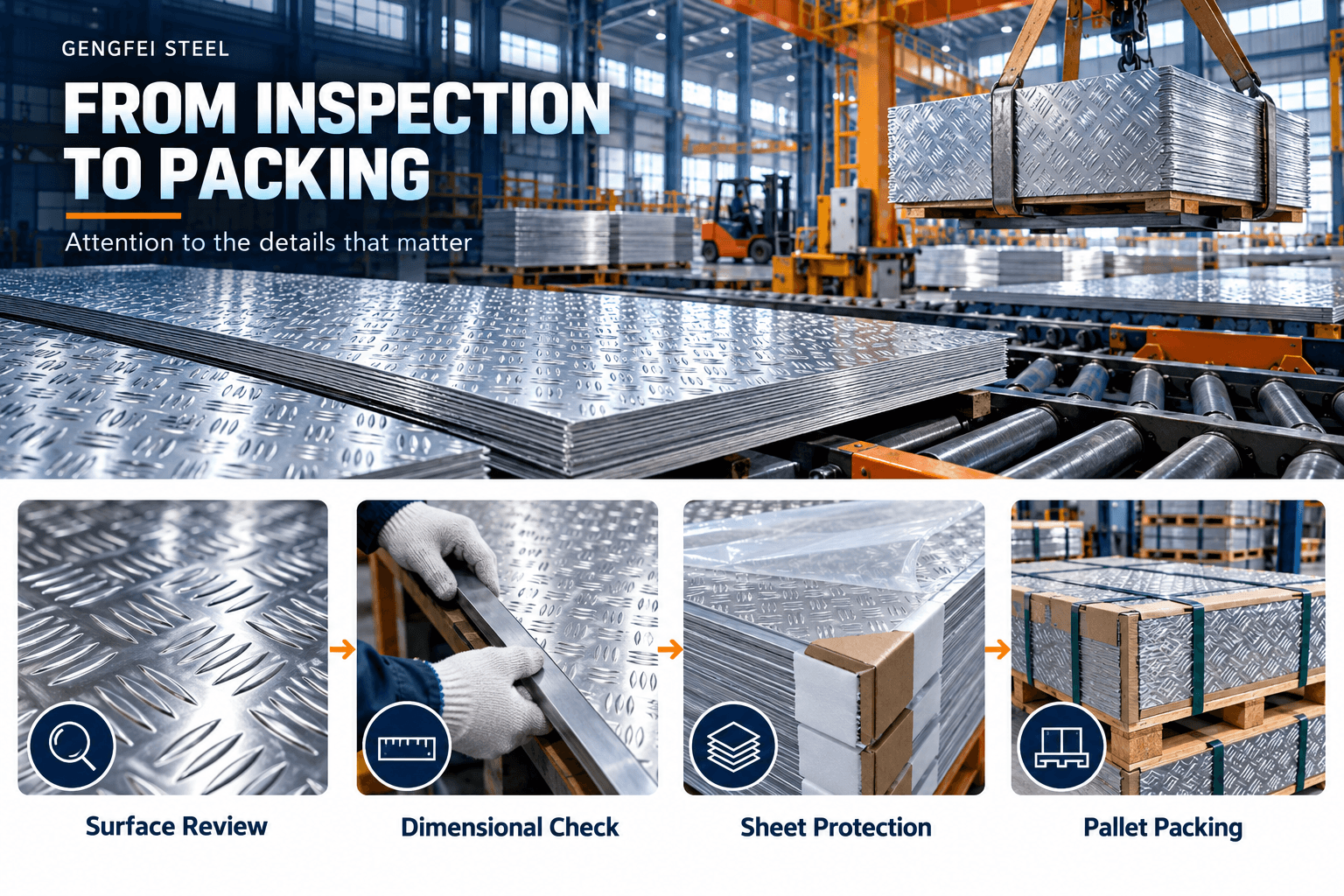
Proper packaging is important for preventing surface damage during international transportation.
Aluminum checker plate may be supplied in full sheets or customized cut pieces. Depending on product dimensions and shipping requirements, export packaging may include:
Surface Protection
Protective film, interleaving material, or suitable surface protection can be used to reduce scratching and contamination.
Moisture Protection
Waterproof paper and plastic wrapping can help reduce moisture exposure during storage and transportation.
Pallet Packaging
Wooden pallets or crates provide support and help protect plates during handling.
Edge Protection
Suitable corner and edge protection can reduce damage caused by strapping and transportation movement.
Container Loading
Cargo should be properly secured to prevent shifting during sea transportation. Buyers should confirm packaging and loading requirements according to plate dimensions, quantity, destination, and unloading equipment.
14. Common Mistakes When Purchasing Aluminum Checker Plate
Mistake 1: Comparing Overall Thickness Instead of Base Thickness
Two suppliers may quote the same nominal thickness while using different measurement methods. Always confirm whether the thickness includes the raised pattern.
Mistake 2: Selecting an Alloy Based Only on Price
A lower-priced alloy may not provide the required corrosion resistance, mechanical properties, or fabrication performance. Select the alloy according to the actual application.
Mistake 3: Ignoring the Temper
The same aluminum alloy can have different mechanical properties in different tempers. Always confirm the complete alloy-temper designation.
Mistake 4: Assuming All Checker Plate Patterns Have the Same Performance
Different pattern designs may provide different surface characteristics. Pattern selection should consider the application and operating conditions.
Mistake 5: Choosing Thickness Without Considering Support Spacing
Thickness alone does not determine load-bearing performance. The supporting structure and loading conditions are equally important.
Mistake 6: Assuming All Aluminum Plate Is Suitable for Marine Service
Marine applications require careful evaluation of alloy, temper, corrosion exposure, and installation details. For demanding seawater applications, request the appropriate material documentation.
Mistake 7: Not Confirming Processing Requirements
Cutting, bending, and welding requirements should be discussed before production. This helps avoid problems with material availability and fabrication suitability.
15. How to Prepare a Complete Aluminum Checker Plate Purchase Specification
A clear purchase specification helps suppliers understand the project and prepare an accurate quotation.
| Specification | Example |
|---|---|
| Product | Aluminum Checker Plate |
| Alloy | 5052 |
| Temper | H32 |
| Pattern | 5-Bar |
| Base Thickness | 3.0 mm |
| Overall Thickness | To Be Confirmed |
| Width | 1250 mm |
| Length | 2500 mm |
| Surface Finish | Mill Finish |
| Standard | ASTM B632/B632M, where applicable |
| Quantity | 20 MT |
| Application | Trailer Flooring |
| Processing | Cut to Size |
| Packaging | Export Seaworthy Packing |
| Destination Port | To Be Confirmed |
This is an illustrative purchasing specification rather than a universal recommended configuration. The final alloy, temper, thickness, and dimensions should be determined according to actual application and project requirements.
Information Needed for Truck and Trailer Projects
- Vehicle type
- Floor dimensions
- Expected maximum load
- Type of loading
- Distance between supports
- Installation method
- Required alloy and temper
Information Needed for Marine Projects
- Vessel type
- Intended installation location
- Saltwater exposure conditions
- Required alloy and temper
- Relevant marine standards
- Welding or fastening requirements
- Certification requirements
Providing this information at the quotation stage helps reduce misunderstandings and improves purchasing efficiency.
16. Why Choose Gengfei Steel for Aluminum Checker Plate Supply?
Henan Gengfei Industrial Co., Ltd. is a China-based steel and aluminum supplier serving international customers in construction, transportation, marine engineering, and industrial manufacturing.
We supply aluminum checker plate in different alloys, patterns, and specifications to meet various application requirements.
Our Aluminum Checker Plate Product Options
- Alloy Grades: 1060, 1100, 3003, 5052, 5754, and other available grades.
- Tempers: O, H12, H14, H22, H24, H32, and other available conditions.
- Pattern Types: 1-bar, 2-bar, 3-bar, 5-bar, and diamond.
- Thickness: 1.2–8.0 mm on the listed checker plate product range.
- Width: 600–2000 mm.
- Length: Up to 6000 mm, subject to product and order requirements.
- Surface Finish: Mill finish, anodized, and painted options.
Actual availability, tolerances, and combinations should be confirmed for each order.
Our Supply Services
Customized Specifications
We help buyers evaluate suitable alloy grades, tempers, thicknesses, patterns, and dimensions.
Material Documentation
Relevant material documentation can be provided according to the agreed order requirements.
Cutting and Processing Coordination
Customized sizes and processing requirements can be discussed before production or procurement.
Export Packaging
We arrange suitable export packaging to help protect aluminum plates during international transportation.
International Shipping Coordination
We support overseas customers with export documentation and shipping arrangements.
Whether you are purchasing aluminum checker plate for truck flooring, trailer decks, boat walkways, marine platforms, industrial flooring, equipment covers, loading ramps, or architectural applications, our team can help you evaluate suitable material options based on your project requirements.

Explore our product range:
17. Frequently Asked Questions About Aluminum Checker Plate
Q1. What is the difference between aluminum checker plate and aluminum diamond plate?
These terms generally refer to aluminum sheets with raised surface patterns. Aluminum checker plate and aluminum tread plate are commonly used in international markets, while aluminum diamond plate is particularly familiar in North America. The exact pattern may vary between suppliers.
Q2. Which aluminum alloy is best for truck flooring?
5052 and 5754 are commonly considered for truck and trailer flooring because of their corrosion resistance and fabrication characteristics. 3003 may be suitable for certain general-purpose applications. The final alloy should be selected according to structural loading, processing requirements, and the applicable material specification.
Q3. Is 5052 aluminum checker plate suitable for marine applications?
5052 has good corrosion resistance and can be considered for suitable marine-related applications. More demanding marine structural applications may require 5083 or 5086 in specified marine tempers and with appropriate documentation.
Q4. What is the difference between 5052 and 5754 aluminum checker plate?
Both are aluminum-magnesium alloys with good corrosion resistance and useful fabrication characteristics. 5052 is commonly used in North American transportation and general fabrication markets, while 5754 is widely used in European transportation and industrial applications. The actual choice should depend on mechanical properties, temper, applicable standards, and availability.
Q5. What is the most common pattern for aluminum checker plate?
Common patterns include 1-bar, 2-bar, 3-bar, 5-bar, and diamond. Five-bar and diamond patterns are widely used for transportation and industrial flooring. The final selection should consider the required surface characteristics and appearance.
Q6. What thickness is suitable for aluminum trailer flooring?
There is no universal thickness for all trailer floors. The correct thickness depends on the trailer structure, load distribution, support spacing, alloy, temper, and installation method. For heavy-duty trailers, engineering verification is recommended.
Q7. What is the difference between base thickness and overall thickness?
Base thickness is the thickness of the flat aluminum substrate, excluding the raised pattern. Overall thickness includes the raised pattern height. Buyers should clearly specify both values where necessary to avoid quotation differences.
Q8. Can aluminum checker plate be welded?
Yes. Many aluminum checker plate alloys can be welded using suitable aluminum welding procedures. The filler material and welding process should match the alloy and application. For structural components, the effect of welding on the heat-affected zone must be considered.
Q9. Is aluminum checker plate suitable for outdoor use?
Yes. Aluminum naturally forms a protective oxide layer and offers good corrosion resistance in many outdoor environments. The appropriate alloy, temper, surface finish, and installation method should be selected according to actual exposure conditions.
Q10. Can aluminum checker plate be used in saltwater environments?
Certain aluminum alloys are suitable for marine applications. However, saltwater exposure requires careful material selection, electrical isolation from dissimilar metals, appropriate drainage, and regular maintenance.
Q11. What international standards apply to aluminum checker plate?
ASTM B632/B632M is a specific standard for aluminum-alloy rolled tread plate. Other relevant material standards may include ASTM B209/B209M, EN 485, and GB/T 3880, depending on the product form and purchase specification. ASTM B928/B928M addresses specified high-magnesium aluminum-alloy products for marine service.
Q12. Can aluminum checker plate be supplied in customized sizes?
Yes. Aluminum checker plate can be supplied in customized widths and lengths depending on alloy availability, thickness, pattern, processing capabilities, and order quantity.
Q13. How do I calculate aluminum checker plate weight?
A preliminary flat-sheet weight can be calculated using: Weight (kg) = Length (m) × Width (m) × Base Thickness (mm) × 2.70. The actual checker plate weight will generally be higher because the raised pattern adds material. For accurate calculations, request the supplier’s confirmed unit weight.
Q14. What documents should I request when purchasing aluminum checker plate?
Depending on the project, buyers may request a Mill Test Certificate, chemical composition report, mechanical property report, dimensional inspection report, applicable standard documentation, and third-party inspection certificate where required.
Q15. How can I get a quotation for aluminum checker plate?
Send your required alloy, temper, pattern, base thickness, width, length, quantity, application, and destination port. For truck and trailer flooring, include support spacing and loading information. For marine applications, include vessel type, seawater exposure conditions, and required certification.
Conclusion: Choose the Right Aluminum Checker Plate for Your Project
Aluminum checker plate is a versatile material for truck flooring, trailer decks, marine walkways, industrial platforms, and construction applications.
However, selecting the correct product requires more than comparing thickness or price. Buyers should carefully evaluate aluminum alloy and temper, pattern type, base metal thickness, overall thickness, structural loading requirements, corrosion exposure, fabrication methods, applicable product standards, and quality documentation.
For transportation applications, reducing weight while maintaining the required structural performance is an important consideration. For marine applications, corrosion resistance, material traceability, and installation details deserve additional attention.
A clearly defined purchasing specification is the best starting point for comparing suppliers and ensuring that the delivered product meets the intended requirements.
Looking for a Reliable Aluminum Checker Plate Supplier in China?
Gengfei Steel supplies aluminum checker plate in different alloys, patterns, thicknesses, and customized dimensions for international customers.
Send us your required specifications, quantity, application, and destination port. Our team will help you evaluate suitable material options and prepare a quotation for your project.
Contact Gengfei Steel today to discuss your aluminum checker plate requirements and request a quotation.
