
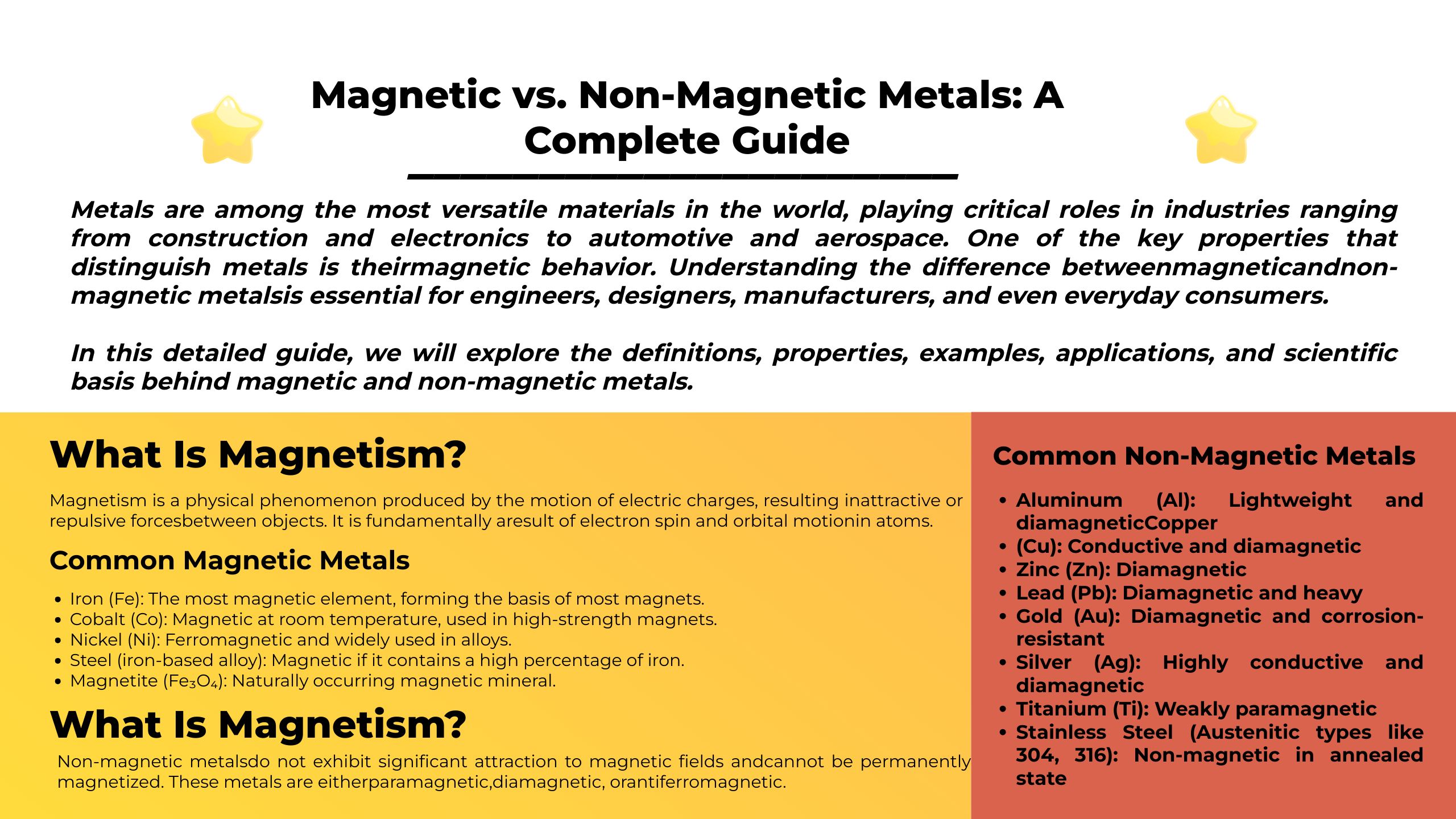
Metals are among the most versatile materials in the world, playing critical roles in industries ranging from construction and electronics to automotive and aerospace. One of the key properties that distinguish metals is their magnetic behavior. Understanding the difference between magnetic and non-magnetic metals is essential for engineers, designers, manufacturers, and even everyday consumers.
In this detailed guide, we will explore the definitions, properties, examples, applications, and scientific basis behind magnetic and non-magnetic metals.
1. What Is Magnetism?
1.1 Definition
Magnetism is a physical phenomenon produced by the motion of electric charges, resulting in attractive or repulsive forces between objects. It is fundamentally a result of electron spin and orbital motion in atoms.
1.2 Types of Magnetic Behavior in Materials
Materials can be classified into five main magnetic categories:
| Magnetic Type | Magnetic Response | Examples |
|---|---|---|
| Ferromagnetic | Strongly attracted to magnets; can be magnetized | Iron, cobalt, nickel |
| Ferrimagnetic | Similar to ferromagnetic, but less intense | Magnetite (Fe₃O₄), some ceramics |
| Paramagnetic | Weakly attracted to magnets; no retention | Aluminum, magnesium |
| Diamagnetic | Weakly repelled by magnets | Copper, bismuth, gold |
| Antiferromagnetic | Internal magnetic fields cancel out | Manganese oxide |
2. What Are Magnetic Metals?
2.1 Definition
Magnetic metals are those that exhibit ferromagnetic or ferrimagnetic behavior, meaning they are strongly attracted to a magnetic field and can become permanently magnetized.
2.2 Common Magnetic Metals
- Iron (Fe): The most magnetic element, forming the basis of most magnets.
- Cobalt (Co): Magnetic at room temperature, used in high-strength magnets.
- Nickel (Ni): Ferromagnetic and widely used in alloys.
- Steel (iron-based alloy): Magnetic if it contains a high percentage of iron.
- Magnetite (Fe₃O₄): Naturally occurring magnetic mineral.
2.3 Properties of Magnetic Metals
| Property | Description |
|---|---|
| Magnetic Permeability | High — allows magnetic fields to pass through easily |
| Retentivity | Ability to retain magnetism after external field is removed |
| Coercivity | Resistance to becoming demagnetized |
2.4 Applications
- Transformers and motors
- Magnetic sensors
- Loudspeakers
- Data storage (hard drives)
- Electromagnets
3. What Are Non-Magnetic Metals?
3.1 Definition
Non-magnetic metals do not exhibit significant attraction to magnetic fields and cannot be permanently magnetized. These metals are either paramagnetic, diamagnetic, or antiferromagnetic.3.2 Common Non-Magnetic Metals
- Aluminum (Al): Lightweight and diamagnetic
- Copper (Cu): Conductive and diamagnetic
- Zinc (Zn): Diamagnetic
- Lead (Pb): Diamagnetic and heavy
- Gold (Au): Diamagnetic and corrosion-resistant
- Silver (Ag): Highly conductive and diamagnetic
- Titanium (Ti): Weakly paramagnetic
- Stainless Steel (Austenitic types like 304, 316): Non-magnetic in annealed state
3.3 Properties of Non-Magnetic Metals
| Property | Description |
|---|---|
| Magnetic Permeability | Low — magnetic fields are blocked or weakly transmitted |
| No Remanence | Do not retain magnetic properties once field is removed |
| Electrical Conductivity | Often high (e.g., copper, silver) |
3.4 Applications
- MRI-compatible tools and equipment
- Electrical wiring (copper, aluminum)
- Aerospace and marine structures
- Decorative and non-interference environments
- EMI shielding (aluminum foil)
4. Key Differences Between Magnetic and Non-Magnetic Metals
| Feature | Magnetic Metals | Non-Magnetic Metals |
|---|---|---|
| Attraction to Magnet | Strong | None or very weak |
| Can Be Magnetized | Yes | No |
| Electron Alignment | Aligned | Random or opposing |
| Magnetic Permeability | High | Low |
| Common Examples | Iron, steel, nickel, cobalt | Copper, aluminum, gold, silver |
| Used in Magnets? | Yes | No |
| Response in MRI Environment | Dangerous (can be pulled violently) | Safe and MRI-compatible |
5. Why Are Some Metals Magnetic and Others Not?
5.1 Atomic Structure
The magnetic properties of a metal depend on its electron configuration, especially the d-orbitals. Metals like iron, cobalt, and nickel have unpaired electrons that generate a net magnetic moment.5.2 Crystal Structure
Certain crystal structures like body-centered cubic (BCC) or hexagonal close-packed (HCP) support ferromagnetism better than face-centered cubic (FCC).5.3 External Influences
- Temperature: At high temperatures, even ferromagnetic materials can become paramagnetic. The transition point is called the Curie temperature.
- Mechanical Working: Cold working can induce magnetic properties in otherwise non-magnetic metals (e.g., stainless steel).
- Alloying: Adding or removing elements can significantly affect magnetism. For example, adding nickel to iron enhances magnetism; adding chromium or austenite stabilizers reduces it.
6. Special Categories of Magnetic Metals
6.1 Soft Magnetic Metals
- Easy to magnetize and demagnetize
- Examples: Silicon steel, iron-silicon alloys
- Used in: Transformers, electric motors, relays
6.2 Hard Magnetic Metals
- Difficult to magnetize but retain magnetism well
- Examples: Alnico, rare-earth magnets (neodymium, samarium-cobalt)
- Used in: Permanent magnets, speakers, magnetic locks
7. Role of Magnetism in Metal Applications
7.1 Electronics and Electromagnetism
- Magnetic materials are essential in inductors, motors, and generators.
7.2 Medical Devices
- Non-magnetic metals are preferred for MRI-safe tools and implants.
7.3 Construction
- Magnetic metals are used for structural stability and sensing systems.
- Non-magnetic metals like stainless steel (304/316) are used where corrosion resistance and magnetic neutrality are needed.
7.4 Aerospace and Marine
- Non-magnetic alloys (e.g., titanium, aluminum) are used due to weight savings and magnetic compatibility.
8. Myths and Misconceptions
❌ “All metals are magnetic”
Not true. Only a few metals (mainly iron, cobalt, nickel) are magnetic.
❌ “Stainless steel is always non-magnetic”
Some types of stainless steel (e.g., 410, 430) are magnetic. Others (e.g., 304, 316) are not—unless cold worked.
❌ “Magnetism has no practical importance”
Magnetic properties affect design, material compatibility, safety, and functionality in many industries.
9. Summary Table: Magnetic vs. Non-Magnetic Metals
| Metal | Magnetic? | Type of Magnetism | Common Applications |
|---|---|---|---|
| Iron | Yes | Ferromagnetic | Construction, magnets |
| Nickel | Yes | Ferromagnetic | Batteries, electronics |
| Cobalt | Yes | Ferromagnetic | Permanent magnets, alloys |
| Stainless 304 | No | Austenitic | Food processing, medical |
| Stainless 430 | Yes | Ferritic | Appliances, architecture |
| Aluminum | No | Diamagnetic | Wiring, aerospace |
| Copper | No | Diamagnetic | Electrical, plumbing |
| Titanium | No | Paramagnetic | Aerospace, medical implants |
| Gold | No | Diamagnetic | Jewelry, electronics |
10. Conclusion
The magnetic properties of metals are determined by their atomic structure, electron configuration, and external influences such as temperature or mechanical processing. While metals like iron, nickel, and cobalt are strongly magnetic and widely used in industrial applications, many others such as aluminum, copper, and titanium are non-magnetic and chosen for applications that require magnetic neutrality. Understanding the difference between magnetic and non-magnetic metals helps professionals make informed decisions in engineering design, material science, medical applications, and electronic manufacturing.11. FAQs: Magnetic vs. Non-Magnetic Metals
Q1: What makes a metal magnetic?
Metals with unpaired electrons and aligned magnetic domains (like iron, cobalt, nickel) are magnetic.
Q2: Is all stainless steel non-magnetic?
No. Austenitic grades like 304/316 are non-magnetic, but ferritic and martensitic types (e.g., 430, 410) are magnetic.
Q3: Can non-magnetic metals become magnetic?
In some cases, cold working or alloying can induce magnetism in non-magnetic metals.
Q4: What metals are safe to use near MRI machines?
Non-magnetic metals like titanium, aluminum, and austenitic stainless steel (304, 316) are MRI-safe.
Gengfei Provides High Quality Stainless Steel
Please let us know your procurement requirements, and we will quickly tailor the most competitive quotation for you.
- [email protected]
- +86 19139863252
- Jenny-GFSteel

