

304 and 304L are closely related austenitic stainless steels. The most important practical difference is carbon content: 304L is the low-carbon version of 304, developed primarily to reduce the risk of sensitization and intergranular corrosion associated with welding and certain thermal exposures.
For many non-welded, general-purpose applications, 304 and 304L provide very similar corrosion resistance, appearance, formability and fabrication characteristics.
The difference becomes more important when the material will be:
- Extensively welded
- Used in heavy welded sections
- Fabricated into tanks or pressure equipment
- Used for process piping
- Exposed to a corrosive environment after welding
- Held within temperatures that can promote carbide precipitation
This is why a buyer may receive a quotation for 304, 304l, or even 304/304L dual-certified material for what initially appears to be the same application.
The correct selection should be based on the applicable material standard, product form, fabrication method and service environment—not simply on the assumption that one grade is universally “better.”
304 vs 304L: Quick Comparison
| Mórdhíoltóir | 304 Cruach dhosmálta | Cruach dhosmálta 304L |
|---|---|---|
| Ainmniú SAM | S30400 | S30403 |
| Stainless family | Austenitic | Austenitic |
| Main alloy system | CR-NIE | CR-NIE |
| Carbionsann | Standard carbon limit | Low-carbon version |
| Common comparison | Up to about 0.08% C* | Up to 0.030% C |
| General corrosion resistance | An -mhaith | Very similar |
| Inmharthanacht | Thar cionn | Thar cionn |
| Sensitization risk during relevant thermal exposure | Higher than 304L | Reduced |
| Intergranular corrosion concern after welding | More condition dependent | Lower risk |
| Foirmiúlacht | Thar cionn | Thar cionn |
| Úsáid tipiciúil | General-purpose fabrication | Welded fabrication |
| Common products | Sheet, coil, bar, tube, components | Plate, pipe, tube, tanks, welded assemblies |
| Dual certification | Commonly available depending on specification | Commonly available depending on specification |
*Exact chemical limits depend on the governing product standard. Always verify the applicable ASTM, ASME, EN, JIS or other specification and the actual Mill Test Certificate.
What Is the Main Difference Between 304 and 304L?
An “L” in 304L means low carbon.
304 and 304L have essentially the same chromium-nickel alloy concept. Their biggest practical distinction is the maximum permitted carbon content.
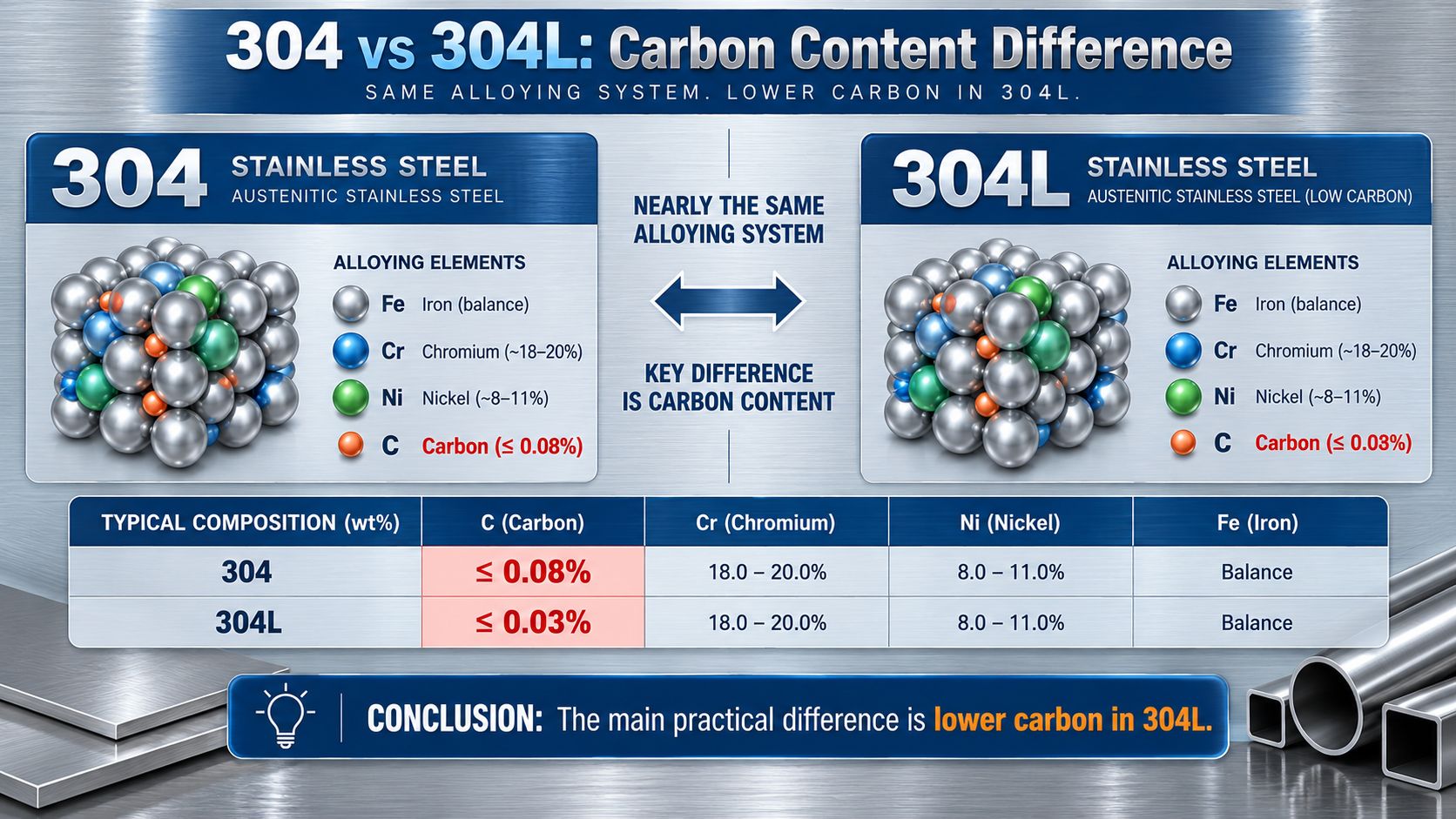
A commonly used comparison is:
- 304: carbon up to approximately 0.08%
- 304L: carbon up to 0.030%
The exact 304 carbon limit can vary with the governing product specification, so a purchasing specification should never rely only on a generic internet composition table.
The lower carbon level in 304L matters because carbon can interact with chromium during certain thermal cycles.
That interaction is particularly relevant during welding.
304 vs 304L Chemical Composition
304 and 304L belong to the same basic chromium-nickel austenitic stainless steel family.
A simplified comparison is:
| Eilimint | 304 | 304l | Main Function |
|---|---|---|---|
| Carbón (c) | Standard limit; commonly ≤0.08% depending on specification | ≤0.030% | Strength and carbide formation |
| Cróimiam (CR) | Typically around 18–20% | Typically around 18–20% | Passive film and corrosion resistance |
| Nicil (Ni) | Typically around 8–11% | Similar, specification dependent | Austenite stability, ductility |
| Mangainéis (MN) | Controlled by specification | Controlled by specification | Deoxidation and alloy balance |
| Silicon (IR) | Controlled by specification | Controlled by specification | Steelmaking / oxidation behavior |
| Fosfar (p) | Áirithe | Áirithe | Residual element |
| Sulfair (í) | Áirithe | Áirithe | Residual element |
| Nítrigin (n) | Controlled depending on specification | Controlled depending on specification | Strength and austenite stability |
| Iarann (Fe) | Cothromaigh | Cothromaigh | Bun-mhiotal |
The most important point is not memorizing every number.
For purchasing purposes:
304 and 304L are very similar alloy systems; the lower carbon limit of 304L is the key selection difference.
When placing an order, always reference the required product standard because composition limits may differ slightly between sheet, plate, pipe, bar and different international specifications.
Why Does Carbon Matter in Stainless Steel?
At normal service temperatures, the difference between the carbon levels of 304 and 304L may appear small.
During welding or prolonged exposure to certain elevated temperatures, however, carbon can interact with chromium.
That can influence the corrosion resistance near grain boundaries.
The process is called íogaireacht.
What Is Stainless Steel Weld Sensitization?

When an austenitic stainless steel such as 304 is held in an approximate temperature range where sensitization can occur—commonly discussed around 450–850°C—carbon can migrate toward grain boundaries.
Carbon can then combine with chromium to form chromium-rich carbides, commonly represented as:
Cr₂₃C₆
The process can be summarized as:
Welding heat
↓
Carbon migrates toward grain boundaries
↓
Carbon + Chromium → Chromium Carbides
↓
Chromium is locally consumed
↓
Chromium-depleted regions develop beside grain boundaries
↓
Local passive-film protection can become weaker
↓
Intergranular corrosion may occur if the material is subsequently exposed to a sufficiently aggressive corrosive environment
This is why the small difference in carbon content between 304 and 304L can have a significant effect in welded fabrication.
What Is the Heat-Affected Zone?
During welding, not all material melts.
The weld metal melts and solidifies, while nearby base metal experiences elevated temperatures without melting.
This surrounding region is called the:
HAZ — Heat-Affected Zone
The HAZ can undergo metallurgical changes because of the welding thermal cycle.
When sensitization occurs, chromium carbide precipitation typically develops in regions affected by the heat cycle rather than uniformly throughout the whole component.
What Is Intergranular Corrosion?
Intergranular corrosion is preferential corrosion along or near the grain boundaries of a metal.
In sensitized stainless steel, chromium carbide formation can reduce the chromium concentration immediately adjacent to grain boundaries.
If those local regions no longer maintain adequate passivity in the service environment, corrosion can progress preferentially along the grain boundaries.
This is sometimes referred to as weld decay when associated with welded stainless steel.
It is important to understand that:
Sensitization does not mean a welded component will automatically corrode.
Actual corrosion still depends on factors such as:
- Service environment
- Teocht
- Exposure time
- Chloride level
- Acidity
- Surface condition
- Welding procedure
- Material thickness
- Heat input
- Post-weld treatment
304L reduces one important metallurgical risk factor: carbon availability for chromium carbide precipitation.
Why Is 304L Often Preferred for Welding?
304L contains less carbon.
Lower carbon means less carbon is available to react with chromium during the relevant welding thermal cycle.
This reduces the tendency for chromium carbide precipitation and therefore lowers the risk of sensitization.

For this reason, 304L is commonly considered for:
- Welded tanks
- Brú soithigh
- Process piping
- Malartóirí teasa
- Food-processing equipment
- Pharmaceutical equipment
- Chemical-processing equipment
- Large welded fabrications
- Heavy plate assemblies
- Multi-pass welding
Can 304 Be Welded?
Absolutely.
304 has excellent weldability and is routinely welded using conventional stainless steel welding processes.
These can include:
- GTAW / TIG
- GMAW / MIG
- SMAW
- FCAW
- SAW in suitable applications
The difference is not:
304 cannot be welded / 304L can be welded.
The more accurate statement is:
Both 304 and 304L are readily weldable, but 304L provides a lower-carbon chemistry that reduces sensitization risk in applications where welding and subsequent corrosion exposure are important.
Common Welding Consumables
Depending on the welding procedure, design code and service requirement, commonly used filler materials for 304/304L can include:
- ER308
- ER308L
- E308
- E308L
Low-carbon filler such as ER308L or E308L is widely used in stainless steel fabrication.
However, filler-metal selection should always follow the qualified Welding Procedure Specification (WPS), governing code and service conditions.
Does 304L Have Better Corrosion Resistance Than 304?
This question is frequently oversimplified.
Frithsheasmhacht Ginearálta i gCreimeadh
In normal, non-sensitized conditions, 304 and 304L generally offer very similar overall corrosion resistance because their principal chromium-nickel alloy systems are very similar.
304L should therefore not automatically be described as a universally more corrosion-resistant stainless steel.
Corrosion Resistance After Welding
The difference becomes more important when welding or thermal exposure creates conditions favorable to sensitization.
304L’s lower carbon content reduces chromium carbide precipitation and helps preserve corrosion resistance around grain boundaries.
That is the important corrosion advantage of 304L.
What About Chlorides?
304L does nach bhfuil become chloride-resistant simply because it contains less carbon.
Neither 304 nor 304L contains the molybdenum addition that gives 316/316L improved resistance to pitting in many chloride environments.
If the application involves:
- Sáile
- Salt spray
- Coastal atmosphere
- De-icing salts
- Chloride-containing chemicals
- Aggressive process solutions
you may need to evaluate:
- 316
- 316L
- 2205 Duplex
- 2507 super duplex
- Other corrosion-resistant alloys
See our detailed comparison of 304 vs 316 Stainless Steel for the next stage of grade selection.
Is 304 Stronger Than 304L?
This also requires a more careful answer than simply saying “yes.”
304 can have somewhat different mechanical-property requirements from 304L depending on:
- Product specification
- Foirm táirge
- Tiús
- Cóireáil teasa
- Coinníollacha a chur le
- Manufacturing process
However, in modern commercial supply, a single heat can sometimes satisfy the requirements for both grades.
This is one reason 304/304L dual-certified material is common.
For engineering and procurement purposes, never assume mechanical properties based only on the grade name.
Check the specific standard and Mill Test Certificate for:
- Neart teanntachta
- Neart toraidh
- Édáileáil
- Hardness where applicable
What Does 304/304L Dual Certified Mean?
International buyers frequently encounter material described as:
304/304L
or:
Dual Certified 304/304L
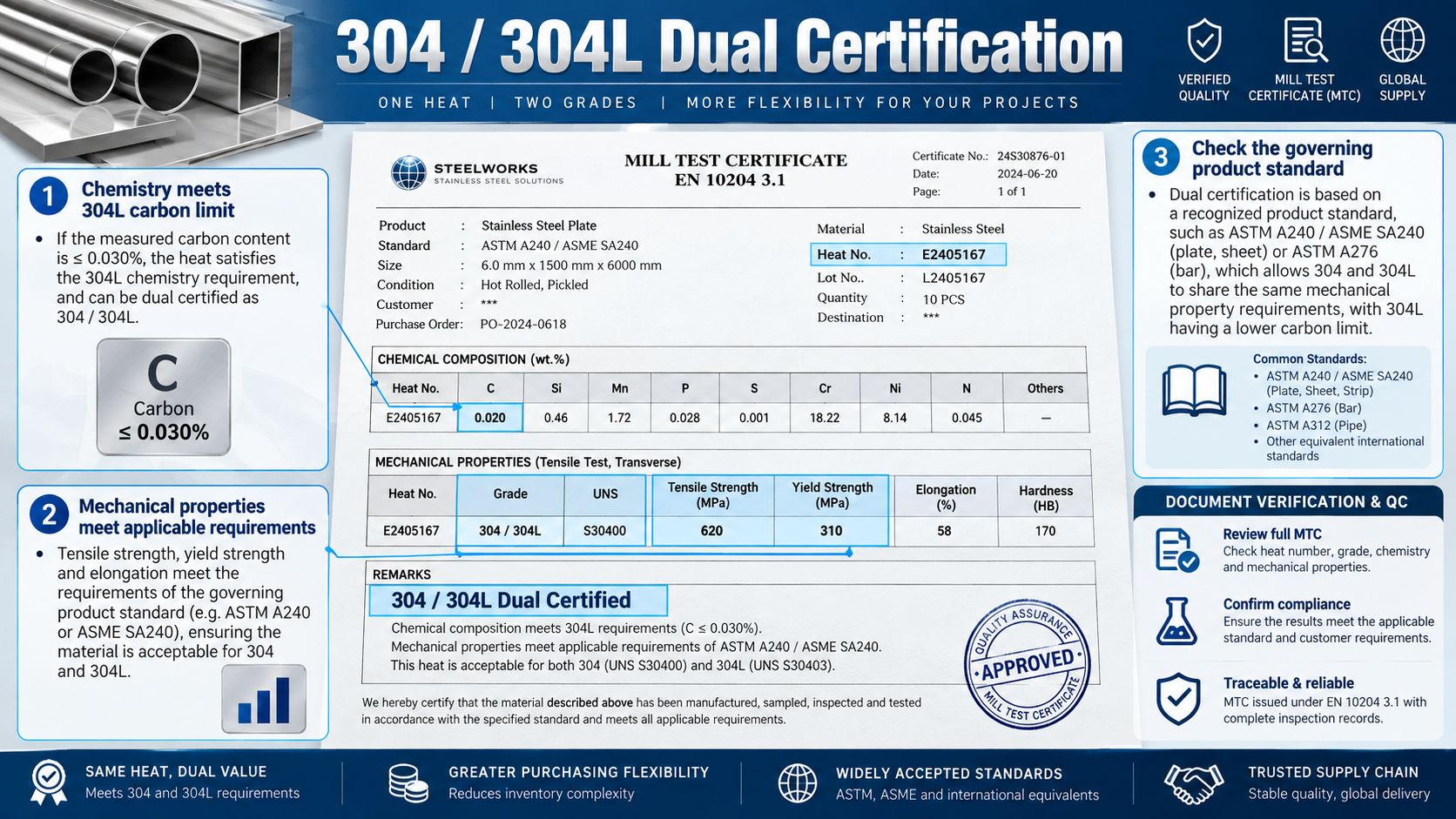
This does not mean the supplier is unsure which grade the steel is.
Dual certification means that the specific material heat satisfies the applicable chemical and mechanical requirements needed to be certified as both 304 and 304L under the relevant product specification.
Why Is Dual Certification Possible?
Imagine a heat of stainless steel with actual carbon content of:
0.020%
That chemistry is below the 0.030% carbon limit normally associated with 304L.
If the same heat also satisfies the required:
- Chromium range
- Nickel range
- Other chemical limits
- Neart teanntachta
- Neart toraidh
- Édáileáil
- Product-specific requirements
for both grades under the applicable standard, the material may be certified as both.
Dual Certification Is More Than Carbon Content
This point is important.
A material is not automatically dual certified simply because carbon is below 0.030%.
The complete certification must comply with the governing specification.
Depending on the product, that might include standards applicable to:
- Scód
- Baol
- Strip
- Píobán
- Feadán
- Bar
Therefore:
Always verify the complete MTC and governing product standard rather than checking only the carbon number.
How to Read a 304/304L Mill Test Certificate
When purchasing stainless steel internationally, the Mill Test Certificate is an important part of material verification.
A typical 304/304L MTC may include the following.
1. Heat Number
An Heat No. connects the material to a specific production heat.
It is the core traceability identifier and should correspond with material markings and production documentation where required.
2. Grade
Look for designations such as:
- 304
- 304l
- 304/304L
- S30400
- S30403
3. Governing Standard
Examples may include standards for:
- Sheet and plate
- Píobán
- Feadán
- Bar
- Forgings
Do not compare chemistry and properties against a standard for a different product form.
4. Carbon Content
For 304L, check that carbon complies with the required low-carbon limit.
5. Chromium and Nickel
Verify the actual heat chemistry against the relevant standard.
6. Mechanical Properties
Check values such as:
- Neart teanntachta
- Neart toraidh
- Édáileáil
- Hardness when specified
7. Dimensions
Confirm:
- Tiús
- Leithead
- Ar fad
- OD
- Tiús balla
- Lárlíne
depending on the product.
8. Material Condition
Examples may include:
- Annealed
- Solution annealed
- Hot rolled
- Cold rolled
- Picilte
- Geal anúnta
9. Certificate Type
International projects may request:
GA 10204 3.1
or another certificate requirement.
10. Additional Test Requirements
Depending on the project:
- PMI
- Intergranular corrosion testing
- NDT
- Tástáil ultrasonach
- Iniúchadh dromchla
- Third-party inspection
may also be specified.
A future detailed Gengfei guide will cover How to Read a Stainless Steel Mill Test Certificate in greater depth.
304 vs 304L by Product Form
The correct grade choice can depend heavily on what is actually being purchased.
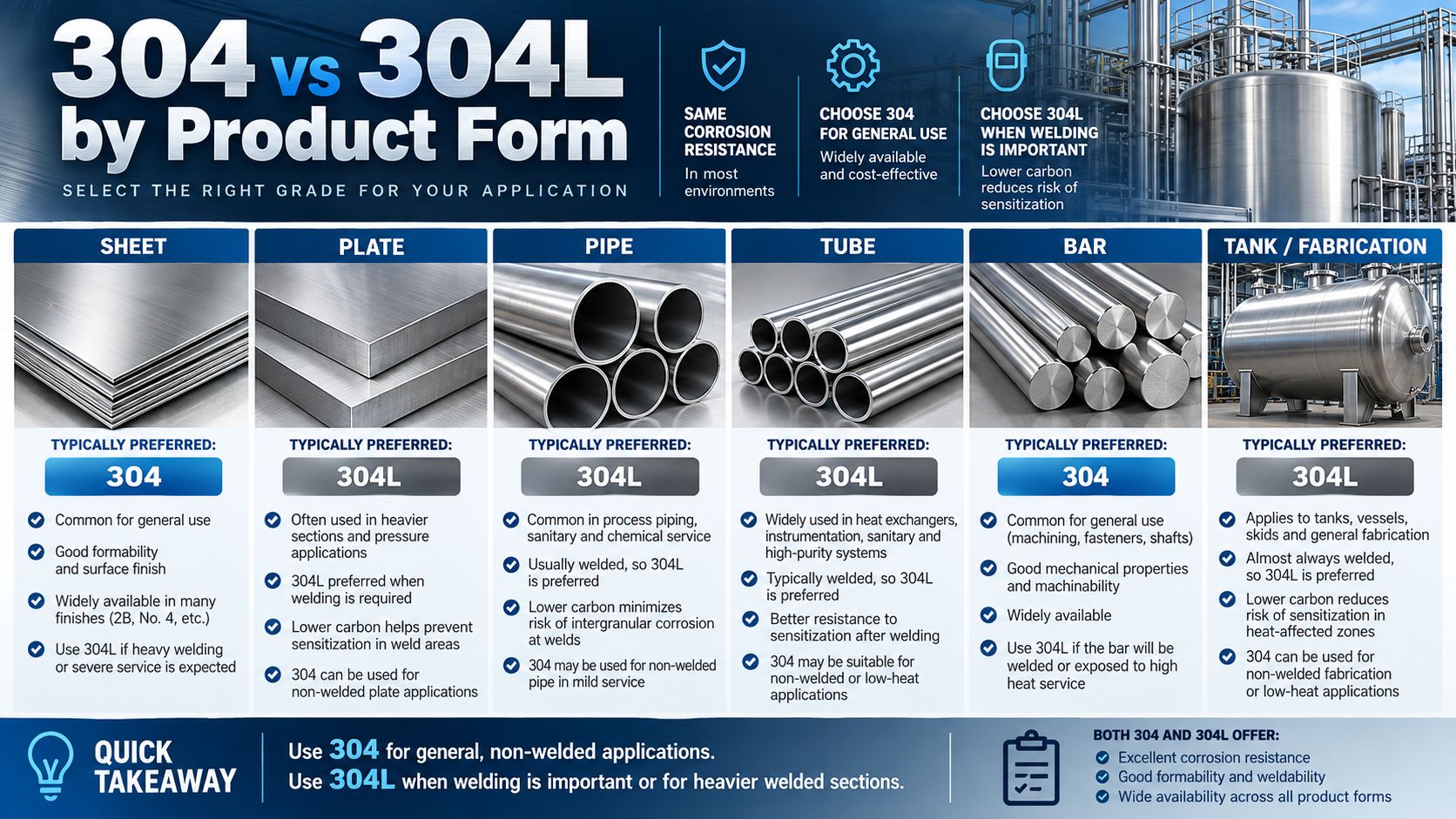
304 vs 304L Stainless Steel Sheet
304 is widely used for general-purpose Bileog cruach dhosmálta applications because it provides:
- Excellent formability
- Friotaíocht Creimthe Maith
- Attractive finishes
- Wide availability
- Táthaitheacht mhaith
Applications include:
- Trealamh cistine
- Appliance panels
- Ailtireacht
- Painéil maisiúil
- Cabinets
- General sheet-metal fabrication
304L sheet becomes particularly useful where the finished sheet components will undergo extensive welding and the service environment makes post-weld intergranular corrosion a concern.
Typical Selection
General formed or decorative sheet → 304
Heavily welded sheet fabrication → consider 304L
304 vs 304L Stainless Steel Plate
The advantage of 304L often becomes more relevant with plate because thick plate assemblies may involve:
- Multi-pass welding
- Higher total heat input
- Pressure fabrication
- Large welded joints
- Complex welded structures
Typical applications include:
- Umair stórála
- Brú soithigh
- Trealamh próiseála
- Skids
- Heavy industrial fabrication
304 is still suitable for many non-welded or lightly welded plate applications.
Typical Selection
General/non-welded plate → 304 may be sufficient
Heavily welded plate → 304L is frequently preferred
304 vs 304L Stainless Steel Pipe
Stainless steel pipe used in process systems commonly requires welding.
304L is therefore very common for:
- Food piping
- Beverage systems
- Chemical-process piping
- Water-treatment equipment
- Pharmaceutical installations
- Industrial fluid systems
The lower carbon content reduces sensitization concerns around welded joints.
See our existing guide to Píobán Cruach Dhosmálta 304L for product-specific information.
304 vs 304L Stainless Steel Tube
304 and 304L tube can be used in:
- Malartóirí teasa
- Sanitary systems
- Feadánra meicniúil
- Instrumentation
- Food-processing equipment
- Pharmaceutical systems
Where substantial welding is involved, 304L is commonly selected.
Where tube is primarily mechanically assembled, bent or used without significant welding, 304 may remain entirely appropriate.
304 vs 304L Stainless Steel Bar
304 bar is commonly used for:
- Machined parts
- Seafta
- Dúntóirí
- Feistis
- Valves
- Mechanical components
If machining rather than welding is the primary manufacturing operation, there may be little practical reason to specify 304L solely for its lower carbon content.
304L bar can still be selected where the final component will be welded or the project specification specifically requires it.
304 vs 304L for Tanks and Fabricated Equipment
This is one area where 304L has a particularly clear practical advantage.
Large:
- Tanks
- Vessels
- Trealamh próiseála
- Fabricated skids
- Welded housings
can contain significant amounts of welding.
For these applications, designers often specify 304L to reduce sensitization risk.
When Should You Use 304 vs 304L?
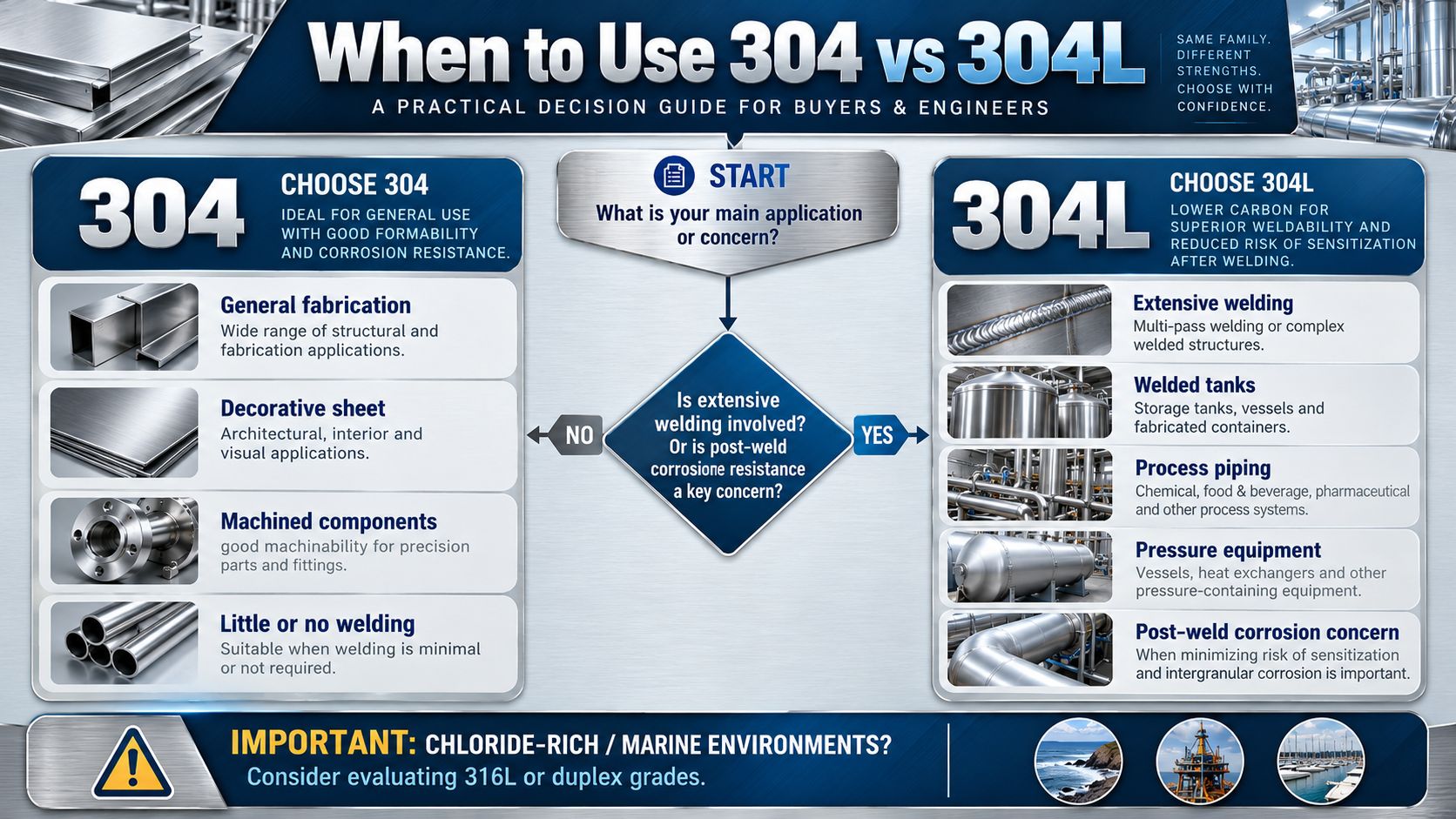
There is no universal rule, but the following selection logic provides a useful starting point.
Choose 304 When
304 is often suitable when:
- There is little or no welding
- The product is primarily formed
- The product is primarily machined
- General-purpose corrosion resistance is sufficient
- Decorative appearance is important
- The project specification explicitly calls for 304
- The component will not experience sensitizing thermal exposure
- 304 is readily available in the required size and finish
Typical examples include:
Decorative Sheet
- Painéil bhalla
- Appliance panels
- Interior architecture
- Kitchen surfaces
Machined Components
- Feistis
- Seafta
- Dúntóirí
- General mechanical parts
Monarú ginearálta
Where welding is limited and the environment is not especially aggressive.
Choose 304L When
304L is often preferred when:
- Extensive welding is required
- Multi-pass welding is involved
- Heavy sections are being fabricated
- Post-weld solution annealing is impractical
- The component will operate in a corrosion-sensitive environment after welding
- Intergranular corrosion risk must be minimized
- The applicable project standard specifically requires a low-carbon grade
Typical examples include:
Welded Tanks
- Food tanks
- Umair stórála
- Process tanks
- Pharmaceutical vessels
Process Piping
- Food and beverage
- Chemical processing
- Pharmaceutical processing
- Water systems
Pressure Equipment
- Brú soithigh
- Malartóirí teasa
- Welded process equipment
Large Fabricated Structures
Especially where substantial welding is required.
304 vs 304L Application Matrix
| Iarrchán | 304 | 304l | Typical Selection Logic |
|---|---|---|---|
| Decorative sheet | ✓✓ | ✓ | 304 usually sufficient |
| Appliance panel | ✓✓ | ✓ | Limited welding |
| Trealamh cistine | ✓✓ | ✓✓ | Depends on fabrication |
| Comhpháirteanna machined | ✓✓ | ✓ | 304 commonly used |
| Bar / shafts | ✓✓ | ✓ | 304 common unless welded |
| General sheet fabrication | ✓✓ | ✓✓ | Both suitable |
| Welded tank | ✓ | ✓✓ | 304L often preferred |
| Pressure vessel | Evaluate | ✓✓ | Code and welding dependent |
| Process piping | ✓ | ✓✓ | 304L commonly specified |
| Sanitary tubing | ✓ | ✓✓ | 304L common when welded |
| Heat exchanger fabrication | Evaluate | ✓✓ | Depends on service |
| Heavy multi-pass weldment | Evaluate | ✓✓ | 304L frequently preferred |
| Seawater service | ✕ | ✕ | Evaluate 316L / duplex |
| Severe chloride service | ✕ | ✕ | Evaluate higher-alloy grades |
✓✓ = commonly preferred✓ = can be suitableEvaluate = review service conditions and specification✕ = grade selection should be reconsidered for the stated environment
304 vs 304L vs 304H
Another member of the 304 family is 304H.
Understanding all three makes the carbon relationship easier to see.
| Grád | Carbon Strategy | Main Purpose |
|---|---|---|
| 304l | Low carbon | Welding / reduced sensitization risk |
| 304 | Standard carbon | General-purpose stainless steel |
| 304H | Higher controlled carbon | Elevated-temperature strength |
304H is designed for applications where elevated-temperature mechanical performance is important.
It should not be assumed that:
lower carbon = always better
or:
higher carbon = always worse
Different carbon levels are used to achieve different performance goals.
Can 304 and 304L Be Welded Together?
Yes, 304 and 304L can commonly be welded to each other when the welding procedure and service conditions allow it.
In many applications, low-carbon filler metals such as ER308L are used.
However, joining two materials successfully involves more than matching grade names.
The welding engineer should consider:
- Base-metal specifications
- Filler metal
- Joint geometry
- Heat input
- Section thickness
- Welding process
- Corrosive environment
- Code requirements
Does 304L Need Post-Weld Heat Treatment?
Ní gá.
One of the advantages of low-carbon 304L is that it reduces sensitization concerns in many conventional welding situations without requiring solution annealing solely to address carbon-related carbide precipitation.
However, post-weld treatment requirements can still depend on:
- Component design
- Fabrication code
- Welding procedure
- Service temperature
- Corrosion environment
- Residual stress requirements
Do not interpret “304L” as meaning that all post-weld treatment considerations disappear.
Does 304L Have Better Weldability?
Both 304 and 304L have excellent weldability.
It is therefore more precise to say:
304L offers greater resistance to sensitization during welding because of its lower carbon content.
Rather than simply saying:
“304L can be welded and 304 cannot.”
That distinction is important for engineering accuracy.
304 vs 304L Surface Finishes
Both grades can be supplied in similar common surface finishes.
Depending on the product form, these may include:
- Uimh.1
- 2b
- Ba
- U.4
- Bain gruaige
- Mirror / 8K
- Picilte
- Snasta
For most visual applications, it is impossible to identify 304 versus 304L by appearance alone.
Both can look essentially identical.
Can a Magnet Tell 304 from 304L?
No.
A magnet cannot reliably distinguish 304 from 304L.
Both are austenitic stainless steels and are normally non-magnetic or only weakly magnetic in the annealed condition.
Cold work can introduce some magnetic response.
More importantly, the key difference between the grades is carbon content—and ordinary field magnet testing cannot measure carbon.
Positive verification may require:
- Material documentation
- Heat-number traceability
- Laboratory chemical analysis
- Appropriate PMI / analytical testing
Note that many handheld XRF instruments are not designed to accurately measure low carbon. If separating 304 from 304L specifically by carbon content is required, an appropriate analytical method should be used.
What Does 304L Cost Compared with 304?
There is no reliable fixed percentage difference.
304 and 304L prices depend on:
- Nickel market
- Muileann
- Foirm táirge
- Tiús
- Lárlíne
- Bailchríoch
- Order quantity
- Infhaight
- Thuisíonn
- Origin
- Deimhniú
- Freight
Because dual-certified 304/304L material is common in many markets, the price difference may sometimes be very small.
In other cases, availability in a specific:
- Dimension
- Bailchríoch
- Caighdeánach
- Foirm táirge
can affect the quotation more than the grade name itself.
For purchasing, it is usually better to request actual quotations than to assume a fixed 304-to-304L price premium.
How to Specify 304 or 304L in an RFQ
One of the easiest ways to create procurement problems is to send a supplier an incomplete specification.
Mar shampla:
Need 304L plate.
is not enough information for a precise quotation.
A stronger RFQ would look like:
ASTM A240 Type 304L stainless steel plate, 6 mm × 1500 mm × 6000 mm, No.1 finish, 20 MT, EN 10204 3.1 MTC required.
A good stainless steel RFQ should include:
Grád
Mar shampla:
- 304
- 304l
- 304/304L dual certified if acceptable
Product Standard
Specify the exact applicable specification.
Foirm táirgí
Mar shampla:
- Scód
- Baol
- Coláiste
- Strip
- Píobán
- Feadán
- Bar
Toisí
Examples:
Sheet / Plate
- Tiús
- Leithead
- Ar fad
Pipe / Tube
- OD / NPS
- Wall thickness / schedule
- Ar fad
Bar
- Lárlíne
- Ar fad
Bailchríoch
Examples:
- Uimh.1
- 2b
- Ba
- U.4
- Bain gruaige
- Scáthán
Quantity
Specify:
- Pieces
- Metric tons
- Coil quantity
- Annual volume
as appropriate.
Deimhniú
Examples:
- Mill Test Certificate
- GA 10204 3.1
- Third-party inspection
- PMI
- NDT
Thuisíonn
Examples:
- Gearr go méid
- Slitting
- Snasú
- Laser cutting
- Beveling
Destination
For export quotations, include:
- Tuath
- Port
- Incoterm if known
This allows the supplier to quote the correct material rather than making assumptions.
Should You Specify 304, 304L, or Dual-Certified 304/304L?
A useful purchasing decision is:
Specify 304 When
- The design explicitly requires 304
- Extensive welding is not a concern
- General-purpose performance is adequate
- 304 satisfies the governing code
Specify 304L When
- Low carbon is technically required
- Significant welding is expected
- Project specifications require S30403
- Post-weld sensitization is a concern
Accept Dual-Certified 304/304L When
- The governing specification permits it
- The material meets both grade requirements
- The MTC clearly demonstrates compliance
- The project or client specification accepts dual certification
For code-controlled projects, final acceptance should always follow the project specification, design code and responsible engineer—not a supplier’s generic recommendation.
304 vs 304L vs 316L: Do You Actually Need a Different Grade?
Sometimes the correct answer to “304 or 304L?” is:
Neither.
If the service environment contains significant chloride exposure, choosing the low-carbon variant does not solve the fundamental chloride-corrosion problem.
Consider moving beyond the 304 family when the material will face:
- Sáile
- Sáile
- Coastal splash zones
- High chloride concentration
- Aggressive chemical environments
- High pitting risk
In these cases, buyers may need to evaluate:
316L
or, for more demanding environments:
2205 Duplex
2507 Super Duplex
This distinction prevents a common purchasing mistake:
Choosing 304L because it is assumed to be a “better 304” when the actual problem requires a different alloy chemistry.
Gengfei Steel 304 and 304L Stainless Steel Supply
Gengfei Steel supplies 304, 304L and dual-certified stainless steel materials for international manufacturing, fabrication and project requirements.
Our broader stainless steel product range includes:
- Bileog cruach dhosmálta
- Stainless steel plate
- Corna cruach dhosmálta
- Stiall cruach dhosmálta
- Stainless steel pipe
- Stainless steel tube
- Stainless steel bar
- Stainless steel angle
- Other processed stainless products
For buyers focusing specifically on the 304 family, see:
- 304 Stainless Steel: Properties, Uses and Selection Guide
- Bileog chruach dhosmálta 30 / 304L
- Píobán Cruach Dhosmálta 304L
- 304 vs 316 Stainless Steel
- What Is Stainless Steel? Types, Grades, Properties & Uses
When requesting a quotation, send us the:
grade + standard + product form + dimensions + finish + quantity + certification + processing + destination
so the material can be matched to the actual purchasing specification.
Ceisteanna coitianta
What is the main difference between 304 and 304L stainless steel?
The main practical difference is carbon content. 304L has a lower maximum carbon level, which reduces the risk of chromium carbide precipitation and sensitization during certain welding and thermal exposures.
What does the L in 304L mean?
An L means low carbon.
304L normally has a maximum carbon content of approximately 0.030%.
Is 304L better than 304?
Not universally.
304 is excellent for general-purpose applications.
304L becomes particularly advantageous when extensive welding or sensitization-related corrosion is a concern.
Is 304L more corrosion resistant than 304?
In normal, non-sensitized service, their general corrosion resistance is very similar.
304L’s main corrosion advantage is its reduced susceptibility to intergranular corrosion associated with sensitization after certain thermal exposures.
Can 304 stainless steel be welded?
Tá.
304 is highly weldable and is widely used in welded fabrication.
304L is often selected for more demanding welded applications because its lower carbon content reduces sensitization risk.
Is 304L weaker than 304?
Mechanical-property differences depend on the governing standard, product form and material condition.
Do not assume strength from the grade name alone. Review the applicable specification and MTC.
Can 304 and 304L be welded together?
Yes, they are commonly welded together when permitted by the applicable welding procedure and project specification.
What filler is used for 304 and 304L?
ER308L / E308L is widely used for welding 304 and 304L, although actual filler selection should follow the qualified WPS and service requirements.
What is 304/304L dual-certified stainless steel?
Dual-certified material meets the applicable requirements for both 304 and 304L under the governing product specification.
A typical dual-certified heat has sufficiently low carbon to satisfy 304L chemistry while also meeting the applicable mechanical requirements for both grades.
Does carbon below 0.03% automatically mean the steel is dual certified?
No.
Low carbon is only one requirement.
The material must satisfy all applicable chemical, mechanical and product-standard requirements for both certifications.
Can dual-certified 304/304L be used when the drawing requires 304L?
Potentially yes if the material satisfies the required specification and project requirements.
For code-controlled equipment, verify acceptance with the governing specification and responsible engineer.
Is 304L suitable for seawater?
304L should not automatically be selected for seawater simply because it is low carbon.
For chloride-rich environments, evaluate 316L, duplex or another more corrosion-resistant grade.
Is 304L more expensive than 304?
Ní gá.
Price differences depend heavily on availability, product form, dimensions, mill, market conditions and whether dual-certified stock is available.
Can you identify 304 vs 304L with a magnet?
No.
Their key difference is carbon content, which cannot be reliably determined using a magnet.
Can handheld XRF distinguish 304 from 304L?
Typical handheld XRF is useful for identifying major alloying elements such as chromium and nickel, but it is generally not the preferred method for accurately distinguishing the low carbon difference between 304 and 304L.
Suitable carbon analysis and documentation should be used where positive differentiation is required.
Which should I choose for a welded tank?
304L is commonly preferred for heavily welded tanks and vessels because of its lower sensitization risk.
However, the service medium, temperature, pressure, code and corrosion environment must also be considered.
Which should I choose for stainless steel sheet?
For general forming, decorative or lightly welded sheet applications, 304 is widely used.
For heavily welded assemblies, 304L may be preferred.
Which should I choose for process piping?
304L is commonly selected for welded process piping where the 304 alloy family provides sufficient corrosion resistance.
If chlorides or aggressive chemicals are present, consider whether 316L or a higher-alloy grade is required.
Final Selection: 304 or 304L?
For most buyers, the decision can be reduced to one central question:
How important is welding and post-weld corrosion performance in this application?
If the material is intended for:
- General sheet-metal fabrication
- Painéil maisiúil
- Comhpháirteanna machined
- Lightly welded products
- Standard general-purpose service
304 is often an appropriate and economical choice.
If the material is intended for:
- Extensive welding
- Heavy welded plate
- Tanks
- Pressure equipment
- Process piping
- Sanitary systems
- Welded structures where sensitization must be minimized
304L is frequently the more appropriate choice.
But carbon content is only one part of stainless steel selection.
If the real challenge is chloride exposure, seawater, aggressive chemicals or unusually high strength, the correct answer may be neither 304 nor 304L.
The most reliable purchasing process is therefore:
Define the environment → define fabrication → define the governing standard → select the grade → verify the MTC → issue the RFQ.
That approach is far more reliable than simply specifying “304 stainless steel” and assuming all 304-family materials are interchangeable.
