
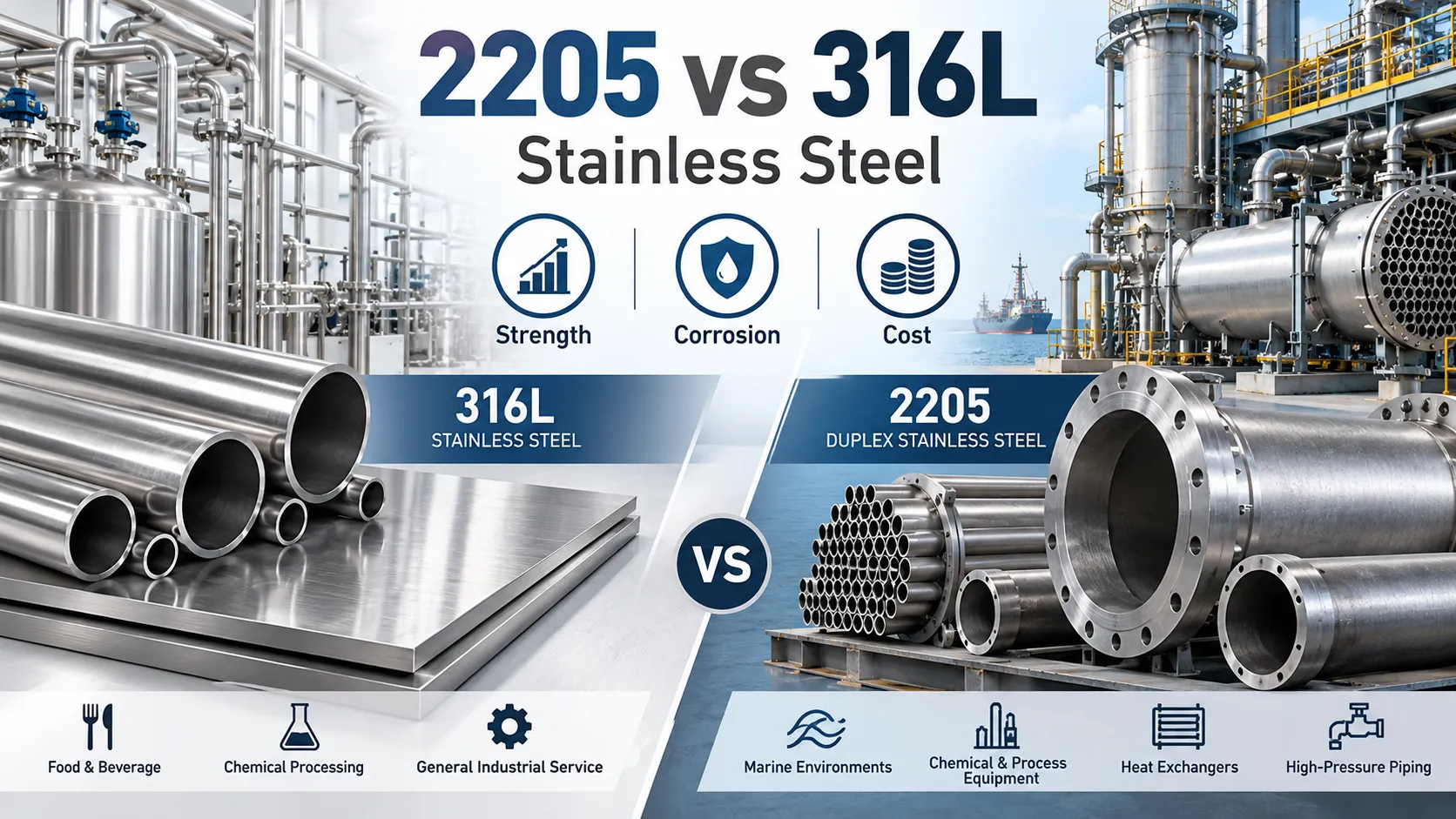
Duplex 2205 stainless steel offers significantly higher strength and better resistance to chloride-related pitting and stress corrosion cracking than 316L. However, 316L remains an excellent choice for many industrial applications because of its established weldability, formability, toughness, and broad availability.
The decision between 2205 and 316L is not simply about choosing the material with higher corrosion resistance.
For engineers and industrial buyers, the more important questions are:
- Does the operating environment require the additional chloride resistance of 2205?
- Can higher material strength reduce wall thickness or equipment weight?
- Will fabrication and welding become more complicated?
- Does the design involve pressure, temperature, or cyclic loading?
- What is the difference between S31803 and S32205?
- Will the higher-performance alloy reduce total installed cost?
- Which grade is permitted by the applicable engineering code?
A 316L process tank, a Duplex 2205 offshore pipeline, and a high-pressure chemical vessel can have very different material requirements, even when they operate within the same industrial facility.
This guide compares 2205 duplex stainless steel and 316L austenitic stainless steel from an engineering and procurement perspective, including chemical composition, mechanical strength, corrosion performance, fabrication, costs, standards, and material certification.
2205 vs 316L Stainless Steel: Quick Comparison
| Property | 316L Stainless Steel | Duplex 2205 Stainless Steel |
|---|---|---|
| Stainless steel family | Austenitic | Austenitic-Ferritic |
| UNS designation | S31603 | S31803 / S32205 |
| EN designation | 1.4404 | 1.4462 |
| Typical chromium | 16–18% | Approximately 22% |
| Typical nickel | 10–14% | Approximately 4.5–6.5% |
| Typical molybdenum | 2–3% | Approximately 3–3.5% |
| Nitrogen | Relatively low | Higher |
| Microstructure | Austenitic | Ferrite + Austenite |
| Minimum yield strength* | Approximately 170 MPa | Approximately 450 MPa |
| Minimum tensile strength* | Approximately 485 MPa | Approximately 655 MPa for S32205 |
| Elongation* | Approximately 40% | Approximately 25% |
| Typical PREN | Approximately 24–26 | Approximately 35 |
| Pitting resistance | Good | Higher |
| Crevice corrosion resistance | Good | Higher |
| Chloride SCC resistance | More susceptible in certain conditions | Significantly improved |
| Magnetic behavior | Usually low when annealed | Magnetic |
| Formability | Excellent | Higher forming forces required |
| Weldability | Excellent | Good, but more process-sensitive |
| Fabrication complexity | Relatively straightforward | More specialized |
| Potential for wall reduction | Baseline | Higher in suitable designs |
| Typical applications | Food, pharma, tanks, piping | Chemical, offshore, pressure systems |
| Main advantage | Fabrication flexibility | Strength + chloride corrosion resistance |
Mechanical values are representative minimum requirements for commonly specified annealed ASTM A240 flat-product grades. Product form, thickness, standard, and delivery condition affect the applicable requirements.
Quick selection: Choose 316L when its corrosion resistance and strength are sufficient and fabrication flexibility is important. Consider Duplex 2205 when higher strength, chloride resistance, or reduced susceptibility to chloride stress corrosion cracking can provide meaningful engineering value.
What Is the Main Difference Between Duplex 2205 and 316L?
The fundamental difference is their metallurgical structure.
316L is an austenitic stainless steel.
Duplex 2205 contains both austenite and ferrite.
This combined structure is one reason 2205 provides higher strength and improved resistance to certain corrosion mechanisms.
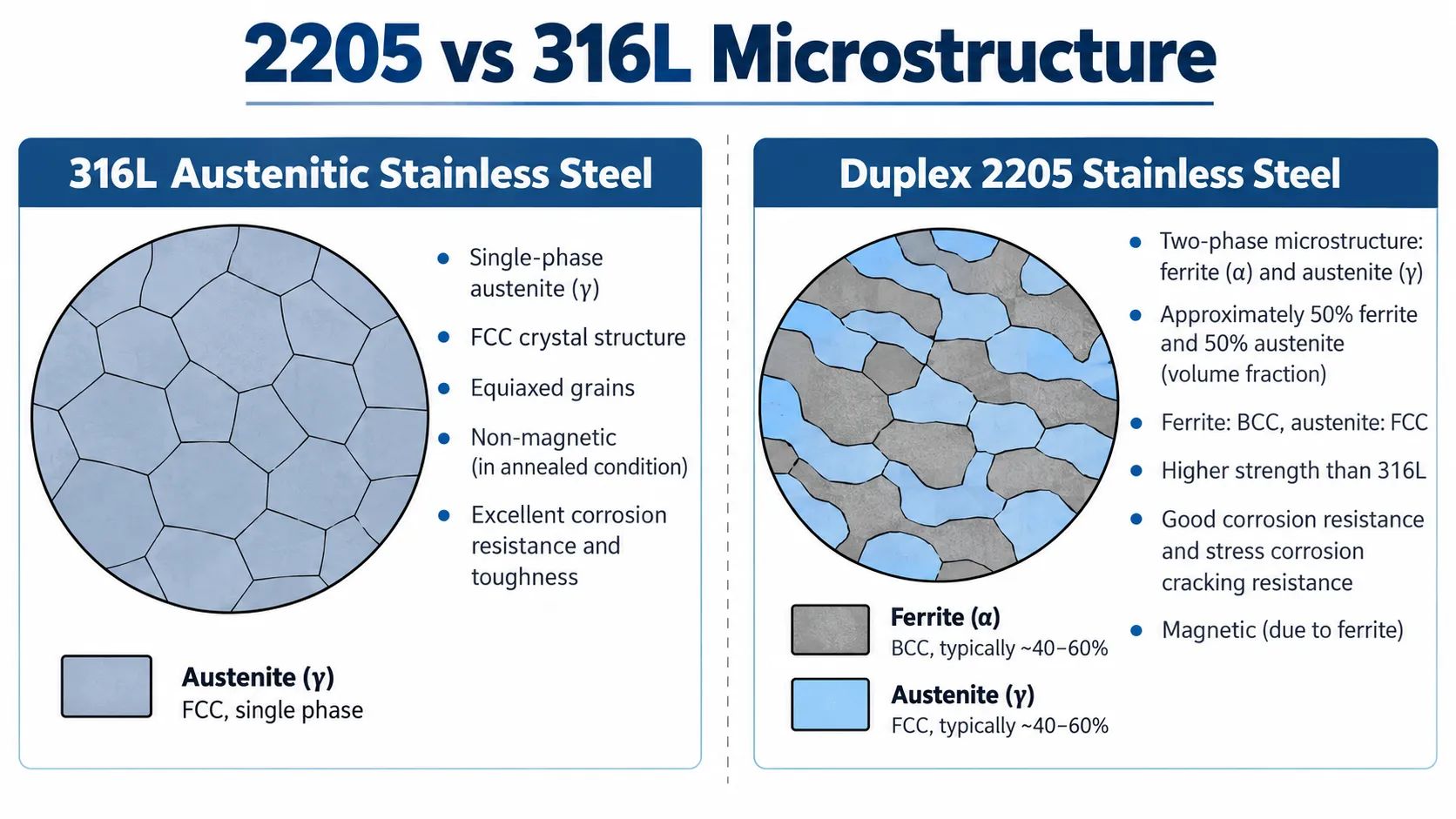
Simplified schematic illustration. Actual phase morphology and fractions depend on processing and heat treatment.
316L Austenitic Stainless Steel
316L is a low-carbon chromium-nickel-molybdenum stainless steel.
Its austenitic structure provides:
- Excellent ductility
- Excellent formability
- Good toughness
- Good weldability
- Broad industrial corrosion resistance
316L is widely used for tanks, process equipment, food-processing systems, pharmaceutical equipment, and stainless steel piping.
Its low carbon content reduces sensitization-related intergranular corrosion concerns during welding.
For a comparison within the 316 family, read our 316 vs 316L Stainless Steel Guide.
Duplex 2205 Stainless Steel
Duplex 2205 contains approximately balanced proportions of:
- Austenite (γ)
- Ferrite (α)
The actual phase balance depends on composition, solution treatment, welding, and manufacturing history.
Duplex 2205 combines useful properties of both phases.
Its advantages include:
- High yield strength
- Good toughness in its specified service range
- Improved pitting resistance
- Improved crevice corrosion resistance
- Better resistance to chloride stress corrosion cracking
- Lower thermal expansion than conventional austenitic stainless steels
This combination makes 2205 particularly attractive for structural and pressure-containing components in chloride-bearing industrial environments.
2205 vs 316L Chemical Composition
The performance difference between these materials is closely related to their chromium, nickel, molybdenum, and nitrogen contents.
| Element | 316L / S31603 | Duplex 2205 / S32205 |
|---|---|---|
| Carbon (C) | ≤0.030% | ≤0.030% |
| Chromium (Cr) | 16.0–18.0% | 22.0–23.0% |
| Nickel (Ni) | 10.0–14.0% | 4.5–6.5% |
| Molybdenum (Mo) | 2.0–3.0% | 3.0–3.5% |
| Nitrogen (N) | ≤0.10% | 0.14–0.20% |
| Manganese (Mn) | ≤2.0% | ≤2.0% |
| Silicon (Si) | Controlled by standard | Controlled by standard |
| Iron (Fe) | Balance | Balance |
Values represent commonly specified ASTM chemistry requirements. Buyers should verify the applicable edition and product specification.
Chromium: Passive Film and Corrosion Resistance
Chromium helps create the protective passive film on stainless steel surfaces.
Duplex 2205 contains approximately 22% chromium, compared with approximately 16–18% in 316L.
The additional chromium contributes to its corrosion resistance.
However, chromium content alone does not fully determine performance.
Molybdenum and nitrogen are particularly important when evaluating chloride-induced localized corrosion.
Nickel: Why Does 2205 Contain Less Nickel?
316L uses nickel to stabilize its austenitic structure.
Duplex 2205 requires less nickel because its intended structure combines austenite with ferrite.
The lower nickel content does not mean 2205 is a lower-grade stainless steel.
Its higher chromium, molybdenum, and nitrogen contents, combined with its two-phase microstructure, produce a different performance profile.
From a purchasing perspective, the lower nickel content also means 2205 pricing does not respond to nickel markets in exactly the same way as 316L.
However, it does not guarantee that 2205 will always be cheaper.
Molybdenum: Improved Localized Corrosion Resistance
Molybdenum helps improve resistance to:
- Pitting corrosion
- Crevice corrosion
- Certain chloride-containing environments
2205 generally contains more molybdenum than 316L.
Together with higher chromium and nitrogen, this contributes to the alloy’s higher PREN.
Nitrogen: Strength and Corrosion Resistance
Nitrogen is particularly important in duplex stainless steels.
It helps:
- Stabilize austenite
- Increase strength
- Improve pitting resistance
- Support the desired duplex microstructure
The relatively high nitrogen content of 2205 is one of the reasons its strength and localized corrosion resistance are significantly different from 316L.
S31803 vs S32205: Are All 2205 Stainless Steels the Same?
This is an important procurement question.
Duplex 2205 is commonly associated with two UNS designations:
- UNS S31803
- UNS S32205
They belong to the same general duplex alloy family, but their specified chemistry is not identical.
Chemical Composition Differences
| Element | S31803 | S32205 |
|---|---|---|
| Chromium | 21.0–23.0% | 22.0–23.0% |
| Nickel | 4.5–6.5% | 4.5–6.5% |
| Molybdenum | 2.5–3.5% | 3.0–3.5% |
| Nitrogen | 0.08–0.20% | 0.14–0.20% |
| Carbon | ≤0.030% | ≤0.030% |
S32205 has tighter minimum requirements for chromium, molybdenum, and nitrogen.
This generally provides greater consistency in the alloy’s intended corrosion-resistance characteristics.
Why Does the Difference Matter?
A material that meets the broader S31803 chemistry range does not necessarily meet S32205 requirements.
For example, lower molybdenum or nitrogen levels permitted under S31803 may produce a lower PREN than a typical S32205 heat.
Therefore, buyers should avoid specifying only:
Duplex 2205 stainless steel.
For demanding projects, specify the actual required designation.
For example:
ASTM A240 UNS S32205 Duplex Stainless Steel Plate.
Can 2205 Be Dual Certified as S31803/S32205?
Yes, a heat may be certified to both designations when it satisfies all applicable requirements for both grades under the governing product specification.
However, dual certification must be supported by:
- Chemical composition
- Mechanical properties
- Applicable material standard
- Material condition
- Mill Test Certificate
Do not assume that every product marketed as 2205 is automatically S32205 or dual certified.
Mechanical Properties: How Much Stronger Is 2205 Than 316L?
Mechanical strength is one of the main reasons engineers consider replacing 316L with Duplex 2205.
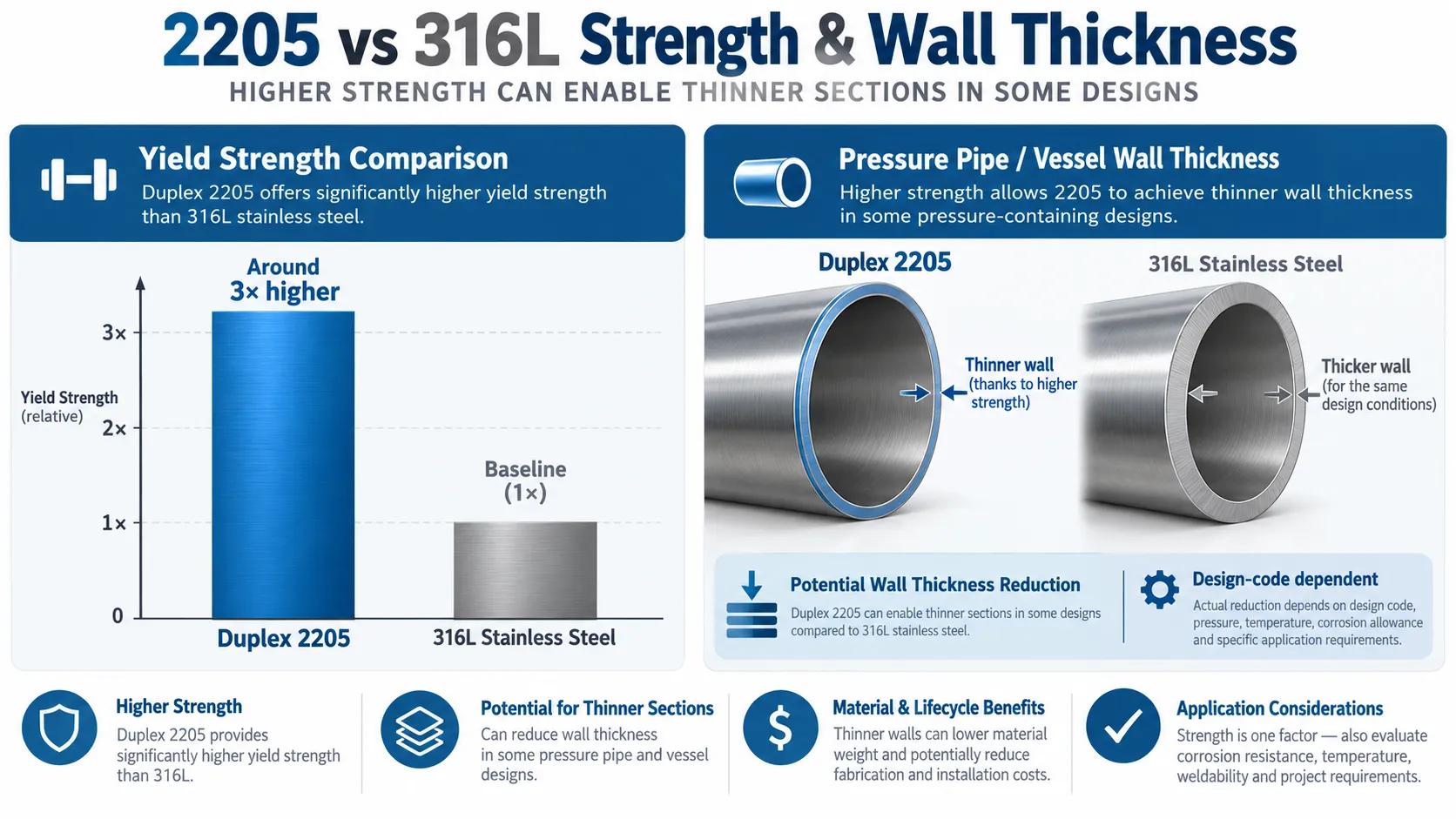
Conceptual design comparison. Actual wall thickness must be determined using the governing engineering code and loading conditions.
Mechanical Property Comparison
The following values are representative minimum requirements for commonly specified ASTM A240 annealed flat products.
| Mechanical Property | 316L / S31603 | 2205 / S32205 |
|---|---|---|
| 0.2% Yield Strength | ≥170 MPa | ≥450 MPa |
| Tensile Strength | ≥485 MPa | ≥655 MPa |
| Elongation | ≥40% | ≥25% |
| Hardening by cold working | Yes | Yes |
| Magnetic behavior | Generally low when annealed | Magnetic |
| Relative yield strength | Baseline | Approximately 2.65× |
| Forming force | Lower | Generally higher |
These values are specification minima rather than actual measured values for every delivered heat.
Product standards for pipe, tube, bar, and forgings may establish different requirements.
Why Is Duplex 2205 Stronger?
The higher strength of 2205 results from several factors, including:
- Nitrogen alloying
- Ferrite-austenite microstructure
- Alloy composition
- Microstructural strengthening
316L remains a useful engineering material, but it has substantially lower specified yield strength in common annealed conditions.
This difference can be valuable where equipment weight, wall thickness, or structural loading is important.
Does 2205 Have Three Times the Strength of 316L?
It depends on which mechanical property is being compared.
Using the example minimum yield strengths:
450 MPa ÷ 170 MPa ≈ 2.65
Thus, 2205 has approximately 2.65 times the specified minimum yield strength of 316L in this comparison.
However, tensile-strength ratios are much smaller.
It is therefore more accurate to state:
Duplex 2205 offers substantially higher yield strength than annealed 316L, but the comparison depends on the mechanical property and specification used.
Can Duplex 2205 Reduce Pipe Wall Thickness?
Potentially, yes.
This is one of the most commercially important advantages of duplex stainless steel.
Pressure pipes, tanks, and vessels must be designed to withstand the applicable pressure, temperature, and mechanical loading.
In some strength-controlled applications, the higher allowable stress of 2205 may permit thinner sections than 316L.
However, the actual reduction must be determined through engineering calculations.
Why Higher Strength Can Reduce Material Consumption
A pressure component must satisfy requirements such as:
- Internal pressure
- External pressure
- Allowable stress
- Temperature
- Corrosion allowance
- Fabrication tolerance
- Minimum wall thickness
- Joint efficiency
- Fatigue
- Buckling
- Applicable design code
If strength is the controlling factor, a higher-strength material may reduce the required section thickness.
Lower thickness can reduce:
- Raw material consumption
- Component weight
- Transportation weight
- Installation loads
- Supporting structural requirements
However, higher yield strength does not mean the wall thickness can automatically be reduced by the same percentage.
Pipe Weight Formula
For a straight pipe, the theoretical mass per meter can be calculated using:
Weight (kg/m) = π × (OD − t) × t × Density / 1,000,000
Where:
- OD = outside diameter in mm
- t = nominal wall thickness in mm
- Density = kg/m³
For commonly used design approximations:
- 316L density ≈ 8,000 kg/m³
- Duplex 2205 density ≈ 7,800 kg/m³
Illustrative Pipe Weight Comparison
Consider two pipes with the same outside diameter but different wall thicknesses.
| Parameter | 316L Example | Duplex 2205 Example |
|---|---|---|
| Outside diameter | 88.9 mm | 88.9 mm |
| Assumed wall thickness | 5.0 mm | 4.0 mm |
| Assumed density | 8,000 kg/m³ | 7,800 kg/m³ |
| Approximate weight | 10.54 kg/m | 8.32 kg/m |
| Weight reduction | Baseline | About 21% |
This example illustrates the mass difference between two hypothetical pipe geometries.
It does not establish that a 4 mm 2205 pipe can replace a 5 mm 316L pipe at any particular design pressure.
A real substitution must be verified against the applicable pressure design code, design temperature, minimum wall tolerance, corrosion allowance, and all relevant mechanical loads.
When Thickness Reduction May Not Be Possible
Wall reduction may be limited by:
- Standard pipe schedules
- Minimum practical fabrication thickness
- Corrosion allowance
- External pressure
- Buckling resistance
- Fatigue requirements
- Vibration
- Handling damage
- Weld joint requirements
- Minimum code thickness
For example, if a pipe is already at the minimum permitted manufacturing thickness, higher alloy strength may not create any meaningful weight saving.
The engineering value of 2205 must therefore be evaluated on a project-by-project basis.
2205 vs 316L Corrosion Resistance
Corrosion performance is the second major reason to consider Duplex 2205.
The difference is particularly important in chloride-containing environments.
316L provides good corrosion resistance in many industrial environments, but it can suffer localized corrosion when chloride concentration, temperature, or crevice conditions become severe.
Duplex 2205 offers a higher resistance margin against several of these mechanisms.
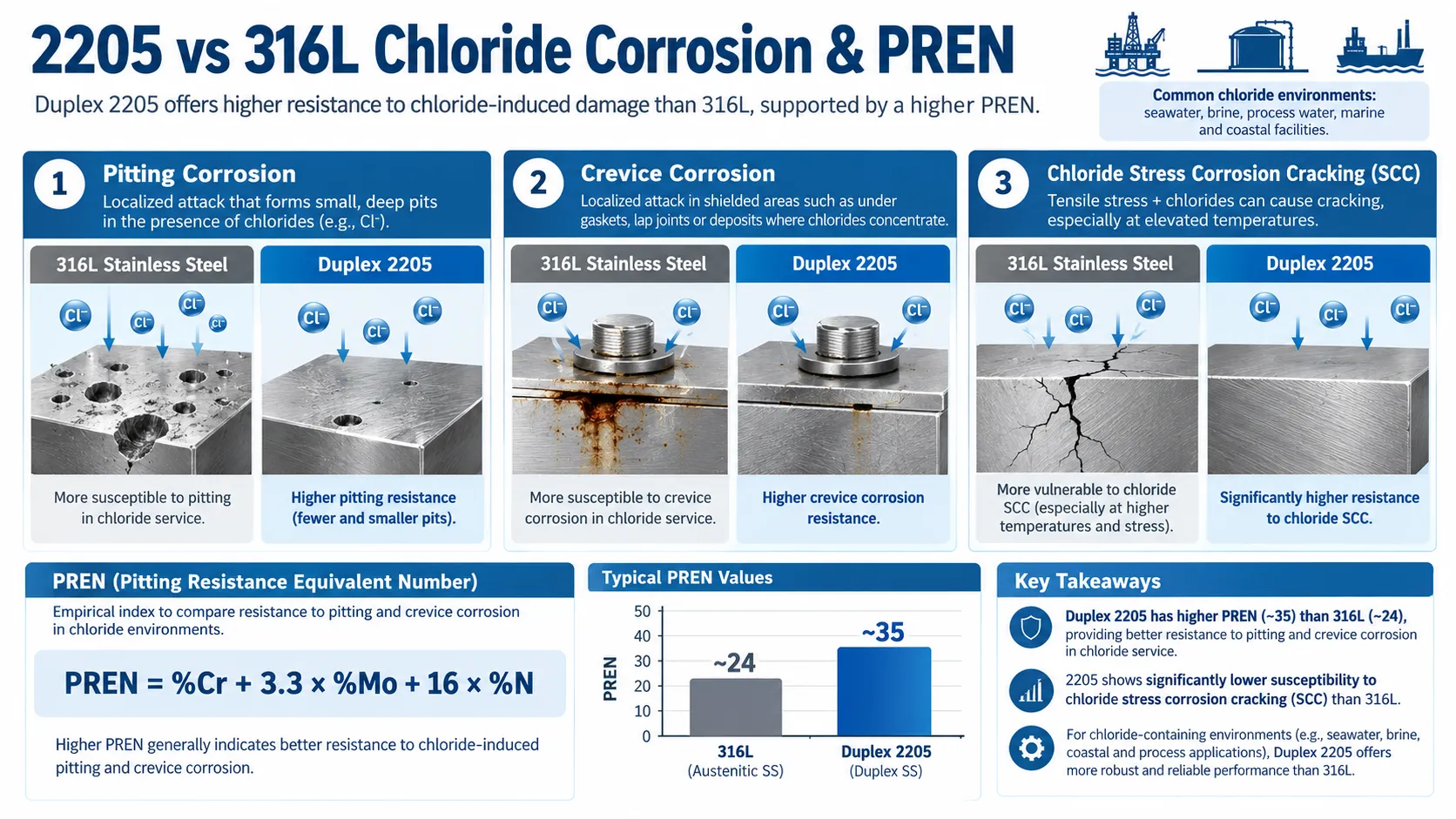
Engineering illustration showing typical relative behavior. It is not a measured corrosion test of the displayed specimens.
General Corrosion
General corrosion involves material loss over a larger exposed surface.
2205 and 316L both provide excellent corrosion resistance in many environments.
However, neither alloy is universally resistant to all acids, alkalis, or industrial chemicals.
The correct material depends on:
- Chemical composition
- Concentration
- Temperature
- Oxygen availability
- Flow conditions
- Contamination
For example, a material suitable for one chloride-containing solution may perform poorly in another chemical medium.
Pitting Corrosion
Pitting is localized corrosion that produces small, potentially deep cavities.
Chloride ions are a common factor in stainless steel pitting.
Duplex 2205 has higher chromium, molybdenum, and nitrogen contents than 316L.
These elements contribute to its higher resistance to chloride-induced pitting.
Crevice Corrosion
Crevice corrosion occurs in restricted areas such as:
- Gasket joints
- Bolted connections
- Lap joints
- Deposits
- Flange faces
- Under washers
These areas can develop localized chemistry that is more aggressive than the bulk environment.
2205 generally offers higher crevice-corrosion resistance than 316L in comparable chloride environments.
However, even 2205 can suffer crevice corrosion under sufficiently severe conditions.
Chloride Stress Corrosion Cracking
Chloride stress corrosion cracking, commonly abbreviated SCC, can occur when a susceptible alloy is exposed to the appropriate combination of:
- Chlorides
- Tensile stress
- Temperature
- Electrochemical conditions
Conventional austenitic stainless steels such as 316L can become susceptible under certain operating conditions.
Duplex 2205 generally provides substantially better resistance to chloride SCC.
This is especially important for:
- Process piping
- Heat exchangers
- High-pressure components
- Chemical plants
- Offshore equipment
However, better SCC resistance does not mean complete immunity.
Material selection must still consider the actual service conditions.
PREN Comparison: Why Is 2205 More Resistant to Chloride Pitting?
PREN stands for:
Pitting Resistance Equivalent Number
It is an empirical index commonly used to compare the relative pitting resistance of stainless steel alloys.
A widely used formula is:
PREN = %Cr + 3.3 × %Mo + 16 × %N
Where:
- Cr = chromium content by weight
- Mo = molybdenum content by weight
- N = nitrogen content by weight
Typical PREN Values
| Material | Chromium | Molybdenum | Nitrogen | Approximate PREN |
|---|---|---|---|---|
| 316L | 17% | 2.2% | Low | 24–26 |
| Duplex 2205 / S32205 | 22% | 3.2% | 0.18% | About 35 |
Actual PREN varies with the heat chemistry and calculation convention.
For an illustrative S32205 composition:
PREN = 22 + (3.3 × 3.2) + (16 × 0.18)
PREN = 22 + 10.56 + 2.88
PREN ≈ 35.44
What Does a Higher PREN Mean?
A higher PREN generally indicates improved resistance to chloride-induced pitting.
However, PREN is not a direct measure of:
- Guaranteed service life
- Corrosion rate
- Crevice corrosion immunity
- SCC resistance
- Suitability for continuous seawater immersion
Actual performance also depends on welding, surface condition, temperature, chloride concentration, deposits, and component design.
For critical projects, corrosion testing or service-specific material evaluation may be necessary.
2205 vs 316L in Seawater and Chloride Environments
Marine-related applications vary significantly in corrosion severity.
A coastal handrail, a seawater heat exchanger, and a continuously submerged offshore component do not experience the same conditions.
Coastal Atmosphere
Both 316L and 2205 can be evaluated for coastal atmospheric service.
For many architectural and general outdoor applications, 316L may provide adequate performance.
2205 may offer additional corrosion resistance or structural strength where required.
Brackish Water
Brackish water contains dissolved salts at concentrations between freshwater and seawater.
Material selection depends on:
- Chloride concentration
- Temperature
- Flow
- Deposits
- Biological activity
- Crevice design
2205 may provide a meaningful corrosion advantage over 316L.
Industrial Cooling Water
Cooling-water systems can involve:
- Chlorides
- Concentration cycles
- Deposits
- Biofouling
- Elevated temperatures
2205 is often considered where 316L may have inadequate localized corrosion resistance.
However, cooling-water chemistry and equipment design must be evaluated.
Seawater Splash Zones
Splash zones can be especially aggressive because repeated wetting and drying may concentrate chlorides.
2205 generally provides more corrosion margin than 316L.
The final selection must consider temperature, geometry, deposits, surface treatment, and maintenance.
Continuous Seawater Immersion
Continuous seawater service requires careful material selection.
Neither 316L nor 2205 should be assumed suitable without evaluation.
Even duplex stainless steel can experience localized corrosion in:
- Stagnant seawater
- Biofouled systems
- Tight crevices
- Elevated-temperature seawater
- Poorly cleaned weld zones
For particularly severe conditions, super duplex stainless steel or other higher-alloy materials may be required.
Hot Chloride Solutions
Higher temperature generally increases the risk of certain localized corrosion and cracking mechanisms.
Hot chloride systems may require an alloy with greater corrosion resistance than 2205.
The combination of chloride concentration, pH, temperature, stress, and crevice geometry should determine the final grade.
When Is Duplex 2205 Not Enough?
Duplex 2205 offers higher corrosion resistance than 316L in many chloride-bearing applications, but it is not the highest-performance stainless steel available.
More severe conditions may require:
Super Duplex 2507
2507 generally contains higher levels of:
- Chromium
- Molybdenum
- Nitrogen
It provides higher pitting resistance and is frequently evaluated for demanding offshore, seawater, and chemical-processing applications.
Read our 2205 vs 2507 Duplex Stainless Steel Comparison.
Superaustenitic Stainless Steels
Higher-alloy austenitic grades may also be considered for certain aggressive chloride or chemical environments.
Selection depends on the specific corrosion mechanism and project specification.
The correct alloy should be selected by corrosion engineering rather than assuming that increasing the grade number automatically solves every corrosion problem.
2205 vs 316L Welding Comparison
Both grades can be welded successfully.
However, the metallurgical requirements are different.
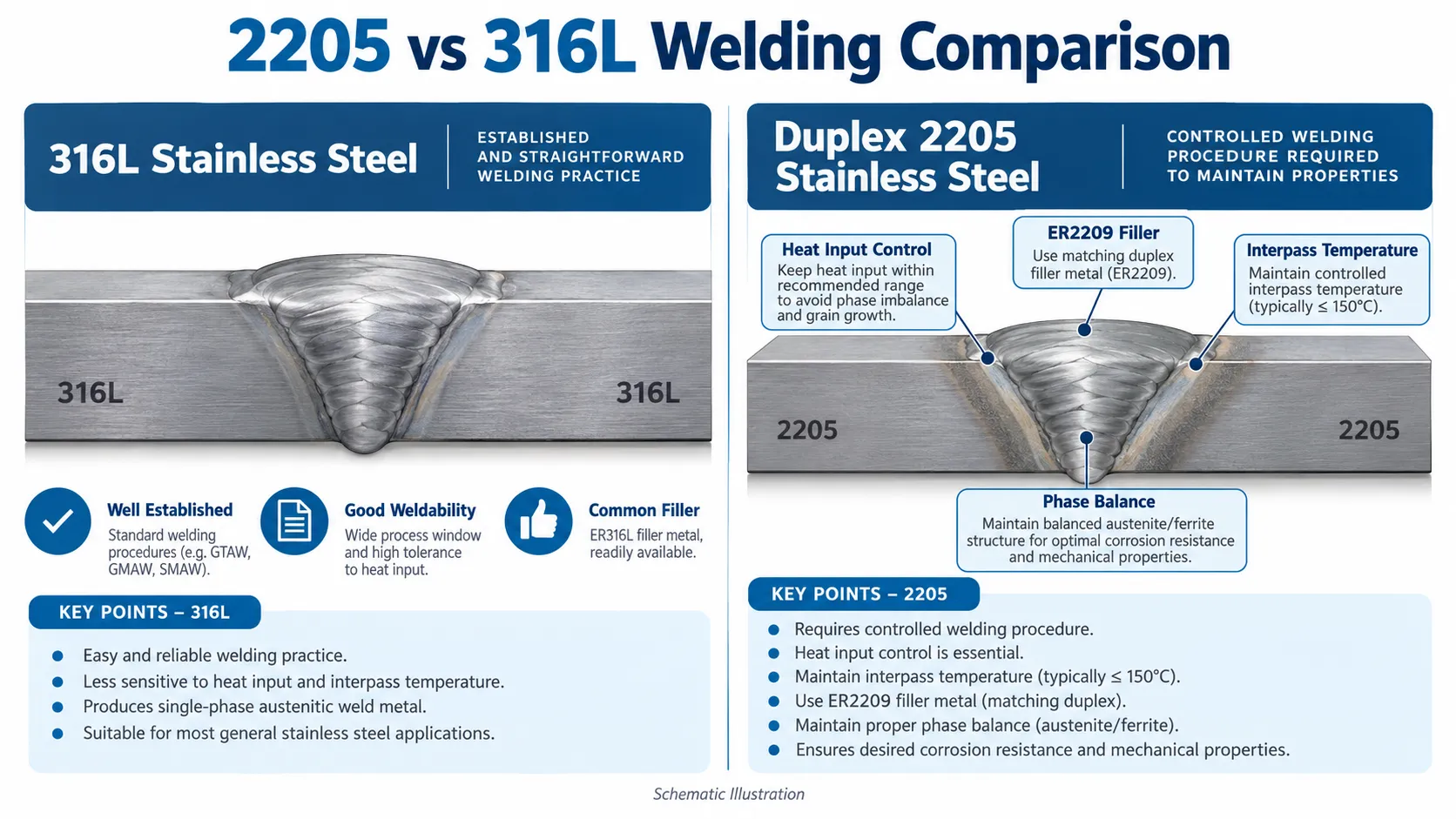
Simplified weld cross-section illustration. Welding parameters must be established by a qualified procedure.
Welding 316L Stainless Steel
316L has well-established welding procedures.
Common processes include:
- GTAW / TIG
- GMAW / MIG
- SMAW
- FCAW
- SAW where appropriate
316L’s low carbon content reduces the risk of sensitization-related intergranular corrosion.
Common filler metals include:
- ER316L
- E316L
Actual filler-metal selection must follow the qualified welding procedure, design code, and service requirements.
Welding Duplex 2205
Duplex 2205 also has good weldability, but the welding thermal cycle must be controlled to maintain acceptable microstructure and performance.
Important factors include:
- Heat input
- Interpass temperature
- Cooling rate
- Filler-metal chemistry
- Shielding gas
- Ferrite/austenite balance
- Formation of detrimental phases
- Weld-zone corrosion resistance
Why Is Phase Balance Important?
Duplex stainless steel is designed to contain both ferrite and austenite.
Welding can change their relative proportions.
An unfavorable phase balance can affect:
- Toughness
- Corrosion resistance
- Mechanical properties
Excessively rapid cooling may leave too much ferrite in some weld regions.
Excessive or prolonged thermal exposure can promote unwanted metallurgical changes.
Therefore, the goal is controlled heat input, not simply the lowest possible heat input.
Typical 2205 Welding Guidance
For one established SAF 2205 product system, published manufacturer guidance includes:
- Heat input: approximately 0.5–2.5 kJ/mm
- Interpass temperature: below 150°C
- GTAW / TIG as a commonly preferred method
- Matching duplex filler such as ER2209
These are manufacturer recommendations for specific material and product conditions, not a universal WPS for every 2205 fabrication.
Welding parameters should always be established according to the relevant procedure qualification and design requirements.
Welding Comparison Table
| Factor | 316L | Duplex 2205 |
|---|---|---|
| General weldability | Excellent | Good |
| Welding experience | Very established | Specialized procedures recommended |
| Common filler | ER316L | ER2209 |
| Heat input control | Important | Particularly important |
| Interpass control | Required by applicable procedure | Generally more restrictive |
| Phase balance | Austenitic metallurgy | Ferrite-austenite balance critical |
| Detrimental phase risk | Must control sensitization and other weld effects | Must control phase imbalance and detrimental precipitation |
| Welding procedure | Qualified WPS | Duplex-specific qualified WPS |
| Post-weld cleaning | Important | Important |
| Corrosion testing | As specified | May include additional duplex requirements |
Can 2205 and 316L Be Welded Together?
Potentially, yes.
However, dissimilar welding requires appropriate evaluation of:
- Filler metal
- Dilution
- Phase balance
- Mechanical properties
- Corrosion resistance
- Service temperature
- Applicable code
The filler should not be selected solely from the grade name of one base material.
A qualified procedure is essential.
Formability and Machining: Which Is Easier to Fabricate?
316L is generally easier to form than Duplex 2205.
The substantially higher strength of 2205 can require:
- Higher bending forces
- Higher forming loads
- Greater allowance for springback
- Different tooling
- Modified machining parameters
Bending
For the same section geometry and material condition, higher-strength duplex steel generally requires more force to bend.
Fabricators should verify:
- Minimum bend radius
- Material thickness
- Springback
- Press capacity
- Surface protection
Deep Drawing
316L is widely used in complex formed products.
2205 can be formed, but its higher strength and different work-hardening characteristics make process design more demanding.
Machining
Both alloys require appropriate stainless steel machining practices.
2205’s higher strength can require adjustments to:
- Cutting speed
- Feed
- Tool material
- Tool geometry
- Coolant
- Chip control
Actual machining performance also depends on the product’s metallurgy, cleanliness, and manufacturing condition.
Temperature Limits: 2205 vs 316L
Temperature is a major material-selection constraint.
316L and 2205 should not be treated as having identical allowable service temperatures.
High-Temperature Service
Duplex 2205 is generally not preferred for prolonged service at elevated temperatures where ferritic-phase embrittlement and detrimental phase precipitation may become concerns.
Long-term exposure around or above approximately 250–300°C deserves particular attention.
The actual permitted temperature depends on the alloy, product condition, design code, service duration, and required toughness.
316L may be more appropriate for certain higher-temperature applications, but its selection must also account for:
- Allowable stress
- Creep
- Oxidation
- Corrosion
- Sensitization
- Design code
No single universal maximum temperature should be applied to all products.
Low-Temperature Service
Austenitic stainless steels such as 316L generally offer excellent low-temperature toughness.
Duplex 2205 can also perform well at reduced temperatures within its qualified limits, but ferritic-phase behavior makes impact toughness and minimum design temperature important.
For low-temperature pressure equipment, check the governing code and required impact testing.
Practical Temperature Comparison
| Requirement | 316L | Duplex 2205 |
|---|---|---|
| Room-temperature industrial service | Excellent | Excellent |
| Moderate-temperature pressure equipment | Commonly used | Commonly used where permitted |
| Prolonged elevated-temperature service | Evaluate code and material properties | Greater metallurgical limitations |
| Cryogenic applications | Often advantageous | Requires careful qualification |
| Thermal expansion | Higher | Lower |
| Heat-affected-zone concerns | Sensitization and weld quality | Phase balance and detrimental phases |
Is Duplex 2205 More Expensive Than 316L?
There is no universal answer.
Both alloys contain costly alloying elements, but their compositions differ.
316L has a relatively high nickel content.
2205 has lower nickel but higher chromium, molybdenum, and nitrogen requirements.
The market price depends on:
- Nickel price
- Molybdenum price
- Steel mill
- Product form
- Thickness
- Diameter
- Heat treatment
- Production quantity
- Certification
- Availability
- Inspection requirements
- Freight
In some market conditions, 2205 may have a higher price per kilogram.
In other conditions, nickel prices and product availability can narrow or change the difference.
Buyers should compare actual quotations for the required form and specification.
Total Installed Cost: Why Price per Kilogram Is Not Enough
For high-value industrial projects, the material with the lower price per kilogram is not necessarily the material with the lower installed cost.
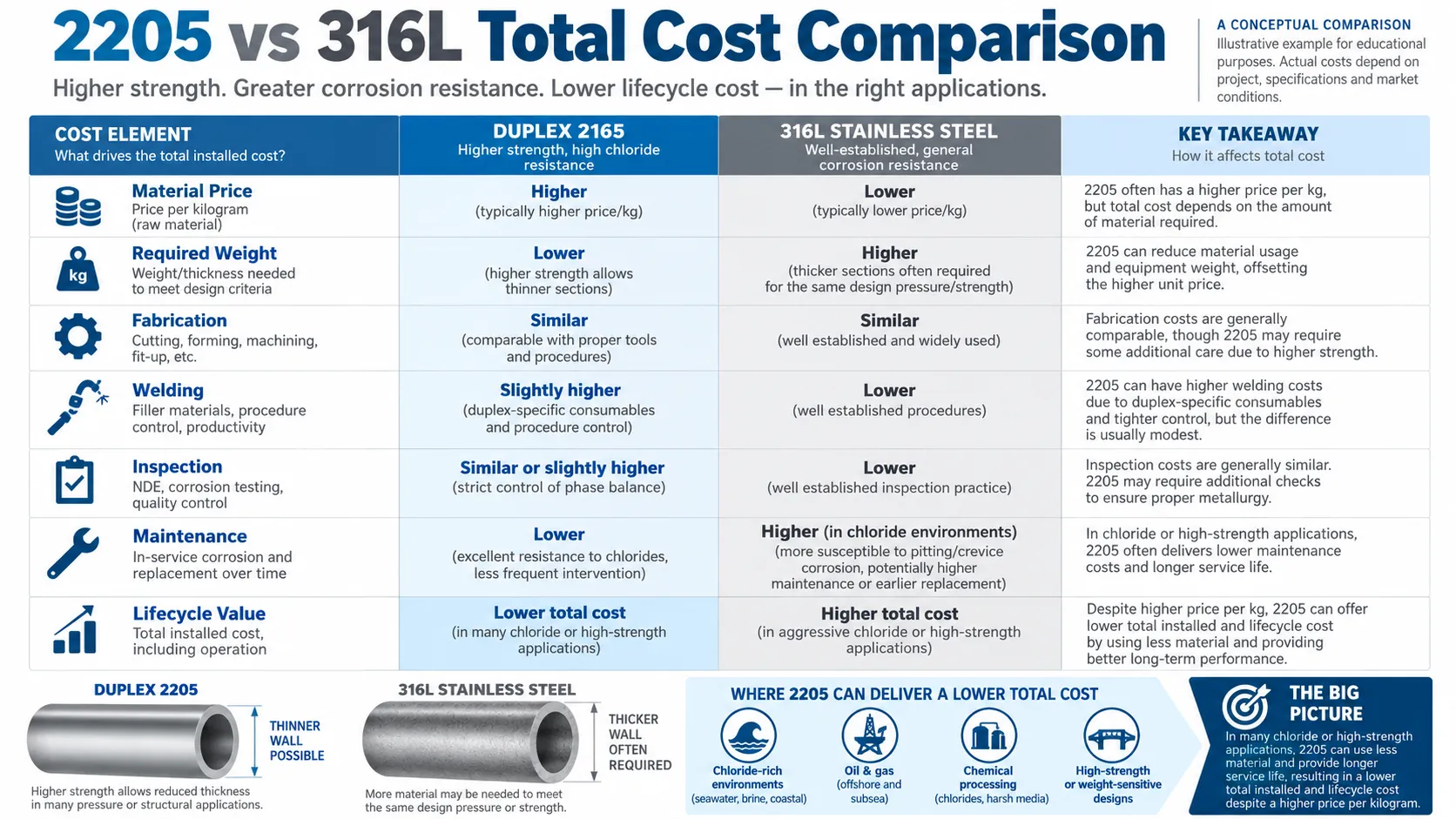
Conceptual illustration only. Actual project costs must be calculated from qualified designs and current supplier quotations.
A practical comparison should include:
Total Installed Cost = Material + Fabrication + Welding + Inspection + Transport + Installation
For lifecycle evaluation, also include:
Lifecycle Cost = Installed Cost + Maintenance + Repairs + Replacement + Downtime
Cost Comparison Framework
| Cost Factor | 316L | Duplex 2205 |
|---|---|---|
| Material price/kg | Depends on quotation | Depends on quotation |
| Required material weight | Design dependent | May be reduced in strength-controlled designs |
| Bending/forming | Generally easier | Higher force may be needed |
| Welding procedures | Established | More specialized |
| Welding consumables | Commonly available | Duplex-compatible filler required |
| Material inspection | Project dependent | Additional duplex-specific checks may apply |
| Transport | Based on weight | Potential saving if design is lighter |
| Installation | Based on component design | Potential saving if equipment is lighter |
| Corrosion maintenance | Depends on environment | May be reduced in suitable chloride environments |
| Expected service life | Application dependent | Application dependent |
| Lifecycle cost | Must be calculated | Must be calculated |
Can 2205 Reduce Project Cost?
Potentially.
If the higher strength allows significant material reduction, savings may arise from:
- Lower raw-material quantity
- Reduced transportation weight
- Reduced support loads
- Easier handling of lighter components
- Reduced installation requirements
If 316L experiences unacceptable localized corrosion in the actual environment, choosing 2205 may also reduce the need for premature replacement.
However, these benefits are not guaranteed.
More demanding welding, testing, machining, or procurement requirements can offset material savings.
A Practical Cost Decision
A buyer considering 2205 should compare at least two qualified design alternatives:
Option A — 316L Design
- Code-compliant thickness
- Actual 316L quotation
- Welding cost
- Fabrication cost
- Inspection
- Expected service performance
Option B — Duplex 2205 Design
- Independently calculated code-compliant thickness
- Actual 2205 quotation
- Duplex welding requirements
- Fabrication cost
- Inspection
- Expected service performance
Only after both options meet the same engineering requirements should the total costs be compared.
2205 vs 316L by Product Form
The material choice can change significantly depending on what is being purchased.
Duplex 2205 vs 316L Pipe
Pipe is one of the most important commercial applications of these grades.
2205 pipe is frequently considered for:
- Chemical processing
- Chloride-bearing process piping
- Offshore equipment
- High-strength piping systems
- Industrial cooling water
- Selected seawater-related systems
316L pipe remains common for:
- Food and beverage
- Pharmaceutical processing
- General industrial piping
- Chemical services compatible with 316L
- Hygienic systems
For buyers evaluating duplex piping, see our 2205 Duplex Stainless Steel Pipe.
For conventional austenitic options, see 316 Stainless Steel Pipe and Tube.
Duplex 2205 vs 316L Tube
Tube applications include:
- Heat exchangers
- Condensers
- Instrumentation
- Process equipment
- Mechanical systems
Material selection should consider:
- Operating fluid
- Chloride concentration
- Temperature
- Pressure
- Tube wall thickness
- Welding
- Inspection
2205 may be preferable where strength and chloride resistance provide a clear advantage.
316L remains useful for many general and hygienic tube applications.
Duplex 2205 vs 316L Plate
Plate is commonly used in:
- Pressure vessels
- Storage tanks
- Chemical reactors
- Heat exchangers
- Industrial equipment
The higher strength of 2205 can make it attractive for weight-sensitive or pressure-controlled equipment.
However, heavy plate welding and fabrication require careful procedure control.
Duplex 2205 vs 316L Sheet
316L is widely used in fabricated sheet products because of its formability and surface finish options.
2205 sheet may be selected where additional strength or corrosion resistance is required.
See 316/316L Stainless Steel Sheet for austenitic flat-product options.
Duplex 2205 vs 316L Coil
Both materials are available as coil for downstream processing.
For 2205 coil, important purchase specifications include:
- UNS designation
- Thickness
- Width
- Surface finish
- Edge condition
- Coil weight
- Mechanical properties
- Material certification
See our 2205 Duplex Stainless Steel Coil.
Duplex 2205 vs 316L Bar and Forgings
Bar and forging applications include:
- Shafts
- Valve components
- Flanges
- Pump components
- Mechanical parts
- High-strength fittings
2205 may be selected where greater strength or chloride resistance is required.
316L may offer advantages for complex fabrication or applications where its corrosion and mechanical performance are sufficient.
2205 vs 316L by Industry
Chemical Processing
Both alloys are used in chemical-processing industries.
316L is often selected for general-purpose welded equipment.
2205 may be considered where the process involves:
- Higher chloride exposure
- Greater mechanical loading
- SCC concerns
- More demanding localized corrosion conditions
Actual material selection must be based on the chemical species, concentration, temperature, pressure, and process conditions.
Offshore Oil and Gas
2205 is widely used in selected offshore and oil-and-gas applications because of its high strength and chloride SCC resistance.
Applications can include:
- Process piping
- Flowlines
- Instrumentation
- Heat exchangers
- Structural and pressure components
For sour service involving hydrogen sulfide, selection must follow the applicable NACE MR0175 / ISO 15156 requirements and actual environment.
Desalination
Desalination systems present significant chloride-related material-selection challenges.
2205 may be appropriate for selected components.
However, severe seawater conditions or crevice-prone designs may require higher-alloy materials.
The correct choice depends on equipment design, water chemistry, temperature, and flow.
Pressure Vessels
The higher strength of 2205 can offer weight and wall-thickness advantages in certain pressure-vessel designs.
However, pressure-vessel selection is governed by:
- Design code
- Allowable stresses
- Temperature
- Welding procedures
- Inspection
- Corrosion requirements
316L remains a well-established option when its performance is sufficient.
Heat Exchangers
Heat exchangers frequently encounter combinations of:
- Chlorides
- Temperature
- Differential pressure
- Flow
- Crevices
- Fouling
2205 may provide benefits where 316L’s localized corrosion or strength performance is insufficient.
However, higher corrosion resistance is only one part of the selection.
Thermal performance, tube manufacturing, welding, and equipment cleaning must also be considered.
Food and Pharmaceutical
316L is extensively used in hygienic processing equipment.
Its advantages include established:
- Fabrication methods
- Surface finishing
- Welding procedures
- Cleaning practices
- Material documentation
2205 may be considered for specialized equipment when higher strength or corrosion resistance is justified.
However, replacing 316L with 2205 does not automatically improve hygienic performance.
Pulp and Paper
Certain pulp and paper applications involve corrosive process chemicals, elevated temperatures, and chloride exposure.
2205 is used in selected process equipment and piping.
Material selection should be made according to actual chemical exposure and operational conditions.
Industry Application Matrix
| Application | 316L | Duplex 2205 | Main Decision Factor |
|---|---|---|---|
| General industrial tank | Often suitable | Suitable | Corrosion and cost |
| Welded pharmaceutical tank | Common choice | Specialized applications | Hygiene and fabrication |
| Food-processing pipe | Common choice | If additional performance required | Process chemistry |
| Chemical process tank | Evaluate | Often considered | Corrosion and welding |
| High-pressure piping | Evaluate | Attractive option | Allowable stress |
| Chloride-bearing process piping | More limited | Often advantageous | Pitting and SCC |
| Offshore equipment | Application dependent | Commonly evaluated | Chloride and strength |
| Seawater cooling | Requires careful evaluation | Requires careful evaluation | Localized corrosion |
| Heat exchanger tubing | Common in suitable media | Attractive for more demanding media | Corrosion and thermal conditions |
| Weight-sensitive pressure equipment | Possible | Potential advantage | Design-code strength |
| Complex deep-formed components | Often advantageous | More difficult | Formability |
| Prolonged elevated-temperature service | Evaluate | Generally more restricted | Metallurgical stability |
ASTM Standards for 2205 and 316L Stainless Steel
Material grades should always be purchased under the correct product standard.
The same UNS alloy can have different requirements depending on whether it is supplied as plate, pipe, tube, bar, or forging.
Common Product Standards
| Product Form | 316L | Duplex 2205 |
|---|---|---|
| Sheet / Plate / Strip | ASTM A240 | ASTM A240 |
| General Pipe | ASTM A312 | ASTM A790 |
| General Tubing | ASTM A269 where applicable | ASTM A789 |
| Heat Exchanger Tubing | ASTM A213 / A249 as applicable | ASTM A789 where applicable |
| Bar | ASTM A276 / A479 | ASTM A276 / A479 |
| Forgings / Flanges | ASTM A182 | ASTM A182 |
| Butt-Weld Fittings | ASTM A403 | ASTM A815 |
Applicable specifications should be checked for the exact alloy designation, product form, service requirements, and project edition.
Why Standards Matter
A purchase request stating:
2205 stainless steel pipe.
does not fully define the product.
A more complete specification would identify:
ASTM A790 UNS S32205 Duplex Stainless Steel Pipe.
Depending on project requirements, the buyer may also need to specify:
- Seamless or welded manufacture
- Nominal pipe size
- Schedule
- Length
- Heat treatment
- Mechanical testing
- NDT
- Certification
- Additional corrosion testing
How to Verify 2205 and 316L Mill Test Certificates
Material traceability is particularly important for high-value industrial projects.
A proper MTC should provide enough information to establish whether the delivered material complies with the purchase specification.
MTC Verification Checklist
| Inspection Item | 316L | Duplex 2205 |
|---|---|---|
| Heat number | Required for traceability | Required for traceability |
| UNS designation | S31603 | S31803 / S32205 |
| Product standard | Verify | Verify |
| Chromium content | Verify | Verify |
| Nickel content | Verify | Verify |
| Molybdenum content | Verify | Verify |
| Nitrogen content | Verify | Particularly important |
| Tensile strength | Verify | Verify |
| Yield strength | Verify | Particularly important |
| Elongation | Verify | Verify |
| Heat treatment | Verify | Solution treatment is critical |
| Material condition | Verify | Verify |
| Phase balance | As specified | May require verification |
| Impact testing | If required | Especially relevant at low temperature |
| Corrosion testing | If required | May include ASTM G48 or other project tests |
| PMI | If required | If required |
| NDT | According to standard | According to standard |
| Certificate type | As specified | As specified |
Why Is Nitrogen Important in 2205 MTCs?
Nitrogen contributes to:
- Strength
- Austenite formation
- Pitting resistance
For S32205, the nitrogen requirement is more tightly controlled than for the broader S31803 designation.
Therefore, buyers should verify actual nitrogen content rather than relying only on the commercial designation “2205.”
Should Buyers Request PMI?
Positive Material Identification may be appropriate for:
- High-value industrial equipment
- Offshore projects
- Pressure equipment
- Critical piping
- Material substitution control
PMI methods such as handheld XRF can verify key alloying elements including chromium, nickel, and molybdenum.
However, conventional handheld XRF does not normally provide the nitrogen analysis needed to establish full compliance with S32205.
Where nitrogen verification is required, suitable laboratory or optical-emission testing should be considered.
Is EN 10204 3.1 Required?
The certificate requirement depends on the project.
Many international industrial buyers specify:
EN 10204 3.1
Some projects require additional inspection or a certificate under EN 10204 3.2.
The exact requirement should be stated in the purchase order.
How to Write an RFQ for Duplex 2205 or 316L
A good technical RFQ helps avoid material misunderstandings, inaccurate quotations, and unnecessary procurement delays.
Example: Duplex 2205 Plate
ASTM A240 UNS S32205 Duplex Stainless Steel Plate, 10 mm × 1500 mm × 6000 mm, No.1 finish, 15 MT, solution annealed, EN 10204 3.1 MTC required, FOB Shanghai.
Example: 316L Pipe
ASTM A312 TP316L Seamless Stainless Steel Pipe, NPS 3, Schedule 40S, 6-meter lengths, 2 MT, annealed and pickled, MTC required, CIF Hamburg.
These examples illustrate how to communicate the material requirement clearly. Any additional code, testing, and acceptance requirements must be stated separately.
RFQ Checklist
| Information | What to Specify |
|---|---|
| Grade | 316L / S31603 or 2205 / S32205 |
| Product form | Plate, sheet, pipe, tube, coil, bar |
| Standard | ASTM / ASME / EN |
| Dimensions | Thickness, OD, wall, width, length |
| Quantity | Pieces or metric tons |
| Material condition | Annealed / solution annealed, as applicable |
| Surface finish | No.1, 2B, pickled, polished, etc. |
| Welding requirements | If relevant |
| Mechanical requirements | If additional requirements apply |
| Corrosion testing | If required |
| PMI / NDT | If required |
| MTC | EN 10204 3.1 / 3.2 or other specified document |
| Processing | Cutting, slitting, polishing, beveling |
| Service environment | Chlorides, temperature, pressure, chemicals |
| Destination | Country / port |
| Trade terms | EXW, FOB, CIF or other agreed terms |
Providing the real service environment is especially valuable when a buyer is still deciding between 316L and 2205.
When Should You Choose 316L?
316L is often a good choice when:
- Its corrosion resistance is sufficient
- Strength requirements are moderate
- Fabrication flexibility is important
- Complex forming is required
- Hygienic equipment is being manufactured
- Established welding procedures are preferred
- The project specification requires S31603
- The expected service life can be achieved without upgrading the alloy
Typical applications include:
- Food-processing equipment
- Pharmaceutical piping
- Sanitary tanks
- General chemical equipment
- Industrial process vessels
- General stainless steel fabrication
When Should You Choose Duplex 2205?
Duplex 2205 becomes particularly attractive when:
- Higher yield strength is required
- Weight reduction may provide design value
- Chloride pitting resistance must be improved
- Crevice-corrosion risk is significant
- Chloride SCC is a concern
- A conventional 316L design requires excessive wall thickness
- The project can accommodate duplex-specific fabrication
- Design-code requirements permit the material
Typical applications include:
- Chemical-processing equipment
- Chloride-bearing piping
- Offshore process equipment
- Pressure vessels
- Industrial cooling-water systems
- Heat exchangers
- Weight-sensitive structures
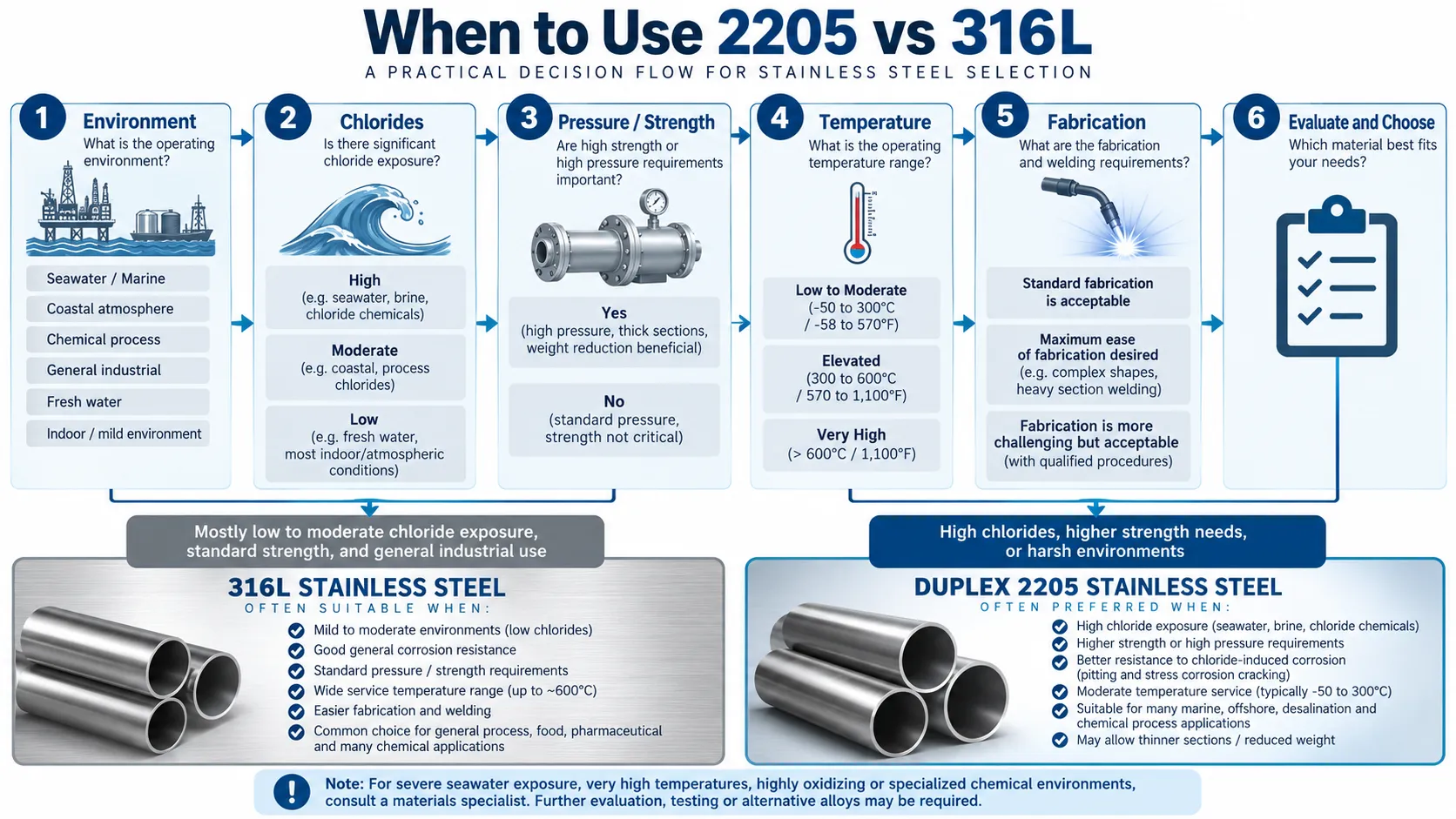
Simplified selection flow. The temperature ranges and recommendations in the illustration are not universal design limits; the governing code and actual service environment control final material selection.
Frequently Asked Questions
Is Duplex 2205 better than 316L?
Not universally.
2205 offers higher yield strength and generally better chloride-related pitting, crevice-corrosion, and SCC resistance.
316L offers excellent formability, established fabrication methods, and suitable corrosion resistance for many industrial applications.
The better choice depends on the project.
Is 2205 stronger than 316L?
Yes.
For commonly specified ASTM A240 annealed flat products, 2205 S32205 has a minimum yield strength of approximately 450 MPa compared with approximately 170 MPa for 316L.
The exact values depend on the product standard and condition.
Can 2205 replace 316L?
Potentially, but not automatically.
A substitution requires evaluation of:
- Corrosion requirements
- Mechanical properties
- Temperature
- Welding
- Fabrication
- Design code
- Material certification
Is Duplex 2205 magnetic?
Yes.
2205 contains ferrite, making it magnetic.
Annealed 316L is generally non-magnetic or weakly magnetic, although cold working can increase its magnetic response.
Is 2205 more corrosion resistant than 316L?
2205 generally offers better resistance to chloride pitting, crevice corrosion, and chloride stress corrosion cracking.
However, corrosion performance depends on the actual chemical environment.
No stainless steel grade is universally resistant to every chemical.
Is 2205 suitable for seawater?
2205 is used in selected seawater and marine-related systems.
However, continuous seawater exposure, elevated temperatures, biofouling, stagnant conditions, and crevices can create significant risks.
Project-specific evaluation is essential.
What is the PREN of 2205?
A typical modern S32205 heat has a PREN of approximately 35 or higher.
Actual PREN depends on chromium, molybdenum, and nitrogen content.
What is the PREN of 316L?
316L typically has a PREN around 24–26 depending on actual chemistry and calculation convention.
What is the difference between S31803 and S32205?
Both are associated with Duplex 2205.
S32205 has tighter minimum alloy requirements for chromium, molybdenum, and nitrogen.
This helps provide greater consistency in corrosion-resistance characteristics.
Are S31803 and S32205 interchangeable?
Not automatically.
Material supplied as S31803 may not meet S32205 chemistry requirements.
Dual certification is possible when the material satisfies both specifications and is properly documented.
Can 2205 reduce pipe wall thickness?
Yes, in some designs.
Its higher strength may permit thinner sections.
However, allowable stress, pressure, temperature, corrosion allowance, stability, fabrication tolerance, and the governing code must be checked.
Is 2205 more expensive than 316L?
The price relationship depends on current alloy markets, product form, supplier, dimensions, and availability.
There is no universal fixed price premium.
Can Duplex 2205 save money?
Potentially.
Higher strength can reduce material consumption, while improved corrosion resistance may reduce maintenance or replacement in suitable environments.
However, specialized fabrication and inspection can offset these advantages.
Can 2205 be welded?
Yes.
2205 has good weldability when appropriate duplex welding procedures are used.
Heat input, interpass temperature, filler chemistry, and phase balance are important.
What filler metal is used for 2205?
ER2209 is a common matching filler for duplex 2205 welding.
Actual selection must follow the qualified welding procedure and application requirements.
Is 2205 more difficult to machine than 316L?
2205’s higher strength can require modified cutting conditions and tooling.
Machinability also depends on the specific product condition and manufacturing process.
Is 2205 suitable for high temperatures?
2205 has metallurgical limitations during prolonged elevated-temperature exposure.
Extended service around or above approximately 250–300°C requires careful evaluation.
The actual permitted range depends on the governing design code and component requirements.
Is 316L better for cryogenic applications?
316L is often preferred for cryogenic service because of its austenitic toughness.
2205 may require additional low-temperature impact qualification and may not be suitable for all cryogenic applications.
Which is better for chemical tanks?
316L is suitable for many chemical tanks.
2205 may be preferable where additional strength or chloride corrosion resistance is required.
The final decision depends on the actual chemicals, concentrations, temperature, and equipment design.
Which is better for pressure vessels?
2205 can provide a strength advantage and potential weight savings.
316L provides fabrication flexibility and established pressure-equipment performance.
Both must be evaluated against the applicable vessel code.
When should I choose 2507 instead of 2205?
2507 may be considered when 2205 does not provide sufficient resistance to severe chloride conditions or other relevant service requirements.
The upgrade should be justified by corrosion engineering rather than the assumption that higher alloy content is always necessary.
Gengfei Steel Duplex 2205 and 316L Stainless Steel Supply
Gengfei Steel supplies stainless steel products for industrial manufacturing, equipment fabrication, and international project applications.
Our relevant product ranges include:
- Duplex 2205 Stainless Steel Pipe
- Duplex 2205 Stainless Steel Coil
- 316/316L Stainless Steel Sheet
- 316/316L Stainless Steel Pipe and Tube
- Stainless Steel Plate
- Stainless Steel Bar
- Other stainless steel product forms
Explore our existing product and material resources:
Duplex 2205 Pipe
2205 Duplex Stainless Steel Pipe
Duplex 2205 Coil
2205 Duplex Stainless Steel Coil
316/316L Sheet
316/316L Stainless Steel Sheet
316/316L Pipe and Tube
316 Stainless Steel Pipe and Tube
Related Technical Guides
- 316 vs 316L Stainless Steel
- Duplex vs Austenitic Stainless Steel
- 2205 vs 2507 Duplex Stainless Steel
- Duplex 2205 Stainless Steel Overview
For an accurate quotation, please provide:
Grade + UNS + Standard + Product Form + Dimensions + Quantity + Certification + Processing + Service Environment + Destination
Where the grade has not yet been finalized, providing the operating conditions and technical specification will help clarify the available material options.
Final Verdict: Should You Choose Duplex 2205 or 316L?
316L is an excellent choice when its corrosion resistance and strength meet the service requirements and fabrication flexibility is important.
Duplex 2205 is often worth evaluating when higher strength, greater chloride-corrosion resistance, or reduced susceptibility to chloride SCC can improve the engineering design.
However, the higher-performance alloy does not automatically produce the lowest project cost.
A successful material-selection process should consider:
- Service environment
- Corrosion mechanisms
- Pressure and mechanical strength
- Temperature
- Welding and fabrication
- Relevant standards
- Required testing
- Total installed and lifecycle costs
The key purchasing question is not simply:
Which stainless steel is stronger or more corrosion resistant?
It is:
Which stainless steel meets the engineering requirements at the lowest acceptable total project cost over its intended service life?
For industrial buyers, that is the most useful way to compare Duplex 2205 and 316L stainless steel.
