Introduction: The Versatile Foundation of Modern Engineering
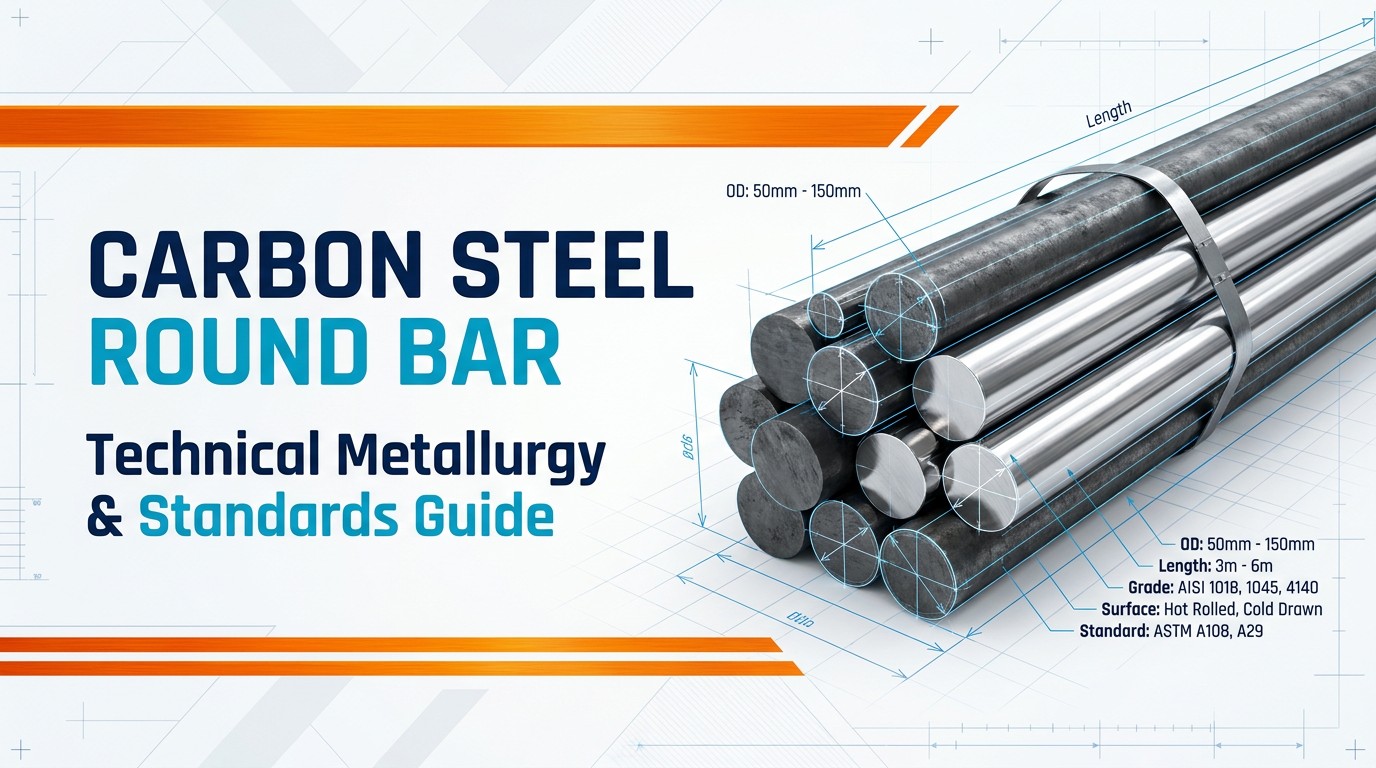
In the hierarchy of industrial materials, the carbon steel round bar remains an irreplaceable staple. Defined by its circular cross-section and high structural integrity, it serves as the fundamental building block for a vast spectrum of mechanical, construction, and automotive components. Whether utilized as a load-bearing member in a high-rise structure or as a precision-machined shaft in a heavy-duty engine, carbon steel round bars offer a unique combination of strength, ductility, and cost-efficiency.
At GF Steel, we leverage decades of metallurgical expertise to supply high-grade carbon steel round bars to the global market. Our products are manufactured to exceed international standards, ensuring consistent performance in the most demanding environments.
Classification by Manufacturing Process
The mechanical properties and surface finish of a carbon steel round bar are significantly influenced by its production method.
1. Hot Rolled Carbon Steel Round Bar
Hot rolling occurs at temperatures above the steel’s recrystallization point.
Characteristics: Scale-covered surface, slightly looser dimensional tolerances, and high internal stress relief.
Applications: General construction, structural supports, and applications where precise surface finish is not critical.
2.Cold Drawn Carbon Steel Round Bar
Cold drawing is a secondary process where hot-rolled bars are pulled through a die at room temperature.
Characteristics: Exceptional dimensional precision, smooth “bright” surface finish, and increased tensile and yield strength due to strain hardening.
Applications: Precision shafts, fasteners, gears, and components requiring high-speed machining.
Common Grades and Their Chemical Profiles
Carbon steel is classified by its carbon content, which dictates the material’s hardness and heat-treatability.
Table 1: Popular Carbon Steel Round Bar Grades
Grade (AISI/SAE)
Carbon Content (%)
Key Characteristics
Typical Applications
1018 (Low Carbon)
0.15 – 0.20
Excellent weldability and formability; easily case-hardened.
Pins, rods, mounting plates, spacers.
1045 (Medium Carbon)
0.43 – 0.50
Higher strength and hardness; responds well to heat treatment.
Axles, bolts, crankshafts, gears.
12L14 (Free Machining)
0.15 Max
Contains lead to facilitate high-speed automatic machining.
High-volume screw machine parts.
A36 (Structural)
0.25 – 0.29
Standard structural grade with predictable yield points.
Brackets, frames, and civil engineering.
Key Engineering Advantages
1.Superior Machinability
One of the primary reasons for the dominance of carbon steel round bars in manufacturing is their excellent machinability. Grades like 1018 and 1045 allow for high metal removal rates with minimal tool wear, reducing production costs for complex components.
2.Robust Structural Strength
Carbon steel provides high tensile and yield capacity relative to its cost. By selecting the appropriate grade and heat treatment (such as quenching and tempering), engineers can achieve the specific mechanical limits required for safety-critical parts.
3. Versatile Fabrication
Carbon steel round bars can be easily welded, forged, and bent using standard industrial equipment. This flexibility simplifies the supply chain, as a single material can be adapted for multiple uses on a project site.
Automotive Engineering: Axles, steering linkages, transmission shafts, and engine fasteners.
Construction & Infrastructure: Rebar for specialized reinforcements, anchor bolts, and bridge pins.
Heavy Machinery: Hydraulics cylinders, heavy-duty rollers, and conveyor shafts.
Energy Sector: Wind turbine components, support rods for solar arrays, and oil-field equipment.
Consumer Goods: Tools, appliances, and high-strength fasteners.
Quality Assurance and Standards Compliance
At GF Steel, we recognize that global projects require verified quality. Our carbon steel round bars comply with the most recognized international specifications:
ASTM A29 / A108 / A36: American standards for bars and structural steel.
EN 10025 / EN 10277: European technical delivery conditions.
JIS G4051: Japanese industrial standards for carbon steels.
Our quality control protocols include PMI (Positive Material Identification), ultrasonic testing for internal flaws, and rigorous dimensional verification using micro-calipers.
Contact GF Steel: Your Global Industrial Partner
GF Steel is a leading global supplier and manufacturer of premium carbon steel products. Our team of metallurgy experts is ready to provide technical support, custom cutting services, and competitive global logistics to ensure your project’s success.