


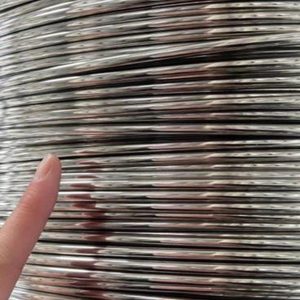
Stainless Steel Spring Wire
Stainless steel spring wire is a high-tensile wire designed for the manufacture of mechanical springs, suspension parts, and precision components. It offers excellent elasticity, corrosion resistance, and fatigue strength—making it ideal for both industrial and automotive use.
- Description
- Reviews (0)
Description
Product Description Of Stainless Steel Spring Wire
Stainless steel spring wire is specially processed through cold drawing and heat treatment to achieve high elasticity and fatigue resistance. It is manufactured from grades such as 302, 304, 316, 631 (17-7PH), and 301, depending on application and performance requirements.
Spring wire is available in round, flat, or shaped profiles and is widely used in compression springs, extension springs, torsion springs, and other precision spring elements across aerospace, electronics, medical, and automotive sectors.
Specifications of Stainless Steel Spring Wire
| Parameter | Range / Option |
|---|---|
| Diameter | 0.15 mm – 12 mm |
| Form | Coil, spool, or straight cut |
| Finish | Bright, Soap-coated, Annealed |
| Temper | Soft, 1/4 Hard, 1/2 Hard, Full Hard |
| Standard | ASTM A313, JIS G4314, DIN EN 10270-3 |
Typical Mechanical Properties (304 Spring Wire)
| Property | Value |
|---|---|
| Tensile Strength | 1600 – 2000 MPa |
| Elongation | ≥ 3% |
| Torsion Strength | Excellent |
| Fatigue Resistance | Very High |
| Modulus of Elasticity | ~193 GPa |
Advantages of Stainless Steel Spring Wire
-
High tensile and yield strength
-
Excellent resistance to fatigue and deformation
-
Corrosion-resistant in harsh environments
-
Superior surface finish and dimensional control
-
Available in cold drawn and oil-tempered conditions
-
Easy to form, wind, and process
Applications of Stainless Steel Spring Wire
✅ Compression springs for valves, suspensions
✅ Extension springs in machinery and tools
✅ Torsion springs for hinges and motors
✅ Electronic devices and battery contact springs
✅ Medical instruments like surgical clamps
✅ Aerospace and defense spring assemblies
✅ Automotive systems like clutch and brake springs
✅ Industrial robots and precision components
Common Grades and Properties
| Grade | Type | Tensile Strength | Notes |
|---|---|---|---|
| 302 | Austenitic | 1700–2100 MPa | Good spring properties, widely used |
| 304/304V | Austenitic | 1600–2000 MPa | Non-magnetic, weldable |
| 316 | Austenitic | 1500–1900 MPa | Marine-grade corrosion resistance |
| 301 | Austenitic | 1700–2100 MPa | High work hardening rate |
| 17-7PH | PH Steel | 1700–2300 MPa | Excellent strength after aging |
FAQs – Stainless Steel Spring Wire
Q1: What’s the difference between spring wire and regular stainless wire?
A: Spring wire has higher tensile strength, better fatigue resistance, and is processed for elasticity. Regular wire is softer and more formable.
Q2: What grade is best for corrosion resistance and spring performance?
A: 316 stainless spring wire offers the best corrosion resistance. For high strength and fatigue, 17-7PH is ideal.
Q3: Can you supply ultra-fine spring wire for electronics?
A: Yes, Gengfei can supply spring wire as thin as 0.15 mm for micro-components and battery springs.
Q4: How is spring wire packaged?
A: Typically in plastic spools, steel carriers, or paper coils depending on size and quantity.
Q5: Is stainless spring wire magnetic?
A: Grades like 304 and 316 are generally non-magnetic in annealed form but may become slightly magnetic after cold working.
Be the first to review “Stainless Steel Spring Wire” Cancel reply
📧 Email: [email protected]
📞 WhatsApp / Phone: +86 191 3986 3252
🌐 Website: www.gengfeisteel.com
Reviews
There are no reviews yet.