
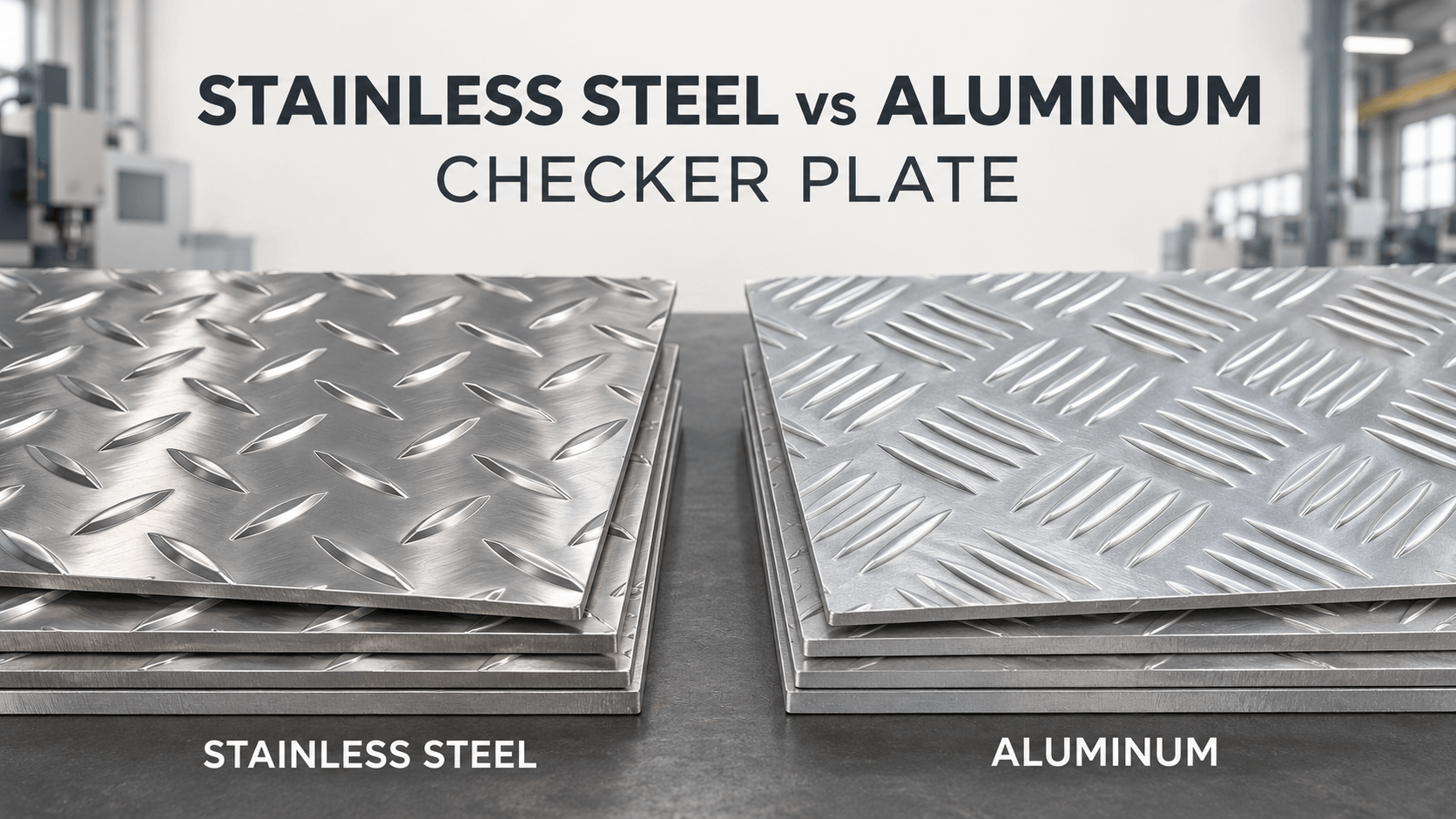
Stainless Steel Checker Plate vs Aluminum Checker Plate: Which material is better for your project? The answer depends on weight, strength, corrosion resistance, fabrication requirements, and total project cost.
Both materials are widely used in industrial flooring, transportation equipment, marine applications, and commercial buildings. Understanding their differences can help importers, distributors, contractors, and manufacturers make better purchasing decisions.
Although both materials feature raised surface patterns designed to improve traction, they differ significantly in weight, mechanical properties, corrosion resistance, fabrication requirements, and overall project costs.
Quick Answer: Which Checker Plate Should You Choose?
Stainless steel checker plate is often preferred when higher stiffness, surface durability, and cleanability are important. Aluminum checker plate is generally a better choice when lightweight construction, easier handling, and transportation efficiency are priorities.
The right choice depends on material grade, aluminum temper, base-metal thickness, load requirements, corrosion exposure, and actual project conditions.
1. What Is Stainless Steel Checker Plate?
Stainless steel checker plate, also known as stainless steel tread plate or stainless steel chequered plate, is a metal sheet manufactured with raised patterns on its surface. These patterns provide additional surface texture and can help improve traction in industrial and commercial environments.
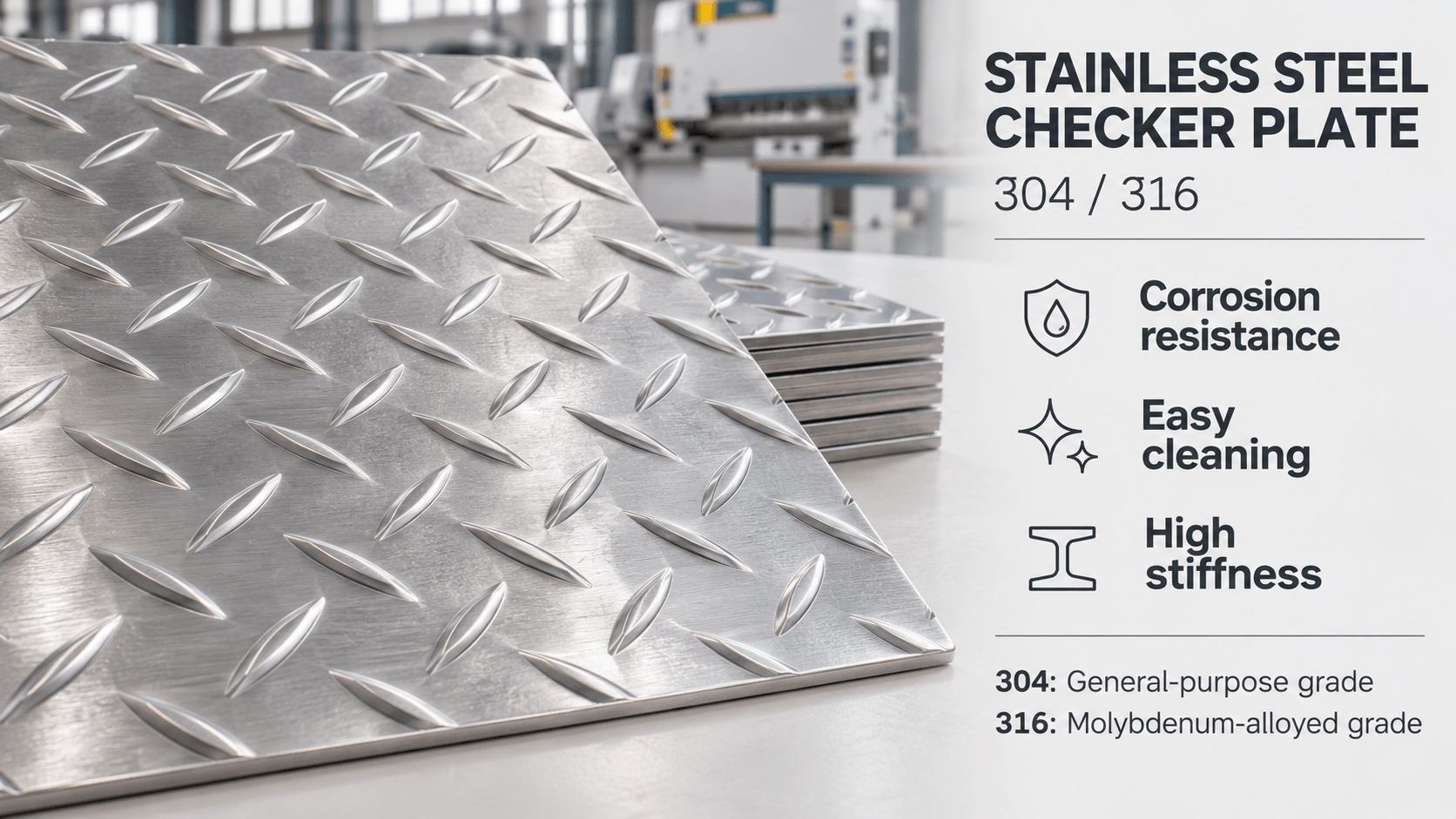
Common stainless steel grades include 304, 316, and 316L. Each grade offers different corrosion resistance and mechanical properties.
常见不锈钢牌号
304 Stainless Steel: Offers good general corrosion resistance and is widely used in industrial and commercial applications.
316 Stainless Steel: Contains molybdenum, providing improved resistance to chloride-related corrosion compared with 304 in many environments.
316L Stainless Steel: A low-carbon version of 316, commonly selected for applications requiring suitable corrosion resistance and welding performance.
典型应用
- Industrial factory floors and production workshops.
- Food processing facilities and commercial kitchens.
- Chemical plants and industrial equipment platforms.
- Stair treads, walkways, and access platforms.
- Transportation equipment and protective flooring.
- Architectural decoration and wall protection.
Stainless steel checker plate is particularly suitable for environments where durability, cleanability, and corrosion resistance are important considerations.
探索我们的 不锈钢花纹板 products for different grades and specifications.
2. What Is Aluminum Checker Plate?
Aluminum checker plate, also known as aluminum tread plate, diamond plate, or aluminum chequered plate, is an aluminum alloy sheet with raised patterns on one side.
Its main advantages are lightweight construction, good corrosion resistance, and convenient fabrication. It is widely used in transportation, marine engineering, construction, and industrial flooring.
Common Aluminum Alloys
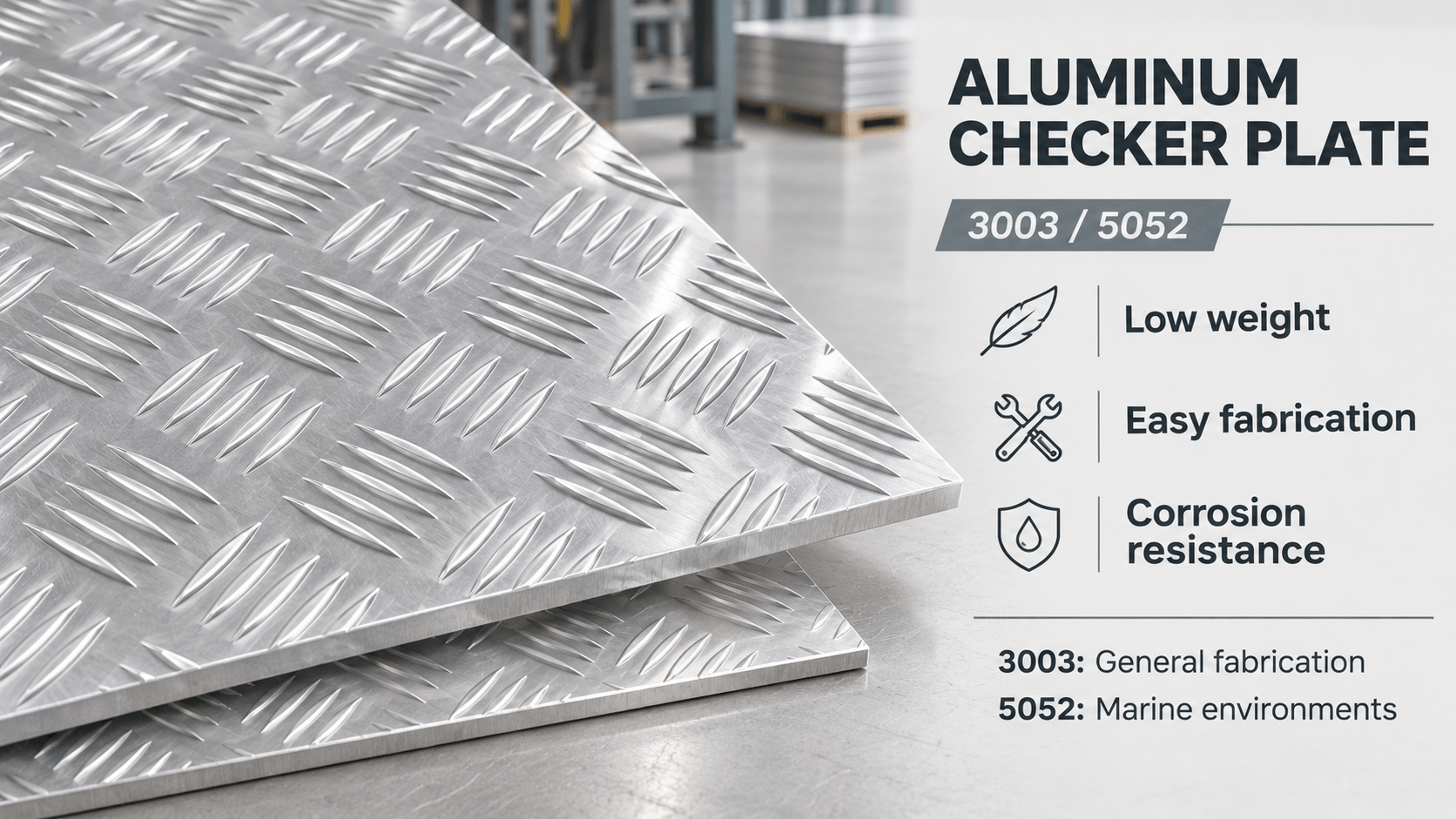
1060 and 1100: Suitable for applications requiring good corrosion resistance and formability.
3003: Offers a balance of corrosion resistance, strength, and workability.
5052: Provides good corrosion resistance and mechanical properties, including suitability for many marine applications.
5754: Commonly selected for transportation and marine-related applications.
6061: Offers higher strength in suitable tempers for structural and industrial applications. Its suitability for marine environments should be evaluated according to actual exposure conditions.
Common Surface Patterns
- 钻石图案
- One-Bar Pattern
- Two-Bar Pattern
- Three-Bar Pattern
- Five-Bar Pattern
典型应用
- Truck and trailer flooring.
- Boat decks and marine walkways.
- Industrial platforms and access ramps.
- Stair treads and protective flooring.
- Equipment covers and transportation components.
Aluminum checker plate is particularly attractive for projects where weight reduction, corrosion resistance, and fabrication flexibility are important.
探索我们的 铝制检查器板 products for available alloys and specifications.
For more information about material selection and applications, read our guide: 如何选择用于卡车、拖车和船用甲板的铝制花纹板。
3. Stainless Steel Checker Plate vs Aluminum Checker Plate: Key Differences
Before choosing a material, buyers should understand the main differences between stainless steel and aluminum checker plates.
| 比较 | 不锈钢花纹板 | 铝制检查器板 |
|---|---|---|
| 通用等级 | 304, 316, 316L | 1060, 1100, 3003, 5052, 5754, 6061 |
| 密度 | Approximately 7.9–8.0 g/cm³ | Approximately 2.66–2.73 g/cm³ |
| 重量 | Relatively heavy | 轻的 |
| Stiffness | Generally higher at the same thickness and geometry | Generally lower at the same thickness and geometry |
| 耐腐蚀性 | Good to excellent, depending on grade and environment | Good to excellent, depending on alloy and environment |
| 制造 | Cutting, welding, bending, polishing | Cutting, welding, bending, forming |
| 典型应用 | Industrial facilities, kitchens, chemical plants | Vehicles, trailers, marine decks, platforms |
These are general comparisons. Actual performance depends on the specified grade, temper, thickness, surface pattern, manufacturing quality, and operating conditions.
4. Weight Comparison: Why Aluminum Checker Plate Is Lighter
Weight is one of the most important differences between stainless steel and aluminum checker plates.
Aluminum has a much lower density than stainless steel. For the same base-metal thickness and dimensions, aluminum checker plate can weigh approximately one-third as much as stainless steel checker plate.

Theoretical Weight Comparison per Square Meter
Assuming a base-metal thickness of 3 mm, excluding the additional raised pattern volume:
| 材料 | Reference Density | Theoretical Weight |
|---|---|---|
| 304不锈钢 | 7.93 g/cm³ | 23.79 kg/m² |
| 316不锈钢 | 7.98 g/cm³ | 23.94 kg/m² |
| 5052铝 | 2.68 g/cm³ | 8.04 kg/m² |
| 3003铝 | 2.73 g/cm³ | 8.19 kg/m² |
Weight Calculation Formula
Weight (kg/m²) = Density (kg/m³) × Thickness (m)
For example, the theoretical weight of 3 mm 5052 aluminum plate is:
2,680 × 0.003 = 8.04 kg/m².
These are theoretical reference values for flat base metal, not finished checker plate weights. Actual product weight varies with pattern height, manufacturing tolerances, and the supplier’s thickness measurement method.
For transportation manufacturers, vehicle builders, and marine engineering contractors, aluminum checker plate can help reduce the overall weight of equipment and structures.
5. Strength and Load-Bearing Performance
Strength is another important factor when choosing between stainless steel checker plate and aluminum checker plate.
Stainless steel generally has a higher elastic modulus than aluminum. This means that, for the same geometry and loading conditions, stainless steel generally offers greater stiffness and lower elastic deflection.
However, stiffness and strength are not the same thing. Aluminum alloys such as 5052 and 6061 can provide useful mechanical strength, depending on their temper and thickness.
When Should You Choose Stainless Steel?
- Industrial platforms exposed to frequent heavy equipment traffic.
- Facilities requiring rigid flooring structures.
- Applications where impact resistance and surface durability are important.
- Projects where additional material weight is not a major limitation.
When Should You Choose Aluminum?
- Truck and trailer flooring where reducing vehicle weight is important.
- Marine walkways and boat deck components.
- Portable platforms and access ramps.
- Equipment covers and lightweight protective panels.
For load-bearing flooring, material selection should never be based on thickness alone. Engineers should consider alloy grade, temper, unsupported span, support spacing, plate geometry, applied loads, deflection limits, and applicable safety requirements.
6. Corrosion Resistance: Which Material Is Better?
Both stainless steel and aluminum can provide good corrosion resistance, but their performance depends on the environment and material grade.
Stainless Steel Corrosion Resistance
Stainless steel obtains its corrosion resistance from a protective chromium-rich passive film on its surface.
304 Stainless Steel: Widely used in general industrial and commercial environments. It offers good corrosion resistance in many atmospheric and indoor conditions.
316 and 316L Stainless Steel: Contain molybdenum, which improves resistance to chloride-related pitting and crevice corrosion compared with 304 in many environments.
For coastal facilities, chemical processing areas, and applications exposed to salt-containing moisture, 316 or 316L may be worth considering.
However, even 316 stainless steel is not immune to corrosion in seawater, stagnant chloride solutions, or severe crevice conditions. Proper grade selection, surface condition, cleaning, and maintenance remain important.
Aluminum Corrosion Resistance
Aluminum naturally develops a thin oxide film that protects its surface from further oxidation.
- 3003: Good general atmospheric corrosion resistance.
- 5052: Good corrosion resistance, including many marine and coastal applications.
- 5754: Suitable for many transportation and marine applications.
- 6061: Good overall corrosion resistance, although performance depends on the environment and temper.
In marine applications, aluminum checker plate is often selected because it combines low weight with good corrosion resistance.
One important consideration is galvanic corrosion. When aluminum is electrically connected to stainless steel in the presence of an electrolyte such as seawater, galvanic corrosion may occur. Suitable electrical isolation, protective coatings, and compatible fasteners should be considered during installation.
7. Slip Resistance and Surface Patterns
Both stainless steel checker plate and aluminum checker plate are available with raised surface patterns designed to improve traction.
- Diamond Pattern: A raised geometric pattern used for industrial and decorative applications.
- Five-Bar Pattern: A popular aluminum tread plate pattern for vehicle floors, ramps, and industrial walkways.
- Three-Bar Pattern: Used in various flooring and transportation applications.
- One-Bar and Two-Bar Patterns: Suitable for selected architectural and industrial designs.
The raised patterns increase surface texture and may improve grip compared with smooth metal sheets.
However, a raised pattern alone does not guarantee a slip-resistant walking surface. Performance can change depending on water, oil, grease, dust, footwear, surface wear, and cleaning conditions.
For facilities with strict workplace safety requirements, buyers should request relevant slip-resistance test data and select a surface design suitable for the actual operating environment.
8. Fabrication, Welding, and Installation
Fabrication requirements can also influence material selection.
不锈钢花纹板
- Selecting suitable cutting tools and processing parameters.
- Using appropriate welding procedures and filler materials.
- Preventing surface contamination during fabrication.
- Protecting finished surfaces from scratches and damage.
- Using appropriate cleaning and passivation procedures when required.
铝制检查器板
- Selecting the correct alloy and temper for bending.
- Using appropriate aluminum cutting and welding procedures.
- Preventing surface scratches during handling.
- Considering thermal expansion during installation.
- Avoiding unsuitable contact with dissimilar metals.
For both materials, the fabrication procedure should be matched to the selected alloy, thickness, and finished application.
9. Cost Comparison: Initial Price vs Long-Term Value
Many buyers compare stainless steel and aluminum checker plates based only on price per ton. However, this approach may not reflect the actual cost of a project.
Initial Material Cost
Stainless steel and aluminum prices vary according to alloy composition, raw material markets, thickness, dimensions, surface finish, and order quantity.
304 and 316 stainless steel also have different alloy costs. Similarly, aluminum prices vary among 3003, 5052, 5754, and 6061 alloys.
Transportation and Installation Costs
Because aluminum is considerably lighter, it may reduce transportation and handling costs in weight-sensitive projects.
Stainless steel is heavier, which may increase lifting and structural support requirements.
Maintenance and Service Life
The total cost of ownership depends on the working environment, cleaning requirements, corrosion exposure, surface damage, and expected service life.
In hygienic industrial environments, stainless steel may offer advantages because of its durable and cleanable surface. However, raised checker patterns can require more attention during cleaning than smooth surfaces.
In transportation and marine applications, aluminum may provide better overall project value by reducing structural weight.
The best material is therefore not necessarily the one with the lowest purchase price. Buyers should evaluate material cost, fabrication, transportation, installation, and maintenance together.
10. Which Checker Plate Should You Choose for Different Applications?
The right material depends on the application, operating environment, load requirements, and project budget.
船舶应用
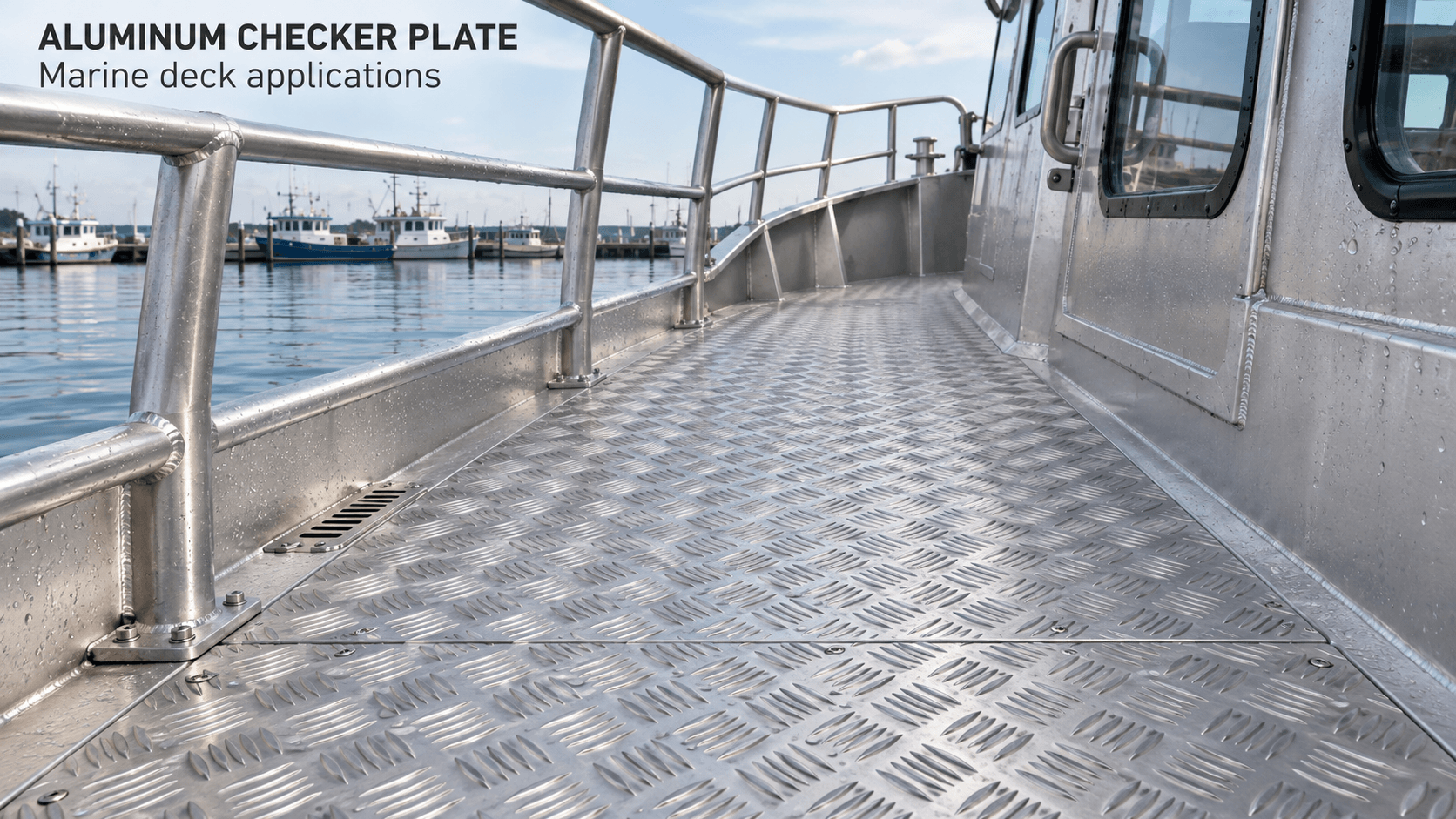
Aluminum checker plate is widely considered for marine walkways, boat decks, and access platforms where weight reduction is important.
Suitable aluminum alloys such as 5052 and 5754 are commonly considered for marine-related flooring and walkway applications.
Their relatively low density helps reduce structural weight, while their corrosion resistance makes them useful for many marine environments. Final alloy selection should account for seawater exposure, structural requirements, fabrication, and galvanic corrosion risks.
Industrial Flooring Applications

For factory platforms, stairs, and equipment walkways, both stainless steel and aluminum checker plates can be suitable.
The final selection depends on the expected loads, support spacing, operating environment, cleaning requirements, and structural design.
| 应用 | Material to Consider | Main Consideration |
|---|---|---|
| Truck and Trailer Flooring | 铝制检查器板 | Lower weight and fabrication flexibility |
| Boat Walkways and Deck Components | Marine-Suitable Aluminum Alloy | Weight reduction and corrosion resistance |
| 食品加工设施 | 304 or 316 Stainless Steel | Cleanability and corrosion resistance |
| Chemical Processing Facilities | Suitable Stainless Steel Grade | 化学相容性 |
| Factory Platforms | Either Material | Load requirements and support structure |
| Portable Access Ramps | 铝制检查器板 | Lightweight construction |
| Industrial Stairs | Either Material | Structural design and traction requirements |
11. How to Choose the Right Checker Plate for Your Project
Before requesting a quotation, buyers should prepare the following information to help suppliers recommend the correct material.
1. Confirm the Material
Specify whether you need stainless steel checker plate or aluminum checker plate.
2. Select the Alloy Grade
For stainless steel, common choices include 304, 316, and 316L. For aluminum, common choices include 3003, 5052, 5754, and 6061.
3. Confirm Thickness
Specify the required base-metal thickness and confirm whether the quoted thickness excludes the raised pattern height.
4. Confirm the Surface Pattern
Choose the required pattern, such as diamond, one-bar, three-bar, or five-bar, according to the intended application.
5. Specify Dimensions
Provide the required width, length, and quantity. Custom cutting may be available depending on the material and production requirements.
6. Confirm Applicable Standards
Specify the applicable material standards, chemical composition requirements, mechanical properties, and dimensional tolerances.
7. Request Quality Documents
- Mill Test Certificate (MTC) or equivalent material certificate.
- Chemical composition reports.
- Mechanical property reports.
- Dimensional inspection records.
- Third-party inspection reports when required.
For traceability, buyers should confirm that the material certificate identifies the relevant heat, cast, or lot number, as applicable to the material and production process.
What Information Should You Provide When Requesting a Checker Plate Quote?
To receive an accurate quotation, buyers should provide the following details:
- Material: Stainless Steel or Aluminum.
- Grade: 304, 316, 5052, 5754, etc.
- Temper: For aluminum products, where applicable.
- Base-Metal Thickness.
- Pattern Type and Pattern Height, if specified.
- Width and Length.
- Required Quantity.
- Applicable Standard and Tolerances.
- Surface Finish and Packaging Requirements.
Providing these details helps suppliers recommend suitable materials and prepare more accurate quotations.
12. Quality Inspection: What Should Buyers Check?
Quality inspection is an important part of purchasing stainless steel and aluminum checker plates.

Before shipment, buyers should pay attention to the following inspection points:
Material Verification: Confirm that the delivered alloy grade matches the purchase order and material certificate.
Thickness Measurement: Check the base-metal thickness using an appropriate measuring method.
Dimensional Inspection: Verify width, length, thickness, and dimensional tolerances.
Pattern Consistency: Check that raised patterns are uniform and free from obvious manufacturing defects.
Surface Quality: Inspect for scratches, dents, corrosion, cracks, and other visible defects.
Flatness: Confirm that the plate meets the agreed flatness requirements.
包装: Ensure that protective packaging is suitable for international transportation.
For large-volume orders and projects with strict technical requirements, third-party inspection can also be arranged according to the purchase agreement.
13. Why Choose GF-STEEL for Checker Plate Supply?
GF-STEEL, operated by Henan Gengfei Industrial Co., Ltd., is a China-based supplier of aluminum and stainless steel products for international buyers.
We support customers looking for metal materials for industrial, commercial, transportation, construction, and marine applications.
Our Main Product Range
- Aluminum Checker Plate and Aluminum Tread Plate.
- Aluminum Sheet and Aluminum Plate.
- Marine Grade Aluminum Plate.
- Stainless Steel Checker Plate.
- Stainless Steel Sheet and Plate.
- Stainless Steel Coil.
We can discuss different material grades, dimensions, thicknesses, surface finishes, and packaging requirements according to your project specifications.
Our team can also assist with material selection, product documentation, inspection arrangements, and export shipping coordination.
Whether you are an importer, wholesaler, distributor, contractor, or manufacturer, we welcome your inquiries.
Looking for a Reliable Checker Plate Supplier in China?
Contact GF-STEEL to discuss your requirements and receive a quotation for stainless steel checker plate or aluminum checker plate.
Explore Stainless Steel Checker Plate
Explore Aluminum Checker Plate
Contact GF-STEEL for a Custom Quote
14. 常见问题
Q1: Is stainless steel checker plate better than aluminum checker plate?
Not necessarily. Stainless steel generally provides higher stiffness at the same thickness and is suitable for applications requiring durability and cleanability. Aluminum is much lighter and is often preferred for transportation, marine walkways, and weight-sensitive structures. The best option depends on the application.
Q2: Which is lighter, stainless steel or aluminum checker plate?
Aluminum checker plate is significantly lighter. Typical aluminum alloy density is approximately 2.68–2.73 g/cm³, compared with approximately 7.9–8.0 g/cm³ for common stainless steel grades.
Q3: Is 304 stainless steel checker plate suitable for outdoor use?
304 stainless steel can be used in many outdoor environments with moderate corrosion exposure. However, chloride-rich environments, coastal locations, and frequent salt exposure may require a more corrosion-resistant grade such as 316 or another suitable material.
Q4: Is aluminum checker plate suitable for marine applications?
Yes. Suitable aluminum alloys such as 5052 and 5754 are commonly considered for marine-related flooring and walkway applications. Alloy selection should account for seawater exposure, structural requirements, fabrication, and galvanic corrosion risks.
Q5: Which checker plate pattern is best for flooring?
Five-bar, diamond, and other raised patterns are commonly used for flooring. The appropriate choice depends on the required traction, cleaning conditions, foot traffic, and operating environment. Pattern geometry alone does not establish a certified slip-resistance rating.
Q6: What thickness is suitable for industrial checker plate flooring?
There is no universal thickness for every industrial floor. The correct thickness depends on the material grade, unsupported span, support spacing, load type, deflection limits, and safety requirements. Engineering calculations should be completed for structural flooring applications.
Q7: Can stainless steel checker plate and aluminum checker plate be customized?
Yes. Depending on material availability and production requirements, suppliers can offer different grades, thicknesses, widths, lengths, surface patterns, and cutting services. Buyers should provide complete specifications when requesting a quotation.
Q8: What documents should I request when purchasing checker plate?
Buyers should request a Mill Test Certificate (MTC) or equivalent material certificate showing the material grade, relevant heat, cast, or lot number, chemical composition, and applicable mechanical properties. Dimensional inspection records and third-party inspection reports can also be requested when required by the project.
结论
Stainless steel checker plate and aluminum checker plate both provide practical solutions for industrial flooring, transportation, construction, and commercial applications.
Stainless steel is a strong option when higher stiffness, durability, cleanability, and suitable corrosion resistance are important. Aluminum is often the better choice when low weight, ease of handling, and transportation efficiency are priorities.
Before making a purchasing decision, compare material grades, thickness, mechanical properties, corrosion exposure, surface patterns, and total project costs.
At GF-STEEL, we help international buyers source aluminum and stainless steel materials according to their project requirements.
Contact our team today to discuss your checker plate requirements and request a customized quotation.
