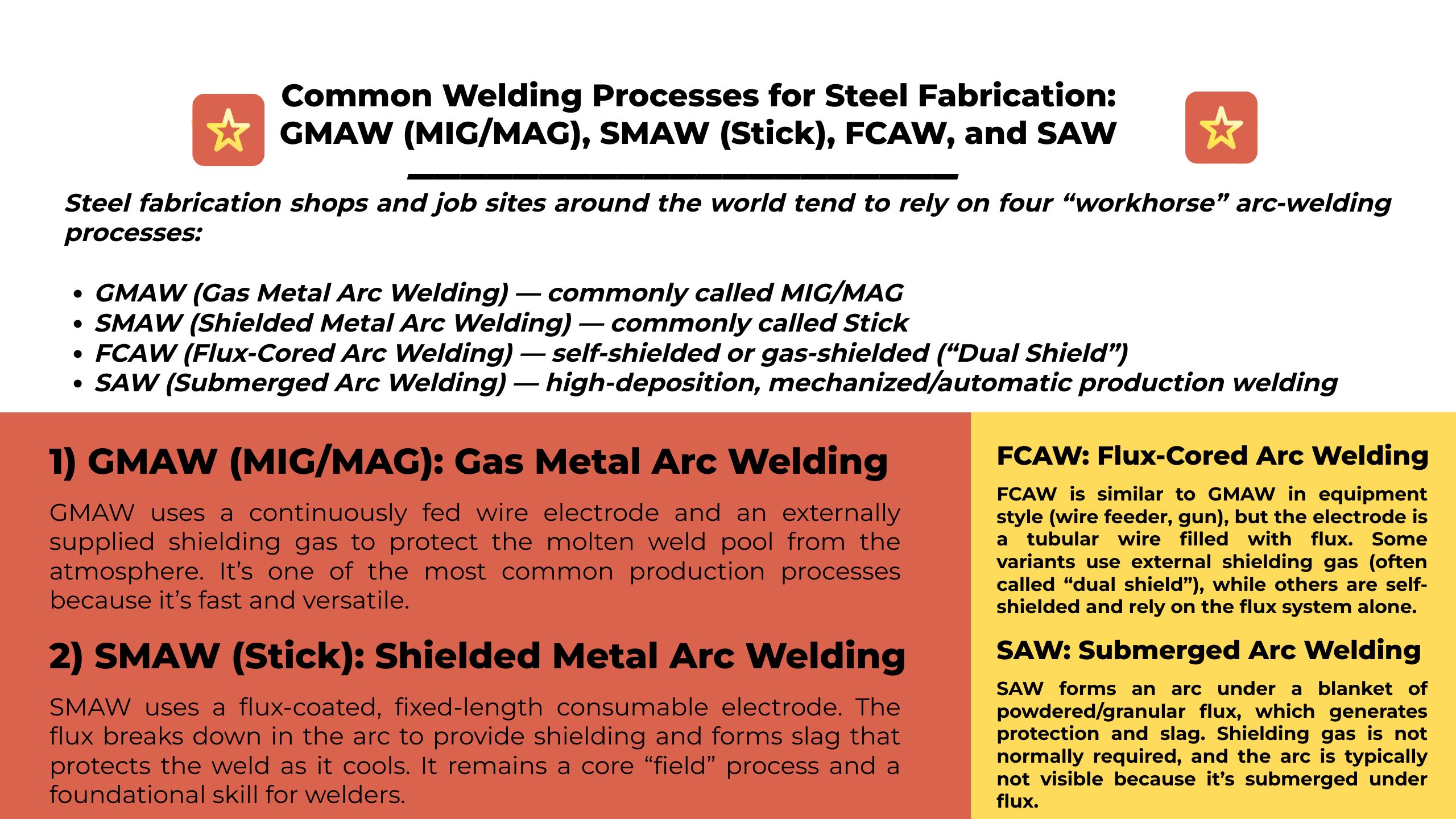
Steel fabrication shops and job sites around the world tend to rely on four “workhorse” arc-welding processes:

  • GMAW (Gas Metal Arc Welding) — commonly called MIG/MAG
  • SMAW (Shielded Metal Arc Welding) — commonly called Stick
  • FCAW (Flux-Cored Arc Welding) — self-shielded or gas-shielded (“Dual Shield”)
  • SAW (Submerged Arc Welding) — high-deposition, mechanized/automatic production welding

Quick Comparison: Which Process Fits Your Job?

ProcessShielding methodBest forWhere it shinesCommon limitations
GMAW (MIG/MAG)External shielding gas + solid wireGeneral fabrication, sheet to medium plateFast, clean, easy to automate, low slag cleanupWind-sensitive outdoors, gas supply needed
SMAW (Stick)Flux-coated electrode creates shielding + slagField welding, repairs, constructionPortable, tolerant of rust/scale, works in windSlower, more skill-dependent, electrode changes, more cleanup
FCAW (Flux-cored)Flux core (may also use gas)Structural steel, heavy fillets, high depositionVery productive, good penetration, outdoor option (self-shielded)More fumes/spatter than GMAW, slag removal
SAW (Submerged)Flux blanket covers arc/weld poolLong seams, thick plate, vessels, pipesExtremely high deposition, consistent quality, easy mechanizationMostly flat/horizontal, equipment/fixtures required

Standard Process Names (ISO 4063) — Helpful for Drawings & WPS Documents

If you work globally, you’ll often see ISO process numbers on drawings, work instructions, and WPS packages. Examples include: 111 (manual metal arc / SMAW), 131 (MIG), 135 (MAG), 136 (tubular cored with active gas shield), 114 (self-shielded tubular cored), 121 (submerged arc with one wire).

1) GMAW (MIG/MAG): Gas Metal Arc Welding

What it is

GMAW uses a continuously fed wire electrode and an externally supplied shielding gas to protect the molten weld pool from the atmosphere. It’s one of the most common production processes because it’s fast and versatile.

Typical steel applications

  • General fabrication: frames, brackets, light-to-medium structural components

  • Manufacturing lines where speed + repeatability matter

  • Thin materials where you want controlled heat input and minimal cleanup (depending on transfer mode)

Why fabricators choose it

  • High travel speed and relatively clean welds (little slag)

  • Easy to learn compared with some manual processes (though quality still depends on fit-up and settings)

  • Excellent for semi-automatic and robotic welding cells

Watch-outs (common real-world issues)

  • Wind and drafts can disrupt shielding gas, causing porosity—so outdoor use needs wind blocks or process changes.

  • Surface contamination (oil, paint, heavy rust) can quickly degrade quality.

2) SMAW (Stick): Shielded Metal Arc Welding

What it is

SMAW uses a flux-coated, fixed-length consumable electrode. The flux breaks down in the arc to provide shielding and forms slag that protects the weld as it cools. It remains a core “field” process and a foundational skill for welders.

Typical steel applications

  • Construction and field erection (stair/handrail installation, joists, site welding)

  • Maintenance, repair, and “dirty” conditions where perfect prep isn’t realistic

  • Remote jobs where shielding gas logistics are difficult

Why fabricators choose it

  • Portability (simple equipment, no gas bottles required)

  • Works well outdoors and in less controlled environments

  • Huge electrode variety for different steels and positions

Watch-outs

  • Lower productivity (electrode changes, slower deposition)

  • More operator skill needed to keep arc length, travel angle, and heat input consistent

  • Slag removal between passes is required for multi-pass welds

3) FCAW: Flux-Cored Arc Welding (Self-Shielded vs Gas-Shielded)

What it is

FCAW is similar to GMAW in equipment style (wire feeder, gun), but the electrode is a tubular wire filled with flux. Some variants use external shielding gas (often called “dual shield”), while others are self-shielded and rely on the flux system alone.

Two common variants (and when they win)

FCAW-G (Gas-shielded / “Dual Shield”)

  • Great for shop fabrication where you want high deposition and strong welds

  • Often chosen for structural steel fillets and multi-pass work

FCAW-S (Self-shielded)

  • A strong option for outdoor structural welding because it does not rely on external shielding gas

  • Particularly useful when wind would disrupt GMAW gas coverage

Typical steel applications

  • Structural fabrication, bridge components, heavy frames

  • Multi-pass fillet welds where productivity matters

  • Job-site structural welding (especially FCAW-S)

Watch-outs

  • Slag removal is still part of the workflow

  • Typically more fume and spatter than clean GMAW setups (plan ventilation and cleanup)

4) SAW: Submerged Arc Welding (High-Deposition Production)

What it is

SAW forms an arc under a blanket of powdered/granular flux, which generates protection and slag. Shielding gas is not normally required, and the arc is typically not visible because it’s submerged under flux.

Where SAW dominates

SAW is widely used for thick steel sections and long, straight seams, including shipbuilding, structural steel fabrication, pressure vessels, and pipe/pipeline-type production—especially where mechanization improves repeatability and throughput.

Why fabricators choose it

  • Very high deposition rate and high productivity

  • Excellent consistency for validated procedures

  • Highly compatible with mechanized/automatic systems

Watch-outs

  • Usually limited to flat/horizontal welding positions because the flux blanket must stay in place

  • Requires more equipment, fixtures, flux handling/recovery—best for repetitive production, not small one-off jobs

How to Choose

If you’re welding outdoors (windy site conditions)

  • Start with SMAW or FCAW-S

  • Use GMAW only if you can reliably control drafts with screens/tents

If you’re in a fabrication shop optimizing throughput

  • GMAW for clean, fast general welding and automation cells

  • FCAW-G for heavy structural fillets and high-deposition multi-pass welds

  • SAW for long seams on thick plate where mechanization pays back quickly

If your welds are long, straight, and repetitive on thick plate

  • SAW is often the first process to evaluate

Quality & Safety Notes You Shouldn’t Skip

  • Ventilation and fume control matter for every arc process—position airflow to move fumes away from the breathing zone and use appropriate controls (local exhaust, extraction, work practices).

  • Regardless of process, high-performing shops standardize: joint prep, fit-up control, WPS parameters, interpass cleaning, and inspection routines.

Codes & Documentation: WPS/PQR Still Drive Real-World Acceptance

If you ship steel into global projects, customers may require welding to recognized codes and documented procedures. For example:

  • AWS D1.1 is a major structural steel welding code used in many steel construction projects, covering areas like fabrication, inspection, and qualification.

  • ASME BPVC Section IX is widely referenced for qualification rules for welding/brazing/fusing procedures and personnel when required by other ASME code sections.

  • WPS/PQR concepts are central to procedure control and qualification workflows.

FAQ

Is MIG the same as GMAW?

“MIG” is commonly used as a shop term, but the formal process name is GMAW (Gas Metal Arc Welding).

Which is best for structural steel: GMAW or FCAW?

Both can be used successfully. Many fabricators choose FCAW (especially FCAW-G) for high-deposition fillets and multi-pass structural work, while GMAW is popular for clean, fast general welding and automation—your joint type, position, and production goals usually decide.

Why is stick welding still so common?

Because SMAW is portable and field-friendly, tolerates harsher conditions, and doesn’t rely on shielding gas logistics—making it reliable for site erection and repairs.

When does SAW make the most sense?

When you have long seams, thick steel, repetitive production, and the ability to use mechanized/automatic setups—common in vessels, pipe production, shipbuilding, and heavy fabrication.

Leave a Reply

Your email address will not be published. Required fields are marked *