
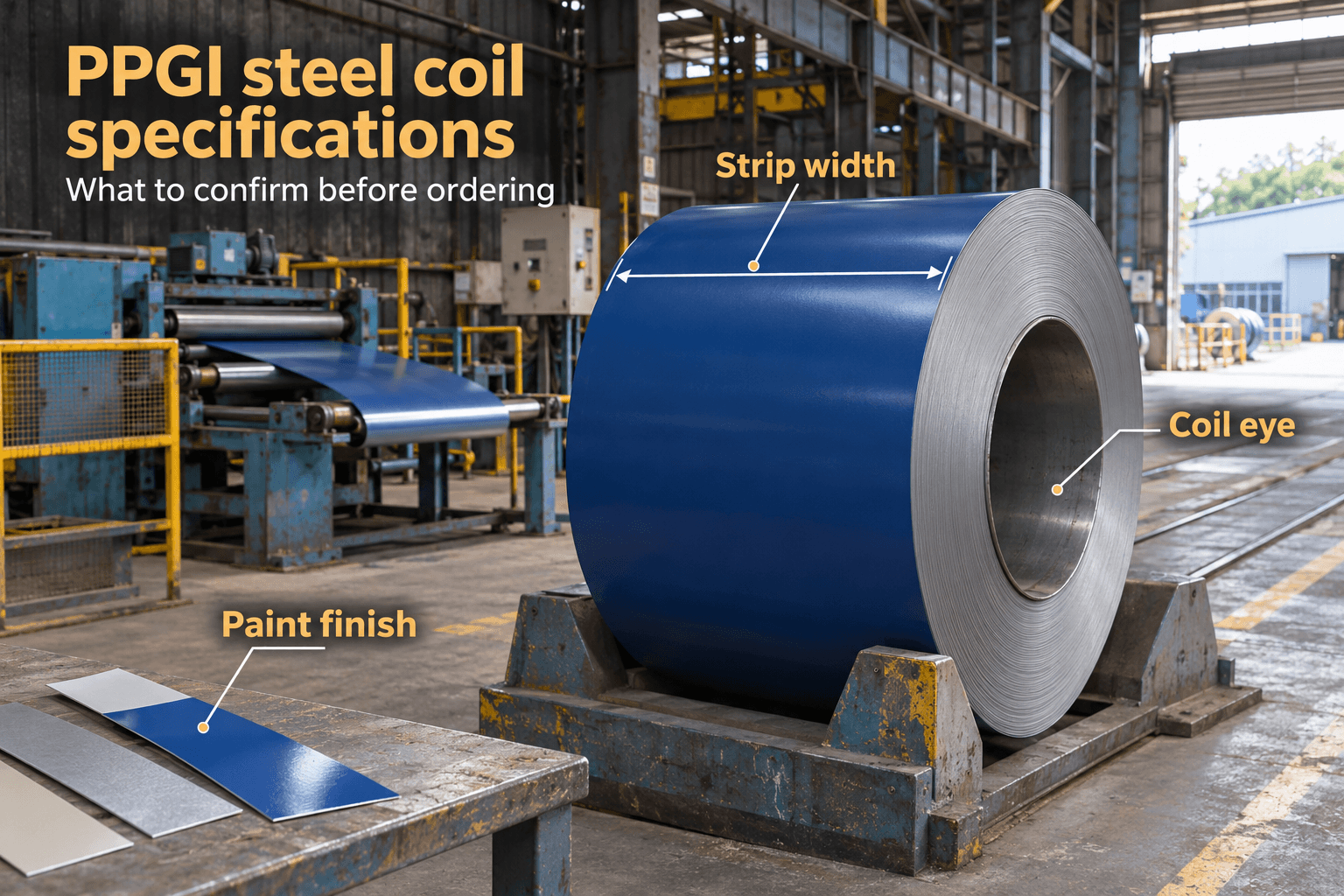
Two offers land on a roofing buyer’s desk. Both say “0.50 mm blue PPGI.” One supplier means 0.50 mm of bare steel. The other has measured the finished, painted strip. Both quotes may describe their products accurately, yet the roll former could receive materials with different steel thicknesses, weights and processing characteristics. Add an unspecified zinc coating or a back coating unsuitable for bonding, and the lowest price per tonne becomes difficult to evaluate.
A purchase-ready PPGI steel coil specification identifies the steel grade, thickness basis and tolerance, zinc coating mass, paint system on each face, and dimensions the processing line can accept. It also tells the inspector how to verify these requirements before shipment.
For importers, steel distributors, roofing manufacturers, construction material suppliers and industrial purchasing teams, understanding PPGI steel coil specifications is essential for controlling material quality and purchasing costs. A well-defined specification helps prevent misunderstandings between buyers and suppliers, reduces production problems and makes quotations easier to compare.
This comprehensive guide explains how to evaluate prepainted galvanized steel coils, from the galvanized substrate and coating structure to paint selection, dimensional tolerances, manufacturing processes, quality inspection, packaging and final purchasing decisions.
Whether you are sourcing PPGI steel coils for roofing sheets, wall cladding, sandwich panels, household appliances or metal fabrication, this guide provides practical information to help you prepare a more accurate purchasing specification.
1. PPGI Steel Coil Specifications at a Glance
PPGI stands for Pre-Painted Galvanized Iron, commonly referred to as pre-painted galvanized steel coil. It consists of a hot-dip galvanized steel substrate covered with an organic paint coating. The zinc layer provides metallic corrosion protection, while the paint system adds color, surface protection and decorative value.
Gengfei Steel lists the following general PPGI product specifications. These ranges provide a starting point for buyers preparing an inquiry. The exact combination of grade, thickness, coating weight, paint system and dimensions must be confirmed before production.
| پارامتر | Published Range or Options | آنچه خریداران باید تایید کنند |
|---|---|---|
| محصول | Pre-Painted Galvanized Steel Coil | Intended application and finished product requirements. |
| درجه فولادی | DX51D+Z، DX52D+Z، DX53D+Z | Grade, applicable standard and forming requirements. |
| ضخامت | 0.12-1.50 mm | BMT or TCT, nominal thickness and permitted tolerance. |
| عرض | 600-1500 mm | Required feed width and slitting tolerance. |
| روکش روی | 30-275 g/m2, listed as Z30-Z275 | Coating designation and applicable standard. |
| Paint Types | PE ، SMP ، HDP ، PVDF | Coating formulation, color, gloss and exposure conditions. |
| پوشش بالا | 10-30 microns | Whether the stated thickness includes primer. |
| Back Coating | 5-20 microns | Reverse-side coating configuration and application. |
| قطر داخلی سیم پیچ | 508 میلی متر / 610 میلی متر | Compatibility with the customer’s uncoiling equipment. |
| وزن سیم پیچ | 3-8 metric tons | Maximum weight per coil and handling capacity. |
| پایان سطح | براق ، مات ، برجسته ، چاپ شده | Approved sample, texture and appearance requirements. |
| Substrate Standards | ASTM A653, EN 10346, JIS G3302 | Applicable edition and galvanized substrate designation. |
| Finished Product Standards | ASTM A755, EN 10169, JIS G3312 | Organic coating requirements and performance criteria. |
These are general published product ranges rather than a guarantee that every possible specification combination is available. For example, a special color combined with a narrow width, a particular zinc coating mass and a specific paint system may require separate production confirmation.
When comparing quotations, make sure that all suppliers are pricing the same material specification. A quotation for 0.50 mm BMT with Z275 zinc coating and a specified paint system cannot be compared directly with an offer that only states 0.50 mm painted steel.
Explore Gengfei Steel PPGI Steel Coil Products.
2. What Is PPGI Steel Coil?
PPGI is a pre-painted galvanized steel product manufactured by applying an organic coating to a galvanized steel substrate through a continuous coil coating process.
Traditional galvanized steel has a metallic zinc surface. PPGI adds a paint coating system to the galvanized substrate, creating a material that combines the strength and corrosion protection of coated steel with the color and appearance required for architectural and industrial applications.
The combination of steel grade, zinc coating and paint formulation determines the overall properties of the finished material. Therefore, PPGI should be evaluated as a complete coating system rather than simply as colored galvanized steel.
2.1 Basic Structure of PPGI Steel Coil
| لایه | مواد | عملکرد اصلی |
|---|---|---|
| بستر فولادی | Cold-rolled steel base metal | Provides mechanical strength and formability. |
| روکش روی | Hot-dip galvanized zinc layer | Provides barrier and sacrificial corrosion protection. |
| Pretreatment | Chemical conversion treatment | Prepares the surface for improved paint adhesion. |
| Primer | Organic primer coating | Supports adhesion and corrosion protection. |
| Topcoat | PE, SMP, HDP, PVDF or other systems | Provides color, gloss and surface protection. |
| Back Coating | Protective reverse-side coating | Protects the back surface and supports the intended application. |
The actual coating configuration depends on the production line and the customer’s requirements. Some products use different primer and finish coat arrangements on the front and back surfaces.
2.2 Why Do Buyers Choose Pre-Painted Galvanized Steel?
- Ready-to-Use Surface: The steel arrives with an applied paint finish, reducing the need for additional painting operations in many manufacturing processes.
- Color Flexibility: Different colors, gloss levels and surface textures can be selected for architectural and decorative applications.
- Combined Protection: The galvanized substrate and organic paint coating provide complementary protection when the material is correctly specified and maintained.
- Processing Convenience: PPGI coils can be slit, cut and roll-formed when the selected substrate and coating system are compatible with the operation.
- Consistent Appearance: Coil coating production allows manufacturers to control coating application and surface appearance across continuous material lengths.
- Manufacturing Efficiency: Pre-painted material can simplify downstream production for roofing, wall panels and selected appliance components.
3. PPGI Steel Coil Manufacturing Process
The manufacturing process is an important factor in determining the appearance, coating adhesion and consistency of pre-painted galvanized steel. PPGI is normally produced through a continuous coil coating process in which the galvanized strip passes through a series of cleaning, pretreatment, painting and curing stages.
3.1 Preparation of the Galvanized Substrate
The production process begins with a hot-dip galvanized steel coil selected according to the required steel grade, thickness and zinc coating designation. The substrate must meet the agreed requirements before entering the painting process.
3.2 Cleaning and Pretreatment
Cleaning removes oil, dust and other surface contaminants. Chemical pretreatment then prepares the galvanized surface for the application of organic coatings. Proper pretreatment is important because the paint system must bond effectively to the prepared substrate.
3.3 Primer Application
A primer is applied to improve the coating system’s adhesion and contribute to corrosion protection. The primer formulation should be compatible with the galvanized substrate and the selected topcoat.
3.4 Topcoat and Backcoat Application
The front surface receives the specified finish coating, such as PE, SMP, HDP or PVDF. The reverse side receives the agreed back coating system. The two surfaces may have different coating requirements depending on the final application.
3.5 Baking and Curing
The coated strip passes through a curing oven under controlled production conditions. The coating must reach the required curing condition to achieve its intended film properties. The exact curing conditions depend on the coating formulation and production equipment.
3.6 Cooling, Inspection and Recoiling
After curing, the strip is cooled and inspected. The production team checks the surface appearance, coating thickness, color consistency and other agreed requirements. The finished material is then recoiled, identified and packaged for transportation.
4. International Standards for PPGI Steel Coil
International standards provide a common technical framework for steel grade classification, metallic coating requirements, dimensional tolerances and organic coating performance.
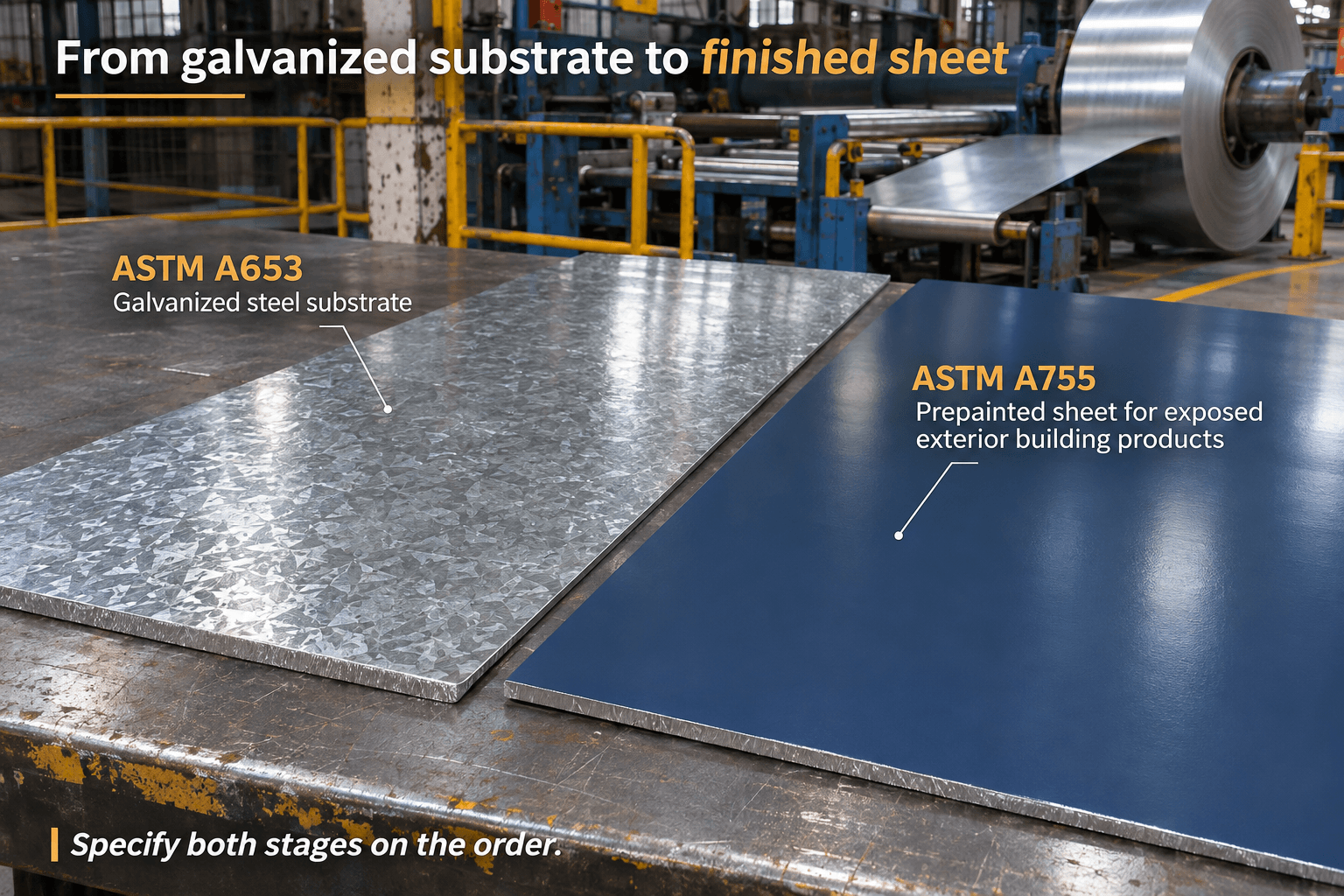
One important purchasing consideration is that the galvanized substrate and the finished pre-painted steel may be covered by different standards. Buyers should identify both parts of the specification rather than relying on a single standard number without defining its scope.
4.1 ASTM A653/A653M
ASTM A653/A653M covers steel sheet coated with zinc or zinc-iron alloy through a hot-dip process. It is commonly referenced for galvanized steel substrates used in PPGI manufacturing.
When ordering PPGI under an ASTM-based specification, buyers should identify the substrate grade, metallic coating designation, thickness and applicable dimensional requirements.
4.2 ASTM A755/A755M
ASTM A755/A755M addresses factory-prepainted hot-dip metallic-coated steel sheet intended for exterior exposed building products. It is relevant when specifying the finished pre-painted material, including the metallic-coated substrate and organic coating requirements.
4.3 EN 10346 and EN 10169
EN 10346 covers continuously hot-dip-coated steel flat products, including galvanized substrate grades and metallic coating designations. EN 10169 addresses continuously organic-coated coil-coated steel flat products and is relevant when defining the performance and delivery requirements of the finished painted material.
For example, a buyer may specify DX51D+Z275 to EN 10346 for the galvanized substrate and EN 10169 for the organic coating requirements, with the applicable performance classification clearly identified.
4.4 JIS G3302 and JIS G3312
JIS G3302 covers hot-dip zinc-coated steel sheet and strip. JIS G3312 covers pre-painted hot-dip zinc-coated steel sheet and strip.
4.5 Standard Comparison Table
| استاندارد | محدوده اصلی | Use in PPGI Purchasing |
|---|---|---|
| ASTM A653/A653M | Hot-dip galvanized and galvannealed steel sheet | Galvanized substrate requirements. |
| ASTM A755/A755M | Factory-prepainted metallic-coated steel sheet | Finished pre-painted product requirements. |
| EN 10346 | Continuously hot-dip-coated steel flat products | Steel grades and metallic coating requirements. |
| EN 10169 | Continuously organic-coated steel flat products | Paint coating and performance requirements. |
| JIS G3302 | Hot-dip zinc-coated steel sheet and strip | Galvanized substrate requirements. |
| JIS G3312 | Pre-painted hot-dip zinc-coated steel sheet and strip | Finished pre-painted steel requirements. |
Do not assume that different standards or grade designations are automatically interchangeable. If a supplier proposes an alternative grade, request a written comparison covering mechanical properties, coating mass, thickness tolerances and paint performance before approving the substitution.
Official references: ASTM A653/A653Mبا ASTM A755/A755Mبا EN 10346با EN 10169با JIS G3302 وت JIS G3312.
5. Zinc Coating Weight: What Do Z80, Z120 and Z275 Mean?
The zinc coating is an important part of the corrosion protection system of PPGI steel coil. It provides a barrier between the steel substrate and the surrounding environment and can offer sacrificial protection when small areas of steel become exposed.
Zinc coating mass is commonly expressed in grams per square meter (g/m2). The designation and acceptance requirements depend on the applicable standard.
5.1 Understanding Z275
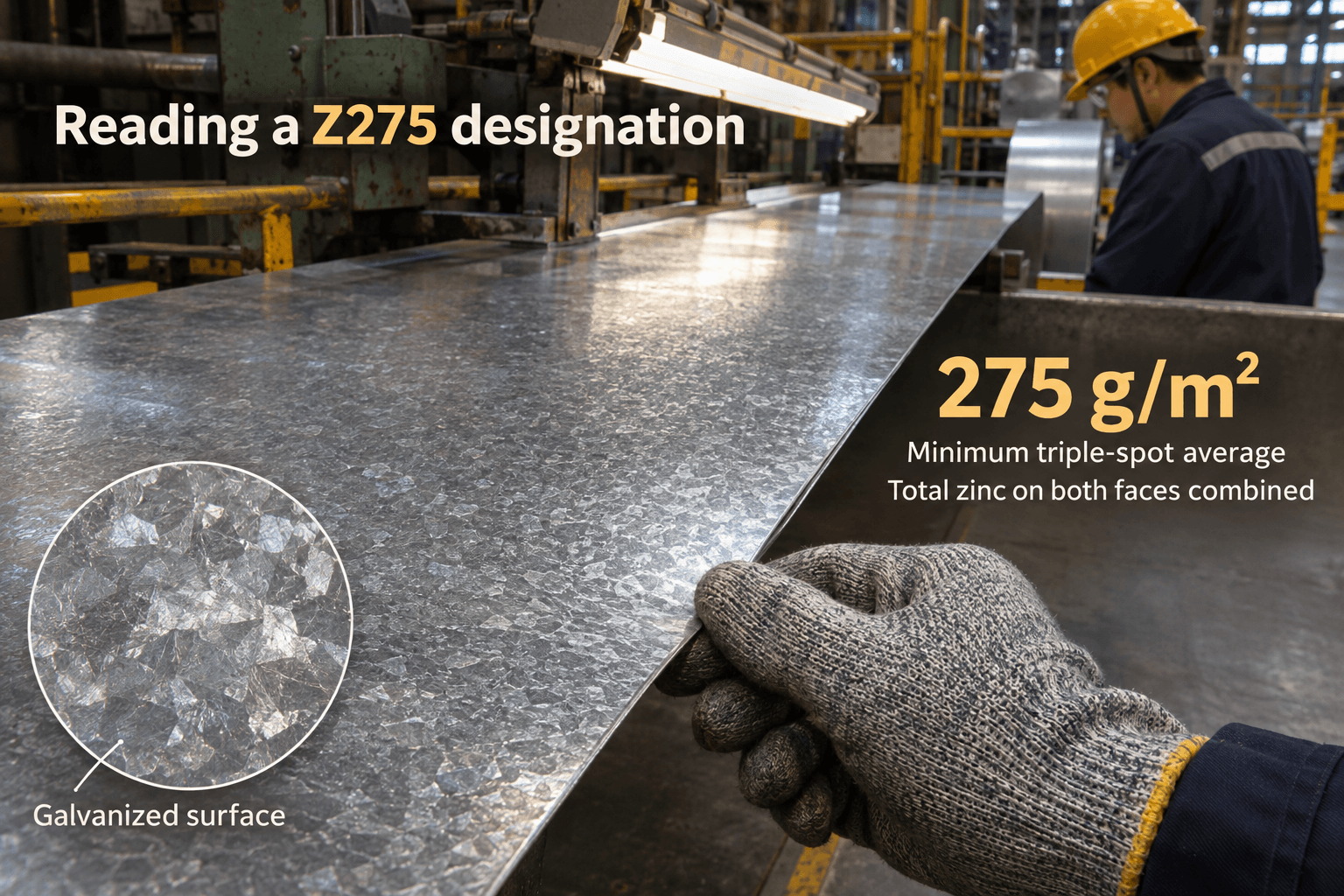
Under the EN coating designation system, Z275 represents a minimum triple-spot average zinc coating mass of 275 g/m2 for both surfaces combined. It does not mean 275 g/m2 on each individual surface.
5.2 Examples of EN Zinc Coating Mass Requirements
| تعیین | Minimum Triple-Spot Average | Minimum Single-Spot Result |
|---|---|---|
| Z140 | 140 g/m2 | 120 g/m2 |
| Z200 | 200 g/m2 | 170 g/m2 |
| Z275 | 275 g/m2 | 235 g/m2 |
The table illustrates common EN coating mass requirements. Buyers should use the exact values from the applicable standard edition and product specification when preparing a contract.
5.3 Z275 and ASTM G90
ASTM G90 is a commonly referenced galvanized coating designation. Its nominal coating mass is approximately equivalent to 275 g/m2 total for both surfaces when converted from the relevant inch-pound unit. However, buyers should not treat two designations as automatically interchangeable without checking the applicable standard, sampling procedure and acceptance requirements.
5.4 How to Select Zinc Coating Weight
- Indoor Applications: Material used in relatively controlled indoor environments may have different corrosion protection requirements from exterior building panels.
- Outdoor Construction: Roofing and wall cladding products should be evaluated according to rainfall, humidity, pollution and other exposure conditions.
- Coastal Locations: Salt exposure and airborne chloride can create more demanding corrosion conditions. The complete coating system and installation details require careful evaluation.
- Industrial Environments: Chemical pollutants, moisture and process conditions may influence the selection of both substrate and paint system.
- Processing Requirements: Cutting and forming operations may expose edges or affect the coating. The finished design should account for these conditions.
A higher zinc coating designation does not automatically guarantee a particular service life. Actual performance also depends on the organic coating, cut edges, installation, maintenance and environmental exposure.
For more information, buyers can review GalvInfo’s explanation of galvanized coating designations.
6. PPGI Steel Coil Thickness, Width and Dimensional Tolerances
Thickness and width are two of the most important parameters in a PPGI purchase order. They affect material weight, processing performance, finished product dimensions and total project cost.
6.1 Base Metal Thickness and Total Coated Thickness
- Base Metal Thickness (BMT): The thickness of the steel substrate, excluding the metallic zinc coating and organic paint layers.
- Metallic-Coated Thickness: The thickness of the steel substrate together with its metallic coating, before the organic paint system is considered.
- Total Coated Thickness (TCT): The overall thickness of the finished material, including the steel substrate, metallic coating and organic paint layers.
Different suppliers may use different measurement conventions in their quotations. Always define the measurement basis in the purchase order instead of assuming that a quoted thickness represents the same layer structure.
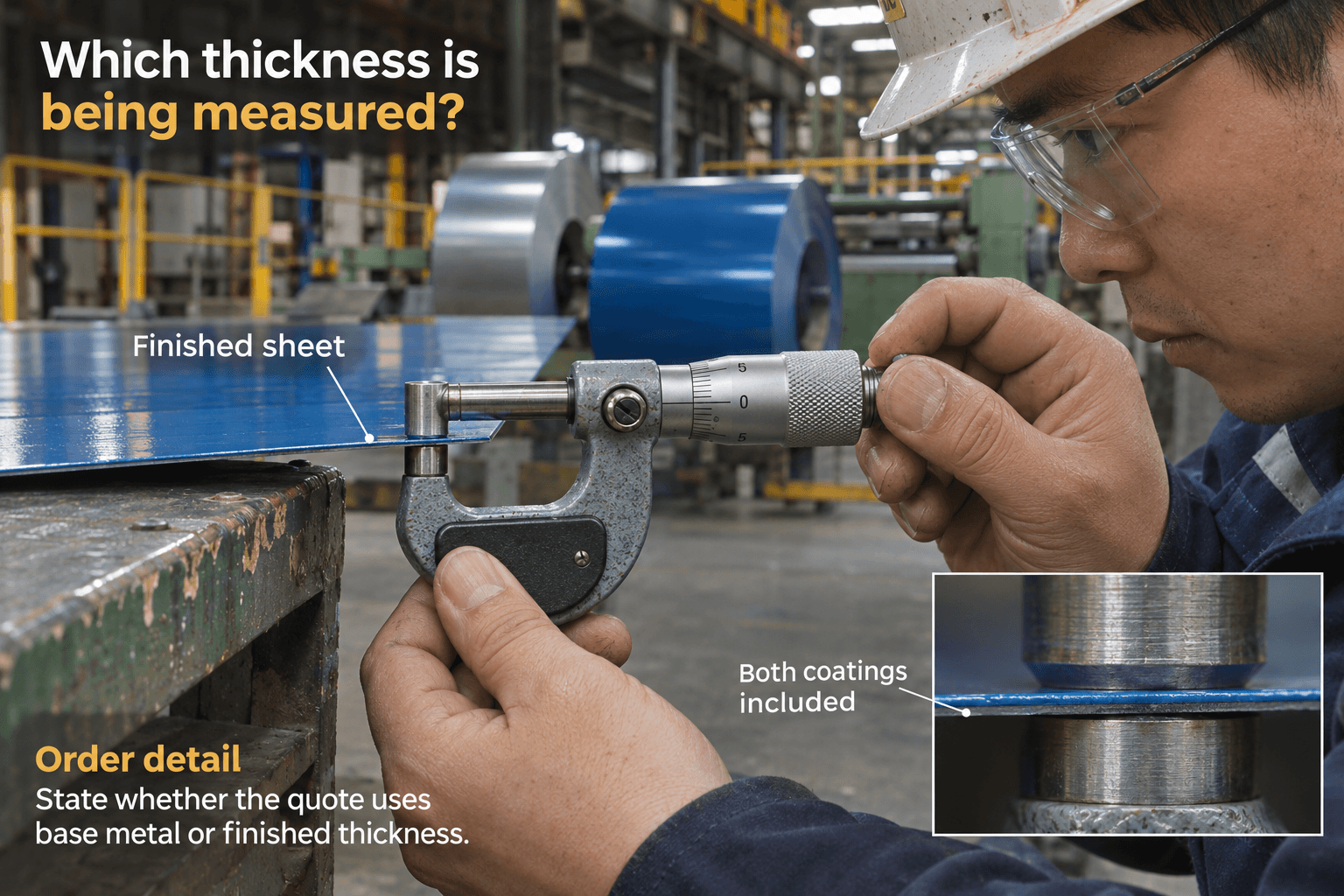
For example, a purchase order stating “0.50 mm BMT” is different from one stating “0.50 mm TCT.” If the customer requires a minimum steel substrate thickness, this requirement should be written explicitly and reflected in the quotation.
6.2 Why Thickness Tolerance Matters
Thickness tolerance refers to the permitted difference between the nominal thickness and the actual measured value.
It can depend on:
- Nominal steel thickness.
- Steel grade and mechanical property category.
- Product width.
- Applicable product standard.
- Specified tolerance class.
- Measurement location and inspection method.
For buyers manufacturing roofing panels, even a small variation may influence profile consistency, finished panel weight and installation performance. For precision fabrication, thickness variation can also affect forming force and dimensional repeatability.
If a drawing specifies a minimum thickness rather than a nominal thickness, state this distinction clearly. A supplier should not assume that a nominal value automatically represents a guaranteed minimum measurement at every point.
6.3 Common PPGI Coil Widths
Gengfei Steel lists a general PPGI width range of 600-1500 mm. The required width should match the customer’s roll forming equipment, slitting process or final component dimensions.
Buyers should distinguish between:
- Original Coil Width: The width of the supplied steel coil.
- Slit Width: The width after a coil has been slit into narrower strips.
- Feed Width: The flat strip width entering a roll forming line.
- Formed Width: The overall width of the finished profile.
- Effective Cover Width: The usable coverage after side laps or overlaps are considered.
For roofing manufacturers, the effective cover width is particularly important because it determines how much roof area can be covered by each finished panel.
6.4 Theoretical Steel Weight Calculation
Steel buyers can use a theoretical weight calculation to estimate the bare steel mass of a coil before adding the metallic and organic coating weights.
Approximate bare steel weight per square meter:
Steel Weight (kg/m2) = Thickness (mm) x 7.85
Approximate bare steel weight per meter of strip:
Weight (kg/m) = Width (mm) x Thickness (mm) x 0.00785
For example, a steel strip with a 0.50 mm BMT and 1200 mm width has an approximate bare steel weight of:
1200 x 0.50 x 0.00785 = 4.71 kg/m
For 1000 meters, the approximate bare steel mass is 4.71 metric tons, excluding zinc and paint coatings.
This calculation is useful for preliminary estimation, but it should not replace the actual net coil weight or the supplier’s verified dimensional and weight records. Coating mass, thickness tolerance and actual strip dimensions will affect the final result.
7. PPGI Steel Coil Quality Inspection and Testing
Quality inspection is essential when purchasing PPGI steel coils, particularly for bulk orders and projects with strict appearance, dimensional or durability requirements.
A complete inspection plan should cover the substrate, zinc coating, organic paint system, dimensions, surface condition and packaging. Buyers should define inspection methods and acceptance criteria before production rather than relying only on a general statement that the material meets quality requirements.
7.1 Visual Surface Inspection
Visual inspection helps identify obvious surface defects before the coils are accepted or processed.
- Scratches and visible surface damage.
- Uneven color or inconsistent gloss.
- Paint bubbles, peeling or visible coating defects.
- Oil contamination and foreign particles.
- Roll marks, dents and handling damage.
- Edge damage and visible corrosion.
7.2 Thickness and Width Measurement
Thickness and width should be checked using suitable calibrated measuring instruments. The measurement basis, sampling locations and acceptance limits should follow the agreed standard and purchase specification.
For PPGI products, it is particularly important to distinguish between steel substrate thickness and total coated thickness.
7.3 Zinc Coating Weight Inspection
Zinc coating mass can be evaluated using an appropriate coating mass test method. The inspection should confirm the required coating designation, sampling procedure and acceptance limits.
When independent confirmation is required, buyers may agree on a laboratory method such as ASTM A90/A90M where applicable.
7.4 Paint Film Thickness Testing
Paint film thickness should be checked on the required surfaces using a suitable calibrated coating thickness instrument or another agreed method.
The inspection report should identify the tested surface, measurement method and whether the stated value includes primer. The instrument and test method must be appropriate for the specific inspection requirement.
7.5 Paint Adhesion and Flexibility Testing
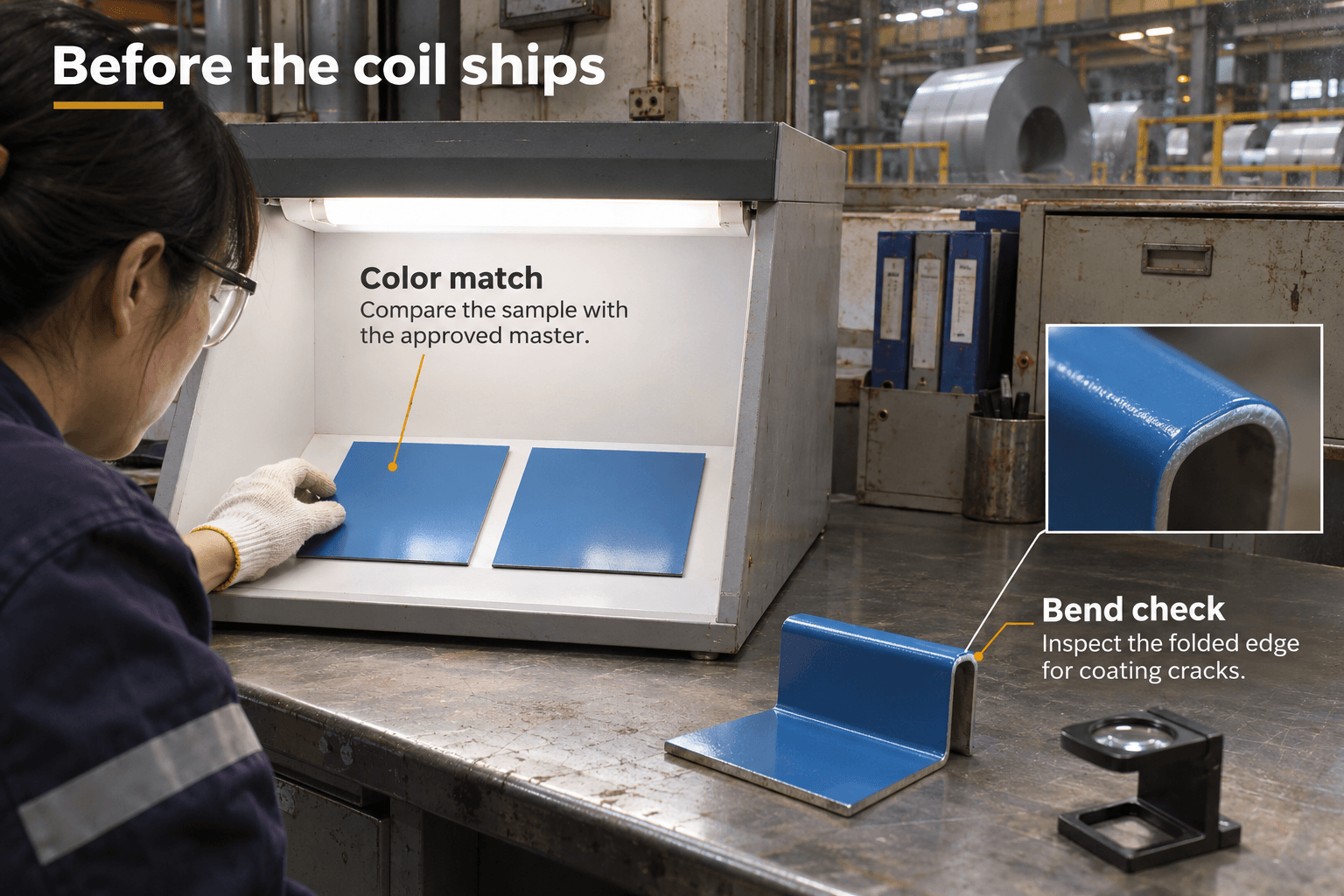
Adhesion and flexibility testing helps evaluate whether the paint coating can remain attached during bending and forming operations. Depending on the agreed standard, common evaluation methods may include cross-cut adhesion testing, T-bend testing and other relevant coating performance checks.
7.6 Color and Gloss Inspection
Color and gloss inspection is important for architectural and decorative PPGI products. Measurements should be compared with an approved reference sample under consistent conditions.
For large orders, the buyer should specify the color difference limit, gloss measurement angle and acceptable appearance range.
7.7 Corrosion and Weathering Performance
Depending on the application, buyers may request accelerated corrosion testing, humidity resistance testing and ultraviolet weathering evaluation.
Salt spray test hours should not be interpreted as a direct prediction of outdoor service life. Accelerated test results depend on the test method, sample preparation, coating system and acceptance criteria. Real-world performance also depends on installation, maintenance and environmental exposure.
7.8 Pre-Shipment Inspection Checklist
| آیتم بازرسی | هدف | Required Record |
|---|---|---|
| Coil Identification | Verify product and batch traceability. | Coil labels and production records. |
| ضخامت | Verify the agreed measurement basis. | Thickness inspection report. |
| عرض | Confirm dimensional compliance. | Width measurement record. |
| روکش روی | Verify metallic coating mass. | Coating test record. |
| Paint Thickness | Verify front and back coating requirements. | Dry-film thickness record. |
| Adhesion and Bending | Evaluate coating behavior during forming. | Relevant test results. |
| Color and Gloss | Verify appearance consistency. | Approved sample and inspection record. |
| بسته بندی | Check protection before shipment. | Packaging photographs and checklist. |
Inspection frequency, sampling and acceptance criteria should be agreed before production. A test report should identify the material batch or coil to which the result applies.
Technical references: EN 13523 Coil Coating Test Methodsبا ASTM A90/A90M وت Coating Thickness Measurement on Galvanized Steel.
8. Roofing Panel Width and PPGI Material Cost Calculation
For roofing manufacturers, the width of the original steel coil and the effective cover width of the finished roofing sheet are two different measurements. Understanding this difference helps buyers calculate the actual material cost per covered square meter.
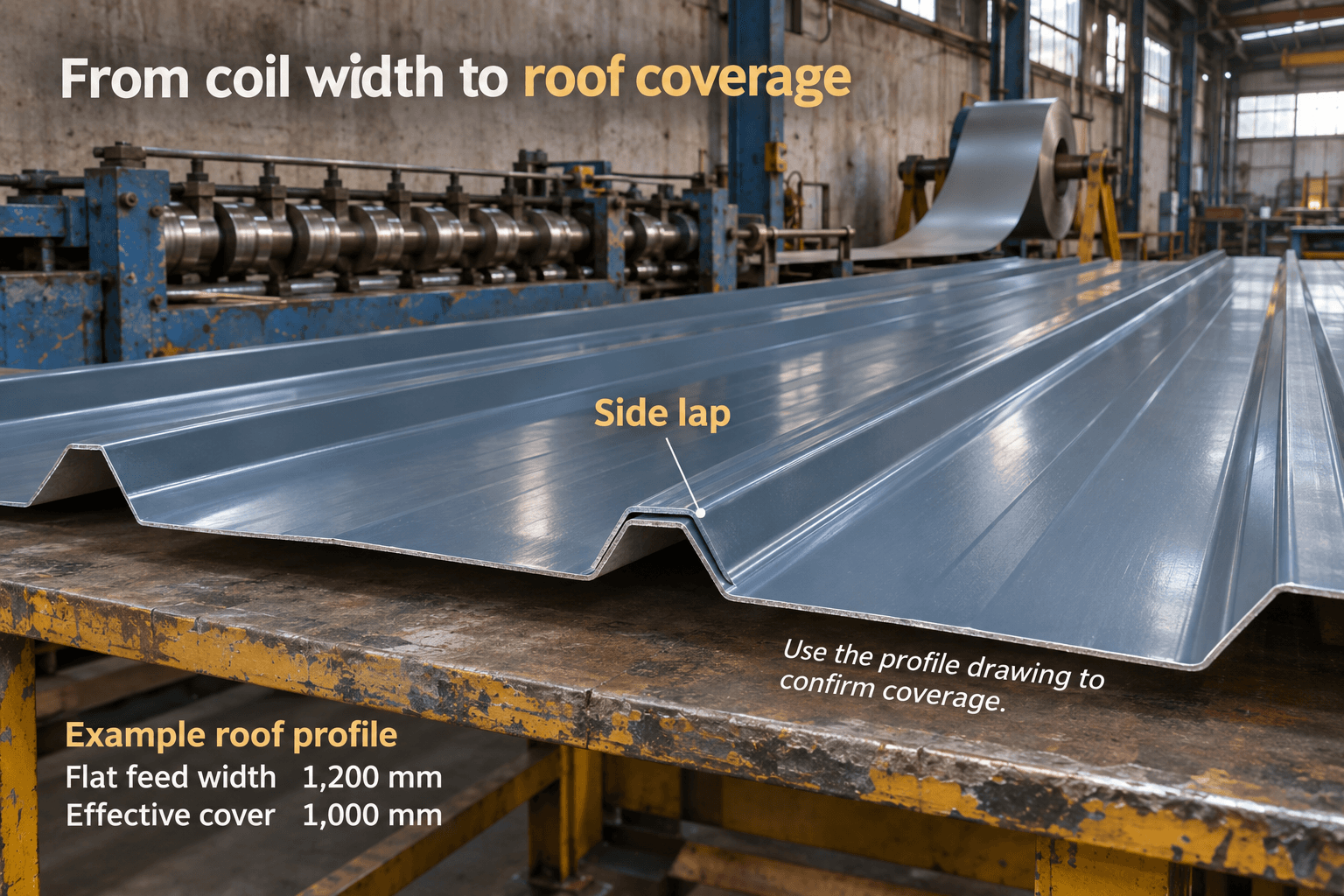
When a flat PPGI strip passes through a roll forming machine, it is shaped into a roofing profile. Side laps and overlaps reduce the effective coverage width compared with the original flat strip width.
Buyers should therefore evaluate the finished roofing profile rather than calculating material costs using only the original coil width.
8.1 Understanding Effective Cover Width
Effective cover width is the usable width of a finished roofing panel after the side lap or overlap is taken into account.
For example, a flat strip may have an original width of 1200 mm, while the finished roofing panel may have an effective cover width of 1000 mm. The difference is related to the profile geometry and side overlap requirements.
The exact relationship depends on the roofing profile design. Buyers should request a drawing or technical specification showing the finished profile width and effective coverage.
8.2 Worked Purchasing Example: Comparing PPGI Cost per Covered Square Meter
The following is an illustrative purchasing calculation. All prices, quantities, production yields and loss percentages are assumptions, not a Gengfei Steel quotation.
A roofing distributor purchases blue PPGI steel coils by metric ton and sells finished roofing sheets by covered square meter.
The distributor’s production line accepts a 1200 mm feed strip and produces a roofing profile with an effective cover width of 1000 mm. The maximum coil weight accepted by the line is 5.5 metric tons.
One supplier quotes “0.50 mm blue PPGI.” Another offers “0.50 mm BMT, Z275, 25 microns total exposed-face coating including primer, 7 microns reverse coating.”
The buyer first asks both suppliers to confirm the same steel grade, thickness basis, zinc coating, paint system, color and coil dimensions. Only after the technical specifications are aligned should the commercial quotations be compared.
| Input or Calculation | ارزش |
|---|---|
| Net Coil Weight | 5.10 metric tons |
| Delivered Coil Price | USD 800 per metric ton |
| Total Material Cost | 5.10 x USD 800 = USD 4,080 |
| Measured Usable Strip Length | 1000 meters |
| Flat Strip Area | 1000 x 1.20 = 1200 m2 |
| Theoretical Roof Coverage | 1000 x 1.00 = 1000 m2 |
| Assumed Forming and Trim Loss | 2% |
| Saleable Covered Area | 1000 x 0.98 = 980 m2 |
| Material Cost per Saleable Covered Square Meter | USD 4080 / 980 = approximately USD 4.16/m2 |
Dividing the material cost by the flat strip area would give approximately USD 3.40/m2. However, this does not reflect the effective roof coverage after side laps and processing losses.
The buyer should use actual measured strip length, effective cover width and production yield when calculating material cost. The theoretical steel weight formula is useful for preliminary estimation, but it should not replace actual coil weight and production records.
8.3 Other Costs to Include
- Ocean freight or inland transportation.
- Insurance where applicable.
- Import duties and customs charges.
- Port handling and destination charges.
- Local transportation to the warehouse.
- Slitting, roll forming and production losses.
- Packaging and storage costs.
A complete purchasing comparison should evaluate the total cost of usable finished material rather than focusing only on the quoted price per metric ton.
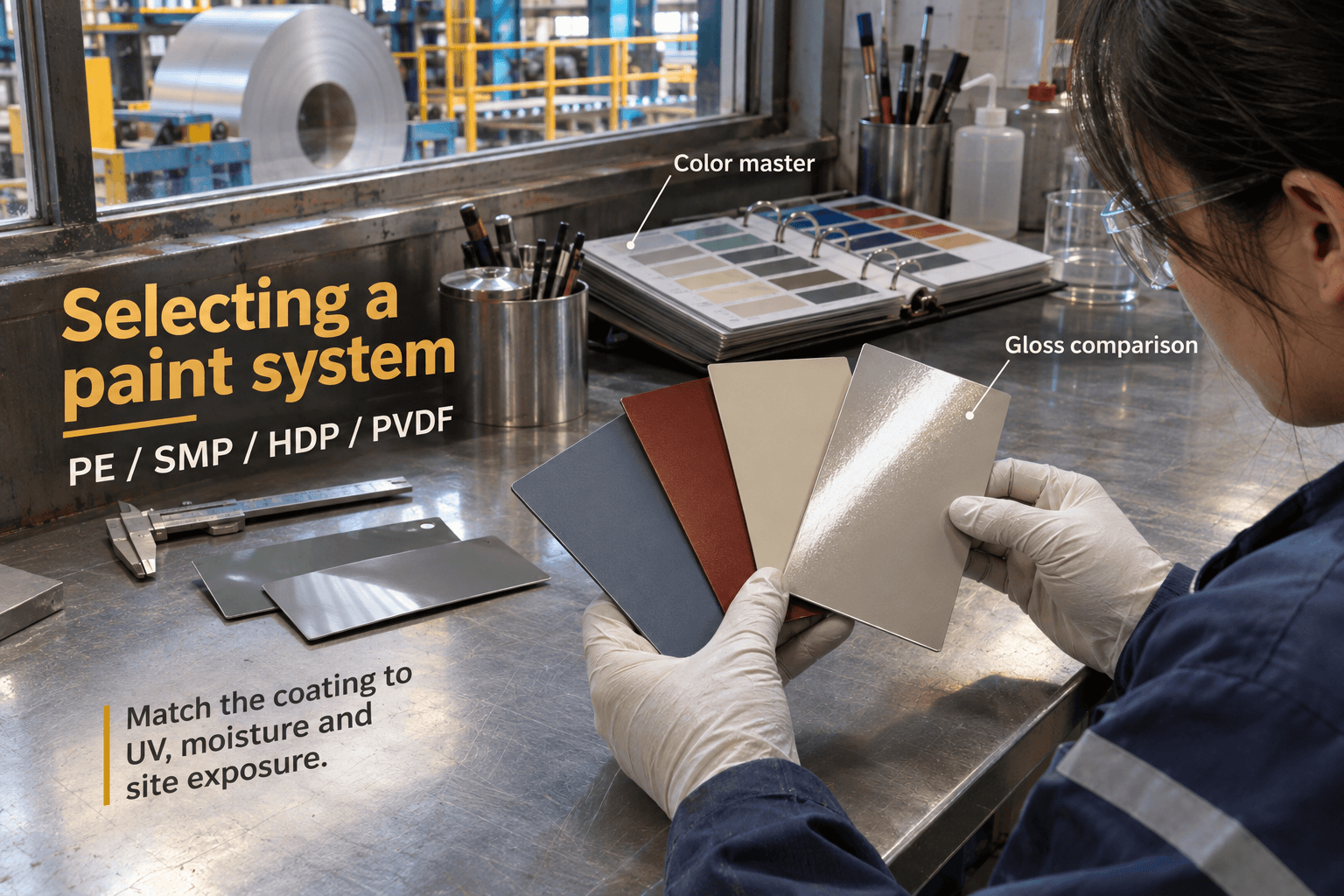
9. PPGI Paint Types: PE, SMP, HDP and PVDF
The paint system has a major influence on the appearance, weather resistance, flexibility and maintenance requirements of PPGI steel coil.
Different coating systems are developed for different exposure conditions and project budgets. The correct selection should consider the resin formulation, coating thickness, pretreatment, curing conditions and actual service environment.
9.1 PE – Polyester Coating
PE, or Polyester, is widely used for general-purpose pre-painted galvanized steel products. It provides a practical balance between cost, color selection and processing requirements.
- Suitable for many general construction products.
- Available in a broad range of colors and surface finishes.
- Can provide good flexibility when properly formulated for the intended forming operation.
- Often considered for projects where cost efficiency is important.
PE is commonly selected for general roofing, wall panels and interior applications, subject to the project’s exposure and performance requirements.
9.2 SMP – Silicone Modified Polyester
SMP is a silicone-modified polyester coating system developed to improve selected weathering and surface performance characteristics compared with conventional polyester formulations.
Depending on the formulation, SMP may offer:
- Improved outdoor weathering performance.
- Good color and gloss retention.
- Suitable flexibility for many forming operations.
- A balance between coating performance and project cost.
Buyers should request product-specific test information rather than assuming that every SMP coating has identical performance.
9.3 HDP – High Durability Polyester
HDP, or High Durability Polyester, is designed for applications where improved weathering performance is required.
Depending on the formulation, it may offer enhanced resistance to ultraviolet exposure, fading and outdoor environmental conditions.
When specifying HDP, buyers should confirm the coating manufacturer, product data sheet, dry-film thickness and relevant performance classification.
9.4 PVDF – Polyvinylidene Fluoride Coating
PVDF is a fluoropolymer coating system commonly considered for architectural applications requiring demanding exterior appearance and weathering performance.
Potential applications include:
- Architectural exterior wall panels.
- Commercial and public buildings.
- Decorative metal facades.
- Projects requiring strict color and gloss retention requirements.
PVDF systems are generally positioned in the higher-performance segment. However, the actual performance depends on the formulation, resin content, coating configuration, surface preparation and applicable test results.
9.5 Comparison of Common PPGI Paint Systems
| نوع رنگ | General Characteristics | Typical Selection Considerations |
|---|---|---|
| پستان | General-purpose polyester coating. | Cost-conscious construction and interior products. |
| SMP | Silicone-modified polyester. | Outdoor applications requiring improved weathering characteristics. |
| HDP | High-durability polyester. | Projects requiring enhanced weathering performance. |
| پی وی سی | Fluoropolymer coating system. | Architectural and demanding exterior applications. |
There is no single paint system that is automatically the best choice for every application. Buyers should compare coating data sheets, test results, warranty conditions and the expected exposure environment.
10. Top Paint Thickness and Back Paint Thickness
Paint film thickness is another essential parameter when purchasing PPGI steel coils. It influences the amount of organic coating applied to the steel surface and forms part of the overall coating system requirements.
| Coating Position | Published Thickness Range | Purchasing Considerations |
|---|---|---|
| پوشش بالا | 10-30 microns | Confirm whether the value includes primer and finish coat. |
| Back Coating | 5-20 microns | Confirm the reverse-side coating system and application. |
10.1 Why Is Front-Side Coating Thickness Important?
The front surface is usually the visible side of the finished product. It influences the material’s color, gloss, decorative appearance and surface protection.
For roofing and exterior wall applications, the coating specification should reflect the expected exposure conditions. For decorative applications, color consistency and gloss requirements may also be important.
10.2 Why Should Buyers Check Back Paint Thickness?
The reverse surface should not be ignored. Depending on the final product, it may be exposed to condensation, indoor humidity, moisture or contact with insulation and adhesives.
For sandwich panel manufacturing, the back coating may need to be compatible with the bonding material or foaming system. A standard protective back coat should not automatically be assumed suitable for every bonding application.
10.3 How to Specify the Paint Film Correctly
- Front-side coating thickness.
- Back-side coating thickness.
- Whether the stated thickness includes primer.
- Whether the value represents total dry film thickness or finish coat thickness alone.
- Paint system and coating manufacturer where specified.
- Measurement method and inspection tolerance.
- Required appearance and surface quality.
For example, one supplier may quote 25 microns as the combined primer and topcoat thickness, while another may quote 25 microns for the topcoat alone. These are different coating configurations and should not be compared without clarification.
مرجع: Coil Coating Comparison Guide.
11. PPGI Steel Grades: DX51D+Z, DX52D+Z and DX53D+Z
Steel grade selection affects the forming performance and mechanical behavior of PPGI steel coil. Different grades are intended for different processing requirements, including bending, profiling, drawing and deep drawing.
11.1 DX51D+Z: Bending and Profiling Quality
DX51D is commonly used for general forming operations. It is a practical starting point for many roofing and wall cladding products manufactured through roll forming.
کاربردهای معمولی عبارتند از:
- Corrugated roofing sheets.
- Industrial wall cladding panels.
- Metal ceilings and partition systems.
- General construction components.
- Light industrial enclosures.
11.2 DX52D+Z: Drawing Quality
DX52D is a drawing-quality grade intended for applications requiring more forming capability than ordinary bending and profiling operations. Buyers should provide the component drawing, forming depth, corner radius and production method so that the proposed material can be evaluated properly.
11.3 DX53D+Z: Deep Drawing Quality
DX53D is a deep-drawing quality grade used for more demanding forming operations.
Potential applications include selected appliance parts, formed covers and industrial components requiring more complex shaping.
For deep-drawing applications, buyers should evaluate the steel properties and the flexibility of the organic coating together. A substrate may form successfully while the paint system develops cracking at tight corners or severe bends.
11.4 Steel Grade Comparison
| درجه | General Classification | Processing Focus | برنامه های کاربردی بالقوه |
|---|---|---|---|
| DX51D+Z | Bending and profiling quality | General bending and roll forming | Roofing and wall panels. |
| DX52D+Z | Drawing quality | More demanding drawing operations | Formed metal components. |
| DX53D+Z | Deep drawing quality | Deep drawing and complex forming | Selected appliance and industrial parts. |
The grade classification should always be interpreted under the applicable standard. A grade name alone does not replace the mechanical property requirements of a customer’s engineering drawing.
12. PPGI Colors, Gloss Levels and Surface Finishes
Color flexibility is one of the main reasons buyers select pre-painted galvanized steel. Different colors and surface finishes allow manufacturers to produce roofing, wall panels, furniture and decorative products that match architectural or commercial requirements.
12.1 RAL Color Selection
Many international buyers use the RAL color system to identify their preferred PPGI color.
Commonly requested color families include:
- White and off-white tones.
- Blue and dark blue tones.
- Red and brick red tones.
- Green and dark green tones.
- Grey and charcoal tones.
- Brown and architectural wood-effect tones.
For bulk orders, provide the exact RAL reference or an approved physical sample. A general color name such as blue or grey is not always sufficient for accurate color matching.
12.2 Color Difference and Batch Consistency
Color consistency is particularly important for large roofing and wall cladding projects. If different coils are installed next to each other, visible differences in shade or gloss may affect the appearance of the building.
Buyers should consider the following controls:
- Approve a physical color sample before production.
- Record the RAL reference and coating product.
- Specify the acceptable color difference where required.
- Confirm gloss level and measurement conditions.
- Request batch identification for multiple coils.
- Arrange production planning to reduce visible differences between adjacent panels.
Instrumental color measurement may use an agreed color difference method such as CIELAB Delta E. The acceptable limit and measurement conditions should be specified by the buyer and supplier rather than assumed.
12.3 Common PPGI Surface Finishes
| پایان سطح | ظاهر | برنامه های معمولی |
|---|---|---|
| Glossy | Smooth and reflective surface. | Roofing and general wall panels. |
| Matte | Low-gloss, subdued appearance. | Modern architecture and decorative products. |
| برجسته | Textured surface with a raised pattern. | Doors, panels and interior decoration. |
| Printed | Decorative patterns such as wood or stone effects. | Furniture, cabinets and architectural decoration. |
Protective film, special textures and other surface treatments should be confirmed before production. Buyers should also specify whether the finish must be consistent across all coils in the order.
13. Coil Inner Diameter, Outer Diameter and Coil Weight
Coil dimensions influence storage, transportation, unloading and compatibility with the buyer’s production equipment.
13.1 Coil Inner Diameter
Coil inner diameter refers to the diameter of the hollow center of the steel coil. Common options listed by Gengfei Steel include 508 mm and 610 mm.
The required inner diameter should match the mandrel and uncoiling equipment at the buyer’s factory.
13.2 Coil Outer Diameter
Coil outer diameter depends on strip thickness, width, total coil length, coil weight and winding conditions. Buyers with limited storage space or specific handling equipment should specify the maximum acceptable outside diameter before placing an order.
13.3 Coil Weight
Gengfei Steel lists a general coil weight range of 3-8 metric tons. The actual weight per coil should be coordinated with the customer’s equipment, storage capacity and transportation plan.
13.4 Net Weight and Gross Weight
- Net Weight: The weight of the steel coil itself.
- Gross Weight: The combined weight of the coil and packaging materials.
- Container Payload: The total cargo weight permitted under the relevant transportation and container requirements.
For international shipments, confirm how the weight is stated on the commercial invoice, packing list and shipping documents.
13.5 Coil Dimension Checklist
| پارامتر | اطلاعات برای تایید |
|---|---|
| Coil Width | Required width in millimeters. |
| شناسه سیم پیچ | 508 mm, 610 mm or another agreed dimension. |
| Coil OD | Maximum acceptable outside diameter. |
| Net Coil Weight | Required weight per coil. |
| Winding Direction | Eye-to-sky or eye-to-side as required by handling equipment. |
| وضعیت لبه | Mill edge or slit edge. |
| بسته بندی | Required protection and loading orientation. |
14. How to Select PPGI Steel Coil for Different Applications
The correct PPGI specification depends on the finished product and operating environment. Roofing manufacturers, appliance producers and steel distributors may have different priorities.
| کاربرد | Important Specification Factors | Recommended Buyer Action |
|---|---|---|
| Roofing Sheets | Steel grade, BMT, zinc coating, paint system and forming flexibility. | Provide the roll forming profile and installation environment. |
| روکش دیواری | Color consistency, gloss, weathering and surface appearance. | Approve a physical sample and confirm batch requirements. |
| Sandwich Panels | Front coating, reverse coating and bonding compatibility. | Test the proposed back coating with the actual adhesive or foam. |
| لوازم خانگی | Surface quality, forming properties, color and finish consistency. | Provide the component drawing and forming requirements. |
| Metal Furniture | Color, texture, scratch resistance and processing requirements. | Confirm the required decorative finish and surface protection. |
| Agricultural Buildings | Environmental exposure, dimensions and coating system. | Evaluate local humidity and chemical exposure conditions. |
14.1 PPGI for Roofing Manufacturers
Roofing manufacturers should focus on substrate formability, thickness, zinc coating mass, paint flexibility and roll forming compatibility.
Before placing an order, confirm the required profile, feed width, thickness tolerance and color reference. If the finished panels will be installed outdoors, the coating system should be selected according to the local climate and exposure conditions.
14.2 PPGI for Architectural Wall Panels
Architectural applications often require strict appearance control. Color, gloss, surface texture and batch consistency may be as important as the basic steel specification.
For large projects, buyers should approve samples under representative lighting and confirm whether multiple coils will be used on the same building elevation.
14.3 PPGI for Sandwich Panels
Sandwich panel manufacturers should evaluate both the exposed face and the reverse coating. The back surface may need to bond with polyurethane foam, mineral wool adhesive or another insulation system.
The compatibility of the reverse coating with the bonding process should be confirmed through a production-representative test. A coating suitable for general indoor protection may not automatically be suitable for every adhesive or foam formulation.
14.4 PPGI for Appliance Manufacturing
Appliance manufacturers may require more demanding surface quality and forming performance. The material should be evaluated using the actual forming geometry and final appearance requirements.
For deep-drawn components, buyers should confirm the steel grade, coating flexibility and the condition of the paint after forming.
14.5 PPGI for Coastal and Industrial Environments
Coastal and industrial locations can expose coated steel to more demanding conditions, including airborne salt, moisture, pollutants and temperature variations.
Buyers should evaluate the complete corrosion protection system, including the metallic substrate coating, organic paint system, cut edges, reverse surface and installation details.
If the project permits an aluminum-zinc alloy-coated substrate, a separate سیم پیچ فولادی PPGL quotation may also be considered. PPGL should be evaluated using its own substrate designation and coating requirements rather than treated as an identical substitute for PPGI.
15. Cutting, Bending and Edge Protection of PPGI
PPGI steel coil is often processed through slitting, shearing, punching, roll forming and bending before becoming a finished roofing panel or metal component.
These operations can affect the coating and expose the steel at cut edges. Buyers should therefore evaluate the compatibility of the coating system with the intended fabrication process.
15.1 Cutting and Slitting
Slitting and cutting create exposed edges. The zinc layer can provide sacrificial protection under suitable conditions, but the actual behavior depends on the coating mass, cut geometry, exposure and surrounding environment.
For demanding projects, buyers should confirm whether cut-edge protection, sealants or additional finishing procedures are required by the product design.
15.2 Bending and Roll Forming
During bending and roll forming, the paint system experiences mechanical deformation. A coating that performs well on a flat sheet may behave differently at a tight bend radius.
عوامل مهم عبارتند از:
- Substrate grade and forming capability.
- Paint flexibility and curing condition.
- Minimum bend radius.
- Tooling condition and forming speed.
- Surface protection during processing.
For critical products, a trial run using the actual production tooling can provide more useful information than relying only on a general product description.
15.3 Handling and Surface Protection
PPGI surfaces can be damaged by improper handling, sharp tools, dragging or contact with abrasive materials.
Manufacturers should use suitable lifting equipment and protective materials when moving coils and finished panels. Protective film may be considered for selected applications where surface scratching is a concern, subject to production availability and removal requirements.
16. How to Compare PPGI Steel Coil Suppliers
Choosing a PPGI supplier should involve more than comparing the quoted price per metric ton. Buyers should evaluate specification consistency, technical documentation, inspection arrangements, packaging and communication.
16.1 Compare Quotations on the Same Technical Basis
| Comparison Factor | What to Evaluate |
|---|---|
| درجه فولادی | Same grade and applicable standard. |
| ضخامت | Same BMT or TCT basis and tolerance. |
| روکش روی | Same coating designation and acceptance basis. |
| Paint System | Same resin system and coating configuration. |
| Paint Thickness | Same front and back coating requirements. |
| رنگ | Same RAL reference and approved sample. |
| Coil Dimensions | Same width, ID, maximum OD and coil weight. |
| بازرسی | Same testing methods and acceptance criteria. |
| بسته بندی | Comparable export protection and handling requirements. |
| تحویل | Same delivery term, destination and shipping scope. |
16.2 Request Technical Documents
Depending on the order requirements, buyers may request:
- Material Test Certificate or relevant substrate inspection documentation.
- PPGI technical data sheet.
- Steel grade and zinc coating records.
- Paint system technical data sheet.
- Coating thickness and quality inspection reports.
- Approved color sample or color reference.
- Packing list and coil identification records.
Not every document is automatically available for every order. Buyers should identify the required documentation before production and confirm what the supplier can provide.
16.3 Evaluate Communication and Specification Control
A supplier should be able to identify unclear requirements, explain specification differences and record agreed changes before production.
For repeat orders, maintaining a consistent technical specification helps reduce differences in color, coating configuration and dimensions between shipments.
17. PPGI Steel Coil Packaging, Storage and Transportation
Proper packaging and storage are important for maintaining the condition of PPGI coils during transportation and before processing. Even correctly manufactured material can suffer damage if it is exposed to moisture, impact or poor handling conditions.
17.1 Export Packaging
Depending on the order and shipping requirements, export packaging may include:
- Water-resistant wrapping materials.
- Protective inner and outer packaging.
- Steel or protective edge guards.
- Secure steel strapping.
- Suitable wooden supports or pallets where required.
- Coil identification labels.
The packaging design should be coordinated with the coil dimensions, weight, loading method, shipping route and destination requirements.
17.2 Storage Recommendations
- Avoid direct exposure to rain and standing water.
- Prevent moisture from becoming trapped between closely packed metal surfaces.
- Use suitable supports to keep coils away from direct floor contact.
- Protect painted surfaces from scratches and impact.
- Avoid dragging coils or finished panels across abrasive surfaces.
- Use suitable lifting equipment and handling procedures.
- Follow a practical stock rotation system and process material in a timely manner.
Moisture trapped between metal surfaces can cause staining or corrosion. Proper unloading, inspection and storage procedures help reduce these risks.
17.3 Transportation and Container Loading
For international shipments, coil weight distribution and cargo securing are important considerations. Buyers and logistics providers should confirm the container type, payload limits, loading orientation and securing method.
For large-volume orders, the loading plan should be coordinated before dispatch to reduce handling risks and avoid transportation delays.
18. PPGI Steel Coil Purchasing Checklist for Importers
Before requesting a quotation, prepare the following information. A complete inquiry helps suppliers understand the exact requirements and reduces repeated clarification during the purchasing process.
| مشخصات | Buyer Requirement |
|---|---|
| محصول | کویل فولادی PPGI |
| درجه فولادی | DX51D+Z / DX52D+Z / DX53D+Z or specified grade. |
| استاندارد | ASTM / EN / JIS or another agreed standard. |
| ضخامت | Required thickness and BMT or TCT basis. |
| تحمل ضخامت | Required standard and tolerance class. |
| عرض | Required width in millimeters. |
| روکش روی | Required Z designation or coating mass. |
| نوع رنگ | PE / SMP / HDP / PVDF. |
| پوشش بالا | Required thickness and coating configuration. |
| Back Coating | Required thickness and coating configuration. |
| رنگ | RAL code or approved physical sample. |
| پایان سطح | Glossy / Matte / Embossed / Printed. |
| شناسه سیم پیچ | 508 mm / 610 mm or other agreed dimension. |
| Coil OD | Maximum acceptable outside diameter. |
| وزن سیم پیچ | Required net weight per coil. |
| مقدار | Total order quantity and quantity by specification. |
| بازرسی | Required tests, sampling and documentation. |
| بسته بندی | Export packaging and loading requirements. |
| مقصد | Destination port or delivery address. |
| Trade Terms | FOB / CFR / CIF / DAP or another agreed term. |
18.1 Example PPGI Steel Coil Inquiry
Subject: Inquiry for PPGI Steel Coils
Dear Sales Team,
We are interested in purchasing pre-painted galvanized steel coils for our roofing and construction material business. Please provide your best quotation based on the following requirements:
- Product: Pre-Painted Galvanized Steel Coil (PPGI)
- Grade: DX51D+Z
- Standard: [Required Standard]
- Thickness: [Required Thickness]
- Thickness Basis: [BMT or TCT]
- Width: [Required Width]
- Zinc Coating: [Required Z Designation]
- Paint Type: [PE / SMP / HDP / PVDF]
- Top Paint Thickness: [Required Thickness]
- Back Paint Thickness: [Required Thickness]
- Color: [RAL Code or Approved Sample]
- Coil ID: [508 mm / 610 mm]
- Coil Weight: [Required Weight]
- Quantity: [Total Metric Tons]
- Destination: [Destination Port]
Please also provide the technical data sheet, available inspection documents, packaging details and estimated production lead time for our evaluation.
Please identify any differences between your proposed specifications and our requirements.
We look forward to receiving your quotation.
19. Frequently Asked Questions About PPGI Steel Coil
1. What does PPGI stand for?
PPGI stands for Pre-Painted Galvanized Iron, commonly known as pre-painted galvanized steel coil. It consists of a galvanized steel substrate covered with an organic paint coating.
2. What is the difference between PPGI and PPGL?
PPGI uses a zinc-coated galvanized steel substrate, while PPGL uses an aluminum-zinc alloy-coated substrate. Both products receive an organic paint coating. The correct choice depends on the project environment, coating requirements and budget.
3. What are the common PPGI steel grades?
Common grades include DX51D+Z, DX52D+Z and DX53D+Z. DX51D is generally used for bending and profiling, DX52D for drawing and DX53D for deep drawing applications. The exact grade should be selected according to the applicable standard and forming requirements.
4. What does Z275 mean in PPGI steel coil?
Z275 is a zinc coating designation representing a minimum triple-spot average coating mass of 275 g/m2 for both surfaces combined under the relevant EN requirements. It does not mean 275 g/m2 on each surface.
5. What is the difference between BMT and TCT?
BMT refers to base metal thickness, excluding the metallic and organic coating layers. TCT refers to the overall finished thickness including the steel substrate and coating layers. Buyers should confirm the measurement basis in the quotation and purchase contract.
6. Which paint system is suitable for outdoor PPGI?
PE, SMP, HDP and PVDF are different coating systems used for different requirements. SMP, HDP and PVDF may be considered for more demanding weathering conditions, depending on the actual formulation and performance data. The final selection should reflect the project environment.
7. Can PPGI steel coils be supplied in customized colors?
PPGI steel coils can be supplied in different colors and surface finishes according to production availability and customer requirements. Buyers should provide an RAL code or approved physical sample before production.
8. What are the common PPGI coil inner diameters?
Common inner diameters include 508 mm and 610 mm. The required ID should match the customer’s uncoiling equipment and handling system.
9. How can buyers check PPGI steel coil quality?
Quality verification may include visual inspection, thickness and width measurement, zinc coating mass testing, paint film thickness measurement, adhesion testing, bending tests, color inspection and other agreed evaluations. Acceptance criteria should be defined before production.
10. What documents should buyers request?
Depending on the contract, buyers may request a Mill Test Certificate, technical data sheet, substrate inspection records, coating test results, dimensional inspection report, packing list and coil identification records.
11. What is the typical MOQ for PPGI steel coil?
Gengfei Steel’s published PPGI product information lists a general MOQ of 5 metric tons per size or specification. The actual minimum quantity should be confirmed for special colors, widths, paint systems and production arrangements.
12. How should PPGI steel coils be stored?
PPGI steel coils should be stored in a dry, ventilated environment and protected from rain, condensation, impact and surface scratches. Proper packaging, unloading and stock rotation help maintain surface quality before processing.
13. Can PPGI steel coil be used for sandwich panels?
PPGI may be used for sandwich panel production when the coating configuration is compatible with the bonding material and manufacturing process. Buyers should test the proposed back coating with the actual adhesive or foam system before bulk production.
14. Is a higher zinc coating always better?
A higher zinc coating mass can provide more metallic protection under comparable conditions, but it does not automatically guarantee a longer service life. Paint performance, installation, cut edges, environmental exposure and maintenance also influence the result.
15. How can buyers compare PPGI prices from different suppliers?
Compare quotations using the same steel grade, BMT or TCT, zinc coating mass, paint system, coating thickness, color, coil dimensions, inspection requirements, packaging and delivery terms. Comparing price per ton without matching specifications may lead to incorrect purchasing decisions.
20. Conclusion: Choosing the Right PPGI Steel Coil for Your Business
Selecting the right PPGI steel coil requires more than choosing a color and thickness. Buyers should evaluate the steel grade, substrate properties, zinc coating mass, paint system, coating thickness, dimensions and final application together.
For roofing manufacturers, formability, dimensional consistency and outdoor coating requirements are particularly important. For steel distributors and importers, specification consistency, coil dimensions, packaging and documentation can improve inventory management and downstream customer satisfaction. For appliance and fabrication factories, surface quality, forming performance and color consistency may be more critical.
A complete purchasing specification makes it easier to compare suppliers, reduce misunderstandings, organize quality inspection and control the cost of finished products.
در شرکت صنعتی هنان گنگفی با مسئولیت محدود, we supply PPGI steel coils with different grades, thicknesses, widths, zinc coating designations, paint systems and surface finishes to support various construction and industrial sourcing requirements.
Whether you are an importer, wholesaler, distributor, roofing manufacturer or project purchaser, our team can help review your technical requirements and discuss suitable PPGI steel coil options.
Looking for a PPGI steel coil supplier? Send us your required steel grade, thickness, width, zinc coating, paint type, color and order quantity. Our team can review your inquiry and prepare a quotation based on the specifications you provide.
Explore PPGI Steel Coil Products
Explore PPGL Steel Coil | Explore Galvanized Steel Coil
شرکت صنعتی هنان گنگفی با مسئولیت محدود
وب سایت: www.gengfeisteel.com
ایمیل: [email protected]
واتس اپ: +86 159 8196 6929
