
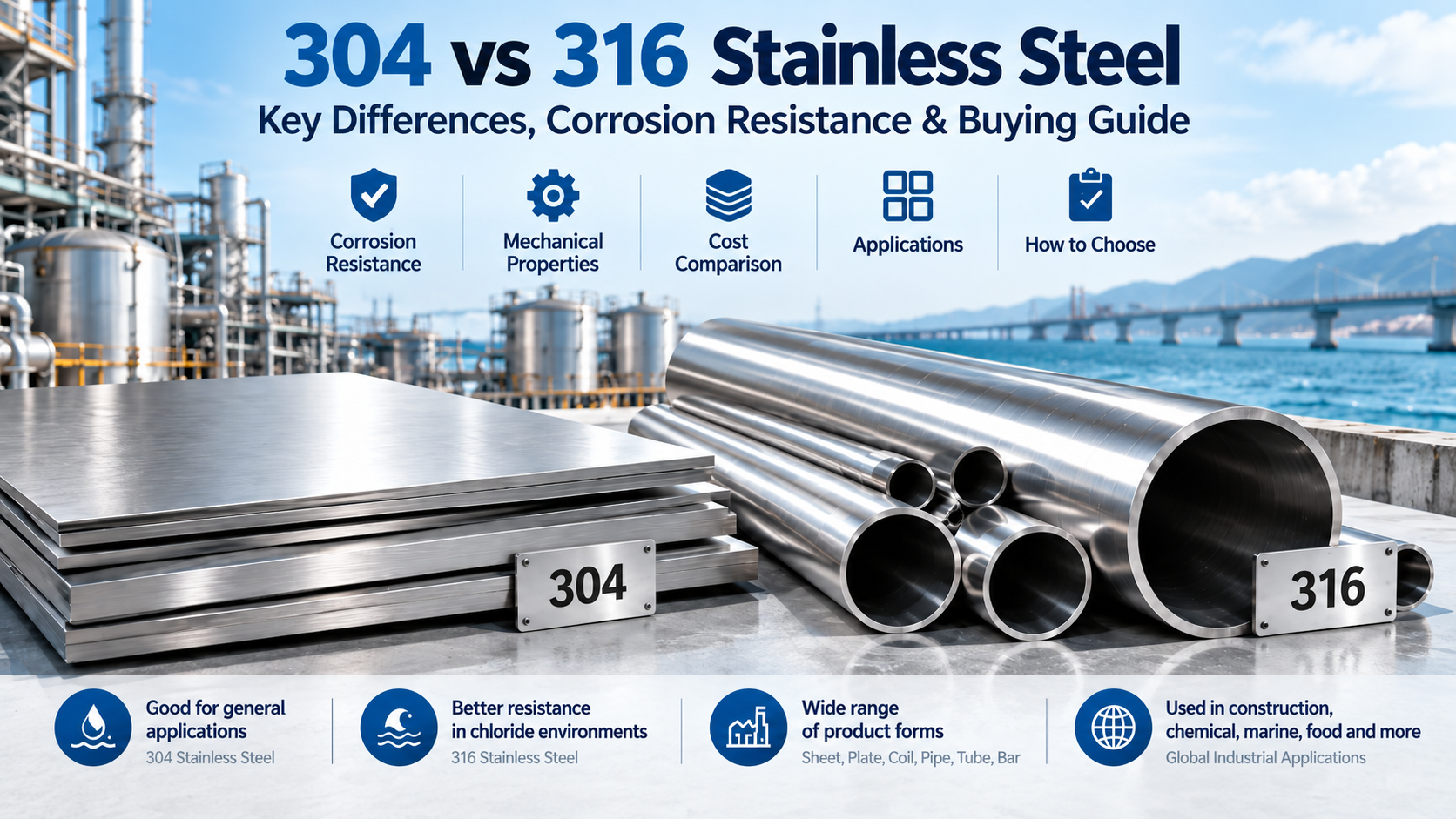
304 and 316 stainless steel are two of the most widely used austenitic stainless steel grades. The key difference is that 316 contains approximately 2–3% molybdenum, which generally improves resistance to pitting and crevice corrosion in many chloride-containing environments.
For general manufacturing, indoor construction, food-processing equipment and many relatively mild environments, 304 stainless steel often provides an effective balance of corrosion resistance, formability, availability and cost.
For selected coastal installations, chemical-processing equipment and more demanding industrial environments, 316 stainless steel may provide better long-term corrosion performance.
However, 316 is not automatically the best choice for every marine or chemical application. Temperature, chloride concentration, surface finish, welding, component design and maintenance all affect material performance.
This guide compares the chemical composition, mechanical properties, corrosion resistance, applications, product standards and purchasing costs of 304 and 316 stainless steel.
It also provides practical advice for engineers, manufacturers, purchasing managers and international steel buyers selecting stainless steel sheets, plates, coils, pipes, tubes and bars.
Quick answer: Choose 304 when it meets your technical and environmental requirements at a lower overall cost. Evaluate 316 when additional resistance to chloride-related localized corrosion is necessary. For severe seawater exposure or critical chemical equipment, obtain an application-specific engineering assessment.
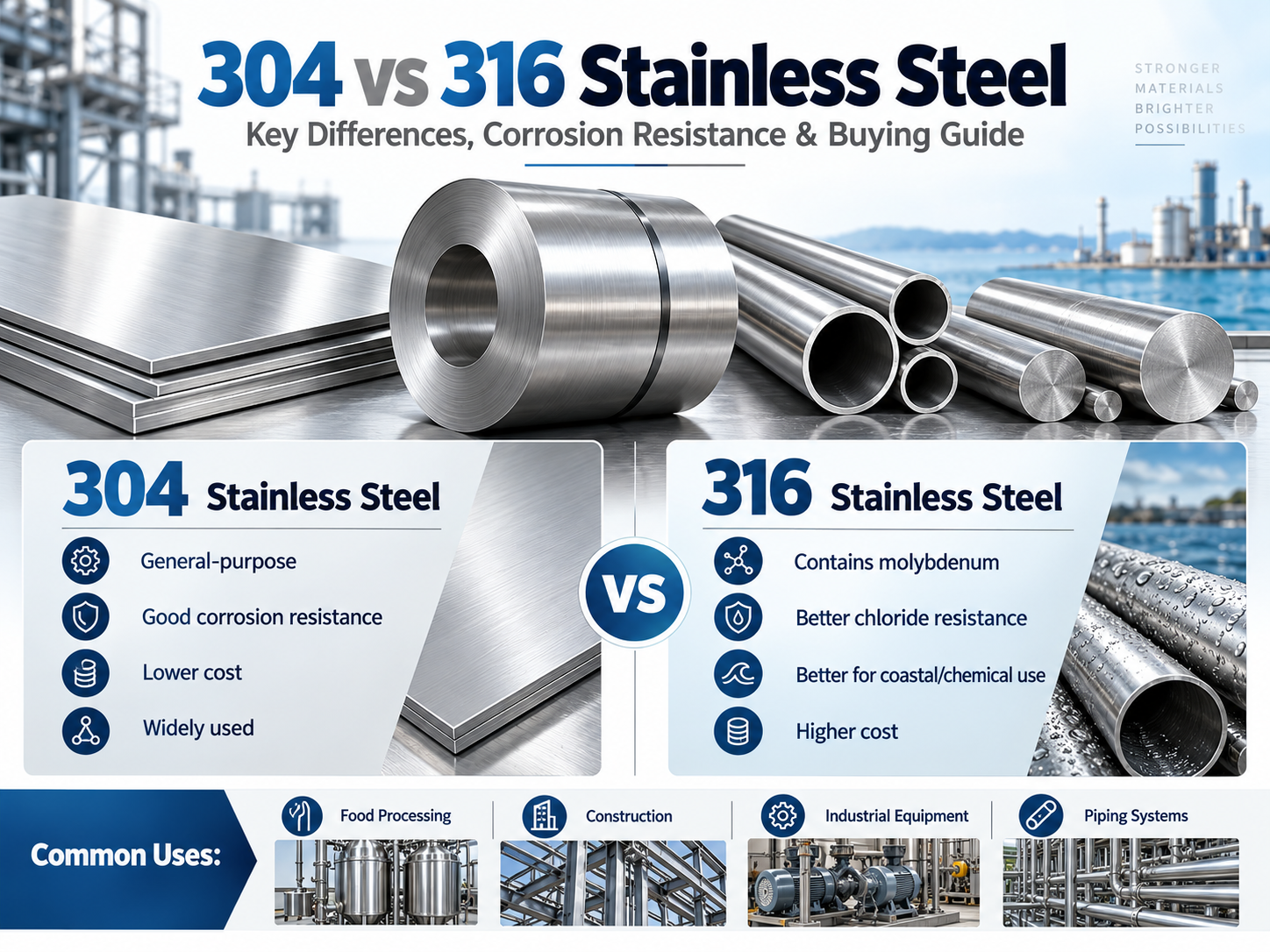
1. 304 vs 316 Stainless Steel: Quick Comparison
Both grades belong to the austenitic stainless steel family and have broadly similar fabrication properties. Their most important practical difference concerns resistance to certain forms of localized corrosion.
| نشان | 304 فولاد ضد زنگ | 316 فولاد ضد زنگ |
|---|---|---|
| خانواده فولاد ضد زنگ | وابسته به اوستن | وابسته به اوستن |
| تعیین ایالات متحده | S30400 | S31600 |
| نام مشترک EN | 1.4301 | 1.4401 |
| Main alloying elements | Chromium and nickel | Chromium, nickel and molybdenum |
| محتوای مولیبدن | No principal specified addition | 2-3 ٪ |
| مقاومت در برابر خوردگی عمومی | خوب | خوب |
| Chloride pitting resistance | پایین | به طور کلی بالاتر |
| قابلیت تشکیل | خوب | خوب |
| قابلیت جوشکاری | Good with suitable procedures | Good with suitable procedures |
| Initial material cost | به طور کلی پایین تر | به طور کلی بالاتر |
| برنامه های کاربردی معمولی | General fabrication and mild environments | Selected coastal and industrial applications |
| Main limitation | Susceptible to aggressive chloride exposure | Not immune to seawater or chloride corrosion |
Note: This table provides general selection guidance. Actual material acceptance requirements must follow the applicable specification and service conditions.
Need Help Choosing 304 or 316 Stainless Steel?
Share your application, product form, dimensions, quantity and destination with Gengfei Steel. Our team can review your purchasing requirements and discuss suitable material and supply options.
2. What Are 304 and 316 Stainless Steel?
304 فولاد ضد زنگ
Grade 304 is a chromium-nickel austenitic stainless steel widely used in manufacturing, architectural components, industrial equipment and commercial applications.
It offers a combination of corrosion resistance, ductility, formability and good general fabrication performance.
Chromium contributes to the formation of a thin, protective passive film on the steel surface. Nickel helps stabilize the austenitic structure and supports useful manufacturing properties.
Common product forms include stainless steel sheets, plates, coils, strips, pipes, tubes and round bars.
Typical applications include food-processing equipment, kitchen components, architectural decoration, storage tanks and general industrial fabrication.
Although 304 is corrosion-resistant, aggressive chlorides, deposits, certain chemicals and poor surface conditions can reduce its performance.
316 فولاد ضد زنگ
Grade 316 is also an austenitic chromium-nickel stainless steel, but its chemical composition includes additional molybdenum.
This alloying element improves resistance to localized corrosion in many chloride-containing environments.
Grade 316 is commonly considered for selected coastal architectural components, chemical processing equipment, pharmaceutical systems, industrial piping and demanding manufacturing applications.
The additional alloying elements generally increase the initial material price compared with 304. However, improved corrosion resistance may reduce maintenance and replacement costs when required by the operating environment.
Neither 304 nor 316 should be assumed suitable for every corrosive environment. The correct grade must match actual service conditions.
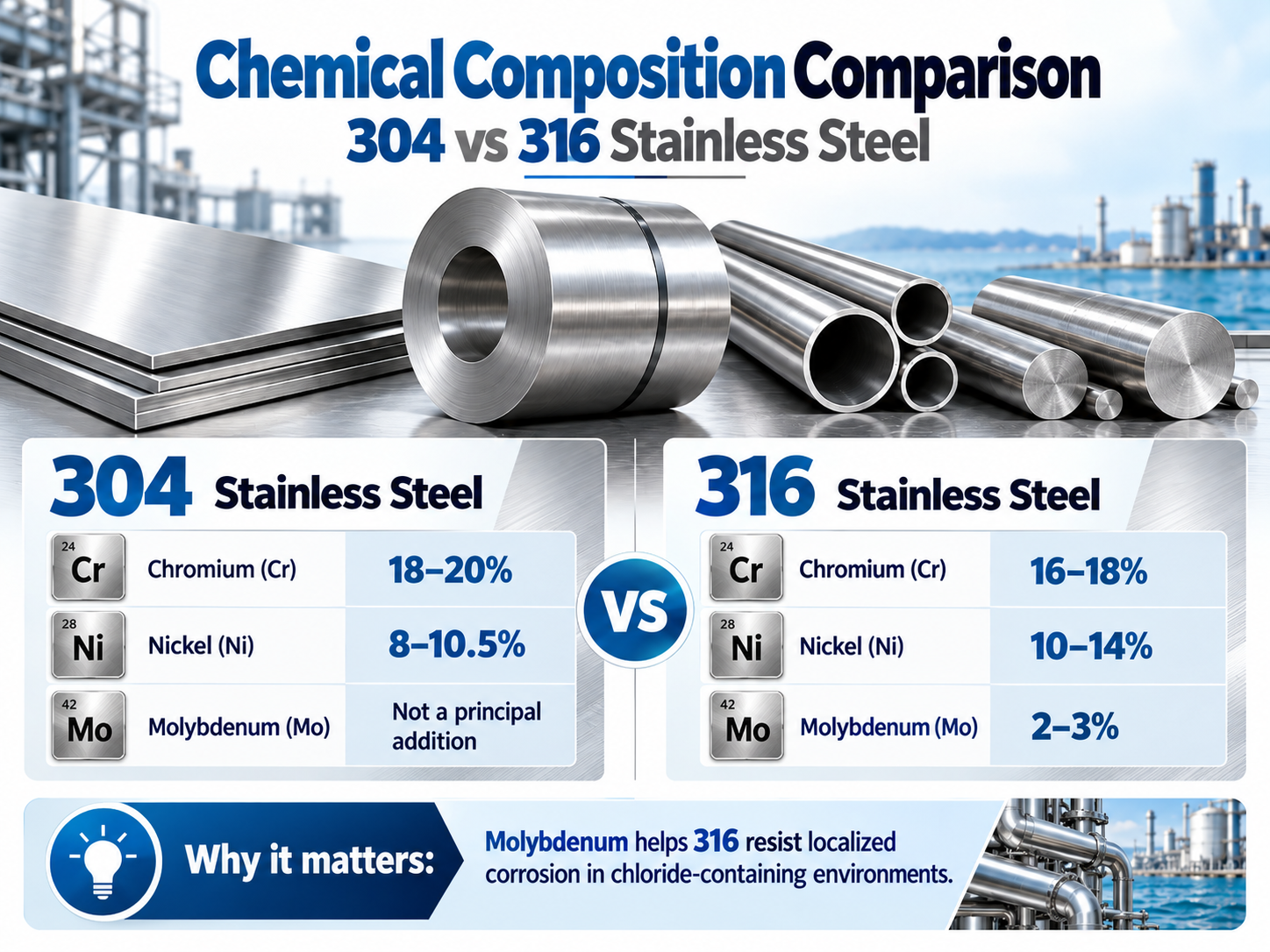
3. Chemical Composition: Why Molybdenum Matters
Chemical composition is one of the primary factors influencing stainless steel corrosion resistance.
Both 304 and 316 contain chromium and nickel, while 316 includes a specified molybdenum addition.
| عنصر | 304 | 316 |
|---|---|---|
| کروم (CR) | 18-20٪ | 16-18٪ |
| نیکل (نیکل) | 8-10.5٪ | 10-14٪ |
| مولیبدن (MO) | No principal specified addition | 2-3 ٪ |
| Carbon (C), max. | 00.08 ٪ | 00.08 ٪ |
| Manganese (Mn), max. | 2% | 2% |
| Silicon (Si), typical max. | 0.75% | 0.75% |
These values represent commonly specified composition ranges for standard 304 and 316 stainless steel. Exact chemistry must be verified against the governing standard and material test certificate.
The Role of Chromium
Chromium enables stainless steel to develop a chromium-rich passive surface film that helps protect the underlying metal from corrosion.
This film can reform under suitable environmental conditions, but aggressive chemicals and unfavorable exposure can cause localized breakdown.
The Role of Nickel
Nickel helps stabilize the austenitic microstructure and contributes to ductility, formability and fabrication performance.
The Role of Molybdenum
Molybdenum improves resistance to pitting and crevice corrosion in many chloride-containing environments.
Its presence in grade 316 is one of the main reasons this grade is considered for more demanding corrosive service conditions.
Nevertheless, surface finish, welding quality, operating temperature and component design remain important to long-term performance.
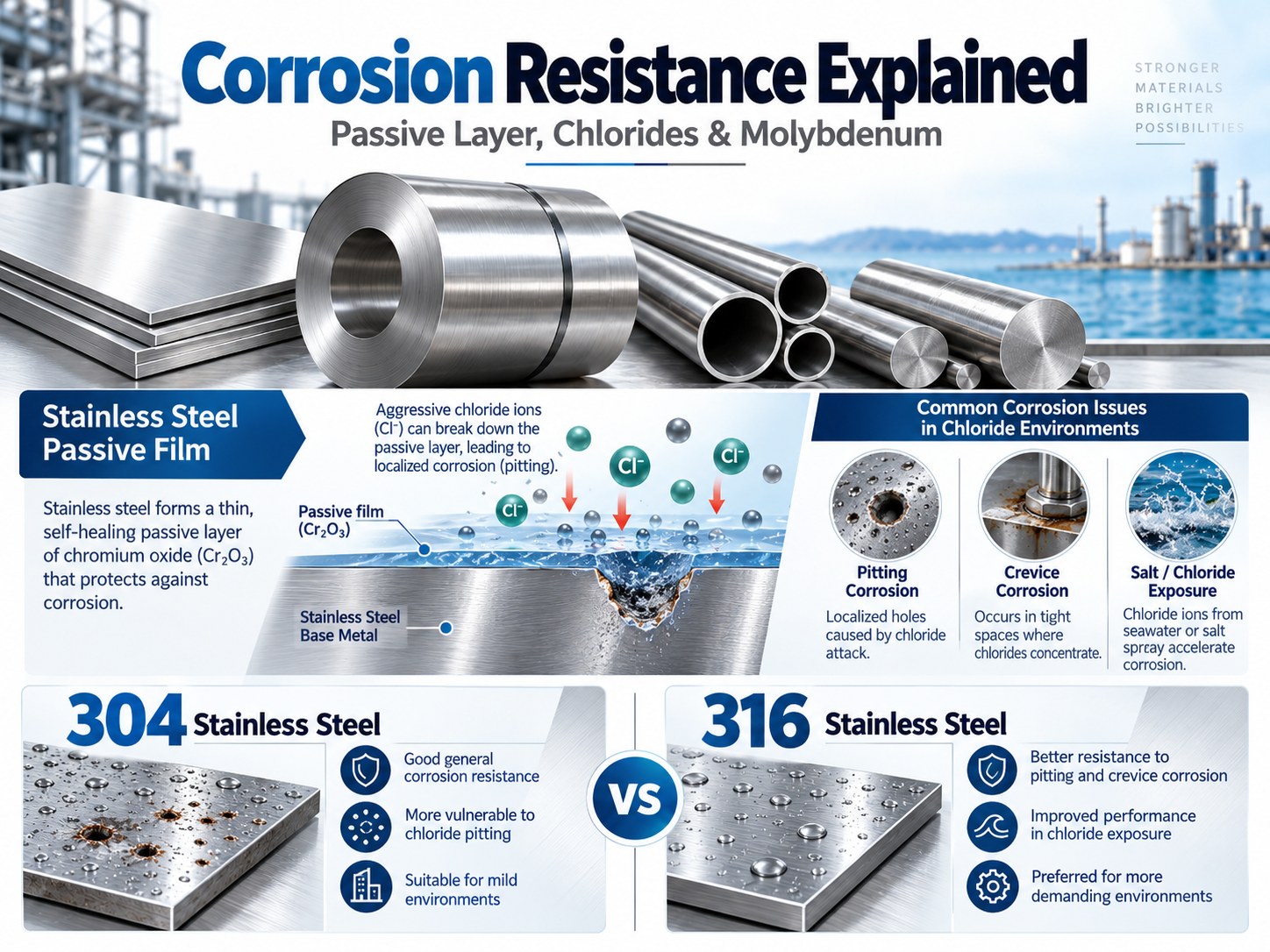
4. Corrosion Resistance: Is 316 Better Than 304?
316 stainless steel generally offers improved resistance to localized corrosion in many chloride environments compared with 304 under similar conditions.
However, corrosion performance depends on the specific corrosion mechanism, temperature, environmental chemistry, surface condition and component design.
خوردگی حفره ای
Pitting corrosion occurs when a small area of the passive film breaks down, allowing localized corrosion to penetrate the metal surface.
A small pit may become a serious problem when it affects thin-wall tubes, storage tanks or industrial process components.
Molybdenum in grade 316 generally improves resistance to chloride-related pitting.
خوردگی شکاف
Crevice corrosion may develop around gaskets, overlapping joints, surface deposits and narrow mechanical connections.
Local chemistry inside a crevice can become more aggressive than the surrounding fluid.
Appropriate grade selection helps, but drainage, cleaning and proper component design remain essential.
ترک خوردگی استرس کلرید
Both 304 and 316 can be susceptible to chloride stress corrosion cracking under certain combinations of tensile stress, temperature and corrosive exposure.
Upgrading from 304 to 316 does not automatically eliminate this risk.
خوردگی بین دانه ای
Certain thermal exposures can cause sensitization and increase susceptibility to intergranular corrosion.
Low-carbon grades such as 304L and 316L are often considered for suitable welded applications where this risk matters.
For additional technical guidance, consult the British Stainless Steel Association corrosion guide وت worldstainless corrosion properties .
5. Which Grade Is Better for Different Applications?
The appropriate stainless steel grade depends on the operating environment, exposure conditions and required service life.
| کاربرد | Selection Guidance |
|---|---|
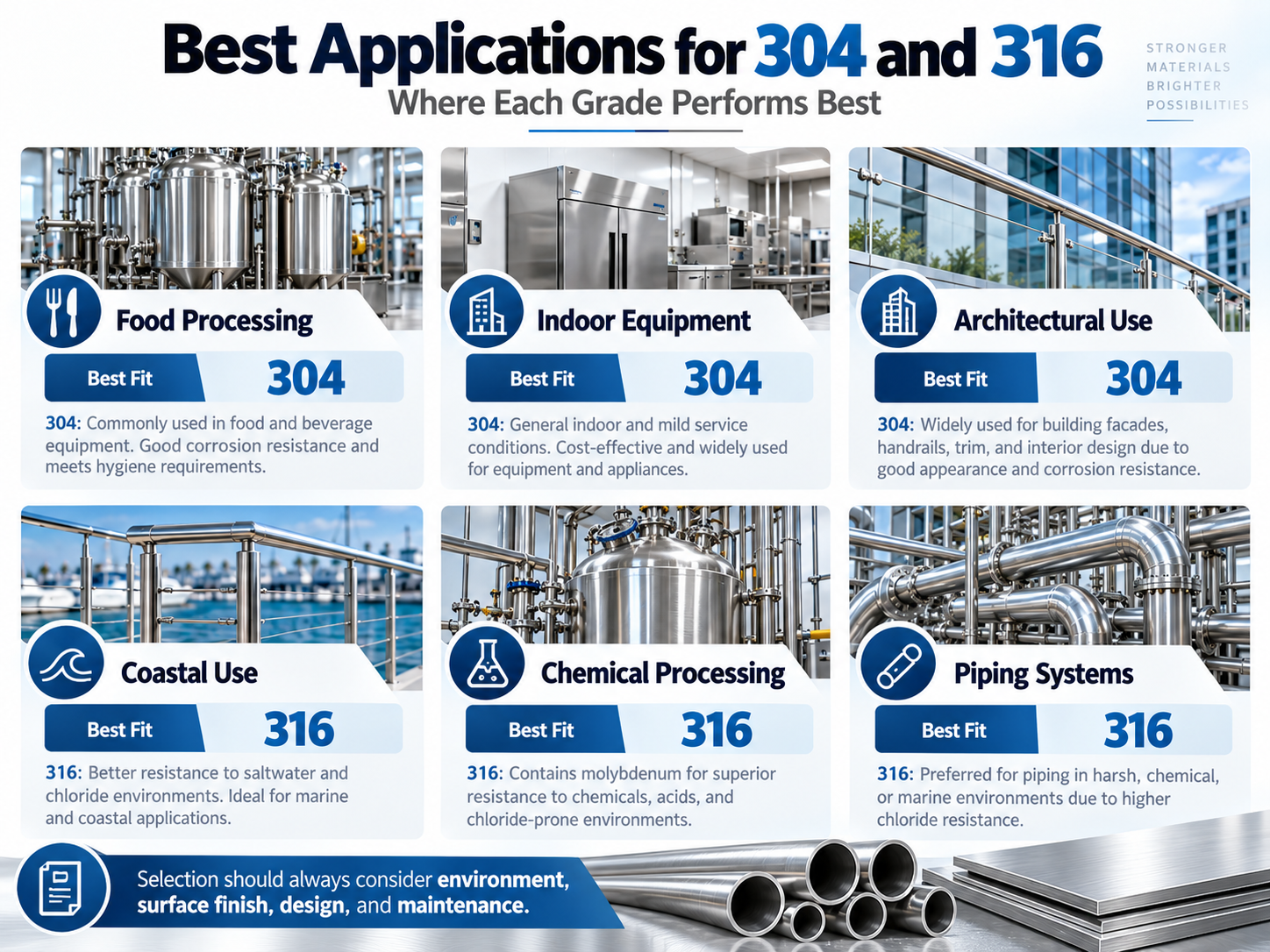
| Indoor equipment | 304 is commonly economical for mild conditions. |
| Food processing | 304 is widely used; evaluate 316 or 316L for demanding cleaning conditions. |
| General outdoor construction | 304 may be appropriate depending on exposure and maintenance. |
| Coastal atmospheric exposure | 316 is often considered for improved localized corrosion resistance. |
| پردازش شیمیایی | Verify the specific chemicals, concentrations and temperatures. |
| غوطه وری مداوم در آب دریا | Do not assume 316 is sufficient without specialist assessment. |
Food Processing and Kitchen Equipment
Grade 304 is widely used in kitchen equipment, food-processing systems, storage components and general hygienic fabrication.
Grade 316 or 316L may be considered when cleaning agents or process conditions require additional corrosion resistance.
Surface finish, weld quality and cleanability are also important selection factors.
ساخت و ساز و معماری
Grade 304 is commonly used for interior components, decorative panels and general architectural fittings.
Coastal exposure or significant salt contamination may justify evaluating 316.
تجهیزات پردازش شیمیایی
Certain chemical-processing applications may benefit from 316 stainless steel.
However, compatibility must be confirmed for the actual chemicals, concentrations, temperatures and operating conditions.
Coastal and Marine Applications
Grade 316 is frequently considered for selected coastal architectural installations exposed to salt deposits.
Nevertheless, continuous seawater immersion can cause pitting or crevice corrosion even in grade 316.
More resistant materials, including certain duplex or higher-alloy stainless steels, may be necessary for severe service.
Example: Indoor Equipment Fabrication
A manufacturer sourcing stainless steel panels for indoor machinery may find 304 suitable when the equipment operates in a mild environment without aggressive chemicals.
Under these conditions, the lower material cost of 304 may provide better economic value.
Example: Coastal Architectural Components
A contractor sourcing exposed architectural fittings for a coastal development may evaluate 316 because of salt deposition and localized corrosion risks.
However, the final choice should still reflect local exposure, surface finish, cleaning frequency and structural requirements.
Example: Industrial Chemical Piping
A buyer selecting piping for chemical processing must identify the fluid composition, concentration, temperature, pressure and required service life.
In some industrial conditions, 316 may be suitable. In others, a more corrosion-resistant material may be required.
6. Mechanical Properties: 304 vs 316 Stainless Steel
Both 304 and 316 stainless steel provide useful combinations of strength, ductility and fabrication performance.
In the annealed condition, their minimum specified tensile and yield strengths can be similar.
The following comparison uses commonly published ASTM A240/A240M requirements for annealed 304 (UNS S30400) and 316 (UNS S31600) stainless steel plate, sheet and strip.
Mechanical Properties Comparison Table
| خاصیت مکانیکی | 304 | 316 |
|---|---|---|
| Tensile Strength, Min. | 515 MPa | 515 MPa |
| Yield Strength, 0.2% Offset, Min. | 205 MPa | 205 MPa |
| Elongation, Min. | 40% | 40% |
| Brinell Hardness, Max. | 201 HB | 217 HB |
| Rockwell B Hardness, Max. | 92 HRB | 95 HRB |
Important: These figures represent minimum or maximum specification requirements, not typical measured properties.
They apply to the stated standard and condition. Stainless steel pipes, tubes, bars and cold-worked products may have different acceptance requirements. Verify the applicable edition of the governing specification before ordering.
Reference: Australian Stainless Steel Development Association (ASSDA): Questions of Carbon .
Density of 304 and 316 Stainless Steel
Density is a physical property commonly used for approximate material weight calculations.
| Physical Property | 304 | 316 |
|---|---|---|
| Approximate Density | 7.9–8.0 g/cm³ | Approximately 8.0 g/cm³ |
Density values are approximate reference values, not ASTM A240 mechanical acceptance limits. For precise engineering calculations, use the relevant grade-specific technical data.
Why Material Condition Matters
Cold rolling, cold drawing and other forming processes can increase hardness and strength while reducing remaining ductility.
This is especially important for precision stainless steel tubes intended for bending, expansion or close-tolerance manufacturing.
Buyers should specify required hardness limits, dimensions, tolerances and testing procedures when these properties affect downstream manufacturing performance.
7. Welding, Forming, Hardness and Surface Finishing
جوش
Both 304 and 316 stainless steel can be welded using appropriate procedures and consumables.
Filler metal selection, heat input, weld preparation and post-weld surface treatment depend on service requirements.
خم و تشکیل
Both grades have useful forming characteristics in suitable conditions.
However, austenitic stainless steel work-hardens during deformation. Product thickness, supplied condition, bend radius and forming method should be considered.
ماشینکاری
Stainless steel machining requires attention to work hardening, chip formation, tool selection and cutting temperatures.
پایان سطحی
Depending on product form and requirements, stainless steel may be supplied with finishes such as 2B, BA, No.4, brushed or polished.
Pickling and passivation treatments may also be specified where appropriate.
Surface finish affects appearance, cleanliness and corrosion performance. Requirements should be clearly stated in the purchase specification.
8. 304L vs 316L: What Does the L Mean?
The letter “L” identifies the low-carbon version of the corresponding stainless steel grade.
Under commonly referenced ASTM A240/A240M requirements, standard 304 and 316 commonly have maximum carbon limits of 0.08%.
Grades 304L and 316L commonly have maximum carbon limits of 0.030%.
Lower carbon content helps reduce susceptibility to sensitization-related intergranular corrosion during certain welding or heating conditions.
When Are Low-Carbon Grades Used?
- Welded tanks and fabricated vessels
- Industrial process piping
- تجهیزات پردازش شیمیایی
- Fabricated structures with extensive welds
- Components requiring corrosion resistance after welding
An L designation does not automatically guarantee better resistance to all forms of corrosion.
Appropriate welding procedures, surface treatment and service-condition assessment are still necessary.
For further information, refer to the BSSA comparison of 304/304L and 316/316L .
9. Stainless Steel Product Forms and International Standards
Both 304 and 316 are supplied in different commercial product forms. The correct product standard depends on the intended application.
| فرم محصول | Main Purchasing Details | Standard Example |
|---|---|---|
| Sheet and Plate | Grade, thickness, width, length, finish | ASTM A240/A240M |
| Coil and Strip | Thickness, width, coil weight, surface finish | ASTM A240/A240M |
| Industrial Pipe | Nominal size, schedule, manufacturing method | ASTM A312/A312M |
| General-Service Tube | OD, wall thickness, length, tolerances | ASTM A269/A269M |
| Mechanical Tubing | Shape, dimensions, weld condition, finish | ASTM A554 |
| Bar and Profile | Diameter, shape, straightness, condition | ASTM A276/A276M |
These standards are examples, not interchangeable alternatives. Always confirm the correct specification, grade and edition for the intended product.
Stainless Steel Sheets and Plates
Sheets and plates are widely used for equipment fabrication, tanks, architectural components and industrial machinery.
Explore Gengfei Steel stainless steel sheet products .
کویل های فولادی ضد زنگ
Stainless steel coils are used in slitting, stamping, roll forming and continuous manufacturing.
View Gengfei Steel stainless steel coil products .
Stainless Steel Pipes and Tubes
Stainless steel pipes are commonly specified for fluid transport, while tubing may be supplied for mechanical, instrumentation or precision applications.
Pipe and tube differ in applicable standards and dimensional conventions, not simply in outside diameter.
Review Gengfei Steel stainless steel pipe products or read Seamless vs Welded Stainless Steel Pipe .
Stainless Steel Bars
Round bars and other profiles are widely used in machining, shafts, fasteners and fabricated mechanical components.
Explore Gengfei Steel stainless steel bar products .
For official flat-product specification information, consult ASTM A240/A240M .
10. 304 vs 316 Stainless Steel Price and Total Cost
Grade 316 generally costs more than 304 because of its alloy composition, including molybdenum and typically higher nickel content.
However, there is no universal fixed price difference between the two grades.
Prices change with alloy markets, product form, dimensions, processing, order quantity and delivery terms.
Factors Affecting Purchasing Cost
- Material grade and alloy content
- Raw-material market conditions
- Product dimensions and tolerances
- Manufacturing and processing methods
- Surface finish requirements
- مقدار سفارش
- Inspection and certification
- Packaging and international transportation
هزینه کل مالکیت
International buyers should compare not only the initial material price but also manufacturing, maintenance, inspection and replacement expenses.
In mild environments, 304 may provide better overall value when it satisfies all technical requirements.
In more demanding environments, 316 may justify its higher price if improved corrosion resistance reduces maintenance or premature replacement.
A meaningful price comparison should use the same product form, dimensions, tolerances, finishing requirements and delivery terms.
11. How to Choose 304 or 316 Stainless Steel
A structured selection process helps buyers reduce material risks and unnecessary costs.
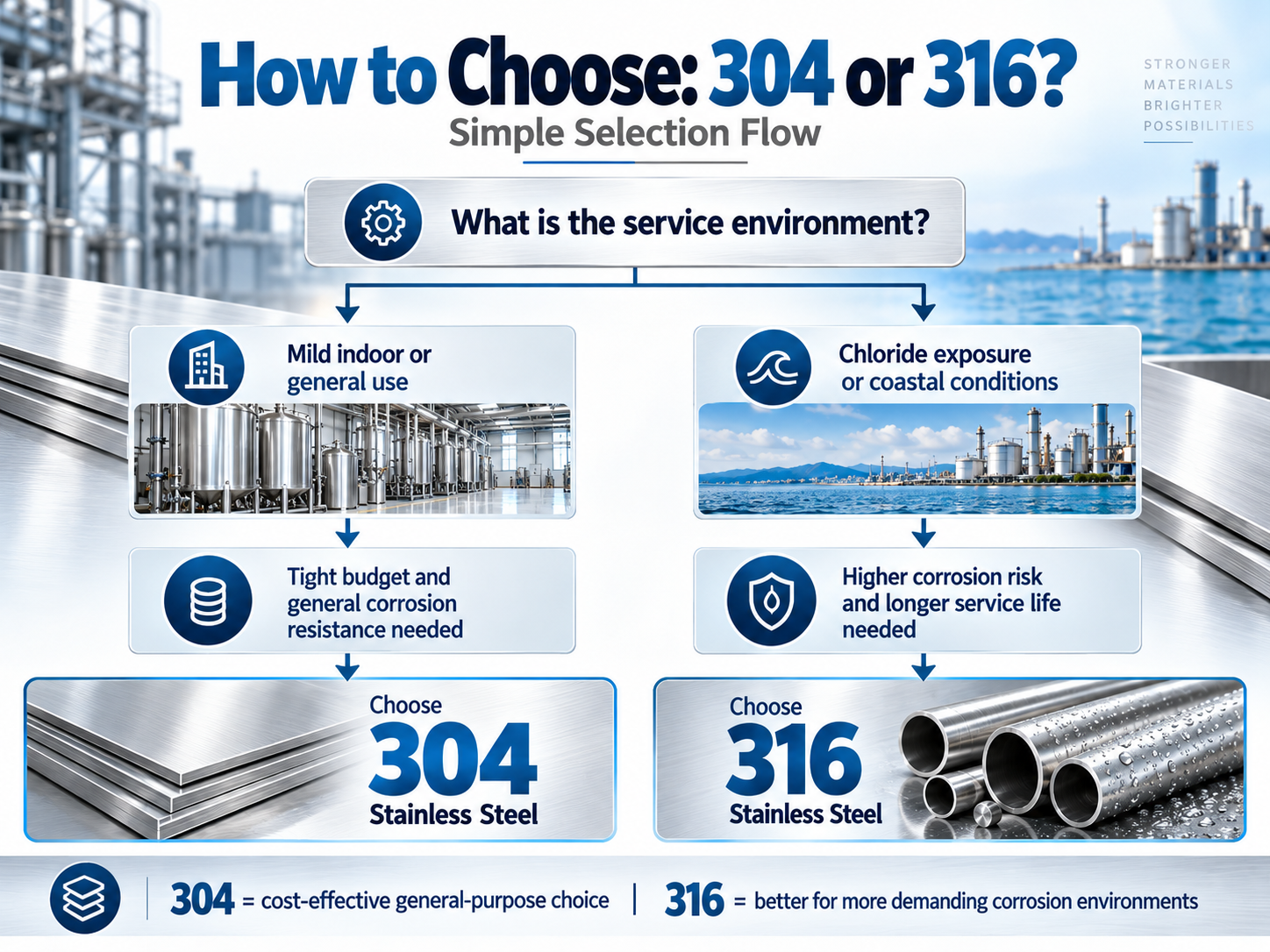
- Identify the operating environment. Determine whether the component will be used indoors, outdoors, near the coast, in seawater or in chemical processing.
- Evaluate corrosion risks. Check chlorides, temperature, deposits, chemical exposure, crevices and maintenance.
- Confirm fabrication requirements. Consider bending, welding, machining, hardness and finish.
- Select the product standard. Identify the correct specification for sheet, plate, pipe, tube, coil or bar.
- Compare total project cost. Consider material, processing, inspection, maintenance and potential replacement.
- Confirm quality requirements. Define certificates, traceability, dimensional inspection and special testing.
Practical selection rule: Start with the most economical grade that satisfies verified service and technical requirements. Evaluate 316 or higher-alloy materials when corrosion conditions justify it.
12. Stainless Steel Buyer’s Checklist Before Ordering
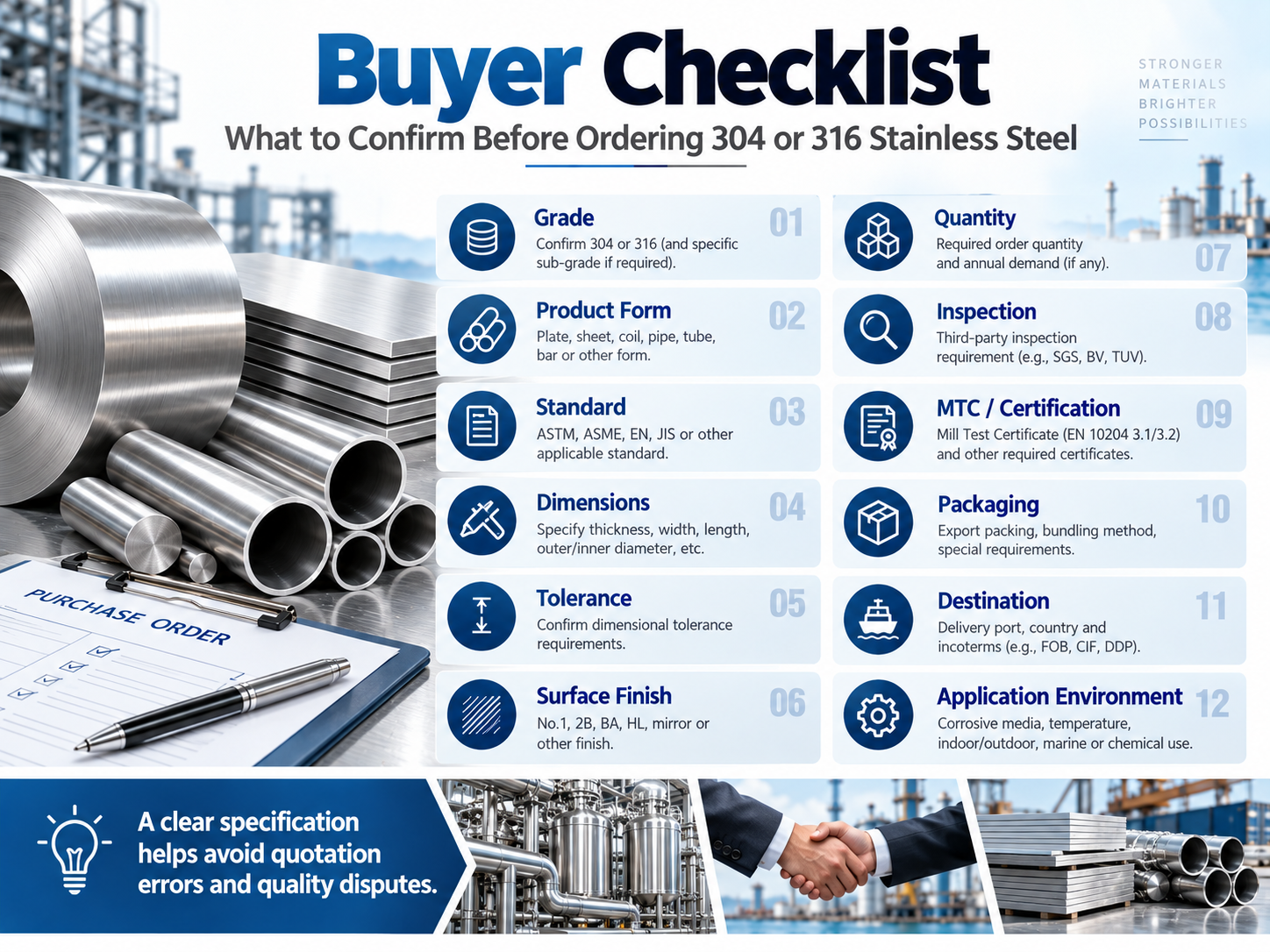
A complete purchasing specification improves quotation accuracy and reduces the risk of material disputes.
Before ordering stainless steel, international buyers should provide the following information.
- درجه مواد: 304, 304L, 316, 316L or another approved grade.
- فرم محصول: Sheet, plate, coil, strip, pipe, tube or bar.
- Applicable Standard: ASTM, ASME, EN, JIS or another specification.
- ابعاد: Thickness, width, length, outside diameter, wall thickness and required tolerances.
- Manufacturing Condition: Welded, seamless, annealed or cold-worked as applicable.
- پایان سطح: 2B, BA, No.4, polished, brushed, pickled or other specified condition.
- Order Quantity: Pieces, kilograms, metric tons or coil weight.
- Inspection Requirements: MTC, heat number, chemical analysis, mechanical testing and third-party inspection.
- Shipping Requirements: Packaging, destination, Incoterms and delivery schedule.
Example of a Complete Inquiry
316L stainless steel welded tube, ASTM A269/A269M, OD 38 mm x WT 2.0 mm, length 6,000 mm, quantity 2 metric tons, specified surface finish and dimensional tolerances, EN 10204 3.1 inspection certificate requested, CIF destination port.
The above is an illustrative inquiry. Actual grades, standards, dimensions, documentation and delivery terms must reflect the individual project.
Ready to Request Your Stainless Steel Quotation?
Have your specifications ready? Send Gengfei Steel your grade, standard, dimensions, quantity, inspection requirements and destination.
Our team can review your inquiry and discuss available product specifications, packaging and delivery arrangements.
13. Quality Inspection, MTC and Export Packaging
Material Test Certificate
A material test certificate, commonly called an MTC, may identify the material grade, heat number, chemical composition and applicable mechanical test results.
Buyers requiring inspection documentation under EN 10204 should specify the correct document type before confirming the order.
Positive Material Identification
Positive material identification may help distinguish alloy families by principal alloying elements.
Ordinary handheld XRF testing cannot reliably verify the low carbon content that distinguishes standard grades from L grades.
Where carbon content is critical, an appropriate analytical method should be specified.
Dimensional Inspection
Depending on product requirements, dimensional inspection may cover thickness, diameter, length, straightness, flatness, wall thickness and tolerances.
Precision tubes may also require internal diameter, hardness and surface quality verification.
بسته بندی صادراتی
Packaging requirements depend on product shape, weight, dimensions, surface condition and transportation method.
Stainless steel sheets may require protective film, suitable pallets and moisture protection.
Stainless steel pipes and tubes may be bundled according to dimensions and handling requirements.
Stainless steel coils require proper support and securing during container loading and transportation.
Packaging, marking, lifting and shipping requirements should be confirmed before dispatch.
14. Frequently Asked Questions
Is 316 Stainless Steel Always Better Than 304?
No. Grade 316 generally offers improved resistance to certain localized corrosion mechanisms, but 304 may provide better economic value in suitable mild operating environments.
آیا فولاد ضد زنگ 304 زنگ می زند؟
Yes. Grade 304 can experience staining, pitting or other corrosion when exposed to aggressive chlorides, contaminants or unfavorable service conditions.
Is 316 Stainless Steel Suitable for Seawater?
Not automatically. Although 316 generally offers improved localized corrosion resistance compared with 304, severe seawater exposure may require more resistant alloys.
What Is the Difference Between 316 and 316L?
Grade 316L has a lower specified maximum carbon content, helping reduce susceptibility to sensitization-related intergranular corrosion in certain thermal conditions.
Can 304 and 316 Stainless Steel Be Welded?
Yes. Both grades are widely welded using suitable procedures and consumables. Welding requirements should reflect the material condition and intended service.
Which Grade Is More Expensive?
Grade 316 generally has a higher initial material cost because of its alloy composition.
Actual prices depend on markets, product form, dimensions, quantity, processing and delivery.
Can 304 and 316 Stainless Steel Be Bent?
Yes, both grades can be formed and bent under suitable conditions.
Work hardening, material thickness, bend radius and supplied condition should be considered.
How Can Buyers Verify 304 or 316 Stainless Steel?
Buyers should review traceable material certificates and any required positive material identification or analytical test records.
What Information Is Needed for a Quotation?
Provide material grade, applicable standard, product form, dimensions, tolerances, finish, quantity, inspection requirements and destination.
15. Conclusion: Choose the Grade That Fits Your Project
The choice between 304 and 316 stainless steel should be based on verified service conditions, material properties, applicable specifications and total project costs.
Grade 304 provides good general corrosion resistance and cost-effective performance for many industrial and commercial applications.
Grade 316 contains molybdenum and generally offers improved localized corrosion resistance in many chloride-containing environments.
Neither grade is universally corrosion-proof, and severe applications may require specialist material evaluation.
For related material comparisons, read 201 vs 304 Stainless Steel یا 2205 vs 316L Stainless Steel .
Explore Gengfei Steel’s stainless steel product range for additional product information.
Request a 304 or 316 Stainless Steel Quotation
Looking for stainless steel sheets, plates, coils, pipes, tubes or bars?
Gengfei Steel can review your material requirements and discuss suitable product specifications.
Please provide your required material grade, product form, standard, dimensions, quantity, surface finish, inspection requirements and destination.
Technical References
The following professional organizations provide additional information on stainless steel corrosion resistance, mechanical properties and material standards.
- British Stainless Steel Association: Corrosion Resistance
- Australian Stainless Steel Development Association: Questions of Carbon and Mechanical Properties
- BSSA: 304/304L and 316/316L Comparison
- worldstainless: Corrosion Properties
- ASTM International: ASTM A240/A240M
This article provides general technical and purchasing information. Actual material selection, engineering design and acceptance requirements must follow the applicable standards and project specifications.
