

316 and 316L are closely related molybdenum-alloyed austenitic stainless steels. The main difference is carbon content: 316L is the low-carbon version of 316, which reduces the risk of sensitization and intergranular corrosion associated with welding and certain thermal exposures.
Both grades contain chromium, nickel and molybdenum and therefore offer substantially better resistance to pitting and crevice corrosion in many chloride-containing environments than conventional 304-type stainless steels.
The important distinction is that molybdenum and low carbon solve two different corrosion problems:
- مولیبدن (MO) improves resistance to pitting and crevice corrosion, especially in chloride-containing environments.
- Low carbon in 316L reduces chromium-carbide precipitation and sensitization during welding.
This means 316L should not simply be described as “more corrosion resistant than 316.”
For unwelded material with comparable chromium, molybdenum and nitrogen levels, 316 and 316L generally offer very similar resistance to general corrosion, pitting and crevice corrosion.
316L becomes particularly valuable when significant welding is involved.
For international buyers, the decision should therefore consider:
- جوش
- Service environment
- Chloride concentration
- درجه حرارت
- Crevice conditions
- الزامات مکانیکی
- فرم محصول
- Applicable standard
- Certification requirements
316 vs 316L: Quick Comparison
| عامل | 316 فولاد ضد زنگ | فولاد ضد زنگ 316 لیتر |
|---|---|---|
| ایالات متحده | S31600 | S31603 |
| Common EN designation | 1.4401 | 1.4404 |
| Stainless steel family | وابسته به اوستن | وابسته به اوستن |
| Main alloy system | cr-in-i | cr-in-i |
| کربن | Standard carbon limit | Low carbon |
| Common carbon comparison | ≤0.08%* | ≤0.030%* |
| مولیبدن | Typically about 2–3% | Typically about 2–3% |
| General corrosion resistance | خیلی خوب | Very similar |
| Pitting resistance | خیلی خوب | Very similar |
| Chloride resistance | Better than 304 family | Similar to 316 |
| قابلیت جوشکاری | عالی | عالی |
| Sensitization risk | Higher under relevant thermal exposure | Reduced |
| Intergranular corrosion after welding | More condition dependent | Lower risk |
| استفاده معمولی | General components, machining, bar, fittings | Welded piping, tanks, sanitary and process systems |
| Dual certification | Commonly available | Commonly available |
*Exact requirements depend on the applicable product specification. Always verify the governing ASTM, ASME, EN, JIS or other standard and the actual Mill Test Certificate.
What Is the Main Difference Between 316 and 316L?
در L in 316L means low carbon.
Both 316 and 316L are chromium-nickel-molybdenum austenitic stainless steels.
Their principal alloy systems are very similar.
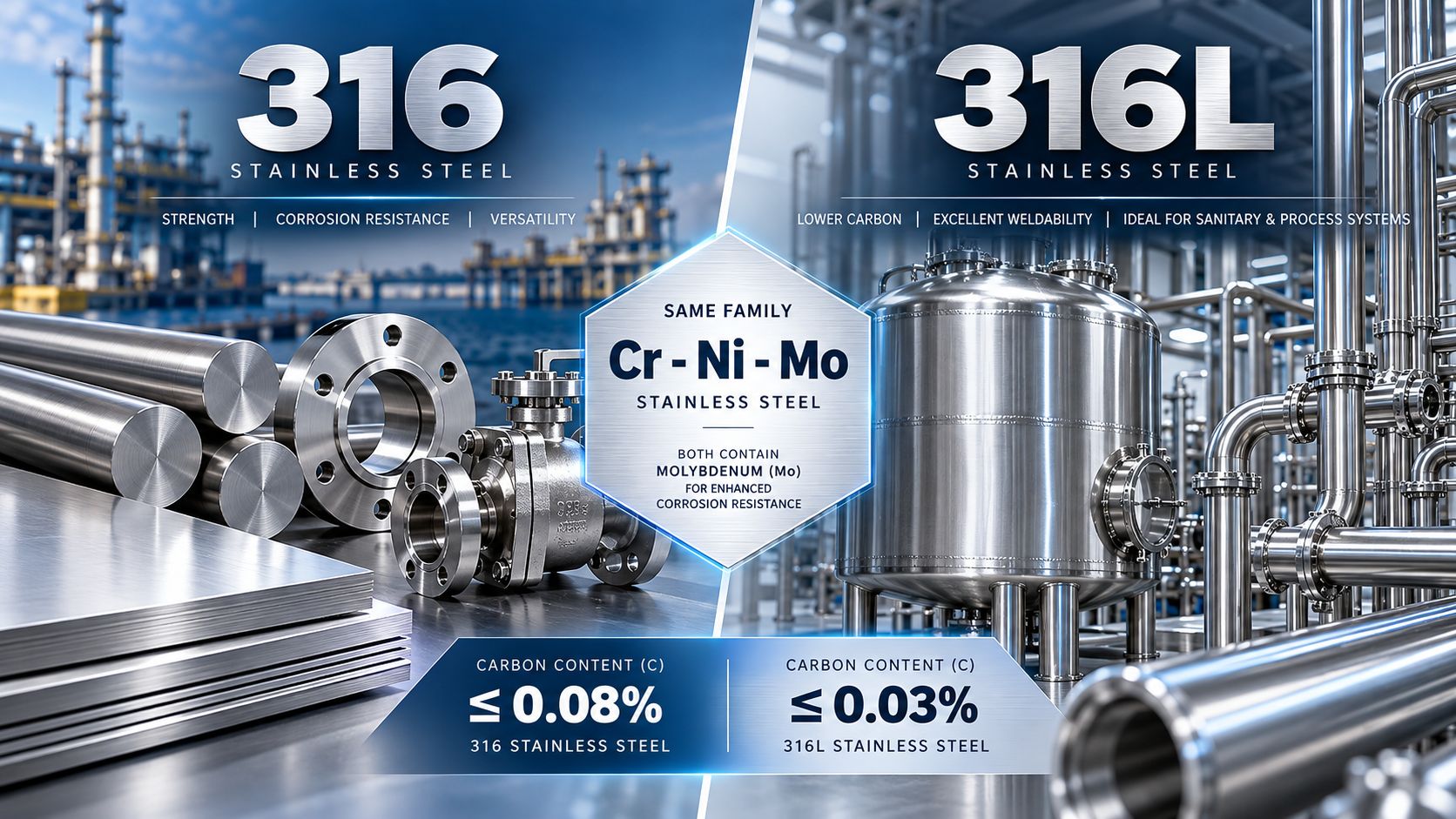
A commonly used comparison is:
- 316: carbon up to approximately 0.08%, depending on product standard
- 316L: carbon up to approximately 0.030%, depending on product standard
Both commonly contain approximately:
- 16-18 ٪ کروم
- 10-14 ٪ نیکل
- 2-3 ٪ مولیبدن
This is why 316 and 316L have very similar resistance to many forms of corrosion in the base-metal condition.
The low carbon content of 316L becomes important primarily when the steel is:
- جوش داده شده
- Heated into a sensitization-prone temperature range
- Used in a corrosive environment after welding
316 vs 316L Chemical Composition
A simplified composition comparison is shown below.
| عنصر | 316 | 316L | Main Role |
|---|---|---|---|
| کربن (ج) | ≤0.08%* | ≤0.030%* | Sensitization, strength and carbide formation |
| کروم (CR) | ~16–18% | ~16–18% | Passive film and general corrosion resistance |
| نیکل (نیکل) | ~10–14% | ~10–14% | Austenite stability, toughness and formability |
| مولیبدن (MO) | ~2–3% | ~2–3% | Pitting and crevice corrosion resistance |
| منگنز (MN) | Controlled | Controlled | Alloy balance and steelmaking |
| سیلیکون (SI) | Controlled | Controlled | Steelmaking and oxidation behavior |
| فسفر (P) | محدود | محدود | Residual element |
| گوگرد (ها) | محدود | محدود | Residual element |
| نیتروژن (N) | Controlled | Controlled | Strength and pitting resistance |
| آهن (آهن) | تعادل | تعادل | فلز پایه |
*Limits vary by product standard.
For a purchase order or engineering specification, always use the composition limits in the actual governing standard rather than copying a generic website table.
Why Does 316 Stainless Steel Contain Molybdenum?
One of the biggest differences between the 304 and 316 families is مولیبدن.
304 is principally a chromium-nickel austenitic stainless steel.
316 adds molybdenum to the alloy system.
This helps improve resistance to localized corrosion, especially:
- خوردگی
- خوردگی
in many chloride-containing environments.
This is why 316 and 316L are frequently evaluated for:
- Coastal environments
- Salt spray
- Chemical processing
- Food equipment
- Pharmaceutical equipment
- Pulp and paper
- Industrial process systems
- Marine-related hardware
For buyers comparing the two most common stainless steel families, see our detailed guide to 304 vs 316 Stainless Steel.
Molybdenum vs Low Carbon: Two Different Corrosion Problems
This distinction is one of the most important concepts to understand when comparing 316 and 316L.

Molybdenum Helps With Localized Chloride Corrosion
Molybdenum contributes to the stability of the stainless steel passive film and increases resistance to localized attack.
Its main benefits are associated with:
- خوردگی
- خوردگی
- Chloride-containing environments
The molybdenum level is therefore one reason 316 generally performs better than 304 in many chloride-bearing environments.
Low Carbon Helps With Welding-Related Sensitization
The lower carbon level in 316L addresses another issue.
During certain thermal exposures, including welding, carbon can react with chromium and form chromium-rich carbides at grain boundaries.
This can reduce chromium concentration immediately next to those grain boundaries.
The result is a condition known as حساسیت.
If the sensitized steel is subsequently exposed to a sufficiently corrosive environment, preferential attack can occur along the grain boundaries.
316L reduces this risk because less carbon is available for carbide formation.
The Key Difference
A useful way to remember it is:
Mo helps protect against pitting and crevice corrosion. Low C helps protect against sensitization-related intergranular corrosion.
Therefore:
316L does not have more molybdenum than 316 simply because it has an L.
And:
316L is not automatically better against chloride pitting than 316.
What Is Pitting Corrosion?
Pitting is a highly localized form of corrosion.
Instead of the entire stainless steel surface corroding evenly, small local areas of the passive film break down.
These sites can develop into deep pits.
Chloride ions are particularly important in pitting corrosion.
Factors that can increase pitting risk include:
- Higher chloride concentration
- Higher temperature
- Deposits
- Poor surface condition
- Stagnant conditions
- Lower alloy content
Because pits can be small at the surface but deep beneath it, localized corrosion can sometimes become serious before it is visually obvious.
What Is Crevice Corrosion?
Crevice corrosion occurs in narrow, poorly aerated spaces such as:
- Gasket interfaces
- Flange joints
- Deposits
- Bolted connections
- Lap joints
- Under washers
- Poorly drained fabrication details
Inside a crevice, the chemistry can become much more aggressive than on an open stainless steel surface.
Chlorides may concentrate and local oxygen levels may decrease.
This can destabilize the passive film.
Crevice corrosion can therefore occur under less severe conditions than open-surface pitting.
Good stainless steel selection must consider not only the grade but also the design geometry.
Why Carbon Matters During Welding
316 and 316L are both readily weldable.
The key metallurgical difference appears in the heat-affected zone when conditions allow sensitization.

During welding:
- The weld metal melts.
- Surrounding base metal is heated but does not melt.
- This region becomes the heat-affected zone, or HAZ.
- Carbon can diffuse toward grain boundaries during certain thermal cycles.
- Chromium-rich carbides can precipitate.
- Chromium concentration near the grain boundary may decrease.
- Corrosion resistance near those boundaries can be reduced.
The chromium carbide is commonly represented as:
Cr₂₃C₆
What Is Sensitization?
Sensitization describes the metallurgical condition in which chromium-rich carbides precipitate at grain boundaries and leave adjacent areas depleted in chromium.
The important point is:
Sensitization itself is not corrosion.
It creates a microstructure that can become susceptible to preferential corrosion when exposed to a suitable corrosive environment.
The resulting attack is known as:
خوردگی بین دانه ای
or, when it occurs around welded areas:
weld decay
Why Is 316L Preferred for Many Welded Applications?
Because 316L contains less carbon, there is less carbon available to combine with chromium.
This reduces:
- Chromium carbide precipitation
- Chromium depletion
- Sensitization risk
- Susceptibility to intergranular corrosion after welding
That makes 316L particularly attractive for heavily welded equipment where post-weld solution annealing is impractical.
Typical examples include:
- مخازن شیمیایی
- Process piping
- Pharmaceutical skids
- Food-processing equipment
- رگهای فشار
- مبدلهای حرارتی
- Sanitary piping systems
- Large fabricated assemblies
Can 316 Stainless Steel Be Welded?
بله.
316 has excellent weldability.
It can be welded using common stainless steel welding processes including:
- GTAW / TIG
- GMAW / MIG
- SMAW
- FCAW
- SAW in suitable applications
The difference is not:
316 cannot be welded, but 316L can.
The more accurate statement is:
Both 316 and 316L are readily weldable, but the lower carbon content of 316L provides additional protection against sensitization in many welded applications.
316 vs 316L Welding Comparison
| Welding Factor | 316 | 316L |
|---|---|---|
| TIG welding | بله | بله |
| MIG welding | بله | بله |
| SMAW | بله | بله |
| General weldability | عالی | عالی |
| میزان کربن | بالاتر | پایین |
| Carbide precipitation tendency | Higher under relevant thermal exposure | Reduced |
| Sensitization resistance | پایین | بالاتر |
| Large welded fabrication | Suitable with correct engineering | Often preferred |
| As-welded corrosive service | Requires careful evaluation | Commonly selected |
| Post-weld solution annealing | May be relevant in certain applications | Less commonly needed solely to control carbon-related sensitization |
Typical Welding Consumables
Low-carbon 316L-type filler metals are widely used for welding 316-family stainless steels.
Examples can include:
- ER316L
- E316L
However, actual filler selection should follow:
- Qualified WPS
- Design code
- Service environment
- Base-metal specification
- Customer requirements
Does 316L Have Better Corrosion Resistance Than 316?
The answer depends on what type of corrosion is being discussed.
General Corrosion
For comparable chemistry and condition, 316 and 316L usually have very similar general corrosion resistance.
Pitting Corrosion
Pitting resistance is influenced primarily by alloy chemistry, including:
- کروم
- مولیبدن
- Nitrogen
Because 316 and 316L normally have very similar Cr-Mo-N chemistry, their intrinsic pitting resistance is usually very similar.
Crevice Corrosion
The same principle applies.
Crevice corrosion resistance is mainly controlled by:
- Alloy chemistry
- Chloride concentration
- درجه حرارت
- Crevice geometry
- Deposits
- Surface condition
Low carbon alone does not dramatically improve crevice-corrosion resistance.
خوردگی بین دانه ای
This is where 316L has the clearest advantage.
Its lower carbon content reduces the risk of sensitization and subsequent intergranular corrosion after relevant welding or thermal exposure.
So the technically useful answer is:
316L is not universally more corrosion resistant than 316. Its major corrosion advantage is reduced susceptibility to sensitization-related intergranular attack after welding.
Is 316L Really “Marine Grade”?
316 and 316L are frequently called marine-grade stainless steels.
That description can be useful, but it is often misunderstood.
316L does provide better resistance to many chloride-containing environments than 304-type stainless steel because it contains molybdenum.
However:
Marine-related does not mean unlimited seawater resistance.

316L can work well in many:
- Coastal atmospheres
- Architectural coastal applications
- سخت افزار دریایی
- Periodic salt spray conditions
- Well-cleaned marine-related equipment
But corrosion risk increases as conditions become more severe.
Important variables include:
- Chloride concentration
- درجه حرارت
- Wetting duration
- Deposits
- Stagnation
- Crevices
- Oxygen availability
- Biofouling
- Surface roughness
- Weld quality
Coastal Atmosphere
316L is commonly suitable for many coastal architectural and outdoor applications.
Routine cleaning can improve long-term appearance and reduce chloride accumulation.
Salt Spray
Periodic salt spray can still be manageable when:
- Surfaces drain properly
- Salt does not accumulate indefinitely
- Components can be cleaned
- Severe crevices are avoided
Splash Zones
Repeated wetting and drying can concentrate chlorides.
This may make splash zones more aggressive than a buyer initially expects.
Seawater Immersion
Continuous natural seawater immersion is a much more demanding condition.
Crevices, deposits, biofouling and stagnant conditions can significantly increase localized corrosion risk.
316L should therefore not automatically be specified for continuous seawater service without engineering evaluation.
Hot Chlorides
Temperature is extremely important.
Hot chloride-containing solutions can substantially increase:
- Pitting
- خوردگی
- ترک خوردگی استرس
In these conditions, a higher-alloy material may be required.
When Is 316L Not Enough?
If the environment becomes too aggressive for 316L, increasing carbon-control alone will not solve the problem.
The alloy chemistry may need to change.
Potential alternatives include:
2205 فولاد ضد زنگ دوتایی
2205 contains higher chromium, molybdenum and nitrogen than conventional 316L and offers:
- Higher pitting resistance
- Better crevice corrosion resistance
- Much higher strength
- Better resistance to chloride stress corrosion cracking
See our 2205 لوله استیل ضدزنگ دوبلکس for product information.
2507 سوپر دوبلکس
2507 provides still higher alloy content and is considered for more aggressive chloride environments.
Typical applications include:
- Offshore systems
- Desalination
- Seawater service
- Aggressive chemical processing
904L
904L is a high-alloy austenitic stainless steel containing higher nickel and molybdenum and is used in selected aggressive chemical applications.
6Mo / Superaustenitic Grades
High-molybdenum superaustenitic grades may be considered for severe chloride applications where conventional 316L is inadequate.
Material selection should be based on actual operating conditions rather than simply choosing the next more expensive grade.
What About Chloride Stress Corrosion Cracking?
Pitting and crevice corrosion are not the only chloride-related concerns.
Austenitic stainless steels can also become susceptible to ترک خوردگی استرس کلرید, or chloride SCC, when a combination of factors is present:
- Tensile stress
- Chlorides
- Sufficiently elevated temperature
- Suitable electrochemical conditions
Welded equipment can contain residual stresses, which is one reason chloride SCC deserves consideration in hot process systems.
Duplex stainless steels such as 2205 generally offer much better resistance to chloride SCC than conventional 316L.
Mechanical Properties: Is 316 Stronger Than 316L?
316 and 316L have very similar physical characteristics, but their specified minimum mechanical properties can differ depending on the governing standard.
For some flat-product specifications, the standard grade may have higher minimum:
- استحکام کششی
- قدرت تسلیم
than the low-carbon grade.
This is one reason buyers should not use one generic mechanical-property table for:
- ورق
- بشقاب
- لوله
- لوله
- Bar
Different product standards may specify different values.
For procurement, verify the actual:
- Product standard
- Material condition
- ضخامت
- Tensile test
- قدرت تسلیم
- کشیدگی
- سختی
on the MTC.
Does Lower Carbon Make 316L Weak?
Not in the sense that 316L should be considered a weak material.
316L remains a widely used structural and pressure-equipment stainless steel.
However, certain standards permit different minimum mechanical values.
For this reason:
Always compare certified mechanical properties rather than assuming 316 and 316L are mechanically identical.
What Is Dual-Certified 316/316L Stainless Steel?
International buyers frequently encounter stainless steel marked:
316/316L
or:
Dual Certified 316/316L

Dual certification means that one material heat meets the applicable requirements necessary to be certified to both grade designations under the governing product specification.
This is possible because modern stainless steelmaking can produce low-carbon material that also satisfies the mechanical-property requirements of the standard grade.
Does Carbon Below 0.03% Automatically Mean Dual Certified?
No.
This is a very important purchasing point.
Suppose an MTC reports:
Carbon = 0.020%
That may satisfy the chemistry requirement for 316L.
But dual certification also requires compliance with the other applicable requirements.
These can include:
- کروم
- نیکل
- مولیبدن
- Nitrogen
- Other chemical limits
- استحکام کششی
- قدرت تسلیم
- کشیدگی
- Product condition
- Governing material specification
Therefore:
Low carbon alone does not automatically make a product 316/316L dual certified.
The certification must be supported by the complete MTC and applicable product standard.
How to Read a 316/316L Mill Test Certificate
For industrial purchasing, the MTC is one of the most important documents to check.
1. Heat Number
The heat number provides traceability to a specific steelmaking heat.
It should correspond to:
- Material markings
- MTC
- Inspection records
- Traceability documentation
when required.
2. Grade
Check whether the certificate states:
- 316
- 316L
- 316/316L
The UNS designation may also be shown:
- S31600
- S31603
3. Product Standard
Examples can include standards applicable to:
- بشقاب
- ورق
- Strip
- لوله
- لوله
- Bar
- Forging
This matters because mechanical and chemical requirements may differ by product standard.
4. Carbon
For 316L, verify that carbon meets the applicable low-carbon requirement.
5. Chromium
Chromium contributes to passive-film formation and overall corrosion resistance.
6. Nickel
Nickel stabilizes the austenitic microstructure and contributes to toughness and fabrication properties.
7. Molybdenum
For 316/316L, molybdenum is particularly important.
Verify that the heat chemistry satisfies the applicable standard.
8. Nitrogen
Nitrogen can contribute to strength and pitting resistance and should also be checked where required.
9. Tensile Strength
Confirm compliance with the governing specification.
10. Yield Strength
Verify the certified minimum.
11. Elongation
Check required ductility.
12. Heat Treatment / Condition
Depending on product form, the certificate may state conditions such as:
- Solution annealed
- آنیل شده
- Hot rolled
- Cold rolled
- ترشی
13. Dimensions
Confirm:
- ضخامت
- عرض
- طول
- OD
- ضخامت دیواری
- قطر
as applicable.
14. Certificate Type
For international industrial projects, buyers may request certification such as:
EN 10204 3.1
Additional third-party inspection can also be required for certain projects.
Can PMI Verify 316 vs 316L?
This requires an important distinction.
PMI methods such as handheld XRF can be very useful for identifying major alloying elements such as:
- کروم
- نیکل
- مولیبدن
XRF can therefore help identify whether a material belongs broadly to a 316-type alloy family.
However, the primary difference between 316 and 316L is کربن.
Many common handheld XRF instruments do not measure low carbon accurately enough to distinguish 316 from 316L.
Therefore, distinguishing 316 from 316L may require:
- Verified MTC
- Heat-number traceability
- Optical Emission Spectroscopy (OES)
- Laboratory carbon analysis
- Another suitable analytical method
depending on project requirements.
316 vs 316L by Product Form
The choice between 316 and 316L often changes with the final product form and fabrication method.
316 vs 316L Stainless Steel Sheet
Both grades are widely available in stainless steel sheet.
Gengfei 316/316L Stainless Steel Sheet is used for applications including:
- Chemical equipment
- Food-processing equipment
- Tanks
- معماری
- Pharmaceutical fabrication
- Coastal applications
Choose 316 Sheet When
316 sheet may be suitable for:
- General formed components
- Components with little welding
- Decorative or architectural work
- Specified 316 applications
Choose 316L Sheet When
316L sheet is often preferred for:
- Welded tanks
- Welded housings
- Food-processing systems
- Pharmaceutical equipment
- Chemical fabrication
- Large welded assemblies
316 vs 316L Stainless Steel Plate
Plate is frequently used in:
- رگهای فشار
- مخازن شیمیایی
- تجهیزات فرآیند
- مبدلهای حرارتی
- Heavy fabrication
These applications often involve extensive welding.
Therefore, 316L is very common in plate fabrication when resistance to sensitization is important.
316 can still be appropriate where:
- Welding is limited
- Solution annealing is available
- The governing specification explicitly requires 316
- Mechanical properties drive the selection
316 vs 316L Stainless Steel Pipe
Process piping is one of the strongest commercial applications for 316L.
Gengfei 316 Stainless Steel Pipe is used in:
- Chemical processing
- Food and beverage
- Pharmaceutical equipment
- Water treatment
- مبدلهای حرارتی
- Industrial piping
- Marine-related systems
Because piping systems typically contain many welded joints, 316L is commonly specified.
Typical Selection
Machined or minimally welded pipe components → 316 may be suitable
Welded process piping → 316L is frequently preferred
316 vs 316L Stainless Steel Tube
Tube applications include:
- Heat exchanger tubing
- Sanitary tubing
- Instrument tubing
- Pharmaceutical systems
- Food-processing equipment
- کندانسورها
316L is especially common where:
- Welds are present
- High-purity fabrication is important
- Post-weld corrosion resistance matters
- Sanitary fabrication is required
316 vs 316L Stainless Steel Bar
316 bar remains a strong choice for:
- اجزای ماشینکاری شده
- شفت ها
- Flanges
- اتصالات
- اتصال دهنده
- قطعات شیر
If the final part is primarily machined rather than welded, there may be little technical reason to specify 316L solely because it contains less carbon.
See our Stainless Steel Bar range for available product forms.
316 vs 316L Coil and Strip
Both grades can be supplied as coil or strip.
Selection depends on what happens downstream.
If the material will be:
- Formed
- Stamped
- Slit
- Mechanically assembled
316 may be fully suitable.
If the coil or strip will become a heavily welded component, 316L may be preferable.
316 vs 316L by Industry
پردازش شیمیایی
316 and 316L are widely associated with chemical-processing equipment because molybdenum improves resistance to many aggressive environments compared with 304-type stainless steel.
316L is especially common for:
- Welded tanks
- Process vessels
- Piping
- Fabricated chemical equipment
However, actual chemical compatibility depends on:
- Chemical species
- Concentration
- درجه حرارت
- Contamination
- Aeration
- Flow
- Pressure
“Chemical resistant” should never be interpreted as universal resistance to every chemical.
غذا و نوشیدنی
316L is commonly selected for:
- Processing vessels
- Piping
- Sanitary equipment
- Mixers
- CIP systems
- Brewery and dairy systems
Its popularity is related to:
- مقاومت در برابر خوردگی
- قابلیت جوشکاری
- Hygienic surface capability
- Low sensitization risk after welding
However, “food grade” is not a single stainless steel specification.
The actual suitability depends on the process, cleaning chemicals and regulatory requirements.
Pharmaceutical and Biotechnology
316L is particularly common in:
- High-purity piping
- Bioreactors
- Pharmaceutical tanks
- Skids
- Sanitary processing systems
Projects may specify additional requirements for:
- Surface roughness
- Electropolishing
- Weld documentation
- Orbital welding
- Passivation
- Material traceability
In this industry, grade selection is only one part of the full material specification.
Marine and Coastal
316 and 316L are widely used in:
- Coastal architecture
- Railings
- اتصالات
- سخت افزار دریایی
- Salt-spray environments
But continuous seawater immersion should be treated separately from atmospheric exposure.
More aggressive marine service may justify:
- 2205
- 2507
- Higher-alloy austenitic grades
رگهای فشار
316L is commonly used in pressure-vessel fabrication because pressure equipment typically involves substantial welding.
However, the final grade must follow:
- Design code
- درجه حرارت
- Pressure
- Process medium
- Corrosion allowance
- Material specification
مبدلهای حرارتی
316L is widely evaluated for:
- Tubes
- Tube sheets
- Shell-side equipment
- کندانسورها
But chloride concentration and temperature can become critical.
Where chloride levels or temperatures exceed the capability of 316L, duplex or higher-alloy materials may be required.
نفت و گاز
316/316L may be used in selected oil-and-gas applications.
However, environments involving:
- Chlorides
- H₂S
- High pressure
- High temperature
- Seawater injection
- Sour service
can require more specialized alloys and NACE/ISO material evaluation.
When Should You Choose 316 or 316L?

The following decision process is a practical starting point.
Choose 316 When
316 is often appropriate when:
- Welding is limited
- Components are primarily machined
- Bar stock is required
- Flanges are machined from bar or forging
- Valve components are being manufactured
- The project explicitly specifies S31600
- Applicable mechanical requirements favor 316
- The service environment is within the corrosion capability of the 316 family
Typical examples include:
Machined Components
- شفت ها
- اتصالات
- قطعات شیر
- اتصال دهنده
- Precision components
Bar Products
316 round bar and other long products are widely used for machining.
Flanges
316 can be appropriate for machined flange components, subject to the applicable forging or bar specification.
Applications With Little Welding
If the component is not exposed to significant sensitizing thermal cycles, the main advantage of the low-carbon grade may provide little practical benefit.
Choose 316L When
316L is often preferred when:
- Extensive welding is required
- Multi-pass welding is involved
- Large tanks are fabricated
- Process piping is welded
- Pharmaceutical equipment is being manufactured
- Sanitary systems are required
- Pressure vessels are welded
- Post-weld solution annealing is impractical
- Intergranular corrosion after welding is a concern
Typical examples include:
Welded Chemical Tanks
316L helps reduce sensitization risk in welded areas.
Process Piping
316L is widely used for welded chemical, food, beverage and pharmaceutical piping.
Pharmaceutical Equipment
Low carbon supports welded fabrication while maintaining the corrosion performance expected from the 316 alloy family.
Sanitary Tube Systems
316L is common in hygienic systems involving high-quality welded tubing.
Pressure Equipment
316L is frequently specified for welded vessels and process equipment.
316 vs 316L Application Matrix
| کاربرد | 316 | 316L | Typical Selection Logic |
|---|---|---|---|
| Machined bar component | ✓✓ | ✓ | 316 commonly suitable |
| Shaft | ✓✓ | ✓ | Low welding |
| Flange | ✓✓ | ✓✓ | Depends on standard and fabrication |
| Valve body/component | ✓✓ | ✓✓ | Both possible |
| Decorative coastal hardware | ✓✓ | ✓✓ | Environment controls selection |
| General sheet fabrication | ✓✓ | ✓✓ | Both widely used |
| Welded chemical tank | ✓ | ✓✓ | 316L commonly preferred |
| Process piping | ✓ | ✓✓ | Extensive welding favors 316L |
| Food tank | ✓ | ✓✓ | 316L commonly selected |
| Pharmaceutical skid | ✓ | ✓✓ | 316L widely specified |
| Sanitary tubing | ✓ | ✓✓ | 316L common |
| Pressure vessel | Evaluate | ✓✓ | Code dependent |
| Heat exchanger | Evaluate | ✓✓ | Service-specific |
| Coastal atmosphere | ✓✓ | ✓✓ | Both have similar chloride resistance |
| Continuous seawater | Evaluate | Evaluate | Higher alloy may be needed |
| Severe hot chlorides | ✕ | ✕ | Consider duplex / super duplex / higher alloy |
✓✓ = commonly appropriate✓ = can be suitableEvaluate = engineering evaluation required✕ = conventional 316 family may not be the best starting point
316 vs 316L vs 316H
316H is another grade within the 316 family.
| درجه | Carbon Strategy | Typical Purpose |
|---|---|---|
| 316L | Low carbon | Welded fabrication and reduced sensitization |
| 316 | Standard carbon | General-purpose 316-family service |
| 316H | Higher controlled carbon | Elevated-temperature strength |
Higher carbon in 316H helps provide improved high-temperature strength.
This demonstrates an important principle:
Lower carbon is not universally better.
The correct carbon range depends on the application.
316 vs 316L vs 316Ti
316Ti is a titanium-stabilized stainless steel related to the 316 family.
Titanium preferentially combines with carbon and helps reduce chromium carbide formation.
316Ti can therefore be considered for certain:
- Elevated-temperature applications
- Thermal exposure conditions
- Stabilized stainless steel requirements
However, 316L and 316Ti should not be treated as universally interchangeable.
The applicable standard, design temperature and fabrication process must be considered.
Is 316L More Expensive Than 316?
There is no reliable fixed price difference.
Pricing depends on:
- Nickel price
- Molybdenum price
- Steel mill
- فرم محصول
- اندازه
- ضخامت
- پایان سطح
- Quantity
- در دسترس بودن
- پردازش
- مجوز
- Freight
Because mills frequently produce low-carbon material and dual-certified 316/316L stock is widely available, the commercial price difference can sometimes be small.
Availability may matter more than the theoretical alloy difference.
Always request current quotations for the exact:
grade + product + dimension + finish + quantity + standard
rather than assuming a fixed percentage premium.
How to Specify 316 or 316L in an RFQ
An incomplete enquiry can easily result in:
- Wrong material
- Inaccurate quotation
- Incorrect certification
- Delayed production
- Price revisions
Avoid sending only:
Need 316L plate.
A stronger enquiry would be:
ASTM A240 Type 316L stainless steel plate, 8 mm × 1500 mm × 6000 mm, No.1 finish, 15 MT, EN 10204 3.1 MTC required.
Include the following information whenever possible.
1. Grade
Examples:
- 316
- 316L
- 316/316L dual certified
If dual certification is acceptable, state this clearly.
2. Product Standard
Examples depend on the product form.
Always specify the actual required standard.
3. Product Form
Examples:
- ورق
- بشقاب
- سیم پیچ
- Strip
- لوله
- لوله
- Round bar
- Flat bar
- Forging
4. Dimensions
For flat products:
- ضخامت
- عرض
- طول
For pipe and tube:
- Outside diameter
- NPS / DN
- Wall thickness / schedule
- طول
For bar:
- قطر
- طول
- تحمل
5. Surface Finish
Examples:
- شماره 1
- 2b
- کارشناسی
- شماره 4
- خط مو
- آینه
- ترشی
- جلا داده شده
6. Quantity
State:
- Pieces
- Metric tons
- Coil weight
- Annual requirement
7. Processing
Examples:
- بریدن
- Cut-to-length
- Laser cutting
- صیقل
- Grinding
- Beveling
8. Certification
Examples:
- MTC
- EN 10204 3.1
- PMI
- Third-party inspection
- NDT
9. Application
This is particularly useful for corrosion-resistant alloys.
به عنوان مثال:
Welded food-processing tank exposed to chloride-containing CIP chemicals.
is much more useful than simply:
Tank material.
10. Destination
Provide:
- کشور
- Port
- Delivery terms if known
This allows the supplier to prepare a more accurate commercial quotation.
Should You Specify 316, 316L, or Dual-Certified 316/316L?
Specify 316 When
- The drawing specifies S31600
- Welding is limited
- Mechanical-property requirements favor 316
- The applicable code requires 316
- Machining is the primary manufacturing method
Specify 316L When
- The project explicitly requires S31603
- Extensive welding is expected
- Sensitization must be minimized
- Post-weld solution annealing is impractical
- Welded corrosion resistance is particularly important
Accept Dual-Certified 316/316L When
- The governing standard permits it
- The MTC demonstrates compliance with both grades
- The project specification permits dual-certified material
- Mechanical and chemical requirements are satisfied
For pressure equipment or code-controlled applications, final acceptance should always follow the applicable design code and responsible engineer.
Gengfei Steel 316 and 316L Stainless Steel Supply
Gengfei Steel supplies stainless steel products for international industrial, manufacturing and project requirements.
Our 316-family product range includes:
- 316 / 316L stainless steel sheet
- بشقاب
- سیم پیچ
- Strip
- لوله
- لوله
- Round bar
- Flat bar
- Other processed stainless products
Relevant product and technical pages include:
- 316 / 316L Stainless Steel Sheet
- 316 Stainless Steel Pipe / Tube
- میله استیل ضد زنگ
- 304 vs 316 Stainless Steel
- 304 vs 304L Stainless Steel
- 2205 لوله استیل ضدزنگ دوبلکس
For quotation, provide:
grade + standard + product form + dimensions + surface finish + quantity + certification + processing + application + destination
If you are uncertain whether 316L is sufficient for a chloride-containing application, providing the actual service environment can help narrow the appropriate material options before quotation.
سوالات متداول
What is the main difference between 316 and 316L stainless steel?
The main difference is carbon content.
316L is the low-carbon version of 316 and is designed to reduce the risk of sensitization and intergranular corrosion after welding or certain thermal exposures.
What does the L in 316L mean?
در L means low carbon.
316L is commonly limited to approximately 0.030% maximum carbon, subject to the applicable product standard.
Does 316L contain more molybdenum than 316?
لزوماً
316 and 316L normally have very similar molybdenum ranges.
The L refers to carbon, not molybdenum.
Is 316L more corrosion resistant than 316?
Not in every situation.
Their general, pitting and crevice corrosion resistance is typically very similar when alloy chemistry is comparable.
316L’s main advantage is reduced sensitization-related intergranular corrosion risk after welding.
Is 316L better than 316?
It depends on the application.
For extensive welding, 316L is often preferred.
For machined or minimally welded components, 316 can be entirely suitable.
Can 316 stainless steel be welded?
بله.
316 is readily weldable using conventional stainless steel welding processes.
316L is frequently selected for heavily welded applications because of its lower carbon content.
Which filler metal is used for 316 and 316L?
Low-carbon 316L-type welding consumables such as ER316L or E316L are commonly used, subject to the qualified welding procedure and service requirements.
Is 316L weaker than 316?
Certain product standards may permit lower minimum mechanical properties for 316L.
However, commercially produced dual-certified material frequently satisfies requirements for both grades.
Always verify the relevant product standard and MTC.
Can 316 and 316L be welded together?
Yes, they can commonly be welded together when the applicable welding procedure and project requirements permit it.
Is 316L good for saltwater?
316L performs well in many salt-spray and coastal applications, but it should not automatically be assumed suitable for continuous seawater immersion.
Temperature, chlorides, crevices, deposits and biological activity can substantially increase corrosion risk.
Is 316L suitable for seawater?
It depends on the exact seawater exposure.
Continuous natural seawater immersion and crevice conditions can be too aggressive for 316L.
Duplex, super duplex or higher-alloy stainless steels may be more appropriate.
What stainless steel is better than 316L for seawater?
Depending on temperature, flow, crevice geometry and project requirements, possible alternatives include:
- 2205 دوبلکس
- 2507 super duplex
- 6Mo superaustenitic grades
- Other high-performance corrosion-resistant alloys
Is 316L food grade?
316L is widely used in food-processing equipment, but “food grade” is not one universal material specification.
Suitability depends on the food chemistry, cleaning process, fabrication quality and regulatory requirements.
Is 316L pharmaceutical grade?
316L is extremely common in pharmaceutical equipment, but the grade name alone does not define pharmaceutical suitability.
Projects may also specify:
- Surface roughness
- Electropolishing
- Passivation
- Welding procedure
- مستند سازی
- قابلیت ردیابی
What is dual-certified 316/316L?
Dual-certified material meets the applicable requirements for both 316 and 316L under the governing product specification.
The MTC should demonstrate the required chemistry and mechanical properties.
Does carbon below 0.03% automatically make material 316L?
It may satisfy the carbon portion of the 316L chemistry requirement, but complete certification requires compliance with all applicable chemical, mechanical and product-standard requirements.
Can XRF distinguish 316 from 316L?
Typical handheld XRF is excellent for identifying major alloying elements such as chromium, nickel and molybdenum, but it generally cannot accurately measure the small carbon difference that separates 316 from 316L.
OES or another suitable carbon-analysis method may be required.
Which is better for a chemical tank: 316 or 316L?
For a welded chemical tank where 316-family corrosion resistance is sufficient, 316L is commonly preferred because of its lower sensitization risk.
The actual process chemistry must still be checked.
Which is better for process piping?
316L is widely selected for welded process piping.
However, severe chloride, high-temperature or highly corrosive process conditions may require a higher-alloy material.
316L or 2205: which should I choose?
316L is a widely used austenitic stainless steel with excellent general fabrication characteristics.
2205 offers substantially higher strength and improved resistance to several chloride-related corrosion mechanisms.
The correct choice depends on:
- Chloride level
- درجه حرارت
- Stress
- Pressure
- جوش
- هزینه
- Code requirements
Final Selection: 316 or 316L?
For most buyers, the decision should begin with two separate questions:
Is extensive welding involved?
and:
How aggressive is the chloride environment?
If the component is primarily:
- Machined
- Made from bar
- Used as a flange
- Used as a valve component
- Minimally welded
and the project specification permits it:
316 can be an excellent choice.
If the application involves:
- Extensive welding
- مخازن شیمیایی
- Process piping
- Sanitary systems
- Pharmaceutical equipment
- رگهای فشار
- Welded heat exchangers
316L is frequently preferred because its lower carbon content reduces sensitization risk.
But if the real challenge is:
- Continuous seawater immersion
- Severe crevices
- High chloride concentration
- Elevated-temperature chlorides
- Chloride stress corrosion cracking
then the question may no longer be:
316 or 316L?
The better question may be:
Do we need 2205, 2507 or another higher-alloy corrosion-resistant material?
The most reliable selection sequence is:
Define the service environment → identify the corrosion mechanism → evaluate welding → choose the alloy family → choose 316 or 316L → verify the standard and MTC → issue the RFQ.
That approach produces a much more reliable purchasing decision than simply choosing 316L because it is perceived as a “better 316.”
