
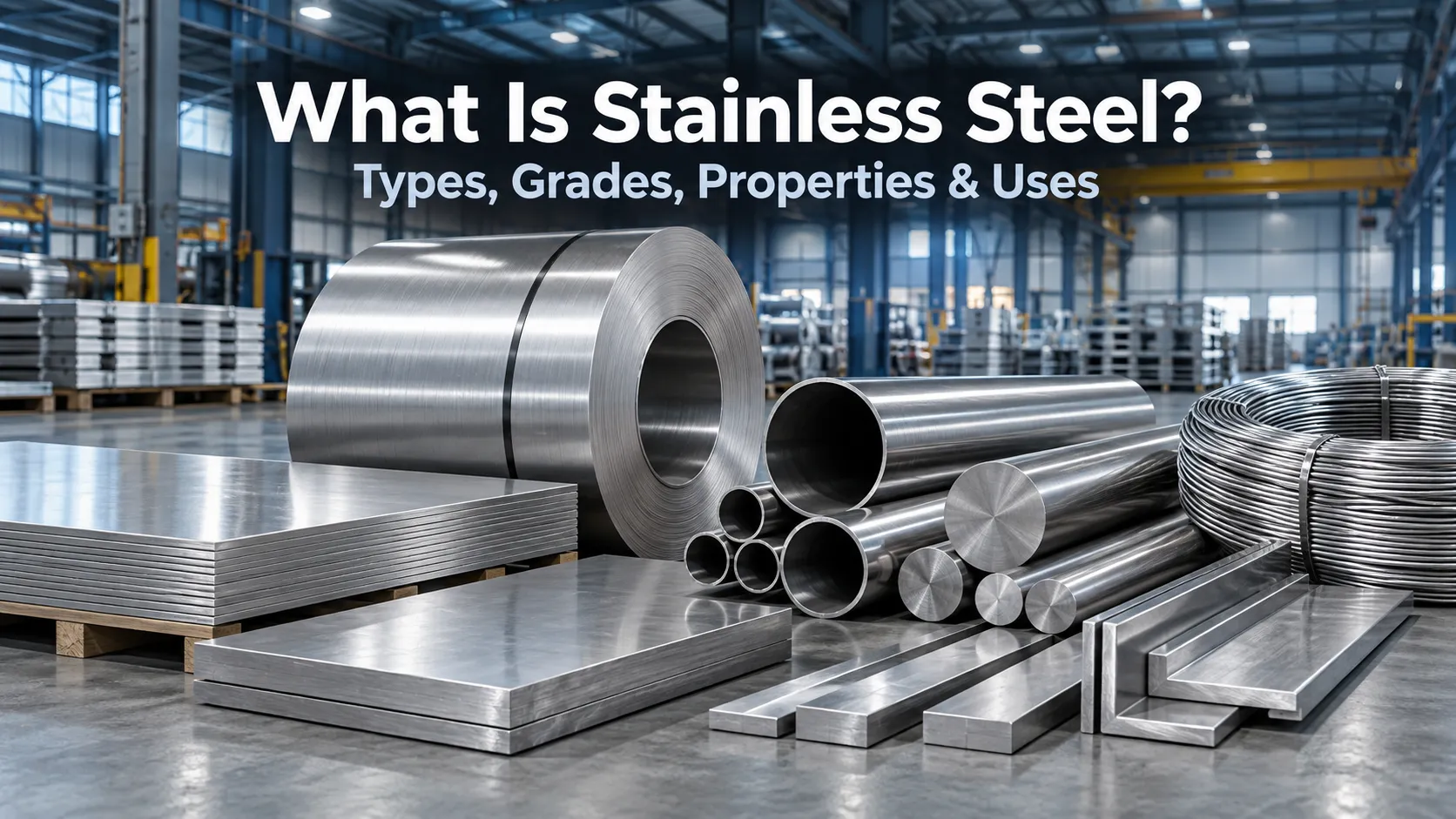
Stainless steel is not a single material or a single grade. It is a large family of iron-based alloys developed to provide corrosion resistance, mechanical strength, durability, cleanability and long service life.
The feature that fundamentally distinguishes stainless steel from ordinary carbon steel is chromium.
Stainless steels contain at least approximately 10,5% Chrom. When chromium in the alloy is exposed to oxygen, it forms an extremely thin chromium-rich oxide layer on the surface. This invisible passive film helps protect the underlying metal from corrosion.
That simple principle explains why stainless steel can remain corrosion resistant without relying on paint, galvanizing or another external coating.
But it does not mean that every stainless steel performs the same way.
A 430 stainless steel appliance panel, a 304 food-processing tank, a 316L chemical pipe, a 2205 duplex pressure vessel and a 2507 super duplex offshore component are all stainless steels, yet they can have very different:
- Chemical compositions
- Microstructures
- Korrosionsbeständigkeit
- Mechanische Stärke
- Magnetic properties
- Schweißbarkeit
- Formbarkeit
- Temperature capability
- Kosten
- Suitable service environments
For engineers, fabricators and international buyers, the real question is therefore not simply:
Should I use stainless steel?
A better set of questions is:
- Which stainless steel family should I use?
- Which grade is appropriate?
- Will the material be exposed to chlorides or chemicals?
- Is welding required?
- What strength is needed?
- Will the material operate at high or low temperature?
- Which surface finish is required?
- Do I need sheet, plate, coil, pipe, tube, bar or another form?
- Which ASTM, EN, JIS, GB or other standard applies?
This guide explains stainless steel from both an engineering and purchasing perspective and provides a practical starting point for selecting the correct material.
What Is Stainless Steel?
Stainless steel is an iron-based alloy containing enough chromium to develop a protective passive surface layer that significantly improves corrosion resistance.
Iron is still the primary constituent in most stainless steels. The difference is that chromium and other alloying elements are deliberately added to modify the way the metal reacts with its environment.
Chromium is essential.
Other elements may include:
- Nickel
- Molybdän
- Kohlenstoff
- Mangan
- Stickstoff
- Silizium
- Titan
- Niobium
- Kupfer
By adjusting these elements and controlling the material’s microstructure, steelmakers can produce hundreds of stainless steel grades for different operating conditions.
This is why the term Edelstahl should be understood as a material family rather than one fixed composition.
Why Is Stainless Steel Resistant to Corrosion?
The corrosion resistance of stainless steel comes primarily from its passive layer.
Chromium Forms a Passive Film
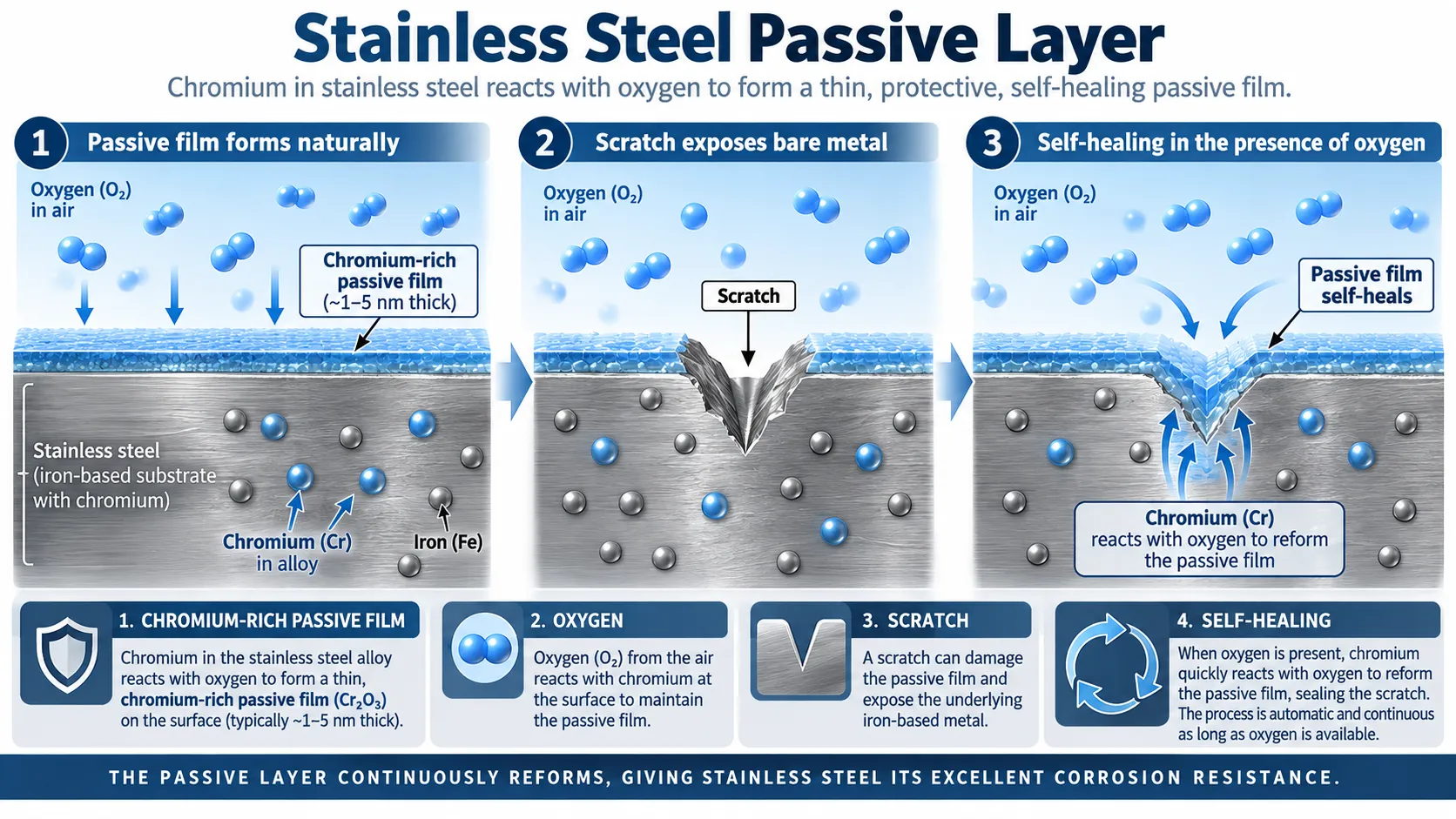
When chromium-containing stainless steel is exposed to oxygen, chromium near the surface reacts with oxygen and forms an extremely thin chromium-rich oxide film.
This passive film is:
- Very thin
- Strongly adherent
- Continuous
- Relatively stable
- Invisible to the naked eye
- Capable of reforming under suitable conditions
Unlike ordinary iron oxide, which can form loose and flaky rust, the passive layer adheres closely to the stainless steel surface and helps separate the underlying metal from the surrounding environment.
The Passive Layer Can Self-Heal
One of the most important characteristics of stainless steel is its ability to re-passivate.
Imagine that a stainless steel surface is lightly scratched.
The scratch may temporarily expose fresh metal. However, if sufficient oxygen is available, chromium at the newly exposed surface reacts with oxygen again and rebuilds the passive film.
This is why stainless steel corrosion resistance does not depend on keeping an external paint layer completely intact.
The protection originates from the alloy itself.
Why Doesn’t Ordinary Carbon Steel Do This?
Carbon steel contains iron but normally does not contain enough chromium to create the same stable passive film.
When carbon steel is exposed to water and oxygen, iron oxides can form.
These corrosion products do not usually provide the same continuous, self-repairing protection as the chromium-rich passive film of stainless steel.
This is one of the fundamental differences between stainless steel and ordinary carbon steel.
Can Stainless Steel Rust?
Ja.
The word stainless does not mean corrosion-proof.
Stainless steel can corrode when:
- The selected grade is not suitable for the environment
- Chloride concentration is too high
- Salt deposits remain on the surface
- Crevices trap stagnant solution
- Aggressive chemicals attack the passive film
- Surface contamination introduces iron particles
- Welding is poorly controlled
- Post-weld cleaning is inadequate
- Temperature exceeds the grade’s suitable range
- The design creates unfavorable corrosion conditions
Different forms of stainless steel corrosion include:
- General corrosion
- Korrosion Lochfraß
- Spaltkorrosion
- Galvanic corrosion
- Intergranular corrosion
- Stresskorrosionsrisse
- High-temperature oxidation
Pitting and crevice corrosion are especially important in chloride-containing environments.
For example, 304 stainless steel can perform very well in many general environments but may not be the correct choice for continuous exposure to saltwater.
This is why grade selection matters.
Is Stainless Steel a Coating?
NEIN.
Stainless steel is not ordinary steel with a stainless coating applied on top.
Chromium and the other alloying elements are present throughout the metal.
That is very different from:
- Painted carbon steel
- Powder-coated steel
- Galvanized steel
- Metal-plated steel
A simplified comparison is shown below.
| Besonderheit | Edelstahl | Coated Carbon Steel |
|---|---|---|
| Corrosion protection | Alloy-generated passive film | Applied surface coating |
| Chromium throughout material | Ja | Usually no |
| Protection after minor scratch | Passive film may reform | Base steel may become exposed |
| Wartung | Generally low with correct grade | Coating may require repair |
| Surface appearance | Natural metallic finish | Depends on coating |
| Initial cost | Normalerweise höher | Often lower |
| Lebenszykluskosten | Can be attractive in corrosive service | Depends heavily on coating life |
| Typische Verwendung | Food, chemical, architectural, marine, industrial | Construction, machinery, structures |
This does not mean stainless steel is always better than coated carbon steel.
Das richtige Material hängt ab von:
- Umfeld
- Required service life
- Maintenance strategy
- Structural requirements
- Herstellung
- Aussehen
- Total lifecycle cost
What Is Stainless Steel Made Of?
The exact composition depends on the grade.
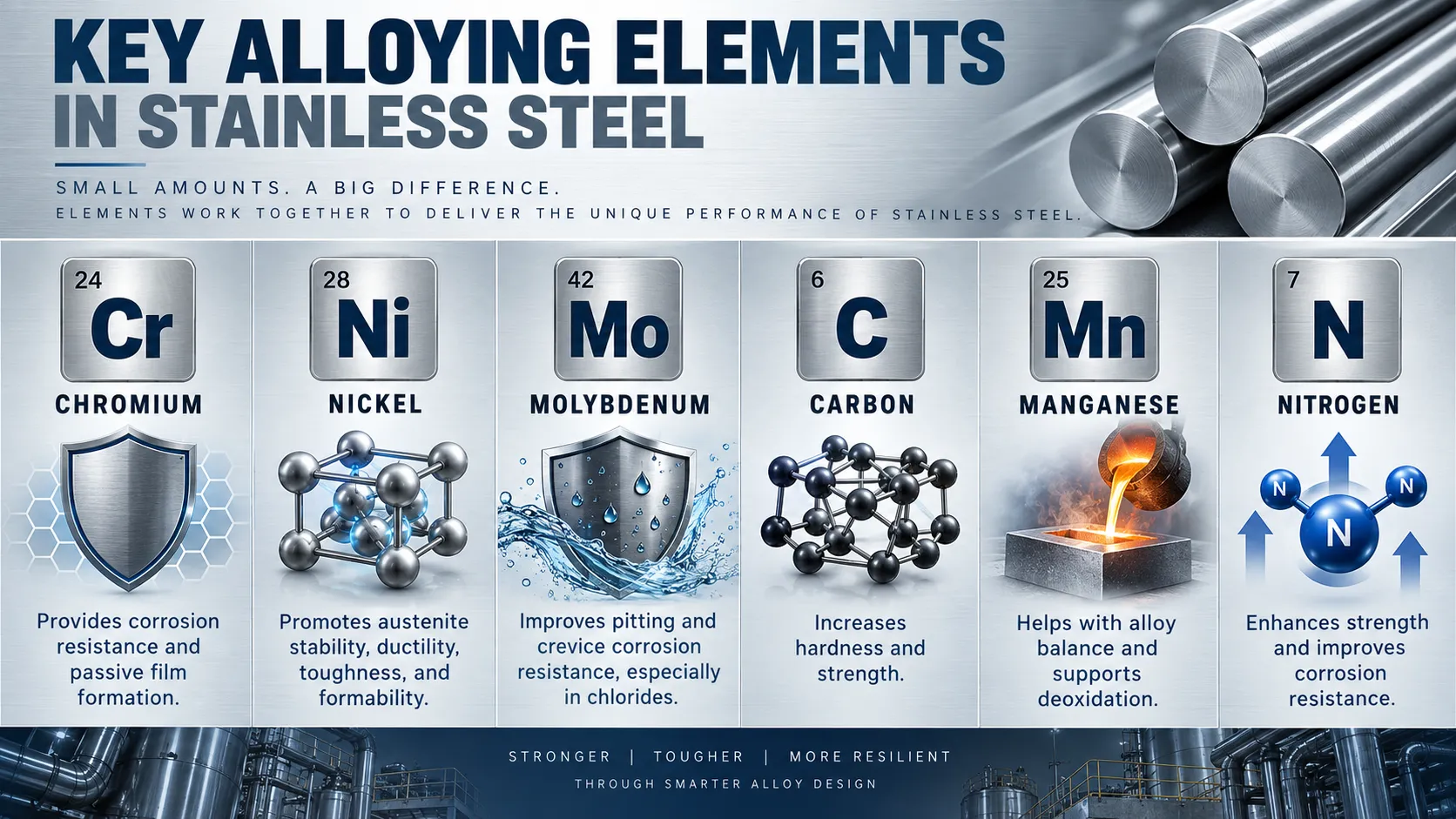
Several alloying elements are especially important.
Chromium — Cr
Chromium is the defining element of stainless steel.
Its most important role is helping form the chromium-rich passive film responsible for corrosion resistance.
Higher chromium levels can also contribute to:
- Oxidationsbeständigkeit
- Hochtemperaturleistung
- Stability of certain stainless steel microstructures
However, chromium content alone does not determine the complete corrosion behavior.
Nickel, molybdenum, nitrogen and other elements also matter.
Nickel — Ni
Nickel is particularly important in many austenitic stainless steels.
It helps stabilize the austenitic structure and contributes to:
- Duktilität
- Zähigkeit
- Formbarkeit
- Schweißbarkeit
- Low-Temperatur-Zähigkeit
304 is one of the best-known chromium-nickel stainless steels.
You can learn more in our detailed 304 Stainless Steel guide.
Molybdenum — Mo
Molybdenum is an important addition in grades such as 316 and many duplex stainless steels.
Its main practical advantage is improved resistance to localized corrosion, particularly:
- Lochfraß
- Spaltkorrosion
This becomes particularly important in environments containing chlorides.
The presence of molybdenum is one of the major reasons 316 is generally more resistant to chloride attack than 304.
For a detailed comparison, see 304 vs. 316 Edelstahl.
Carbon — C
Carbon influences strength, hardness and heat-treatment behavior.
Martensitic stainless steels use carbon to achieve higher hardness after heat treatment.
In austenitic stainless steels, excessive carbon can create concerns during certain welding and high-temperature exposure conditions.
This is why low-carbon grades such as:
- 304L
- 316L
are widely used for welded fabrication.
Manganese — Mn
Manganese contributes to alloy balance and steelmaking.
In some stainless steel compositions it can also help stabilize austenite.
200-series stainless steels such as 201 typically use increased manganese together with lower nickel compared with conventional 300-series austenitic grades.
Nitrogen — N
Nitrogen can significantly improve strength and can also contribute to resistance against localized corrosion.
It is particularly important in many duplex and super duplex stainless steels.
Other Alloying Elements
Depending on the grade, stainless steel may also contain:
Titan
Used in stabilized grades such as 321.
Niobium
Used in stabilized alloys and precipitation-hardening systems.
Kupfer
May be added for specific corrosion or forming characteristics.
Schwefel
May be deliberately increased in certain free-machining grades.
The combination of these alloying elements helps explain why stainless steel grades can behave so differently even when they look almost identical.
The Five Main Types of Stainless Steel
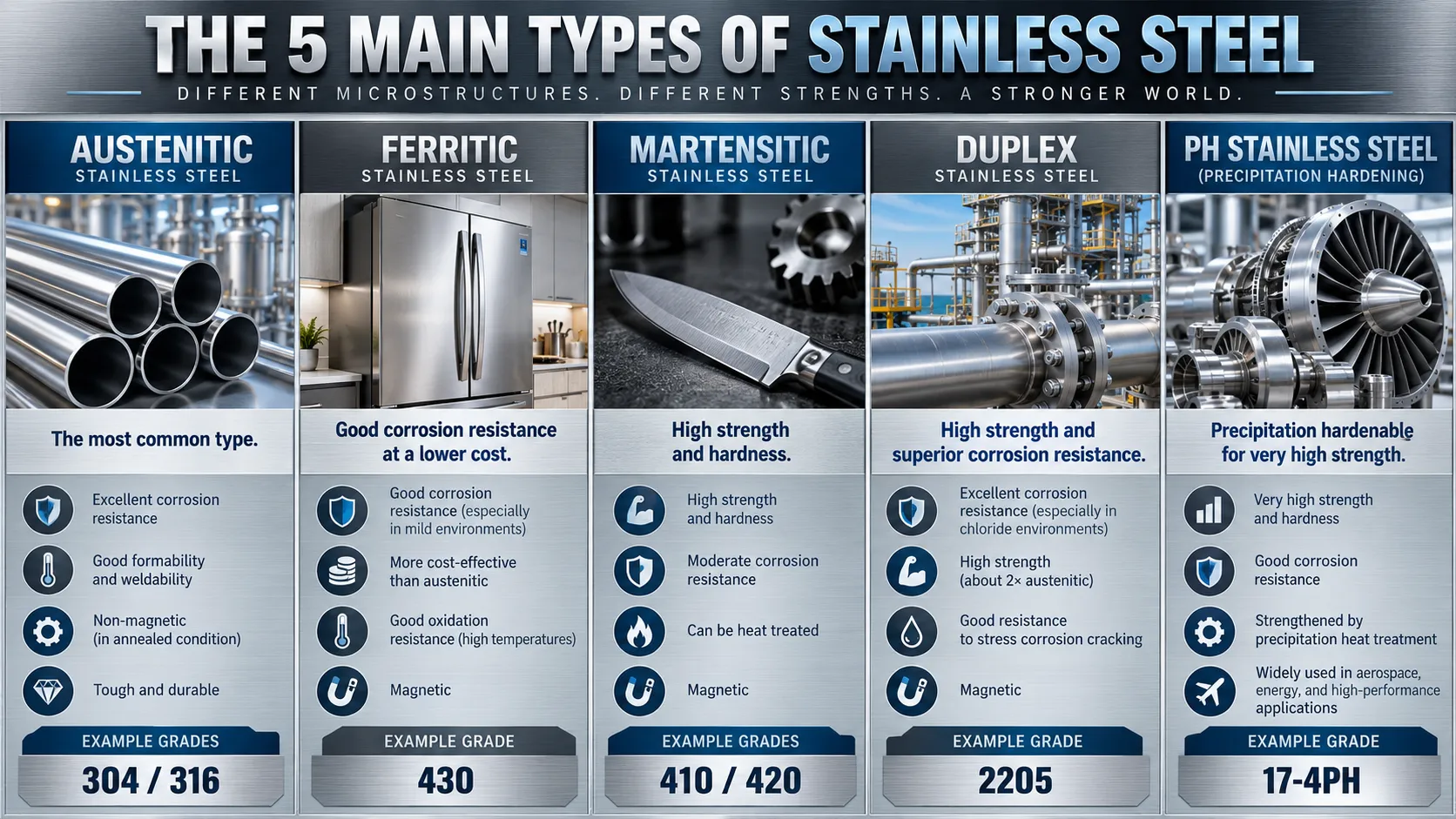
Stainless steels are commonly classified according to their metallurgical microstructure.
The five major families are:
- Austenitisch
- Ferritisch
- Martensitisch
- Duplex
- Ausscheidungshärtung
1. Austenitic Stainless Steel
Austenitic stainless steel is the most widely recognized stainless steel family.
Common grades include:
- 201
- 301
- 304
- 304L
- 316
- 316L
- 321
- 347
Austenitic grades are widely used because they provide a useful combination of:
- Korrosionsbeständigkeit
- Duktilität
- Formbarkeit
- Zähigkeit
- Schweißbarkeit
- Surface quality
Common applications include:
- Ausrüstung für die Lebensmittelverarbeitung
- Panzer
- Küchenausstattung
- Chemische Ausrüstung
- Pharmazeutische Systeme
- Architectural cladding
- Wärmetauscher
- Automotive components
- Pipe and tube systems
Annealed austenitic stainless steels such as 304 and 316 are normally non-magnetic or only weakly magnetic.
Cold working can cause some austenitic grades to develop measurable magnetic response.
2. Ferritic Stainless Steel
Ferritic stainless steels are chromium-containing stainless steels with a ferritic microstructure.
Common grades include:
- 409
- 430
- 439
- 441
- 446
They are normally magnetic.
Ferritic grades generally contain little or no deliberately added nickel compared with conventional 300-series stainless steels.
This can make them an economical choice where their corrosion and mechanical performance are sufficient.
Typical characteristics include:
- Magnetisches Verhalten
- Useful corrosion resistance
- Good oxidation resistance in selected grades
- Good formability in many sheet applications
- Competitive material cost
Typische Anwendungen sind:
- Geräte
- Küchenausstattung
- Dekorative Paneele
- Kfz -Auspuffanlagen
- Interior architectural components
- Heat-resistant components
430 is one of the most familiar ferritic grades.
If you are comparing 430 with 304 for sheet applications, see our guide to 304 vs. 430 Edelstahlbleche.
3. Martensitic Stainless Steel
Martensitic stainless steels are used where mechanical strength, hardness and wear resistance are important.
Common grades include:
- 410
- 420
- 431
- 440A
- 440B
- 440c
They are generally magnetic and can be hardened through heat treatment.
Typische Anwendungen sind:
- Knives
- Cutlery
- Wellen
- Ventilteile
- Pumpenkomponenten
- Turbinenkomponenten
- Chirurgische Instrumente
- Befestigungselemente
- Verschleißfeste Teile
Compared with 304 or 316, many martensitic grades provide higher hardness but lower corrosion resistance.
Material selection is therefore a balance between:
hardness + strength + wear resistance + corrosion environment
rather than corrosion resistance alone.
4. Duplex Stainless Steel
Duplex stainless steel contains both:
- Austenitic structure
- Ferritic structure
The two-phase microstructure gives duplex grades a useful combination of strength and corrosion resistance.
Common grades include:
- Lean duplex grades
- 2205
- 2507 Super-Duplex
Typical advantages include:
- Higher yield strength than conventional annealed austenitic grades
- Good resistance to chloride-related corrosion
- Good resistance to stress corrosion cracking in suitable environments
- Useful weldability when correct procedures are followed
- Magnetisches Verhalten
2205 is widely used in:
- Chemische Verarbeitung
- Öl und Gas
- Zellstoff und Papier
- Wasseraufbereitung
- Druckgeräte
- Offshore -Geräte
- Entsalzung
- Prozessleitungen
5. Precipitation-Hardening Stainless Steel
Precipitation-hardening stainless steels, often called PH stainless steels, can achieve very high mechanical strength through controlled heat treatment.
One of the best-known grades is:
17-4PH
Typical advantages include:
- Very high strength
- Good hardness
- Useful corrosion resistance
- Dimensional stability
- Heat-treatment-controlled properties
Typische Anwendungen sind:
- Luft- und Raumfahrt
- Pumpenkomponenten
- Wellen
- Ventile
- Befestigungselemente
- High-strength mechanical components
- Precision equipment
Stainless Steel Family Comparison
| Edelstahlfamilie | Gemeinsame Noten | Typical Magnetic Behavior | Korrosionsbeständigkeit | Stärke | Formbarkeit | Typische Anwendungen |
|---|---|---|---|---|---|---|
| Austenitisch | 201, 304, 316, 321 | Usually low in annealed condition | Good to excellent | Moderat bis hoch | Exzellent | Food, chemical, architectural, tanks |
| Ferritisch | 409, 430, 441 | Magnetisch | Moderat bis gut | Mäßig | Gut | Appliances, exhaust, decoration |
| Martensitisch | 410, 420, 440C | Magnetisch | Mäßig | High after heat treatment | Untere | Blades, shafts, valves, wear parts |
| Duplex | 2205, 2507 | Magnetisch | Very good to excellent | Hoch | Mäßig | Offshore, chemical, process equipment |
| PH | 17-4PH, 15-5PH | Usually magnetic | Gut | Sehr hoch | Grade dependent | Aerospace, valves, shafts |
Common Stainless Steel Grades
The stainless steel family contains many grades, but a relatively small group accounts for a large proportion of global industrial purchasing.
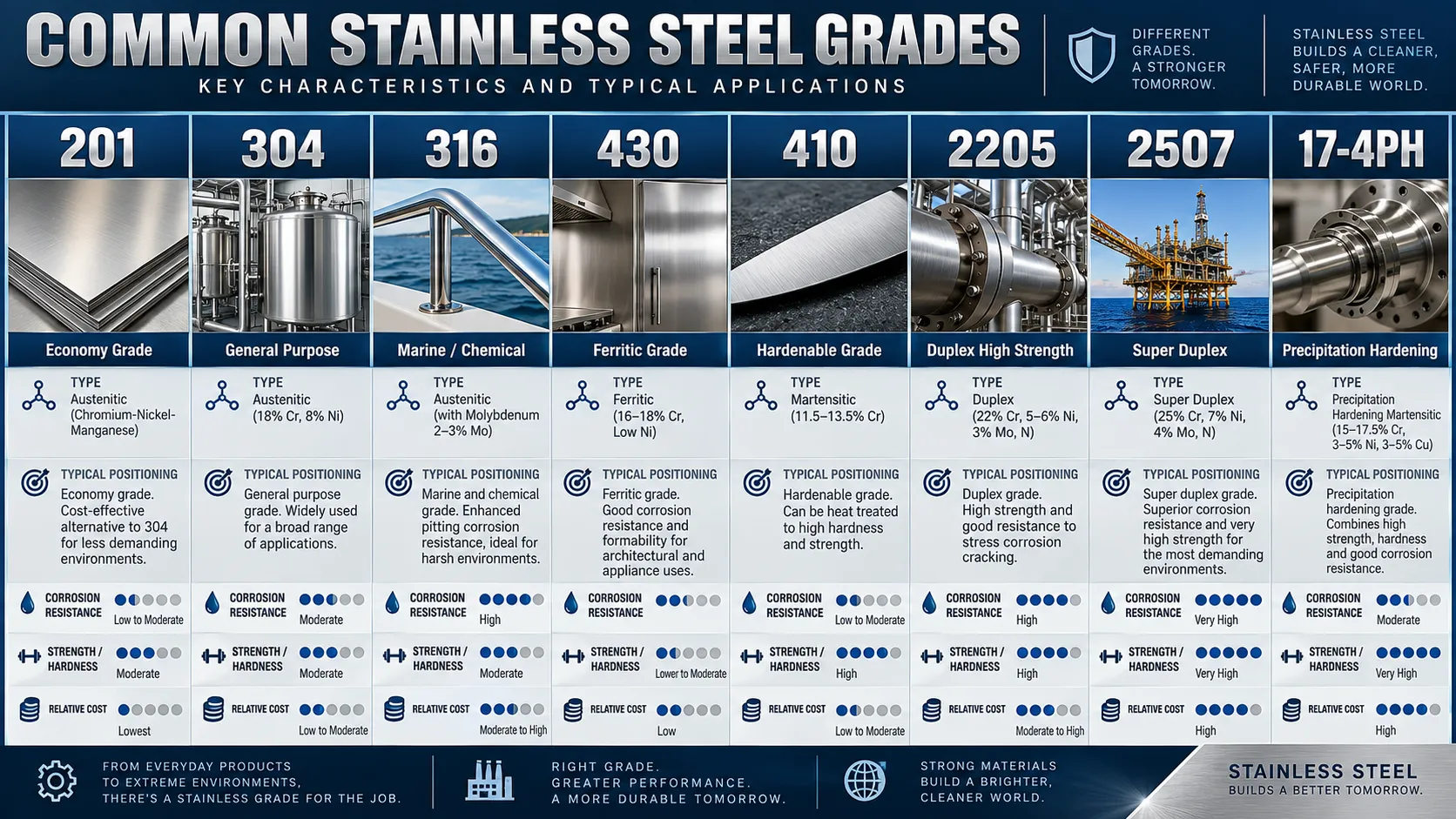
201 Edelstahl
201 is an austenitic stainless steel that typically uses higher manganese and lower nickel content than conventional 304.
It is commonly considered for cost-sensitive applications where extremely high corrosion resistance is not required.
Typical uses include:
- Indoor decorative products
- Möbel
- Geländer
- Küchenutensilien
- Architectural trim
- General fabricated products
It should not automatically be treated as a direct replacement for 304 in aggressive environments.
304 and 304L Stainless Steel
304 is one of the most widely used stainless steel grades.
It offers a strong combination of:
- Allgemeine Korrosionsbeständigkeit
- Formbarkeit
- Schweißbarkeit
- Verfügbarkeit
- Optionen für die Oberflächenveredelung
- Cost efficiency
Typische Anwendungen sind:
- Lebensmittelausrüstung
- Panzer
- Küchen
- Architectural products
- General industrial fabrication
- Rohr und Rohr
- Sheet and coil products
304L is the lower-carbon version and is widely used in welded structures.
316 and 316L Stainless Steel
316 contains molybdenum, which improves resistance to localized corrosion compared with 304 in many chloride-containing environments.
Typische Anwendungen sind:
- Chemische Ausrüstung
- Pharmazeutische Systeme
- Coastal structures
- Ausrüstung für die Lebensmittelverarbeitung
- Wärmetauscher
- Prozessleitungen
- Marine-related equipment
316L provides lower carbon content and is widely specified in welded fabrication.
321 Edelstahl
321 is a titanium-stabilized austenitic stainless steel.
It is commonly considered for elevated-temperature applications and components where stabilization is important.
Typical uses include:
- Wärmetauscher
- Abgassysteme
- High-temperature piping
- Aerospace components
- Thermal equipment
430 Edelstahl
430 is a widely used ferritic stainless steel.
Es ist:
- Magnetisch
- Relatively economical
- Suitable for many mild environments
- Common in sheet applications
Typische Anwendungen sind:
- Geräte
- Küchenausstattung
- Zierbesatz
- Innenarchitektur
- Household products
410 Edelstahl
410 is a martensitic stainless steel.
It can be heat treated to achieve higher hardness and strength.
Typische Anwendungen sind:
- Ventile
- Wellen
- Befestigungselemente
- Pump parts
- Turbinenkomponenten
- Mechanische Komponenten
420 Stainless Steel
420 provides greater hardening potential than many general-purpose stainless grades.
Typical uses include:
- Knives
- Blades
- Chirurgische Werkzeuge
- Wear-resistant components
- Precision mechanical parts
2205 Duplex Edelstahl
2205 is one of the most widely used duplex stainless steels.
It combines:
- Hohe Festigkeit
- Good chloride resistance
- Useful weldability
- Good resistance to stress corrosion cracking in suitable conditions
Typische Anwendungen sind:
- Chemische Verarbeitung
- Öl und Gas
- Druckgeräte
- Offshore structures
- Rohrleitungen
- Water-treatment systems
2507 Super Duplex Edelstahl
2507 is a super duplex stainless steel designed for particularly demanding environments.
It provides:
- Very high strength
- High chromium, molybdenum and nitrogen alloying
- Strong resistance to localized corrosion
- Suitability for severe chloride service
Typische Anwendungen sind:
- Offshore-Systeme
- Meerwasserausrüstung
- Entsalzungsanlagen
- Chemische Verarbeitung
- Aggressive process piping
17-4PH Stainless Steel
17-4PH is a precipitation-hardening stainless steel used when high mechanical strength is a primary requirement.
Typische Anwendungen sind:
- Aerospace components
- Wellen
- Pumps
- Ventile
- Befestigungselemente
- Präzisionskomponenten
Quick Stainless Steel Grade Comparison
| Grad | Family | Main Characteristic | Typische Verwendung |
|---|---|---|---|
| 201 | Austenitisch | Economical Cr-Ni-Mn grade | Interior decoration, furniture |
| 304 / 304l | Austenitisch | General-purpose corrosion resistance | Food, construction, tanks |
| 316 / 316l | Austenitisch | Improved chloride resistance | Chemical, coastal, pharmaceutical |
| 321 | Austenitisch | Stabilized for elevated temperature | Exhausts, heat equipment |
| 430 | Ferritisch | Magnetic and economical | Appliances, decorative panels |
| 410 | Martensitisch | Heat treatable | Shafts, valves, mechanical parts |
| 420 | Martensitisch | Higher hardness | Blades, instruments |
| 2205 | Duplex | High strength + corrosion resistance | Chemie-, Offshore- und Drucksysteme |
| 2507 | Super Duplex | Severe corrosion environments | Seawater, desalination, offshore |
| 17-4PH | PH | Very high strength | Aerospace, shafts, valves |
304 vs. 316 Edelstahl
304 and 316 are frequently compared because both are widely used austenitic stainless steels.
The most important compositional difference is the addition of molybdenum in 316.
| Eigentum | 304 | 316 |
|---|---|---|
| Family | Austenitisch | Austenitisch |
| Hauptlegierungssystem | Cr-nie | Cr-in-i |
| Allgemeine Korrosionsbeständigkeit | Sehr gut | Sehr gut |
| Beständigkeit gegen Chlorid-Lochfraß | Untere | Höher |
| Formbarkeit | Exzellent | Exzellent |
| Schweißbarkeit | Exzellent | Exzellent |
| Relative Materialkosten | Untere | Höher |
| Common applications | Allgemeinzweck | Chemical, coastal, chloride-containing environments |
When Is 304 a Good Choice?
304 is commonly selected for:
- Indoor applications
- General outdoor environments
- Lebensmittelausrüstung
- Küchen
- Panzer
- Architektur
- Allgemeine Herstellung
- Freshwater systems
When Should 316 Be Considered?
316 or 316L may be more appropriate where the equipment encounters:
- Chloride
- Salzspray
- Küstenumgebungen
- Certain chemical solutions
- Aggressive cleaning agents
- Pharmazeutische Verarbeitung
- More demanding process conditions
However, 316 should not automatically be assumed to be suitable for every seawater application.
Continuous seawater exposure, elevated temperature, crevices and severe chloride concentrations may require:
- 2205 Duplex
- 2507 Super-Duplex
- Another higher-alloy stainless steel
Read our dedicated 304 vs 316 Stainless Steel comparison for a more detailed analysis.
Stainless Steel vs Carbon Steel
Stainless steel and carbon steel are both iron-based materials, but they are optimized for different priorities.
| Eigentum | Edelstahl | Kohlenstoffstahl |
|---|---|---|
| Korrosionsbeständigkeit | High when correctly selected | Generally lower without coating |
| Chromgehalt | Significant | Usually low |
| Oberflächenschutz | Passive film | Often paint, galvanizing or coating |
| Anfängliche Materialkosten | Normalerweise höher | Usually lower |
| Wartung | Often lower in corrosive service | Depends on coating system |
| Stärke | Breite Reichweite | Breite Reichweite |
| Surface appearance | Natural metallic finish | Often coated or painted |
| Typische Anwendungen | Food, chemical, architectural, hygienic, marine | Structures, machinery, construction |
Carbon steel remains an excellent engineering material.
If corrosion resistance is not a major concern, carbon steel may provide a more economical solution.
Stainless steel becomes especially valuable when a project requires:
- Korrosionsbeständigkeit
- Hygiene
- Reinigbarkeit
- Attractive metallic appearance
- Niedrige Wartung
- Long service life
Key Properties of Stainless Steel
Korrosionsbeständigkeit
Corrosion resistance is the defining characteristic of stainless steel.
However, resistance varies significantly between grades.
A 430 ferritic stainless steel used in an indoor appliance does not provide the same corrosion resistance as 316L, 2205 or 2507.
Material selection must always match the actual environment.
Stärke
There is no single “strength of stainless steel.”
Strength depends on:
- Grad
- Mikrostruktur
- Wärmebehandlung
- Kaltverformung
- Produktform
- Dicke
- Anwendbarer Standard
Duplex and precipitation-hardening stainless steels can provide significantly higher strength than conventional annealed 300-series stainless steels.
Ductility and Formability
Austenitic stainless steels are especially valued for formability.
304 can be:
- Bent
- Rolled
- Gestempelt
- Deep drawn
- Press formed
This makes it particularly useful for sheet-metal fabrication.
Schweißbarkeit
304, 304L, 316 and 316L are widely welded using established industrial welding processes.
Low-carbon variants such as 304L and 316L are commonly used where welding is important.
Duplex and martensitic stainless steels can also be welded, but they may require more carefully controlled procedures.
Wärmewiderstand
Selected stainless steels can provide useful performance at elevated temperatures.
High-temperature material selection should consider:
- Oxidation
- Kriechen
- Wärmeausdehnung
- Thermal fatigue
- Metallurgische Stabilität
- Mechanical strength at temperature
A stainless steel that works well at room temperature may not necessarily be suitable for continuous high-temperature operation.
Low-Temperature Performance
Many austenitic stainless steels retain useful toughness at low temperatures.
This is one reason austenitic stainless steels are used in certain cryogenic systems.
Hygiene and Cleanability
Stainless steel is widely used in:
- Lebensmittelverarbeitung
- Beverage production
- Dairy equipment
- Pharmazeutische Ausrüstung
- Medical environments
Smooth stainless surfaces can be cleaned effectively and do not require a paint coating for corrosion protection.
Aussehen
Stainless steel can be produced in many surface conditions ranging from industrial mill finishes to highly polished decorative surfaces.
This allows stainless steel to serve both:
- Engineering purposes
- Architectural purposes
Recyclabalität
Stainless steel is recyclable and has established global scrap value.
Its long service life can also help reduce replacement frequency in suitable applications.
Is Stainless Steel Magnetic?
The answer depends on the stainless steel family.
| Family | Typical Magnetic Behavior |
|---|---|
| Austenitisch | Usually non-magnetic or weakly magnetic when annealed |
| Ferritisch | Magnetisch |
| Martensitisch | Magnetisch |
| Duplex | Magnetisch |
| PH Stainless | Many common grades are magnetic |
A common myth is:
If a magnet sticks to the material, it is not stainless steel.
This is incorrect.
Grades such as:
- 430
- 410
- 420
- 2205
are genuine stainless steels and are magnetic.
Even 304 can develop some magnetic response after significant cold working.
A magnet should therefore nicht be used as the sole method for identifying a stainless steel grade.
Common Stainless Steel Product Forms
Stainless steel grade is only one part of a purchase specification.
Buyers must also define the required product form.
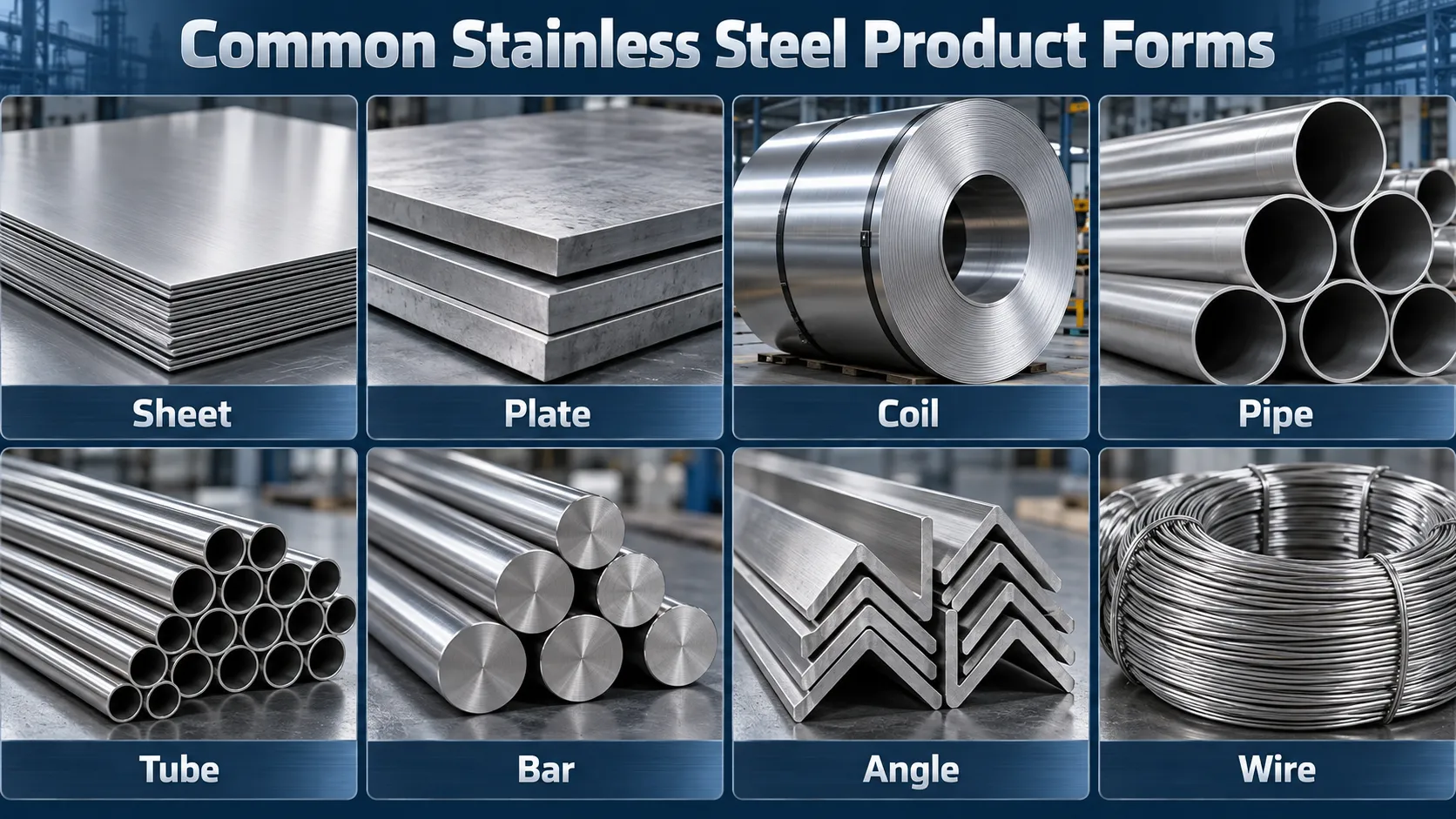
At Gengfei Steel, our Produktpalette aus Edelstahl covers multiple flat and long-product forms for industrial manufacturing and project applications.
Edelstahlblech
Edelstahlblech is commonly used for:
- Lebensmittelausrüstung
- Schränke
- Panzer
- Enclosures
- Architekturpaneele
- Küchenausstattung
- Machine covers
- Decorative fabrication
Important purchasing parameters include:
- Grad
- Dicke
- Breite
- Länge
- Oberflächenbeschaffung
- Toleranz
- Protective film
- Randzustand
Edelstahlplatte
Plate is typically associated with thicker flat stainless products used in heavier fabrication.
Typische Anwendungen sind:
- Druckbehälter
- Industrietanks
- Strukturkomponenten
- Chemische Ausrüstung
- Offshore -Geräte
- Heavy machinery
The exact dividing line between sheet and plate depends on the relevant standard and commercial convention.
Edelstahlspule
Edelstahlspule is suitable for continuous manufacturing and further processing.
Typical downstream operations include:
- Schlitzen
- Auf Länge geschnitten
- Rollformen
- Stempeln
- Tube manufacturing
- Appliance production
- Automotive component production
Coil purchasing normally requires careful definition of:
- Grad
- Dicke
- Breite
- Spule Id
- Spulengewicht
- Oberfläche
- Rand
- Toleranz
Edelstahlstreifen
Stainless steel strip is narrower flat material often used for high-volume manufacturing and precision components.
Zu den Anwendungen gehören:
- Federn
- Clamps
- Elektronik
- Kfz -Teile
- Seals
- Precision stamping
Thickness tolerance, edge condition and temper can be particularly important.
Edelstahlrohr
Stainless steel pipe is widely used for fluid transportation and process systems.
Pipe is often specified according to:
- Nenne Rohrgröße
- Zeitplan
- Außendurchmesser
- Wandstärke
- Applicable pipe standard
Zu den Anwendungen gehören:
- Chemical systems
- Wasseraufbereitung
- Lebensmittelverarbeitung
- Prozessleitungen
- Öl und Gas
- Energy equipment
Stainless Steel Tube
Tube is often specified by outside diameter and wall thickness.
It is widely used in:
- Wärmetauscher
- Instrumentierung
- Sanitäre Ausrüstung
- Automobilsysteme
- Mechanical structures
- Precision assemblies
Pipe and tube may appear similar, but their dimensional conventions and standards can be very different.
Unser 304 Stainless Steel Tubing guide explains the subject in more detail.
Edelstahlstange
Edelstahlstange is available in forms including:
- Rundstab
- Flache Stange
- Square bar
- Hex bar
Zu den Anwendungen gehören:
- Bearbeitete Komponenten
- Wellen
- Befestigungselemente
- Pumps
- Ventile
- Strukturkomponenten
- Mechanical equipment
Edelstahlwinkel
Stainless steel angle is used in:
- Frames
- Unterstützung
- Equipment structures
- Architektur
- Food machinery
- Chemical installations
- Corrosion-resistant structural assemblies
Edelstahldraht
Stainless steel wire is available for applications including:
- Federn
- Mesh
- Befestigungselemente
- Cable
- Filtration
- Industrial weaving
- Schweißen
- Präzisionskomponenten
Stainless Steel Surface Finishes
Surface finish can affect:
- Aussehen
- Reinigbarkeit
- Reflexionsvermögen
- Herstellung
- Korrosionsverhalten
- Customer acceptance
Common stainless steel finishes include:
| Beenden | Typical Appearance | Typische Anwendung |
|---|---|---|
| Nr. 1 | Rougher matte hot-rolled surface | Industrial plate |
| 2D | Dull cold-rolled surface | Industrial processing |
| 2B | Smooth matte / slightly reflective | Allgemeine Blechfertigung |
| Ba | Hell geglüht | Appliances, decoration |
| Nr. 4 | Brushed / satin | Kitchens, architecture |
| Haaransatz | Linear decorative finish | Elevators, wall panels |
| Spiegel / 8K | Highly reflective | Premium decorative applications |
Finish terminology can vary between:
- Mills
- Regions
- Standards
- Customers
For decorative projects, simply stating “brushed” or “mirror” may not be sufficient.
A purchase specification may also need to define:
- Oberflächenrauheit
- Grinding direction
- Polishing quality
- Protective film
- Visual acceptance criteria
How Is Stainless Steel Made?
Stainless steel manufacturing varies by mill and product type, but the overall production route typically contains several stages.
1. Raw Material Preparation
The production charge may contain:
- Stainless steel scrap
- Iron-bearing materials
- Ferrochromium
- Nickel
- Molybdän
- Other alloy additions
Precise raw-material selection depends on the final grade.
2. Melting
Raw materials are melted to create the basic alloy.
3. Refining
The molten steel is refined to control:
- Kohlenstoff
- Chrom
- Nickel
- Molybdän
- Stickstoff
- Verunreinigungen
- Final chemistry
Small chemistry differences can determine whether the final alloy qualifies as 304, 316, 2205 or another grade.
4. Casting
The refined stainless steel is cast into intermediate forms such as:
- Slabs
- Billets
- Blooms
The form depends on the downstream product.
5. Hot Rolling
Cast material is reheated and hot rolled into:
- Platte
- Hot rolled coil
- Bar
- Other intermediate products
6. Annealing
Heat treatment helps establish the required microstructure and properties.
7. Pickling and Descaling
Hot processing creates surface oxides.
Pickling and related processes remove scale and restore a clean stainless steel surface.
8. Cold Rolling
Cold rolling may be used when buyers require:
- Thinner gauge
- Better dimensional control
- Verbesserte Oberflächenbeschaffenheit
- More precise tolerances
9. Finishing
Depending on the product, additional processing can include:
- Schlitzen
- Schneiden
- Leveling
- Schleifen
- Polieren
- Drawing
- Peeling
- Bearbeitung
- Tube forming
10. Inspection
Inspection can involve:
- Chemische Zusammensetzung
- Mechanische Eigenschaften
- Abmessungen
- Oberflächenzustand
- Ebenheit
- Geradlinigkeit
- Nondestructive testing
- Product-specific tests
The required inspection scope depends on the standard and purchase order.
Where Is Stainless Steel Used?
Stainless steel is used across many industries because different grades can be selected for different combinations of corrosion resistance, strength and fabrication requirements.
Essen und Getränk
Commonly considered grades include:
- 304
- 304L
- 316
- 316L
Zu den Anwendungen gehören:
- Panzer
- Brewing equipment
- Dairy systems
- Lebensmittelverarbeitungsmaschinen
- Küchenausstattung
- Conveyors
- Rohrleitungen
Chemische Verarbeitung
Depending on the chemical environment, materials may include:
- 316L
- 2205
- 2507
- Higher-alloy stainless steels
Zu den Anwendungen gehören:
- Reactors
- Lagertanks
- Wärmetauscher
- Prozessleitungen
- Scrubbers
- Druckbehälter
Grade selection should always consider:
- Chemikalie
- Konzentration
- Temperatur
- Druck
- Strömungsbedingungen
Marine und Offshore
Marine environments require special attention because chlorides can promote pitting and crevice corrosion.
Potential grades include:
- 316L
- 2205
- 2507
Zu den Anwendungen gehören:
- Offshore -Geräte
- Coastal infrastructure
- Entsalzung
- Rohrleitungen
- Befestigungselemente
- Meereshardware
There is no single stainless steel that is automatically suitable for every marine environment.
Architektur und Konstruktion
Stainless steel is widely used for:
- Fassaden
- Handläufe
- Dach
- Aufzugskollektoren
- Zierbesatz
- Strukturkomponenten
- Public-space installations
Surface appearance and long-term staining resistance can be as important as mechanical strength.
Automobil und Transport
Zu den Anwendungen gehören:
- Abgassysteme
- Trim
- Rohr
- Hitzeschilde
- Structural parts
- Fuel-system components
Ferritic and austenitic grades are both widely used.
Pharmaceutical and Medical Equipment
Stainless steels are used for:
- Pharmazeutische Tanks
- Process systems
- Laboratory equipment
- Medical equipment
- Reinraumkomponenten
316L is particularly common in many high-hygiene systems, although the exact material specification depends on the process.
Energy
Stainless steels are used across:
- Power generation
- Öl und Gas
- Wärmetauscher
- Prozessausrüstung
- Renewable energy
- Nuclear-related systems
These applications may involve combinations of:
- Druck
- Temperatur
- Korrosion
- Ermüdung
- Mechanical loads
How to Choose the Right Stainless Steel Grade
Choosing stainless steel should be an engineering decision rather than simply selecting the most famous grade.

A practical selection process can begin with six questions.
Step 1: What Is the Environment?
First determine where the material will actually operate.
Beispiele hierfür sind:
- Indoor dry environment
- General outdoor exposure
- Urban atmosphere
- Coastal environment
- Marine environment
- Chemical plant
- Food-processing environment
- High-humidity environment
- Kontinuierliches Eintauchen
This immediately helps narrow the suitable grade range.
Zum Beispiel:
Indoor decorative application
201 or 430 may be worth evaluating.
General industrial equipment
304 may be sufficient.
Coastal or chloride-containing environment
316L may be more appropriate.
Starker Chlorideinsatz
Duplex or super duplex may need to be considered.
Step 2: What Type of Corrosion Is Expected?
Do not evaluate corrosion resistance only as “good” or “bad.”
Ask which corrosion mechanism is relevant.
Possible mechanisms include:
- General corrosion
- Lochfraß
- Spaltkorrosion
- Stresskorrosionsrisse
- Intergranular corrosion
- Galvanic corrosion
For chloride exposure, pitting and crevice corrosion deserve particular attention.
This is where alloying additions such as:
- Molybdän
- Stickstoff
- Higher chromium
become especially important.
Step 3: How Much Strength Is Required?
If normal mechanical strength and excellent formability are sufficient, an austenitic grade such as 304 may be appropriate.
If the project requires significantly higher yield strength, duplex stainless steel may offer advantages.
For hardness and wear resistance, consider martensitic stainless steel.
For very high strength, precipitation-hardening stainless steel may be appropriate.
The material should therefore be selected according to actual mechanical requirements rather than simply corrosion resistance.
Step 4: What Temperature Will the Material Experience?
Consider both:
- Normal operating temperature
- Maximum upset temperature
High temperature can affect:
- Stärke
- Oxidation
- Scaling
- Kriechen
- Metallurgische Stabilität
Low temperature may require good toughness.
Certain austenitic grades are particularly useful for low-temperature applications.
Specialized heat-resistant stainless steels should be evaluated for sustained elevated-temperature service.
Step 5: Will the Material Be Welded?
Welding can influence:
- Mikrostruktur
- Korrosionsverhalten
- Distortion
- Residual stress
- Mechanische Eigenschaften
For common welded fabrication:
- 304L
- 316L
are frequently selected.
Duplex stainless steel can also be welded successfully, but heat input, filler metal and phase balance must be controlled.
Martensitic stainless steels may require:
- Preheating
- Controlled cooling
- Post-weld heat treatment
depending on grade and component requirements.
Step 6: Choose the Grade
Only after understanding the previous conditions should the grade be finalized.
A simplified starting guide is:
| Erfordernis | Grades Commonly Evaluated |
|---|---|
| Low-cost indoor decorative use | 201, 430 |
| General-purpose stainless fabrication | 304 / 304l |
| Greater chloride resistance | 316 / 316l |
| Elevated-temperature stabilized applications | 321 |
| Higher hardness / wear | 410, 420 |
| High strength + chloride resistance | 2205 |
| Starker Chlorideinsatz | 2507 |
| Very high-strength precision parts | 17-4PH |
This is a screening guide, not a substitute for final engineering evaluation.
How to Specify Stainless Steel When Requesting a Quote
A good stainless steel enquiry should contain more than the grade.
Zum Beispiel:
ASTM A240 316L stainless steel sheet, 2.0 mm × 1500 mm × 3000 mm, 2B finish, 20 metric tons.
This is much more useful than:
Need stainless steel sheet.
When requesting a quotation, try to provide:
1. Klasse
Beispiele:
- 201
- 304
- 304L
- 316L
- 430
- 2205
- 2507
2. Standard
Beispiele:
- ASTM
- ASME
- IN
- Er
- GB
3. Produktform
Beispiele:
- Blatt
- Platte
- Spule
- Streifen
- Rohr
- Rohr
- Rundstab
- Angle
- Wire
4. Abmessungen
Depending on product:
- Dicke
- Breite
- Länge
- Außendurchmesser
- Wandstärke
- Durchmesser
5. Quantity
Zustand:
- Stücke
- Tons
- Spulengewicht
- Required annual quantity
where applicable.
6. Surface Finish
Beispiele:
- Nr. 1
- 2B
- Ba
- Nr. 4
- Haaransatz
- Spiegel
7. Processing Requirements
Beispiele:
- Schlitzen
- Auf Länge geschnitten
- Laserschneiden
- Polieren
- Schleifen
- Abschrägung
- Custom dimensions
8. Inspection Requirements
If required, specify:
- Mühlentestzertifikat
- Chemische Analyse
- Mechanische Prüfung
- NDT
- Inspektion durch Dritte
9. Destination
For international trade, provide:
- Land
- Hafen
- Lieferbedingungen
This helps suppliers quote freight and packaging correctly.
Stainless Steel Standards and Grade Designations
International stainless steel buyers frequently encounter several designation systems for similar materials.
Common systems include:
- AISI / Type
- ASTM
- UNS
- IN
- Er
- GB
- KS
Some familiar examples are:
| Common Grade | UNS | IN | Er |
|---|---|---|---|
| 304 | S30400 | 1.4301 | Sus304 |
| 304L | S30403 | 1.4307 / related designation | Sus304l |
| 316 | S31600 | 1.4401 | SUS316 |
| 316L | S31603 | 1.4404 | Sus316l |
| 430 | S43000 | 1.4016 | Sus430 |
| 2205 | S32205 / related duplex designation | 1.4462 | Specification dependent |
| 2507 | S32750 | 1.4410 | Specification dependent |
International cross-reference tables are useful, but similar designations should not automatically be assumed to be perfectly interchangeable.
Before purchasing, verify:
- Chemische Zusammensetzung
- Mechanische Anforderungen
- Wärmebehandlung
- Produktstandard
- Abmessungen
- Testanforderungen
You can also use our Querverweistabelle für Edelstahlsorten as a starting reference.
Advantages of Stainless Steel
Hervorragende Korrosionsbeständigkeit
With correct grade selection, stainless steel can provide long service life without paint or another protective coating.
Wide Range of Grades
The stainless steel family covers applications from decorative panels to severe chemical and offshore equipment.
Good Fabricability
Many grades can be:
- Geschweißt
- Bent
- Gebildet
- Rolled
- Bearbeitet
- Poliert
Attraktives Aussehen
Stainless steel can provide both engineering performance and architectural appearance.
Hygienische Oberfläche
Smooth stainless steel surfaces are suitable for many food, beverage and pharmaceutical environments.
Langes Lebensdauer
Correctly specified stainless steel can reduce replacement and maintenance requirements.
Recyclabalität
Stainless steel can be recycled and reused through established metal recycling systems.
Limitations of Stainless Steel
Stainless steel is not the correct answer for every project.
Höhere anfängliche Kosten
Stainless steel normally costs more than ordinary carbon steel.
Wrong Grade Selection Can Still Cause Corrosion
Using 304 in a severe chloride environment simply because it is “stainless” can lead to premature corrosion.
Härtung arbeiten
Many austenitic stainless steels work harden during machining and cold forming.
Specialized Fabrication May Be Required
Duplex, martensitic and precipitation-hardening grades may require more carefully controlled:
- Schweißen
- Bearbeitung
- Wärmebehandlung
Surface Contamination Can Cause Problems
Carbon-steel grinding particles and tooling contamination can create rust staining on stainless surfaces.
Proper workshop segregation and cleaning are important where surface quality matters.
Frequently Asked Questions About Stainless Steel
What is stainless steel?
Stainless steel is an iron-based alloy containing sufficient chromium, generally at least around 10.5%, to form a thin chromium-rich passive film that provides significantly improved corrosion resistance.
Why doesn’t stainless steel rust easily?
Chromium reacts with oxygen to create a protective passive film on the surface. This film reduces interaction between the underlying metal and the environment.
Can stainless steel rust?
Yes. Stainless steel is corrosion resistant rather than completely corrosion-proof. Chlorides, chemicals, crevices, contamination, temperature and incorrect grade selection can cause corrosion.
Is stainless steel a coating?
No. Stainless steel is an alloy. Chromium and other alloying elements are contained throughout the metal.
What are the five types of stainless steel?
The five main stainless steel families are:
- Austenitisch
- Ferritisch
- Martensitisch
- Duplex
- Ausscheidungshärtung
What is the most common stainless steel?
304 is one of the most widely used stainless steel grades because it combines good corrosion resistance, formability, weldability, availability and cost.
What is the difference between 304 and 316?
316 contains molybdenum, which generally gives it better resistance to localized corrosion in chloride-containing environments than 304.
304 is usually more economical.
Is 316 always better than 304?
NEIN.
316 offers additional corrosion resistance, but if the environment does not require that extra performance, 304 can be the more economical choice.
What does the L mean in 304L and 316L?
Der L indicates a lower-carbon version.
304L and 316L are widely used in welded applications where reduced carbon helps minimize sensitization-related concerns.
Is stainless steel magnetic?
Some stainless steels are magnetic.
Ferritic, martensitic and duplex stainless steels are normally magnetic.
Annealed austenitic grades such as 304 and 316 are normally non-magnetic or weakly magnetic, although cold working can increase magnetic response.
Is 430 real stainless steel?
Ja.
430 is a ferritic stainless steel commonly used for appliances, decorative applications and other mild environments.
It is magnetic.
What is duplex stainless steel?
Duplex stainless steel contains both austenitic and ferritic phases.
Grades such as 2205 offer higher strength than conventional austenitic stainless steel together with useful resistance to chloride-related corrosion.
What is super duplex stainless steel?
Super duplex stainless steel is a highly alloyed duplex material designed for more demanding environments.
2507 is one of the best-known super duplex grades.
What is food-grade stainless steel?
“Food grade” is not one universal stainless steel grade.
304 and 316 are widely used in food-processing equipment, but suitability depends on:
- Lebensmittelchemie
- Reinigungsmittel
- Temperatur
- Regulatory requirements
- Equipment design
What stainless steel is used in marine environments?
316L is widely used in coastal and marine-related applications, but severe or continuous seawater exposure may require higher-alloy materials such as duplex or super duplex stainless steel.
Can stainless steel be welded?
Ja.
Many stainless steels are routinely welded.
304L and 316L are especially common for welded fabrication.
Specialized grades may require controlled welding procedures.
Is stainless steel stronger than carbon steel?
Eine allgemeingültige Antwort gibt es nicht.
Both material families contain many grades.
Some duplex and precipitation-hardening stainless steels provide very high strength, while other stainless grades prioritize formability or corrosion resistance.
Always compare actual specified mechanical properties.
What is the difference between stainless steel sheet and plate?
Both are flat stainless steel products.
Plate is generally associated with thicker material and heavier fabrication, but the exact distinction depends on the applicable product specification and industry convention.
What is the difference between stainless steel pipe and tube?
Pipe is commonly specified by nominal pipe size and schedule.
Tube is more commonly specified by actual outside diameter and wall thickness.
The applicable manufacturing and dimensional standards can also differ.
Gengfei Steel Stainless Steel Supply
Gengfei Steel supplies stainless steel materials for industrial manufacturing, fabrication and international project requirements.
Unser Produktpalette aus Edelstahl beinhaltet:
- Edelstahlblech
- Edelstahlplatte
- Edelstahlspule
- Edelstahlstreifen
- Edelstahlrohr
- Edelstahlrohr
- Stainless steel round bar
- Stainless steel flat bar
- Winkel aus Edelstahl
- Stainless steel wire
Commonly supplied grades include:
- 201
- 304
- 304L
- 316
- 316L
- 321
- 410
- 420
- 430
- 2205
- 2507
- 17-4PH
Depending on the product, we can support requirements involving:
- Custom dimensions
- Schlitzen
- Auf Länge geschnitten
- Oberflächenveredelung
- Export packaging
- Materialzertifizierung
- International standards
For an efficient quotation, provide the grade, standard, product form, dimensions, quantity, surface finish, destination and any special inspection requirements.
Letzte Gedanken
Stainless steel is much more than a shiny, rust-resistant metal.
It is a broad family of engineering alloys whose performance is controlled by:
chemistry + microstructure + processing + environment + fabrication + product specification
Chromium gives stainless steel its fundamental passive behavior, while elements such as nickel, molybdenum and nitrogen allow specific grades to provide different combinations of:
- Korrosionsbeständigkeit
- Stärke
- Formbarkeit
- Schweißbarkeit
- Temperature resistance
For general-purpose fabrication, 304 remains one of the most important choices.
Where chloride resistance becomes more important, 316 or 316L may provide an advantage.
Where high strength and more demanding corrosion resistance are both required, duplex grades such as 2205 may be appropriate.
For severe chloride environments, super duplex grades such as 2507 can be considered.
For hardness and wear, martensitic grades such as 410 and 420 offer a different performance profile.
The correct selection process is therefore not:
Which stainless steel is best?
Instead, it should be:
Which stainless steel grade best matches this environment, mechanical requirement, fabrication process and total lifecycle cost?
Answering that question is the foundation of reliable stainless steel specification and purchasing.
