
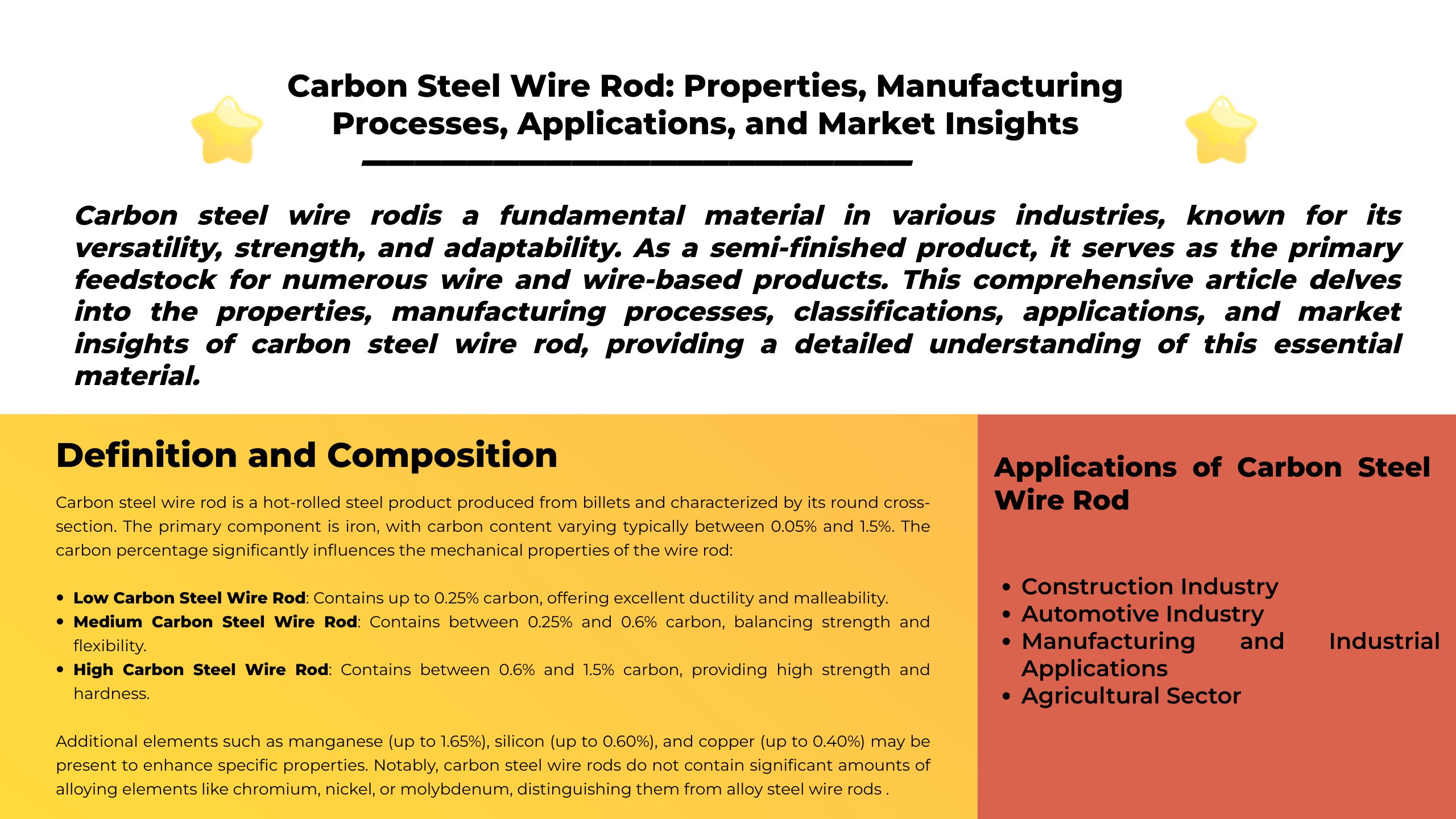
Carbon steel wire rod is a fundamental material in various industries, known for its versatility, strength, and adaptability. As a semi-finished product, it serves as the primary feedstock for numerous wire and wire-based products. This comprehensive article delves into the properties, manufacturing processes, classifications, applications, and market insights of carbon steel wire rod, providing a detailed understanding of this essential material.
1. Understanding Carbon Steel Wire Rod
1.1 Definition and Composition
Carbon steel wire rod is a hot-rolled steel product produced from billets and characterized by its round cross-section. The primary component is iron, with carbon content varying typically between 0.05% and 1.5%. The carbon percentage significantly influences the mechanical properties of the wire rod:
- Low Carbon Steel Wire Rod: Contains up to 0.25% carbon, offering excellent ductility and malleability.
- Medium Carbon Steel Wire Rod: Contains between 0.25% and 0.6% carbon, balancing strength and flexibility.
- High Carbon Steel Wire Rod: Contains between 0.6% and 1.5% carbon, providing high strength and hardness.
Additional elements such as manganese (up to 1.65%), silicon (up to 0.60%), and copper (up to 0.40%) may be present to enhance specific properties. Notably, carbon steel wire rods do not contain significant amounts of alloying elements like chromium, nickel, or molybdenum, distinguishing them from alloy steel wire rods .
1.2 Physical and Mechanical Properties
The properties of carbon steel wire rod vary based on its carbon content:
- Low Carbon Steel Wire Rod:
- Tensile Strength: Lower compared to higher carbon variants.
- Ductility: High, allowing for extensive deformation without fracture.
- Machinability: Excellent, suitable for processes like cold forming and welding.
- Corrosion Resistance: Generally low; often requires coatings such as galvanization for protection.
- Medium Carbon Steel Wire Rod:
- Tensile Strength: Moderate, offering a balance between strength and ductility.
- Ductility: Moderate, suitable for applications requiring a combination of strength and formability.
- Machinability: Good, though may require heat treatment for enhanced properties.
- Corrosion Resistance: Similar to low carbon steel; protective coatings are beneficial.
- High Carbon Steel Wire Rod:
- Tensile Strength: High, providing significant resistance to deformation.
- Ductility: Lower, making it less suitable for applications requiring extensive forming.
- Machinability: Challenging; often necessitates specialized equipment and techniques.
- Corrosion Resistance: Low; protective measures are essential to prevent rust .
2. Manufacturing Processes
The production of carbon steel wire rod involves several critical steps to ensure the desired mechanical properties and quality.
2.1 Raw Material Preparation
The process begins with steel billets, which are semi-finished casting products. These billets are typically produced through continuous casting methods and are selected based on the required chemical composition and dimensions.
2.2 Heating
Billets are heated in a reheating furnace to temperatures around 1,100 to 1,250°C. This high temperature ensures the steel becomes malleable for the subsequent rolling process.
2.3 Rolling
The heated billets undergo hot rolling through a series of rolling stands, reducing their cross-sectional area and elongating them into wire rods with diameters typically ranging from 5.5mm to 19mm. The rolling process is continuous, ensuring uniformity and consistency in the final product .
2.4 Cooling
Post-rolling, the wire rods are cooled using controlled cooling systems. The cooling rate is crucial as it affects the microstructure and mechanical properties of the wire rod. High carbon steel wire rods often require faster cooling to achieve the desired hardness, while low carbon variants may undergo slower cooling to retain ductility .
2.5 Coiling and Packaging
After cooling, the wire rods are coiled into bundles, typically weighing between 1.5 to 2.5 tons. These coils are then strapped and prepared for storage or shipment to customers.
3. Classifications of Carbon Steel Wire Rod
Carbon steel wire rods are classified based on their carbon content, surface finish, and specific applications.
3.1 Based on Carbon Content
- Low Carbon Steel Wire Rod: Up to 0.25% carbon. Known for excellent ductility and used in applications like wire mesh, nails, and fencing.
- Medium Carbon Steel Wire Rod: 0.25% to 0.6% carbon. Balances strength and ductility, suitable for automotive components and machinery parts.
- High Carbon Steel Wire Rod: 0.6% to 1.5% carbon. Offers high strength and hardness, ideal for springs, wire ropes, and cutting tools .
3.2 Based on Surface Finish
- Plain Wire Rod: Uncoated and used in applications where corrosion resistance is not critical.
- Galvanized Wire Rod: Coated with zinc to enhance corrosion resistance, commonly used in outdoor applications.
- Coated Wire Rod: May include coatings like phosphate or polymer for specific applications requiring enhanced surface properties.
4. Applications of Carbon Steel Wire Rod
Carbon steel wire rod serves as a foundational material across various industries due to its adaptability and range of mechanical properties.
4.1 Construction Industry
- Reinforcement: Used in the production of reinforcing bars (rebar) for concrete structures, enhancing tensile strength.
- Wire Mesh and Fencing: Low carbon wire rods are drawn into wires for mesh and fencing applications, providing security and structural support.
4.2 Automotive Industry
- Springs: High carbon wire rods are utilized in manufacturing suspension springs due to their high tensile strength and fatigue resistance.
- Fasteners: Bolts, nuts, and screws are produced from medium carbon wire rods, offering the necessary strength and durability .
4.3 Manufacturing and Industrial Applications
- Cables and Wire Ropes: High strength wire rods are drawn into wires for cables and ropes used in elevators, cranes, and bridges.
- Tools and Cutlery: High carbon steel wire rods serve as raw materials for producing cutting tools and blades.
4.4 Agricultural Sector
- Barbed Wire: Low carbon wire rods are processed into barbed wire for fencing in agricultural lands.
- Chains: Used in manufacturing chains for various agricultural machinery and equipment
5. Market Insights
The global carbon steel wire rod market has witnessed significant growth, driven by increasing demand in construction, automotive, and industrial sectors. Here’s an in-depth look at the current market dynamics, trends, and projections related to carbon steel wire rod.
6. Global Market Overview
6.1 Market Size and Growth
As of the latest market research, the global carbon steel wire rod market is valued at over USD 100 billion, with projections estimating continued growth at a CAGR (Compound Annual Growth Rate) of around 4–6% over the next five years. The growth is primarily driven by:
- Urbanization and infrastructural development in emerging economies.
- Increased demand in the automotive and engineering sectors.
- Rising investments in renewable energy infrastructure and power distribution networks.
6.2 Regional Market Trends
- Asia-Pacific dominates the global wire rod market, led by countries like China, India, and Japan. China remains the largest producer and consumer of carbon steel wire rod, driven by massive construction and manufacturing activities.
- Europe has a strong demand from automotive, machinery, and defense sectors.
- North America shows steady growth, with the United States focusing on infrastructure renewal and automotive innovation.
- Latin America and Africa are emerging markets, with increasing investments in housing and industrialization.
7. Quality Standards and Specifications
To ensure consistency and reliability, carbon steel wire rods are manufactured in accordance with global standards:
7.1 International Standards
- ASTM A510 / A510M – General requirements for wire rods used for drawing.
- ISO 16120 – Specifies the requirements for wire rods intended for mechanical applications.
- JIS G3505 (Japan) – Covers hard-drawn steel wire for general uses.
- EN 10016 (Europe) – European standard specifying non-alloy steel wire rods for conversion to wire.
7.2 Dimensional Specifications
- Diameters: Typically range from 5.5 mm to 20 mm.
- Tolerances: Precision is critical, especially for high-performance applications. Tolerances are usually ±0.2 mm depending on the size and standard.
8. Processing Techniques After Wire Rod Production
Carbon steel wire rods are further processed into specific wire products. Key processes include:
8.1 Wire Drawing
Wire drawing reduces the diameter of the rod through a series of dies, enhancing surface finish and mechanical strength. This is crucial for producing:
- Binding wires
- Welding wires
- Piano wires
- Spring wires
8.2 Annealing
Annealing involves heating and slowly cooling the wire rod to soften the metal, improve ductility, and relieve internal stresses. This process is especially important for low carbon wire rods used in forming and shaping applications.
8.3 Surface Treatments
Surface treatments improve corrosion resistance and adhesion for coatings. Common treatments include:
- Galvanizing: Dipping in molten zinc.
- Phosphating: Applying phosphate coating to enhance lubricity.
- Polymer Coatings: For enhanced durability and specialty applications.
9. Challenges in the Carbon Steel Wire Rod Industry
Despite its widespread use and demand, the industry faces several challenges:
9.1 Raw Material Price Volatility
The cost of iron ore, coal, and energy directly impacts the pricing of steel wire rods. Market fluctuations can affect supply chain stability and profitability.
9.2 Environmental Regulations
Stringent environmental policies around emissions, energy consumption, and waste management are pushing manufacturers to invest in cleaner technologies, which may increase production costs.
9.3 Competition from Alternative Materials
For certain applications, alternative materials like aluminum, stainless steel, or composite materials may offer better performance, weight savings, or corrosion resistance.
10. Sustainability and Innovation
10.1 Eco-Friendly Manufacturing
Steel manufacturers are increasingly adopting environmentally sustainable practices:
- Electric Arc Furnace (EAF) steelmaking, which uses recycled scrap metal and significantly reduces emissions.
- Closed-loop water systems to reduce water pollution.
- Carbon capture technologies to offset greenhouse gas emissions.
10.2 Technological Innovations
The industry is seeing innovation in:
- Microalloying techniques to enhance strength without increasing carbon content.
- Advanced heat treatment processes for improved toughness and durability.
- Digital monitoring for real-time quality control during production.
11. Buying Considerations for Carbon Steel Wire Rod
When selecting carbon steel wire rod, buyers should evaluate several factors:
- Chemical Composition: Must match application-specific strength and ductility requirements.
- Mechanical Properties: Tensile strength, yield strength, elongation.
- Coil Weight and Size: Depending on processing equipment.
- Surface Finish: Especially important in exposed or corrosive environments.
- Standard Compliance: Ensure the material meets national or international standards.
12. Future Outlook
12.1 Green Steel Demand
Global interest in reducing carbon footprints will increase the demand for “green steel,” produced using renewable energy and recycled materials. This shift will likely impact wire rod manufacturing as part of the broader steel value chain.
12.2 Urbanization and Smart Cities
As more smart cities are developed globally, carbon steel wire rods will continue to play a key role in building infrastructure, from bridges and roads to power grids and communication towers.
12.3 Supply Chain Localization
Post-pandemic strategies are focusing on localizing supply chains, especially in critical sectors like construction and automotive. This may create more regional demand and investment in local wire rod production facilities.
13. Conclusion
Carbon steel wire rod is an indispensable product in the global industrial landscape. With its wide range of mechanical properties, it serves as the backbone for a multitude of applications, from infrastructure and manufacturing to agriculture and automotive.
Understanding its classifications, properties, and processing methods is crucial for selecting the right material for specific needs. As the world moves towards greener and more sustainable development, innovation and adaptability in wire rod manufacturing will continue to drive growth and efficiency in the years to come.
Whether you are a manufacturer, buyer, or engineer, carbon steel wire rods represent strength, reliability, and potential — forged in fire, rolled to perfection, and woven into the fabric of modern industry.
Gengfei Provides High Quality Carbon Steel Wire Rod
Please let us know your procurement requirements, and we will quickly tailor the most competitive quotation for you.
- [email protected]
- +86 19139863252
- Jenny-GFSteel

