
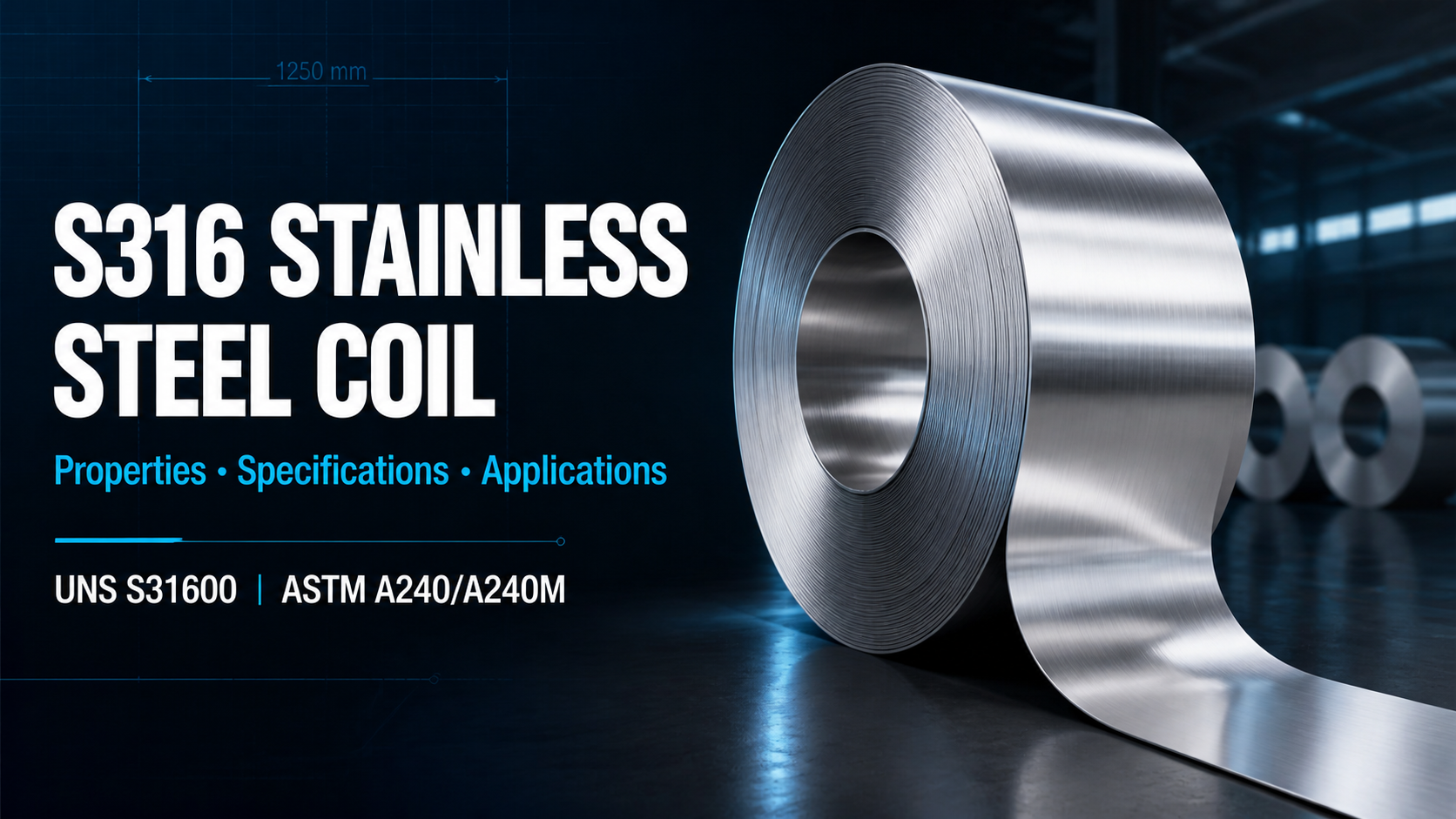
SS316 stainless steel coil is a molybdenum-alloyed austenitic stainless steel coil widely used in industrial environments where stronger corrosion resistance is required than that typically provided by standard 304 stainless steel.
The internationally recognized UNS designation for Type 316 stainless steel is UNS SS31600, while the corresponding European designation is commonly EN 1.4401. Type 316 / UNS S31600 has an austenitic microstructure and is available in both hot-rolled and cold-rolled coil forms.
The addition of molybdenum is one of the major distinguishing features of 316 stainless steel. It improves the alloy’s resistance to localized corrosion and makes the material suitable for many chemical processing, food processing, marine-related, architectural and industrial manufacturing applications.
Because stainless steel coil can be continuously processed into sheet, strip, formed components and fabricated products, S316 stainless steel coil is an important raw material for manufacturers operating in demanding global markets.
Understanding the SS316 / UNS SS31600 Grade
When international buyers search for SS316 stainless steel coil, the intended material is generally Type 316 stainless steel identified under the UNS system as:
UNS S31600
Common grade equivalents include:
| Standard System | Grade |
|---|---|
| AISI / ASTM Type | 316 |
| UNS | SS31600 |
| EN | 1.4401 |
| Stainless Steel Family | Austenitic Cr-Ni-Mo |
Outokumpu identifies Type 316 / UNS S31600 as an austenitic stainless steel corresponding to EN 1.4401. cite turn121376view2
For international procurement, it is preferable to specify 316 / UNS SS31600 rather than using only “SS316,” because the full UNS designation reduces ambiguity in technical documentation, quotations and material certificates.
Chemical Composition of SS316 Stainless Steel
SS316 stainless steel belongs to the chromium-nickel-molybdenum family of austenitic stainless steels. A representative commercial Type 316 composition published by Outokumpu includes approximately:| Element | Representative Content |
| Carbon (C) | 0.04% |
| Chromium (Cr) | 17.2% |
| Nickel (Ni) | 10.1% |
| Molybdenum (Mo) | 2.1% |
| Nitrogen (N) | 0.04% |
Role of the Main Alloying Elements
Chromium Chromium contributes to the formation of the passive oxide layer that gives stainless steel its characteristic corrosion resistance. Nickel Nickel supports the stable austenitic structure of Type 316 and contributes to toughness, ductility and fabrication performance. Molybdenum Molybdenum is particularly important in Type 316 because it improves resistance to localized corrosion in aggressive environments. The molybdenum-containing Cr-Ni-Mo composition is one of the main reasons why 316 stainless steel is selected when environmental conditions are more demanding than those suited to conventional 304 stainless steel.Key Properties of SS316 Stainless Steel Coil
1. Excellent Corrosion Resistance
One of the primary advantages of S316 stainless steel coil is its corrosion resistance.
The molybdenum addition improves resistance to localized attack, particularly pitting and crevice corrosion in chloride-containing environments.
This makes Type 316 suitable for components used in areas involving:
Moisture
Industrial chemicals
Salt-containing environments
Food processing fluids
Process equipment
Outdoor exposure
Certain marine-related conditions
Actual corrosion performance depends on temperature, chloride concentration, surface condition, fabrication method and service environment.
Austenitic Structure
UNS SS31600 is an austenitic stainless steel.
Austenitic stainless steels are widely used because they generally provide a useful combination of:
Corrosion resistance
Ductility
Formability
Toughness
Weldability
Surface finish options
These characteristics make S316 coil suitable for further processing into complex manufactured components.
Good Formability
SS316 stainless steel coil can be processed using common metal-forming operations including:
Bending
Roll forming
Deep drawing
Stamping
Press forming
Cutting
Slitting
The required forming process should be considered when specifying coil hardness, thickness, surface finish and dimensional tolerances.
Good Weldability
Type 316 stainless steel generally offers good welding characteristics and can be processed using commonly applied stainless steel welding methods.
However, when extensive welding is required, buyers may also evaluate 316L / UNS S31603, which contains lower carbon and is designed to improve resistance to intergranular corrosion after welding.
Outokumpu distinguishes conventional 316 / UNS S31600 from low-carbon 316L / UNS S31603, with the latter specifically developed for improved resistance to intergranular corrosion after welding.
Good Weldability
Type 316 stainless steel generally offers good welding characteristics and can be processed using commonly applied stainless steel welding methods.
However, when extensive welding is required, buyers may also evaluate 316L / UNS S31603, which contains lower carbon and is designed to improve resistance to intergranular corrosion after welding.
Outokumpu distinguishes conventional 316 / UNS S31600 from low-carbon 316L / UNS S31603, with the latter specifically developed for improved resistance to intergranular corrosion after welding. citeturn121376view2
ASTM A240 and SS316 Stainless Steel Coil
One of the important standards associated with stainless steel flat products is ASTM A240/A240M.
ASTM A240 covers chromium and chromium-nickel stainless steel plate, sheet and strip for pressure vessels and general applications. The standard establishes requirements including chemical composition and mechanical properties.
Although coil is a supply form rather than a separate metallurgical grade, stainless steel coil is commonly processed and supplied according to applicable sheet or strip requirements.
Therefore, international buyers commonly specify requirements such as:
Grade: 316 / UNS SS31600
Standard: ASTM A240/A240M
Product Form: Stainless steel coil
Rolling Condition: Hot rolled or cold rolled
The exact specification should always be stated on the purchase order.
Hot Rolled SS316 Stainless Steel Coil
Hot rolled 316 stainless steel coil is manufactured through rolling at elevated temperatures.
It is often selected for applications where:
Greater thickness is required
Surface appearance is less critical
Structural or industrial fabrication is the primary purpose
Further processing will follow
Type 316 / UNS S31600 is commercially available in hot-rolled coil form. citeturn121376view2
Hot rolled material can subsequently undergo annealing, pickling, cutting or other processing depending on customer requirements.
Cold Rolled SS316 Stainless Steel Coil
316 stainless steel cold rolled coil undergoes additional rolling after hot rolling and initial processing.
Cold rolling is commonly selected when buyers require:
More precise thickness control
Improved surface finish
Better dimensional accuracy
Thinner gauges
Decorative or precision applications
Type 316 / UNS S31600 is also available as cold-rolled coil.
Cold rolled coils are widely processed into sheets, strips, panels, enclosures, equipment components and precision fabricated parts.
SS316 Stainless Steel Coil vs. 304 Stainless Steel Coil
316 and 304 are two of the most commonly specified austenitic stainless steels, but they should not be considered interchangeable in all environments.| Property | 304 Stainless Steel | S316 Stainless Steel |
| Typical UNS Grade | S30400 | S31600 |
| Structure | Austenitic | Austenitic |
| Chromium | Yes | Yes |
| Nickel | Yes | Yes |
| Molybdenum | Normally no intentional Mo addition | Yes |
| General Corrosion Resistance | Good | Higher in many aggressive environments |
| Chloride Resistance | Moderate | Better than 304 |
| Relative Cost | Lower | Usually higher |
| Typical Use | General purpose | More corrosive environments |
SS316 Stainless Steel Coil vs. 316L Stainless Steel Coil
316 and 316L are closely related but have different UNS designations.
| Feature | 316 | 316L |
| UNS Designation | S31600 | S31603 |
| Carbon Level | Standard | Lower carbon |
| Austenitic | Yes | Yes |
| Molybdenum Alloyed | Yes | Yes |
| Welded Applications | Suitable | Often preferred for extensive welding |
