Description
What is the 304 Stainless Steel Pipe/Tube?
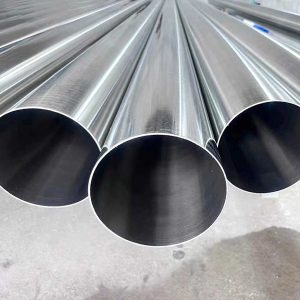
304 Stainless Steel pipe and tube are hollow cylindrical products manufactured from this specific stainless steel alloy. They are renowned for their non-magnetic properties (in the annealed condition), excellent weldability, and good resistance to oxidation and corrosion in many environments.
- Composition: The primary alloying elements are chromium (18-20%) and nickel (8-11%), which provide its characteristic corrosion resistance. It also contains small amounts of carbon (up to 0.08%), manganese, silicon, sulfur, and phosphorus.
- Sub-grades:
- 304L (Low Carbon): Contains a maximum carbon content of 0.03%. This lower carbon content minimizes carbide precipitation during welding, making it highly resistant to intergranular corrosion in the weld heat-affected zone. It’s ideal for welded applications where post-weld annealing is not feasible.
- 304H (High Carbon): Contains a carbon content range of 0.04-0.10%. The higher carbon content provides enhanced strength at elevated temperatures, making it suitable for high-temperature applications.
- Manufacturing Processes:
- Seamless: Produced from a solid billet that is pierced and then rolled or drawn to the desired dimensions. Seamless pipes/tubes offer superior pressure handling and are preferred for high-purity and critical fluid transfer.
- Welded: Manufactured from a strip or sheet that is formed into a cylindrical shape and then welded along the seam. Welded pipes/tubes are generally more cost-effective for less demanding applications. They can be further cold-worked for improved properties.
Technical Parameters of 304 Stainless Steel Pipe
| Property |
Value |
| Material Grade |
304 / 1.4301 |
| Chemical Composition |
18–20% Cr, 8–10.5% Ni, max 0.08% C |
| Standard |
ASTM A312, ASTM A213, ASTM A269 |
| Pipe Size Range |
1/8” to 48” (DN6–DN1200) |
| Wall Thickness |
SCH 5S to SCH XXS, or customized |
| Finish |
Annealed, pickled, polished (as requested) |
| Length |
6m, 12m, or custom cut-to-length |
| Type |
Seamless or Welded |
| Surface Finish Options |
2B, BA, No.4, Mirror, etc. |
304 Stainless Steel Chemical Composition (Weight %)
304 Stainless Steel Mechanical Properties
Advantages of 304 Stainless Steel Pipe
- Excellent Corrosion Resistance: Forms a passive chromium oxide layer that protects against rust and corrosion in various atmospheric, fresh water, and mild chemical environments.
- Good Formability and Weldability: Can be easily formed, fabricated, and welded using common techniques. The 304L variant is particularly well-suited for welding.
- High Strength and Durability: Offers good tensile strength and ductility, providing long-term reliability and resistance to impact and abrasion.
- Hygienic Properties: Its non-reactive surface makes it safe for use with food and beverages, and it’s easy to clean, making it suitable for sanitary applications.
- Aesthetic Appeal: Available in various surface finishes, from bright annealed to satin-polished, offering an attractive appearance for architectural and decorative uses.
- Cost-Effective (Long-Term): While initial costs might be higher than some alternatives, its longevity, minimal maintenance, and recyclability contribute to a lower total cost of ownership.
- Temperature Resistance: Exhibits good heat resistance, though 304 can be prone to sensitization (carbide precipitation) in the temperature range of 425-860°C (800-1580°F) if held for prolonged periods, which can lead to intergranular corrosion. For applications within this range or welding, 304L is often preferred.
Applications of 304 Stainless Steel Tube
The versatility of 304 Stainless Steel makes it suitable for numerous applications, including:
- Food and Beverage Industry: Dairy processing, brewing, winemaking, food preparation equipment, and sanitary piping systems.
- Chemical and Pharmaceutical Industries: Chemical processing equipment, storage tanks, and pipelines for various chemicals (excluding highly corrosive chlorides).
- Architectural and Construction: Handrails, structural components, decorative elements, and outdoor furniture.
- Oil and Gas: Heat exchangers, fluid transport systems (though 316 is often preferred for more aggressive environments).
- Water Treatment: Water purification systems, wastewater treatment plants.
- Automotive: Exhaust systems, trim components.
- Medical Devices: Surgical instruments, hospital equipment.
- General Industrial: Machinery components, heat exchangers, instrumentation tubing.

Comparison of Stainless Steel Pipe/Tube Grades
| Grade |
Corrosion Resistance |
Temperature Resistance |
Main Difference |
| 304 |
Excellent for most environments |
Up to ~870°C (intermittent) |
General-purpose, most common |
| 316 |
Superior (chloride resistance) |
Up to ~870°C |
Contains molybdenum for better pitting resistance |
| 201 |
Moderate |
Slightly lower |
Lower nickel, more economical |
| 321 |
Excellent, stabilized |
Up to ~870°C |
Titanium stabilized to resist carbide precipitation |
| 310 |
Excellent in high-heat |
Up to 1150°C |
High chromium/nickel for heat resistance |




Reviews
There are no reviews yet.