
Quick Answer: Are S235JR and A36 the same?
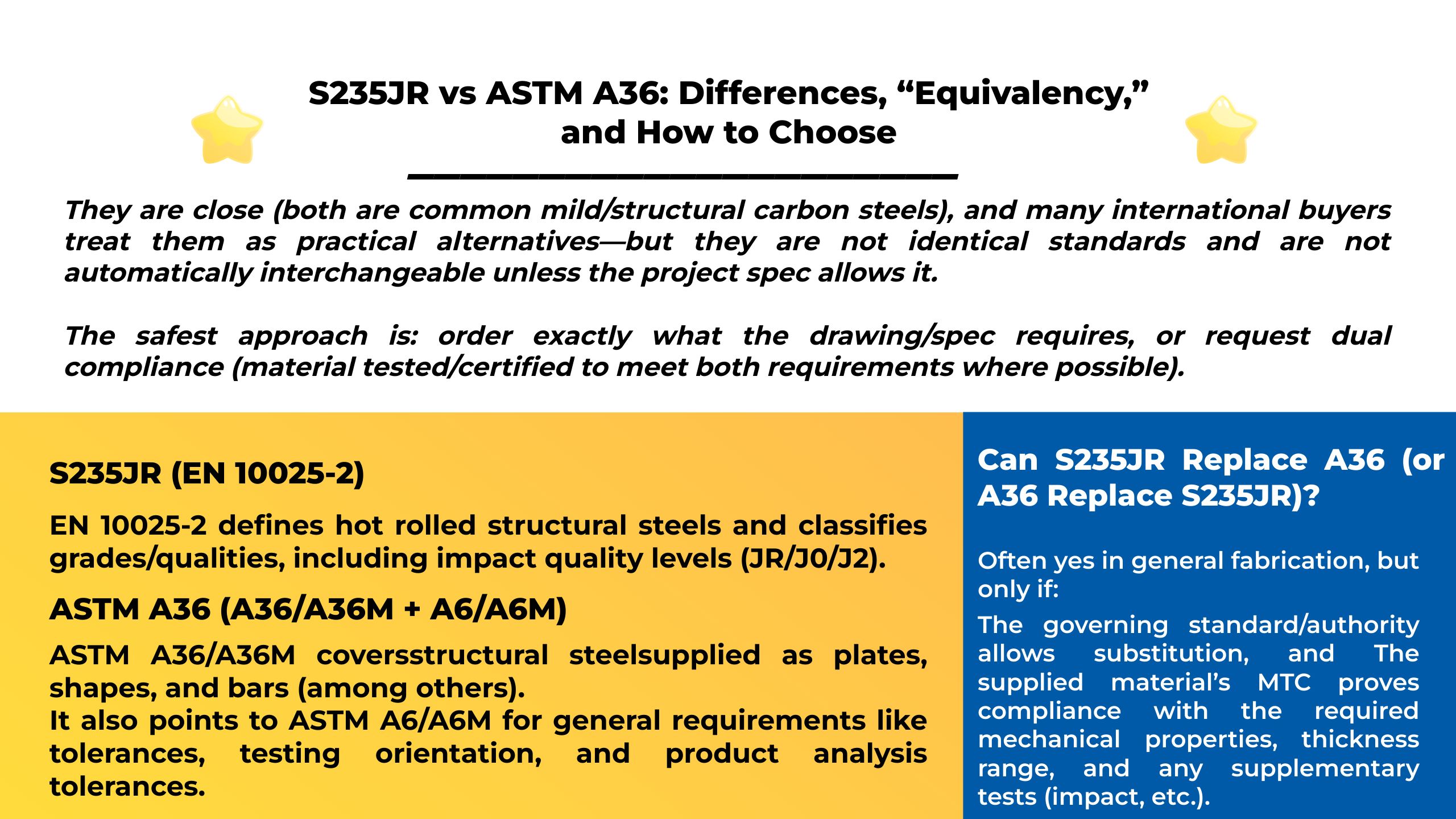
They are close (both are common mild/structural carbon steels), and many international buyers treat them as practical alternatives—but they are not identical standards and are not automatically interchangeable unless the project spec allows it.
The safest approach is: order exactly what the drawing/spec requires, or request dual compliance (material tested/certified to meet both requirements where possible).
S235JR vs A36 at a Glance
| Mír | S235JR (EN) | ASTM A36 (US) |
|---|---|---|
| Standard system | EN 10025-2 non-alloy structural steel | ASTM A36/A36M carbon structural steel |
| Name meaning | S = structural; 235 = min yield (for ≤16 mm); JR = impact-quality class | Grade name “A36” tied to 36 ksi yield class (typical) |
| Min yield strength | 235 MPa at ≤16 mm, then decreases with thickness | 36 ksi [250 MPa] (but 32 ksi [220 MPa] for plates > 8 in / 200 mm) |
| Tensile strength | Typically 360–510 MPa (thickness-dependent ranges in EN tables) | 58–80 ksi [400–550 MPa] |
| Impact toughness | S235JR is associated with 27 J at 20°C (Charpy KV; thickness bands apply) | Charpy is optional (supplementary requirements only, if ordered) |
| Chemistry limits | Controlled by EN tables; max values depend on thickness and analysis type | Chemistry limits vary by product/thickness (e.g., C max ~0.25–0.29%; P max 0.04; S max 0.05) |
Note: Standards have multiple editions; always order to the edition specified by your project contract.
1) Standards & Scope Differences (Why “Equivalent” Isn’t Always “Interchangeable”)
S235JR (EN 10025-2)
EN 10025-2 defines hot rolled structural steels and classifies grades/qualities, including impact quality levels (JR/J0/J2).
ASTM A36 (A36/A36M + A6/A6M)))
ASTM A36/A36M covers cruach struchtúrach supplied as plates, shapes, and bars (among others).
It also points to ASTM A6/A6M for general requirements like tolerances, testing orientation, and product analysis tolerances.
2) Mechanical Properties Comparison (Strength)
Yield strength (why thickness matters)
S235JR: minimum yield is 235 MPa for ≤16 mm, then steps down as thickness increases (e.g., 225 MPa at ≤40 mm, 215 MPa at ≤63 mm, etc.).
ASTM A36: yield is 36 ksi [250 MPa], but for plates over 8 in (200 mm), yield can be 32 ksi [220 MPa].
Practical takeaway: For many common thicknesses, A36 has slightly higher nominal yield than S235JR, but both are in the same “mild structural steel” family.
Tensile strength
S235JR: tensile range commonly 360–510 MPa (by EN table range).
A36: 400–550 MPa.
3) Chemical Composition (Weldability & Consistency)
ASTM A36 chemistry (explicit thickness/product ranges)
A36’s chemistry limits depend on whether it’s shapes, plates, or bars and by thickness—e.g., carbon max values listed around 0.25–0.29% in Table 2, with P max 0.04% is S max 0.05%.
S235JR chemistry (EN-controlled limits)
EN 10025-2 also controls chemistry with thickness-dependent limits (and distinguishes deoxidation practice such as “FN/FF” in the tables).
Practical takeaway: In day-to-day fabrication, both are typically considered easy to weld, but chemistry is not identical—so for low-temperature service, fracture-critical work, or special welding procedures, you should verify the MTC values and any impact requirements.
4) Impact Toughness (Charpy): A Key Real-World Difference
S235JR is tied to Charpy KV longitudinal minimum 27 J at 20°C (JR), with thickness bands shown in the EN table.
Astm A36 does not require Charpy impact by default; Charpy testing appears as ceanglais fhorlíontacha that apply only if specified in the order.
Practical takeaway: If your project cares about notch toughness (even at room temperature), S235JR’s “JR” designation can be meaningful—while for A36 you must explicitly order impact testing if required.
5) Typical Applications (Where Each Is Common)
S235JR: EU/Eurocode-oriented structural fabrication, general steelwork, frames, brackets, base plates, etc.
ASTM A36: North America/Middle East projects using ASTM-based specs for building/structural fabrication (plates, shapes, bars).
6) Can S235JR Replace A36 (or A36 Replace S235JR)?
Go minic yes in general fabrication, but only if:
The governing standard/authority allows substitution, agus
The supplied material’s MTC proves compliance with the required mechanical properties, thickness range, and any supplementary tests (impact, etc.).
When substitution is usually acceptable
General structural parts with no special toughness requirement
Similar thickness ranges
Buyer accepts “nearest equivalent” and reviews the MTC
When you should NOT assume interchangeability
Project is strictly code-controlled (AISC/ASTM-only or EN/CE-only)
Low-temperature or fracture-critical requirements (Charpy mandated)
Customer requires CE marking / EN route, or requires ASTM stamping/testing regime
7) Ordering Tips When Sourcing from China
When you request quotes, include these in your PO/RFQ:
Exact grade + standard: “S235JR to EN 10025-2” or “ASTM A36/A36M” (and required edition if specified)
Thickness and product form: plate / sheet / coil / H-beam / angle / flat bar
Inspection document: EN 10204 3.1 (common for EN work) and/or ASTM-style MTR
Impact test requirement: If you need Charpy for A36, state it clearly (supplementary requirement).
Any special needs: Z-quality, UT, galvanizing suitability, PWHT constraints, etc.
Ceisteanna CCanna
Is S235JR equivalent to A36?
They are widely treated as rough equivalents for many structural uses, but standards differ and they’re not guaranteed interchangeable without reviewing requirements and MTCs.
Which has higher yield strength: S235JR or A36?
For common thicknesses, A36 (250 MPa) is often slightly higher than S235JR (235 MPa at ≤16 mm), and both reduce/step with thickness rules in their respective standards.
Does A36 require Charpy impact testing?
Not by default—Charpy is typically optional and must be specified as a supplementary requirement.
What does “JR” mean in S235JR?
It refers to the impact toughness quality class (Charpy KV), where S235JR is associated with 27 J at 20°C (per EN impact table).
Gengfei Provides High Quality ASTM A36 Products
Cuir in iúl dúinn do riachtanais soláthair, agus cuirfimid an luachan is iomaíche in oiriúint duit go tapa.
- [email protected]
- +86 19139863252
- Jenny-GFSteel

